Key takeaways
- Four groups: ownership and authority, the house, the tenant file, and your tax and bank details.
- If a tenant is in place, the signed lease, the deposit record and the rent ledger matter most; Texas requires a landlord to keep accurate records of all security deposits (Property Code 92.106).
- The manager files Form 1099-MISC for the rent it pays over to you, so it needs your taxpayer number, usually on a Form W-9.
- Switching from another company? A broker must keep property management contracts and transaction records for at least four years (TREC rule 535.2), so the old file should still exist when you ask for it.
- Change smart lock codes and app logins at handover; Texas requires rekeying within 7 days after each tenant turnover (92.156).
What documents do you need to give a new property manager? Four groups: proof that you own the house and who may sign for it, the facts about the house, the complete tenant file if the home is occupied, and the tax and bank details for your money. For a rental in Fort Worth, Keller or North Richland Hills, most owners can gather all of it in an afternoon, and nothing on the list requires a lawyer.
Below is the checklist with why each item matters, what to do when one is missing, and what changes when the documents are coming from a previous management company rather than from you.
The document checklist at a glance
Here is each document a new manager asks for, why it matters and what to do if you do not have it:
| Document | Why the manager needs it | If you do not have it |
|---|---|---|
| Deed, or the appraisal district record in your name | Confirms who owns the house and must sign the agreement | Look up the property on the county appraisal district site |
| LLC or trust papers showing who may sign | The agreement and leases are signed in the owner's name | Ask whoever set up the entity, or your attorney |
| HOA rules on leasing | Some associations restrict leasing or require tenant registration | Ask the HOA management company for the current documents |
| Keys, remotes, alarm and smart lock codes | Access for repairs, inspections and showings | Rekey and reset codes; it is cheaper than chasing copies |
| Insurance declarations page | Shows the policy fits a rental and who to call after a loss | Ask your agent for a landlord policy quote |
| Signed lease and every addendum | The contract the manager must enforce | Write down the terms both sides agree on, then put them on a Texas lease |
| Deposit amount, date paid and where held | The deposit is owed back under the 30-day rule | Find the original payment and confirm the amount with the tenant in writing |
| Rent ledger | What is owed, paid and late, from day one | Rebuild it from bank deposits and confirm with the tenant |
| Move-in condition report and photos | The baseline for any damage charge at move-out | A dated inspection now, with photos |
| Form W-9 and bank account | Year-end 1099 reporting and owner payouts | Download the W-9 from irs.gov; open the account in the owner's name |
How to read this table: the first three rows decide who signs, the middle rows decide whether the manager can run the house and enforce the lease, and the last row decides whether you get paid and taxed correctly. Gaps in the middle rows cost the most later.
Proof you own the house, and who may sign
A manager about to sign leases and collect rent on your behalf needs to know the person signing the management agreement owns the house or may sign for its owner.
- Ownership record. The recorded deed, or the appraisal district page showing the owner's name. In Tarrant County that is the Tarrant Appraisal District's property search.
- Authority to sign. If the house is in an LLC or a trust, the document that names who may sign for it. The guide to managing an LLC-owned rental lists the entity papers.
- ID for each person who will sign.
- Loan documents. Read your mortgage for any occupancy requirement before the house becomes a rental.
- HOA documents. The leasing rules and any tenant registration form. Texas limits what an association can demand: Property Code 209.016 bars a property owners' association from requiring a tenant to be approved for tenancy by the association, or requiring a tenant's credit report or rental application. It may still restrict leasing and ask for each resident's contact details and the lease start date and term.
- Any court order, divorce decree or power of attorney that affects who controls the property.
If two people own the house, both normally sign, and the manager will ask which one approves repairs and receives statements. Decide that before the first meeting.
The house: access, coverage and repair history
The second group is everything a manager needs to run the house without calling you:
- Access. Keys to every lock, garage remotes, mailbox key, gate and alarm codes, and the login or owner transfer for any smart lock, thermostat or doorbell. Reset codes and remove old users at handover, so only the people who should have access do.
- Insurance. Your declarations page. If the house is still on a homeowner policy, the guide to landlord insurance vs. homeowners explains why that matters before a tenant moves in.
- Warranties and service contracts for the HVAC, water heater, roof, appliances, foundation work and any home warranty.
- Utilities. Account numbers and which ones the tenant pays. Who carries them while the house is empty is covered in who handles utilities while a rental is empty.
- Repair history, even informal: the age of the roof and HVAC, the last foundation report, the plumber who knows the house, where the water shutoff is.
- Square footage, bedrooms and features, which feed the listing and the rental analysis.
None of this has to be perfect. Photos of the paperwork are enough to start.
If there is a tenant: the lease, the deposit and the ledger
This group decides how smooth a takeover is. A manager stepping in mid-lease has to enforce a contract it did not write and account for money it did not collect:
- The signed lease and every addendum, such as pet, lead paint and HOA addenda. If there is no written lease, say so. The existing lease stays in force when management changes; see will a new property manager honor the existing lease.
- The deposit: the amount, the date paid and where it is held. Property Code 92.106 says the landlord shall keep accurate records of all security deposits, and the refund or itemized list is due within 30 days after the tenant surrenders the home (92.103), so the new manager needs the figure in writing from day one.
- A rent ledger: what is due, what has been paid, any late fees or balances, and how the tenant pays now.
- The move-in condition report and photos, if any exist.
- Tenant contact details, every adult occupant, and the vehicles and pets on the lease.
- Open repair requests, notices you have sent, and any dispute in progress.
The guide to a mid-lease takeover covers what the manager does with each item in the first weeks.
Your money: the W-9, the bank account and your approval limit
The last group is short, and a missing item here can delay your first payout:
- A Form W-9. The IRS instructions for Form 1099-MISC say a real estate agent or property manager must use that form to report the rent paid over to the property owner, so the manager needs your name and taxpayer number exactly as the IRS has them. For an LLC or trust, that is the entity's name and number, not yours.
- A bank account for owner disbursements, in the same name as the owner.
- A reserve contribution, if the agreement calls for one, so the first vendor can be paid before rent arrives.
- Your repair approval limit, in writing, so routine repairs under it go ahead without waiting.
Everything in this group is private. Ask how it will be collected and stored, and do not send account numbers in a plain email if a secure option is offered. This is general information, not tax advice.
When the documents are coming from your old manager
If another company manages the house now, much of the tenant file is in its hands, not yours. The new manager usually requests it directly once you have given notice. Texas licensing rules help here:
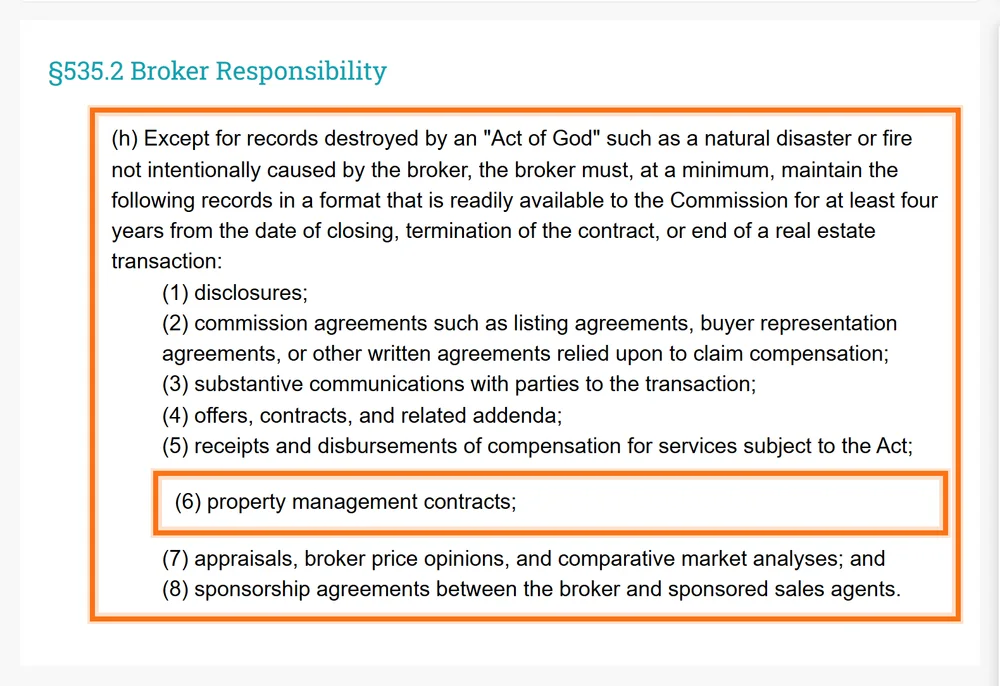
The money side has its own rule: Occupations Code 1101.652(b)(9) lets the Texas Real Estate Commission discipline a license holder who fails within a reasonable time to properly account for or remit money belonging to another person, such as a deposit or reserve it holds for you.
Ask in writing for the lease and addenda, the deposit amount and how it will be transferred, the tenant ledger, the move-in report and photos, keys and codes, open work orders and a final statement. If the company stalls, the escalation steps are in when the old manager won't release keys or records, and the deposit and balance questions in deposits, unpaid rent and repair bills when you switch. This is general information, not legal advice.
What to do when something is missing
Gaps are common, and each one has a fix:
- No written lease. Document the current terms both sides agree on, then move the tenant to a proper Texas lease, at the next renewal or sooner if both agree. See no written lease, or renting to family.
- No record of the deposit. Find the original payment in your bank records, confirm the amount with the tenant in writing, and treat that figure as the deposit from then on.
- No move-in report. A dated inspection with photos now. It will not prove what the house looked like at move-in, but it stops later wear from being blamed on nobody.
- No repair history. The first inspection and a conversation with the tenant usually surface most of it.
- Keys or codes unaccounted for. Property Code 92.156 requires a landlord to rekey key, card or combination locks within 7 days after each tenant turnover. A change of manager is not a tenant turnover, but rekeying and resetting codes is sensible whenever you do not know who holds copies.
Bring what you have to the first conversation and let the manager tell you what actually needs rebuilding.
How Perpetual handles this
Perpetual Property Management is broker-owned, with our office at 5755 Rufe Snow Dr in North Richland Hills, and we manage homes in Keller, North Richland Hills, Fort Worth and nearby. What our site states about the documents side of starting with us:
- Coming from another manager: after you give notice, we request the lease and related documents, the security deposit, keys, the tenant ledger, property records and open work orders, then give the tenant new payment and maintenance instructions. Details are on our switching page.
- A condition record: the enrollment inspection sets a baseline as we begin management. It is included on Full Service, $49 on Standard and $125 on Investor Special, as the price sheet lists.
- Your records afterward: the AppFolio owner portal gives you statements, documents and disbursement history, and the original vendor invoice is always there when we coordinate maintenance.
- A vacant house: the same facts about the house feed the free rental analysis, which includes market rent and a written management quote.
The exact onboarding paperwork we ask you to sign, and how your tax and bank details are collected, are confirmed in writing before you sign, along with every fee. To start, call 682-593-7033.
The takeaway: Gather proof of ownership, the house details, the tenant file and your W-9 and bank details, hand over what you have, and let the new manager tell you what needs rebuilding rather than delaying the start for a perfect folder.
Questions owners ask
Does a property manager need a copy of my mortgage statement?
Usually not the statement itself. What matters is whether the loan has any occupancy requirement, which you can find in your loan documents, and that the insurance fits a rental. The manager does not call your lender; it relies on you to confirm the house can be rented. Mortgage payments stay with you unless your agreement says otherwise.
Do I have to give the property manager my tenant's personal information?
Yes, for the people on the lease. The manager becomes the tenant's contact for rent, repairs and notices, so it needs names, phone numbers, email addresses and the list of adult occupants. Application files from your own screening, if you kept them, help but are not required. Hand them over securely and only to the company you have signed with.
What if the house is owned by my LLC or a family trust?
The manager will ask for the document showing who may sign for the entity, such as the operating agreement or the trust document, and a Form W-9 in the entity's name, because the year-end Form 1099-MISC reports rent paid over to the owner. The management agreement is signed in the entity's name by that person. Have a bank account in the entity's name ready for disbursements.
Can I start with a property manager before I have all the documents?
Usually yes. Ownership proof, ID, the W-9, the bank account and, if there is a tenant, the lease and deposit figure are the items to have in hand before the manager collects rent. Warranties, repair history and utility details can follow in the first few weeks. Tell the manager what is outstanding and agree on a date to deliver it.
What records does my old property manager have to hand over?
Your management agreement is the first place to look, because it may list what is delivered at termination. Texas rules add a floor: TREC rule 535.2 requires a broker to keep property management contracts and transaction records for at least four years, and Occupations Code 1101.652(b)(9) covers failing to account for or remit money belonging to another person, such as the deposit. Ask for everything in writing with a date.
How do smart lock codes and app logins get handed over to a new manager or tenant?
Treat them like keys. At handover, transfer ownership of each smart lock, thermostat or doorbell account to the owner or the new manager, delete old users and codes, and set new ones. Texas requires a landlord to rekey key, card or combination security devices within 7 days after each tenant turnover (Property Code 92.156), so a new tenant should never inherit the last tenant's code.
Related services
Property management in Keller, North Richland Hills and Fort Worth. How full-service management works in Tarrant County →