Key takeaways
- A rental with no written lease is still a tenancy: Property Code 24.005(a) names tenants under an "oral rental agreement" alongside written leases.
- Rent paid monthly with no agreed end date points to a month-to-month tenancy; under 91.001(b) notice ends it on the later of the date in the notice or one month after it is given.
- A lease for longer than one year must be in writing and signed to be enforceable (Business and Commerce Code 26.01(b)(5)).
- Late fees need notice in a written lease (92.019), and a lockout clause must be placed in the lease (92.0081): without paper, those tools do not exist.
- Money paid to secure the tenancy is a security deposit under 92.102, written down or not, and the 30-day refund rule in 92.103 applies when the tenant leaves.
What happens when there is no written lease, or the tenant is a friend or relative? On a house in Fort Worth, Keller or North Richland Hills, Texas law treats it as a tenancy anyway: the statutes fill in notice, deposit and eviction rules, while late fees and other lease-only terms are simply missing. A property manager records the terms both sides already live by and moves the tenant onto a signed written lease.
Below: what the law fills in, step by step from the record to the signed lease, the deposit, the family side, and what to do if the tenant will not sign.
What Texas law fills in when nothing is written
Here is what applies to a Texas tenancy with no written lease, compared with one that has a signed lease, and the statute behind each line:
| Topic | No written lease | Signed written lease | Statute |
|---|---|---|---|
| Ending the tenancy | If rent is paid monthly: the later of the date in the notice or one month after it is given | The lease term, or a different notice period both signed | Property Code 91.001(b), (e) |
| Notice to vacate before an eviction filing | At least three days' written notice; oral rental agreements are named | Same, unless the written lease sets a shorter or longer period | Property Code 24.005(a) |
| A term longer than one year | Not enforceable | Enforceable if in writing and signed | Business and Commerce Code 26.01(b)(5) |
| Late fees | Cannot be collected | Allowed if notice is in the lease, the fee is reasonable, and rent is two full days late | Property Code 92.019(a) |
| Changing locks for unpaid rent | Not available | Only if the right is placed in the lease, with the required notice | Property Code 92.0081(d) |
| Tenant paying for certain repairs | Not available | Only under the written, underlined or bold terms the statute lists | Property Code 92.006(e), (f) |
| Security deposit refund | Applies to any deposit paid | Applies, plus any bold surrender-notice clause | Property Code 92.102 to 92.109 |
How to read this table: the top two rows mean an informal tenant is not easier to remove than a written one. The middle rows are tools an owner only has on paper. The last row works in the tenant's favor whether or not anything was written, so an unrecorded cash deposit from years ago still has to be accounted for. This is general information, not legal advice; ask a Texas attorney about your situation.
What you have when there is no written lease
You have a tenancy. Property Code 24.005(a) applies its notice rules to a tenant "under a written lease or oral rental agreement", so the absence of paper does not make the occupant a guest. When rent has been paid monthly and nobody agreed an end date, the arrangement looks like a monthly tenancy, and Property Code 91.001 sets how either side ends it.
What you do not have is proof. Nobody can show what the rent is, who may live there, whether the dog was approved or what was paid as a deposit. And if someone remembers being promised "two years at this rent", Business and Commerce Code 26.01(b)(5) makes a lease for longer than one year unenforceable unless it is in writing and signed. The tenancy exists; the evidence of its terms does not. That is the gap a manager closes first.
Step one: write down the terms you already live by
Before any lease is drafted, the manager builds a one-page record of the current arrangement, first with you and then with the tenant:
- Rent amount, due date and how it has been paid.
- Any deposit paid, when, and any receipt or bank record of it.
- Everyone who lives there, including anyone who moved in later.
- Pets, parking, storage, garage and yard use.
- Who has handled the lawn, filters, pest control and small repairs.
- Any promises made: a rent freeze, a right to buy, a repair you said you would do.
Bank transfers and text messages are the usual evidence; a tenant who has paid by transfer for years has built a better ledger than most owners keep. The manager then confirms the summary with the tenant. If the two accounts differ, it is far cheaper to find out now than in a dispute.
Step two: a signed Texas lease, same rent first
The manager offers a written Texas lease with the recorded terms carried in. The rent stays what the tenant already pays, at least for the first term: this step is a formalization, not a renegotiation. The lease adds what was missing, such as a fixed end date, the late fee terms 92.019 requires in writing, the bold repair-remedy language 92.056(g) requires, pet and occupant terms, and the deposit clause.
Once everyone signs, Property Code 92.024(a) requires the landlord to give at least one tenant a complete copy no later than the third business day. Most tenants, relatives included, are relieved to have the rules written down. What a Texas residential lease must cover walks through the clauses, and whether a manager can use your existing lease covers the case where some paper already exists.
The deposit that was, or was never, paid
If a deposit was paid. Under Property Code 92.102, a security deposit is any advance of money, other than an application deposit or advance rent, intended primarily to secure performance under the lease. Cash handed over years ago for that purpose counts. When the tenant leaves, 92.103 requires the refund on or before the 30th day after surrender, 92.104 allows deductions only for damages and charges the tenant is liable for (never normal wear and tear) with an itemized list, and 92.107 waits for a written forwarding address. Under 92.109(d), missing the 30 days creates a presumption of bad faith. Record the amount in the new lease so nobody argues about it later.
If none was paid. The new lease can set one going forward. The options are collecting it at signing, collecting it in stated installments, or waiving it in writing with the risk understood. Whatever you choose, photograph the condition of the house at signing: without a condition record there is nothing to measure deductions against. Texas security deposit rules covers the rest.
When the tenant is a friend or relative
A manager helps most here, because it becomes the one who sends the late notice and schedules the inspection, and you stop being the landlord at Thanksgiving. The decision to hire one is covered in hiring a property manager when renting to a friend or family member. This guide is about the paperwork.
Two things to settle first. The rent: if a relative pays less than market, decide whether that continues, because the manager will enforce whatever the lease says. The boundary: the tenant contacts the manager, not you, about repairs and rent.
Below-market rent to family can also change the tax picture. IRS Publication 527 counts a day a family member uses the home as a day of personal use, unless the family member uses it as their main home and pays a fair rental price, which the publication describes as what an unrelated person would be willing to pay. Ask your CPA what that means for you. Renting out a parent's home covers the family side.
Does a tenant who is already there get screened?
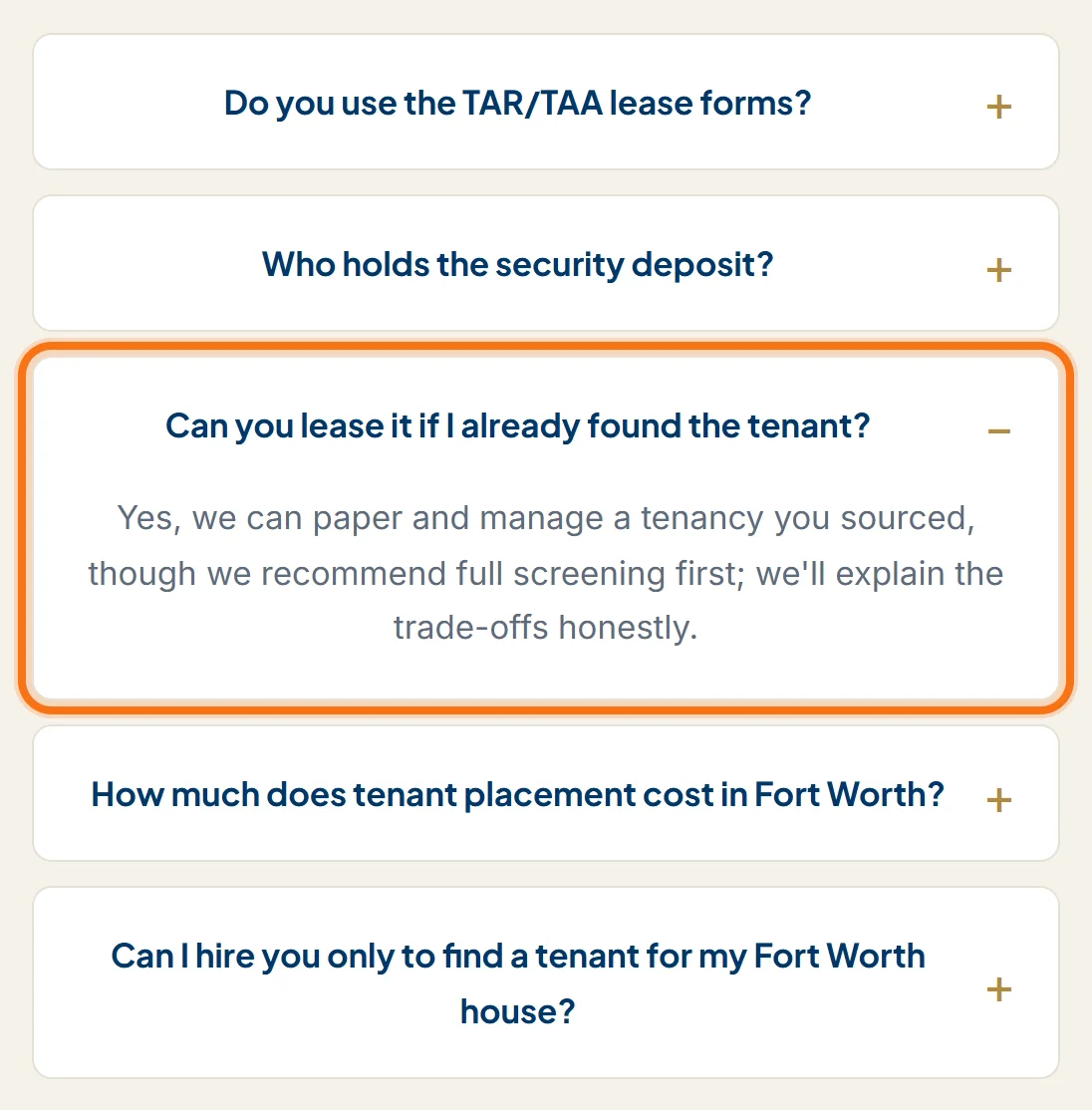
A tenant already living in the house is not an applicant, so the question is what you want to know before you sign a longer written lease with them. Our own practice is stated on our site: we take over occupied properties as they are and apply full screening at the next vacancy, and if you found the tenant yourself, we can paper and manage that tenancy while recommending full screening first.
At a minimum, the new lease must name every adult who lives there and every occupant, because the record from step one is only as good as the names on it.
Introducing the change without a fight
The tenant's first worry is usually "am I being pushed out?" The way the change is introduced decides the next year. Make the first call yourself, in your own words: you have hired someone to handle paperwork and repairs so the house is looked after properly, and nothing about their home is changing.
The manager follows with the practical part: how rent is paid now, how to report a repair, and the lease with the terms the tenant already knows. Rent changes, if any, wait for the first renewal. The order matters: relationship first, paperwork second, changes last.
If the tenant will not sign
A tenant who refuses to sign usually fears one term, often the deposit or a pet rule. Find out which one and whether it can be adjusted, and explain that the lease protects the tenant too: it fixes the rent and the term in writing.
If the refusal stands, the tenancy continues on its old terms until it is ended. For a monthly tenancy, Property Code 91.001(b) ends it on the later of the date in the notice or one month after the notice is given; the new terms can be offered as a fresh lease starting after that date.
If the tenant then stays without a right to, 24.005(a) requires at least three days' written notice to vacate before an eviction filing, delivered by a method in 24.005(f-3) as amended effective January 1, 2026: mail, delivery to the inside of the premises in a conspicuous place, hand delivery to a tenant 16 or older, or email if both agreed in writing. Under 24.005(f-4), those methods do not apply if the tenant actually receives the notice. The notice to vacate in Texas has the detail, and talking to an attorney before that step is wise.
How Perpetual handles this
Perpetual Property Management is broker-owned, with our office in North Richland Hills, and we manage homes in Keller, North Richland Hills, Fort Worth and nearby. What our site states that applies to an informal or family tenancy:
- Tenant in place. We take over occupied properties: the lease, deposit and records transfer to us, and tenants receive new payment and maintenance instructions (how a takeover works).
- The lease. Current Texas-compliant lease documentation with property-specific addenda, and you receive a copy of everything through the owner portal.
- Deposits. Held and accounted for in compliance with the Texas Property Code, with itemization rules and timelines applied at move-out.
- Move-in record. A photo-documented condition report, room by room and timestamped, acknowledged by the tenant (leasing and move-in).
- Fees. Every number is confirmed in writing before you sign, and if a fee is not in the agreement, you do not pay it.
How we charge for papering a tenancy you already have, and whether the placement fee applies, is confirmed in writing before you sign. To talk through your situation, contact us or call 682-593-7033.
The takeaway: With no written lease, Texas law still supplies the notice, eviction and deposit rules, but not late fees or other lease-only terms; record what both sides do today, then move the tenant onto a signed Texas lease without changing the rent in the same step.
Questions owners ask
Can a property manager take over if my tenant doesn't have a written lease?
Yes. Texas law still treats the occupant as a tenant: Property Code 24.005(a) covers oral rental agreements, and a monthly tenancy ends under 91.001. The manager documents the terms from bank records and messages, confirms them with the tenant, and offers a written Texas lease with the same rent and the missing terms added, such as the lease end date, late fee terms and the deposit clause.
Can I hire a property manager if I'm renting to a friend or family member?
Yes, and it usually helps the relationship. The manager sends the notices and handles repair calls, so you are no longer the landlord at family gatherings. Decide up front whether below-market rent continues, agree that the tenant contacts the manager rather than you, and ask your CPA about the IRS Publication 527 rule on family members who pay less than a fair rental price.
Does my relative have to go through tenant screening?
That is your decision with the manager, and it should be made deliberately. Our own site states that we take over occupied properties as they are and apply full screening at the next vacancy, and that for a tenant you found yourself we recommend full screening first. Either way, the new lease names every adult and occupant who lives in the house.
What if no deposit was ever collected?
The new lease can set one going forward: at signing, in stated installments, or waived in writing with the risk understood. If money was paid years ago to secure the tenancy, it is a security deposit under Property Code 92.102 even if nothing was written, so record the amount in the new lease. Photograph the house at signing either way.
What happens if the tenant refuses to sign a written lease?
Find out which term is the problem and whether it can change. If the tenant still refuses, the old arrangement continues until it is ended: for a monthly tenancy, Property Code 91.001(b) ends it on the later of the date in the notice or one month after notice. The new terms can then be offered as a fresh lease. Talk to an attorney before any notice to vacate.
Is a verbal lease legal in Texas?
Yes, for a term of one year or less. Property Code 24.005(a) refers to tenants under an "oral rental agreement", and Business and Commerce Code 26.01(b)(5) requires a signed writing only for a lease of real estate longer than one year. A verbal lease gives the owner no written late fee terms under 92.019, which is one reason to put it on paper.
How much notice does a month-to-month tenant with no lease get in Texas?
Where rent is paid monthly, Property Code 91.001(b) ends the tenancy on the later of the day named in the notice or one month after the notice is given, unless both signed a different period under 91.001(e). If the tenant then stays, 24.005(a) requires at least three days' written notice to vacate before an eviction filing.
Related services
Property management in Keller, North Richland Hills and Fort Worth. How full-service management works in Tarrant County →