Key takeaways
- Yes. A manager can take over a house you already rent to a relative or friend, or lease it to them from the start, and run it like any other rental.
- Texas has no separate rules for family tenants: the lease and the Property Code apply the same way to your cousin as to a stranger.
- No written lease, no late fee: Property Code 92.019 allows one only if notice of the fee is in a written lease.
- IRS Publication 527: a family member's use counts as your personal use unless the house is their main home and they pay a fair rental price. So does anyone's use at less than a fair rental price.
- Decide the rent, the deposit and what happens if rent stops before the manager steps in, and put each one in writing.
Can you hire a property manager if you're renting to a friend or family member? Yes, and it is often the best reason to hire one. On a house in Fort Worth, Keller or North Richland Hills, the manager takes the landlord role: a written lease, a documented deposit, rent through a portal, one channel for repairs and the same late process every tenant gets. You stay the relative or the friend, and you still decide the rent, the renewal and what happens if a payment is missed.
If you are trying to understand renting to friends or family before you agree to it, this guide covers what changes when a manager steps in, the Texas rules that apply, how to tell your relative, the tax question on below-market rent and what happens if rent stops. Whether an informal arrangement can keep its current paperwork is covered in can a property manager use my existing lease, or do I need a new one.
Renting to family or friends: what changes with a written lease and a manager
Here is how a typical informal family or friend arrangement compares with the same house under a written lease and a manager, and the Texas or federal rule behind each line:
| Item | Informal arrangement | Written lease and a manager | Rule that applies |
|---|---|---|---|
| The lease | Terms live in texts or a conversation | A written lease: rent, term, utilities, occupants, pets, repairs | A lease longer than one year must be in writing to be enforceable (Business and Commerce Code 26.01) |
| Late fee | Rarely charged, hard to raise | Charged per the lease, the same way every month | Only if notice of the fee is in a written lease, the fee is reasonable and rent is unpaid two full days after it was due (Property Code 92.019) |
| Security deposit | Often none | An agreed amount, recorded in the lease | Refund on or before the 30th day after the tenant surrenders the house, with deductions itemized in writing (92.103, 92.104) |
| Ending the tenancy | Unclear who can end it, or when | A lease term and a renewal decision | A month-to-month tenancy ends on the later of the date in the notice or one month after notice, unless a signed agreement says otherwise (Property Code 91.001) |
| A new occupant moving in | Granted by text | Named in the lease or added in writing | What the lease allows |
| The rent amount | Often well below market, never revisited | Your decision, documented against a rental analysis | IRS Publication 527: fair rental price and personal use |
How to read this table: every line in the middle column is something a manager can only enforce if it is written down. Most of what goes wrong in a family rental starts in the left column, where nobody can point to an agreed rule.
Why a manager in the middle helps the relationship
The problem with renting to someone you love is not the rent. It is that every landlord decision becomes personal. Charging a late fee feels like punishment, declining a pet feels like rejection, and raising rent to market feels like greed. So owners do none of those things, and the house slowly turns into a favor with a mortgage attached.
A manager changes the frame. The late fee is in the lease and the manager applies it; the pet policy is written and the manager enforces it. The renewal comes with a rent recommendation built from comparable homes, and the manager delivers it after you approve it. Your relative deals with someone polite, consistent and not at Thanksgiving. You stop being the person who says no.
What gets put in writing when the manager takes over
A takeover with a family tenant is the same as any tenant-in-place takeover, with one extra step: agreeing what the current terms actually are, because they often live in a text thread rather than a document.
- A written lease. Rent, due date, term, who pays which utilities, pets, every adult occupant and how repairs are requested. Without one, there is no late fee to enforce (92.019), and a lease longer than one year is not enforceable unless it is in writing (Business and Commerce Code 26.01).
- A security deposit. Many family arrangements have none. Adding one is a term of the new lease, so it needs your relative's agreement. If a licensed broker holds it, TREC rule 535.146 requires trust money to be kept in a designated trust account, not mixed with the broker's own money.
- Rent through a portal, so payment stops being a transfer between family bank accounts.
- One channel for repairs, so requests are logged and invoices are kept instead of argued about.
- A condition record at the start, with photos, which protects both of you at move-out.
Who prepares and signs the lease when a manager is involved is explained in who prepares and signs the lease, and how to size the deposit in how much security deposit to collect on a Texas rental.
If your relative or friend is moving in, not already living there
A relative who already lives in the house is a tenant in place. A relative who is about to move into a vacant house is an applicant, and that changes one thing: the screening question.
Texas Property Code 92.3515 requires a landlord, at the time an applicant is given a rental application, to make available printed notice of the tenant selection criteria and the grounds for denial, such as criminal history, rental history, current income and credit history. Once you publish criteria, the safe course is to apply them to every applicant, your relative included. Applying the same written criteria to everyone is also what fair housing law expects.
You have two honest options. Let your relative apply and be screened like anyone else, and decide in advance what you will do if they do not meet the criteria. Or treat it as a tenant you found yourself: you choose them, and the manager prepares the lease and runs the tenancy from there. Either way, write down which route you took. The rules that apply to every adult are in does every adult living in the house need to be screened.
How to tell your relative or friend
Tell your relative before they hear it from a letter. The message is simple and true: the house is a rental with a mortgage, taxes and insurance behind it, and you want it run properly so it never becomes a strain between you. The manager will handle the paperwork and the repairs, and nothing about the relationship changes except that money and maintenance now have a process.
Expect three questions, and answer them honestly:
- Will the rent go up? Not during the lease. At renewal the manager recommends a figure from comparable homes, and you decide.
- Will I have to sign something? Yes, a written Texas lease that records their terms as well as yours.
- Can I still call you? For anything but the house, always.
Then let the manager send the written notice with the start date and the new payment and repair instructions, and follow up with a call. Who sends that notice and what it should say is in who tells my tenants that the property manager is changing.
Below-market rent to a relative: the IRS fair rental price test
Many owners charge a relative less than the house would rent for, and a manager will manage the house at whatever rent you set. Before you settle on a discount, know how the IRS looks at it.
IRS Publication 527 defines a fair rental price as generally the amount of rent that a person who isn't related to you would be willing to pay, and says the rent is not a fair rental price if it is substantially less than the rents charged for similar properties in your area. It then lists who creates a day of personal use for you, including the two lines that matter here:
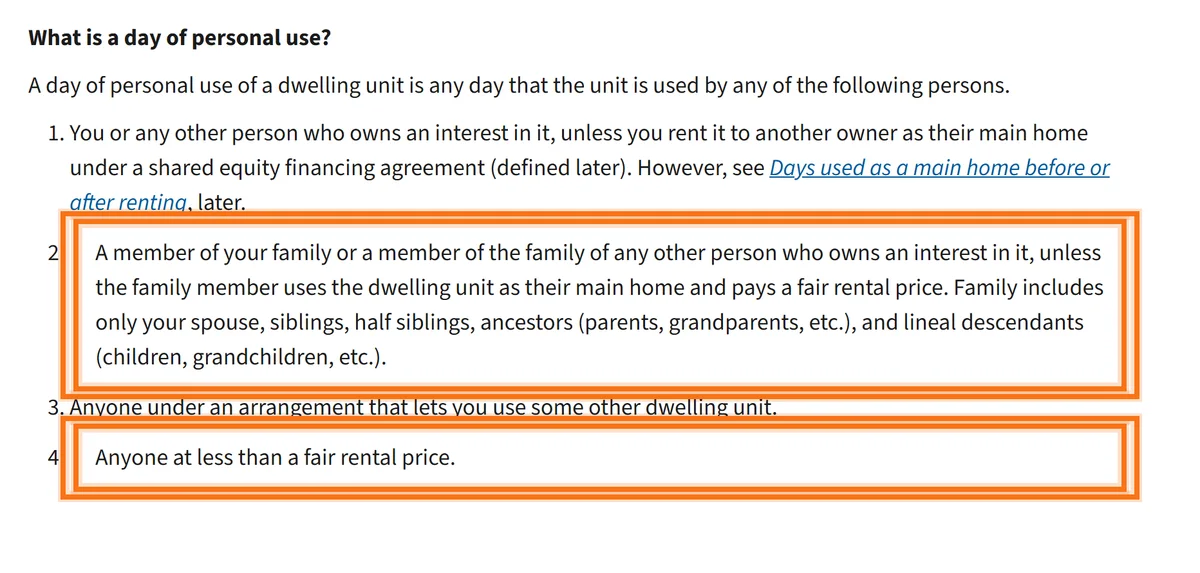
Publication 527 gives an example of a son who rents a property as his main home at a fair rental price: that is not personal use by the owner. Renting an apartment to a mother at less than a fair rental price is. When there is personal use, expenses must be divided between rental and personal use, and the personal share is not deductible as a rental expense.
Illustrative only, not a quote: if a rental analysis shows comparable homes leasing around $2,000 a month and you charge your sister $1,500, the gap is $500 a month, or $500 x 12 = $6,000 a year. Whether that gap is "substantially less" is a question of facts for your CPA. Keep the rental analysis in your file either way. This is general information, not tax advice.
What happens if your relative stops paying
This is the situation owners hire a manager to avoid handling themselves. Texas law does not treat a family tenant differently from any other: the lease governs, a late fee applies only as the written lease and Property Code 92.019 allow, and if rent stops, the next steps are the notices Texas law requires and, if the tenant stays, a filing in the justice court. How that runs is in what happens when a tenant pays late in Texas.
You remain the decision maker at each step. Many owners choose to be more patient with a relative than with a stranger, and that is your right. The difference with a manager is that patience becomes a written decision with a date on it, such as a payment arrangement you approved, rather than a drift that ends in resentment and a large unpaid balance. Whether a manager or a lawyer handles a filing is covered in can a property manager handle an eviction, or do I need a lawyer. This is general information, not legal advice; for a disputed case, ask a Texas attorney.
How Perpetual handles this
Perpetual Property Management is broker-owned, with our office at 5755 Rufe Snow Dr in North Richland Hills, and we manage homes in Keller, North Richland Hills, Fort Worth and nearby. What our site states that applies to a house rented to family or friends:
- Occupied homes. We take over occupied properties: the lease, deposit and records transfer to us, and tenants get new payment and maintenance instructions.
- A tenant you found. Our leasing page says we can paper and manage a tenancy you sourced, though we recommend full screening first. Our screening page says we take over occupied properties as-is and apply full screening at the next vacancy.
- The same rules for everyone. Late fees are applied per the lease, with escalation steps that are the same for every tenant. Our rental criteria are applied to every applicant.
- You set the rent. Our rental pricing page says final pricing is always your call; renewals come with a recommendation, and the decision is always yours.
- What you see. Monthly statements in the Owner Portal, with income, expenses, invoices and documents, and photo or video proof of every completed repair over $500.
How the family terms are written into the lease, including any deposit and payment arrangement you choose, is confirmed in writing before you sign, and every fee is listed in the management agreement. To talk it through, call 682-593-7033 or request a free rental analysis.
The takeaway: Put a manager between you and your relative before anything goes wrong, so that the lease, the deposit and the late fee belong to a written process rather than to a person who has to sit across the table at dinner.
Questions owners ask
Does my relative need to go through tenant screening if they already live in the house?
Not at takeover. Our screening page says we take over occupied properties as-is and apply full screening at the next vacancy, and every adult who lives there is named in the lease. If your relative is moving into a vacant house, they are an applicant: either they apply under the same written criteria as everyone else, or you treat them as a tenant you found yourself and decide on purpose.
Can a property manager evict a family member for me?
Yes, if the lease and Texas law support it and you decide to go ahead. The steps are the same as for any tenant: the notice the Property Code requires, then a filing in the justice court if the tenant stays. Our evictions page describes proper notices, the paper trail courts expect and coordination of the legal process, with an attorney where appropriate; we are not a law firm. You make the decision at each step.
Should I charge a security deposit to a family member?
Yes. A deposit is not a statement about trust; it is what the move-out accounting is measured against. Under Property Code 92.103 it is refunded on or before the 30th day after the tenant surrenders the house, and 92.104 requires a written, itemized list of any deductions. For a relative already living there, adding a deposit is a term of the new lease, so it needs their agreement.
What if there is no written lease at all with my relative?
Texas law requires a lease longer than one year to be in writing to be enforceable (Business and Commerce Code 26.01). A rent-by-the-month arrangement with no agreed term usually works as a month-to-month tenancy, which either side can end with notice under Property Code 91.001. Write down the terms you both agree are current and sign a lease. Without one, you cannot charge a late fee (92.019).
Can I charge my relative less than market rent?
Yes, the rent is your decision, and a manager will manage the house at the number you set. The tax side is separate: IRS Publication 527 treats a family member's use as your personal use unless the house is their main home and they pay a fair rental price, which can limit what you deduct. Keep the rental analysis that shows the market rent and ask your CPA before you settle on the number.
Is renting to friends a good idea?
It can work well when it is treated as a real tenancy: a written lease, a deposit, a due date, a late fee and a repair process that apply the same way they would to a stranger. It goes wrong when the terms stay verbal and every decision becomes personal. A manager between you keeps the house on the lease and the friendship off it.
Property management in Keller, North Richland Hills and Fort Worth. How full-service management works in Tarrant County →