Key takeaways
- Name one channel in the lease for rent and repairs, plus an emergency number, and keep every exchange in it.
- Every reply answers three things: what the issue is, what happens next, and by when.
- Property Code 92.052(d): a repair notice must be written only if the tenant's lease is in writing and requires written notice; 92.159 sets a similar rule, with bold or underlined wording, for security-device requests.
- A notice to vacate must be written (Property Code 24.005); casual texts are not a substitute for formal notices.
- Once a manager is in place, the owner forwards tenant messages instead of answering them.
How should a landlord communicate with tenants professionally? In writing, through one channel the lease names, with replies that state the next step and a date, and without promises the lease does not support. For owners of rentals in Fort Worth, Keller and North Richland Hills, that habit prevents most disputes, and where Texas law requires writing, it is not optional.
This guide gives a channel and wording table for seven common situations, what the lease and the Property Code require in writing, response times, what never to say, and why an owner with a manager should step back.
Which channel, what to say, what not to say: seven common situations
Here are seven situations owners and managers meet every year, with the channel to use, wording that works and the sentence that causes trouble later:
| Situation | Channel | What to say | What not to say |
|---|---|---|---|
| Routine repair request | The tenant portal or the email the lease names | "Received. The plumber will call you by Thursday to set a time." | Nothing, for days |
| Emergency (active leak, no heat in a freeze) | The emergency phone number, then a written note the same day | What to do now (the shutoff), who is coming and roughly when | "Can it wait until Monday?" before anyone has looked |
| Rent is late | The official channel, in writing | The amount due, the late fee as the lease states it, the next step and its date, the payment link | "Don't worry about it this month" |
| Visit for an inspection or repair | Written notice as the lease requires | The date, the time window, who is coming and why | "I'll stop by this weekend" |
| Lease issue (an unapproved pet, noise, parking) | Written notice | The lease clause, what must change, by when, and what follows if it does not | Opinions about the tenant |
| Renewal offer | Written, before the lease's notice deadline | The new rent, the term, a short reason and a reply date | A bare number with no context |
| Tenant contacts the owner after a manager takes over | Reply once, then forward to the manager | "[Manager] handles this now; I've forwarded your message" | Answering the question yourself |
How to read this table: the channel column matters as much as the words, because a reply in the official channel becomes part of the record and a reply by personal text usually does not. Every "what to say" entry names a next step and when it happens. Every "what not to say" entry is a sentence that either changes the lease informally or creates a promise nobody wrote down.
What must be in writing: the lease and the Property Code
Writing protects both sides, but some writing rules come from the law rather than habit. Here is what the Property Code says, as read in the statute text:
- Repair requests (92.052): the duty to repair a condition that materially affects health or safety starts with the tenant's notice to the person to whom, or the place where, rent is normally paid. Under 92.052(d), that notice must be in writing only if the lease is in writing and requires written notice.
- Security devices (92.159): a tenant's request or notice about locks and similar devices may be oral unless a written lease requires writing and that requirement is underlined or in bold.
- Who owns and manages (92.201, 92.202(b)): a tenant may ask for the record owner's name and an address and the off-site management company's name and street address; a written lease may require that first request to be in writing.
- Notice to vacate (24.005(a)): at least three days' written notice before an eviction suit, unless the lease sets a different period.
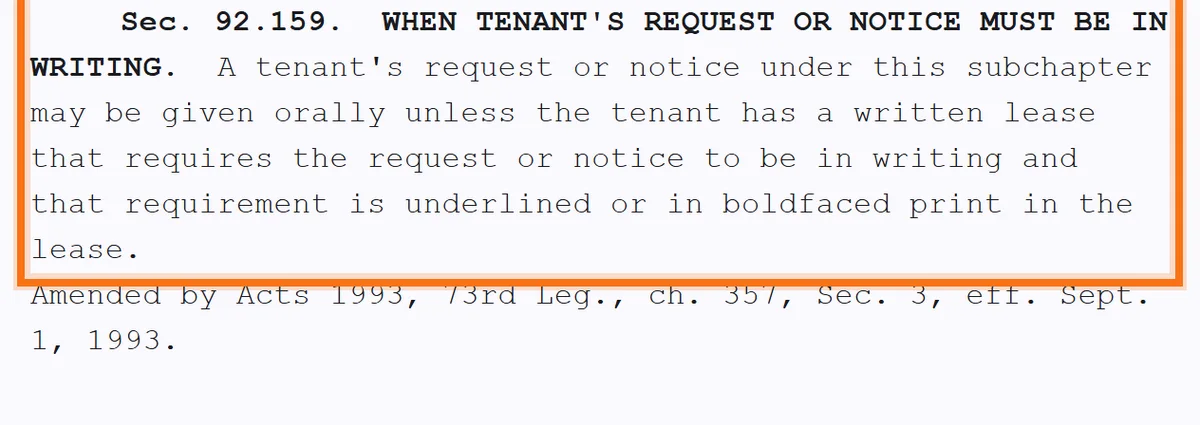
The practical lesson: if you want repair and device requests in writing, the lease has to say so, and for devices the clause must be underlined or bold. Even then, treat a phone call about a real problem as notice and follow it up in writing the same day. This is general information, not legal advice.
One channel, named in the lease
Tenants use whatever is easiest unless the lease says otherwise: a text, a voicemail, a message on social media, a word with the neighbor. Nothing gets lost faster than a request spread across four inboxes. Name one official channel in the lease and the move-in letter, usually a tenant portal with email as backup, plus a phone number for emergencies. Property Code 92.020(d) requires a landlord without an on-site office to give the tenant a telephone number for reporting emergencies.
Self-managing owners can do a version of this with a dedicated email address and a phone number that is not their personal cell. The point is the same: one place, one record, nothing that depends on your memory.
Response times and the Texas repair clock
A tenant who hears nothing for three days assumes the worst. Most of that is prevented by an acknowledgment that names the next step. A workable house standard: emergencies acknowledged at once and someone dispatched the same day; urgent repairs (an appliance down, cooling struggling in summer) acknowledged within one business day; routine requests acknowledged within one or two business days and scheduled normally. These are practice, not law.
The law sets a different clock. Under Property Code 92.056(d), in deciding what is a reasonable time to repair a condition affecting health or safety, there is a rebuttable presumption that seven days is reasonable, measured from the landlord's receipt of the notice. Under 92.053(b), if a tenant sends a written demand for an explanation of a delay and the landlord does not answer in writing by the fifth day, the burden of proof shifts to the landlord. A written "here is why it is taking longer" protects you. This is general information, not legal advice.
Five sentences an owner should never send a tenant
Some sentences are harmless between friends and expensive between a landlord and a tenant:
- "Don't worry about it this month." An informal waiver of rent or a late fee invites the argument that the lease was changed.
- "I'll stop by this weekend." Entry is governed by the lease's notice clause; no Texas statute sets an entry-notice period. More in landlord entry rights in Texas.
- "If you keep complaining, I won't renew." Property Code 92.331 bars a landlord, within six months after a tenant in good faith gives a notice to repair, from retaliating by raising the rent or ending the lease.
- "Just fix it and take it off the rent." That authorizes a repair with no invoice and starts a habit of rent deductions.
- Anything sent in anger. A delayed reply is defensible; a heated one is quoted back.
The tone that gets cooperation
Professional does not mean cold. A tenant who feels treated fairly reports problems early, allows access without a fight and renews. Compare "You need to stop letting the yard go" with "The lease has lawn care with the tenant. The front yard needs mowing and edging by Friday; please send a photo when it is done." The second states the obligation, the deadline and the proof expected, with no opinion about the tenant.
Before sending anything, check three things: does it name the issue, the next step and the date? If one is missing, the message is not finished. That message is also exactly what you would want a judge to read.
The record that settles disputes
A good tenant file is boring: the signed lease and addenda, the move-in condition report with photos, every notice with the date and how it was delivered, every repair request with the date received and the date closed, and the rent ledger. When a dispute comes, the file mostly answers it.
The habits take seconds: log the date and method of every notice; close each repair request with the invoice and a note of what was done; attach dated photos to anything about condition; save texts the same day if texting happened anyway. A portal does most of this by itself. The formal notices a manager sends, and how each is delivered, are in will a property manager handle formal notices to tenants.
Why the owner should not contact the tenant once a manager is in place
When the owner is the tenant's contact, every request is personal: the tenant knows you can waive the fee or approve the dog, so every conversation becomes a negotiation. With a manager in between, the answer is "the lease says" or "the owner's policy is", and most negotiations never start.
That only works if the owner steps back. A reply from you, however kind, splits the record (the manager's file says one thing, your phone another), teaches the tenant that you are the faster channel, and can create a term the manager has to deal with. Reply once, point to the manager and forward the message. How that handoff is done is in will a property manager take over all tenant calls and messages, and what the manager should tell you in return is in what owner communication should look like.
Three replies, written out
Rent is late and the tenant texts an excuse. Reply in the official channel: acknowledge the message, restate the amount due and the late fee as the lease states it, give the date of the next step if it stays unpaid, and include the payment link. No comment on the excuse. What follows is in what happens when a tenant pays late in Texas.
The tenant says the AC is "not cold enough". Acknowledge the same day, ask for the thermostat setting and the indoor temperature, confirm when a technician will come, then close the request with the invoice. Repair complaints that turn into disputes are covered in handling tenant complaints.
The tenant asks to let a friend move in. Thank them for asking, explain that the lease decides who may live in the home and what approval is needed, and say what happens next. Who counts as an occupant is in roommates, co-signers and occupants.
How Perpetual handles tenant communication
Here is what our site states about the tenant's channel and what reaches the owner:
- The tenant's channel: our tenant portal, on AppFolio, is where tenants pay rent, review the lease and submit maintenance requests online. Requests come in with photos, which creates a documented record before anyone is dispatched.
- Emergencies: they follow a 24/7 process, and every plan on our price sheet includes 24/7 emergency response.
- Rent and visits: late fees are applied per the lease, with escalation steps that are the same for every tenant; for inspections, the lease sets the notice and we follow the lease.
- The owner's side: we respond to your calls and emails within one business day under our written guarantees, and monthly statements are in your Owner Portal.
The wording of notices and the lease's communication clauses for your home are confirmed in writing before you sign. To hand tenant communication to us, see our property management page or call 682-593-7033.
The takeaway: Use one written channel, answer with the next step and a date, say nothing the lease does not support, and follow the Property Code's writing rules for repair requests and formal notices. Once a manager is in place, forward tenant messages rather than answering them.
Questions owners ask
Should a landlord give tenants their personal cell phone number?
No. Use a dedicated number or a portal with an emergency line. Once a tenant has your personal cell, every issue becomes a late-night text and every reply an undocumented promise. Texas law requires an emergency number (Property Code 92.020(d)), not your personal one; a manager's emergency line can be that number.
Is a text message from a tenant valid notice of a repair in Texas?
It can be. A text is written, and under Property Code 92.052 the repair notice goes to the person or place where rent is normally paid; it must be in writing only if a written lease requires that. Name the official channel in the lease, and when a request arrives by text anyway, log it and answer through the official channel the same day.
How fast does a landlord have to respond to a tenant in Texas?
For repairs of conditions that materially affect health or safety, Property Code 92.056(d) presumes seven days is a reasonable time to repair after the landlord receives notice, a presumption that can be rebutted. Under 92.053(b), a written demand for an explanation of a delay should get a written answer by the fifth day. No statute sets a reply time for ordinary messages. This is general information, not legal advice.
Can a property manager communicate with my tenant without me?
Yes, that is the point of hiring one. The manager is the tenant's contact for rent, repairs, notices and renewals, and you hear about what needs your decision, such as a repair above your approval limit or renewal terms. If the tenant still contacts you, reply once and forward the message so the record stays in one place.
What should I do if a tenant becomes hostile in messages?
Do not match the tone. Reply once, briefly, in the official channel, restating the facts and the next step, and keep everything. If threats or harassment begin, stop direct contact and route everything through your manager or attorney. The calm record is what protects you.
What should a landlord never say to a tenant?
Avoid informal waivers ("don't worry about it this month"), unannounced visits ("I'll stop by"), anything that links a renewal or rent to the tenant's repair requests, which Property Code 92.331 restricts for six months after a good-faith repair notice, and "fix it and take it off the rent". And never send a message in anger: wait, or let someone else answer.
Does a notice to a tenant have to be in writing in Texas?
Some do. A notice to vacate before an eviction suit must be written (Property Code 24.005(a)). A repair notice must be written only if a written lease requires it (92.052(d)), and a security-device request only if the lease requires it in underlined or bold wording (92.159). Everything else, put in writing anyway. This is general information, not legal advice.
Property management in Keller, North Richland Hills and Fort Worth. How full-service management works in Tarrant County →