Key takeaways
- A full-service manager takes every tenant call, text, email and repair request; the tenant should not need your number at all.
- The handoff is a checklist: your note naming the manager, new payment and repair instructions, open requests, side promises, and the records.
- Property Code 92.201: a tenant may ask for the owner's name and an address and the off-site management company's name and street address. Your phone number is not on that list.
- Once rent is paid to the manager, a tenant's repair notice to the manager starts the repair clock under 92.052(a)(1).
- You still hear about repairs above your limit, renewals, rent problems at the notice stage and anything legal.
Can a property manager handle tenant calls for your rental house? Yes, all of them. Under full-service management the tenant deals with the manager for rent, repairs, questions, notices and renewals, and you hear only about what needs your decision. For an owner in Fort Worth, Keller or North Richland Hills who has been answering the tenant's texts personally, the work is in the handoff: what you tell the tenant, what you pass to the manager, and what you stop doing.
This guide covers the handoff checklist, what Texas law says the tenant must be able to learn, what the tenant gets instead of your number, what still reaches you, and what to do when a tenant calls you anyway.
The handoff checklist: what moves from your phone to the manager
Here is what an owner who has been handling the tenant directly passes to the manager, and why each item matters:
| Item | What you hand over | Why it matters |
|---|---|---|
| You as the tenant's contact | A short note from you naming the manager as the contact from a set date | The tenant hears it from the person they know, so the change is trusted |
| Where rent is paid | The manager's payment method and the first rent date it applies to | Under 92.052(a)(1) a repair notice goes to the person or place where rent is normally paid, so the repair channel follows the rent |
| Open repair requests | Every request not yet closed, with the date reported and any photos | A repair duty may already be running; the manager needs the start date |
| Side promises | Anything agreed outside the lease: a pet, a payment date, a promised repair | The manager can honor only what it knows about; put it in writing or end it |
| Lease and deposit records | The signed lease, addenda, the deposit amount and how it was paid, keys and codes | The manager enforces the lease it holds and answers deposit questions from records |
| Ownership details | Your record name and an address; the management company's name and street address | What 92.201 lets a tenant ask for; it can go in the lease |
| Messages on your phone | The texts and emails from recent months that matter | They belong in the same record as everything after the handoff |
How to read this table: the first two rows change what the tenant does; the rest give the manager what it needs to act without calling you. The side-promises row is the one owners forget, and it is the one that causes the arguments later. On a vacant house most of the table does not apply: the tenant meets the manager at lease signing and never has your number.
Day one: your note and the manager's instructions
On a house with a tenant in place, two messages go out. The first is yours: a few lines saying that from a set date the manager handles everything about the house, with the manager's name and how to reach it. It should come from you because the tenant knows you, and a sudden letter from a stranger asking for rent to go somewhere new looks like a scam. The second comes from the manager: where and how to pay rent from that date, how to report a repair, and the emergency number.
From that date you stop answering tenant messages and forward any that arrive. If you are switching from another management company rather than from managing it yourself, the letter has more to it (the old company's authority ends, the deposit moves); who tells your tenants that the property manager is changing covers that version. The record transfer itself is in how a manager takes over mid-lease.
What Texas law says the tenant must be able to learn
Subchapter E of Property Code chapter 92 decides what a tenant is entitled to know about who owns and who manages the home. Here is what the sections say, as read in the statute text:
- 92.201(a): the landlord must disclose the name and either a street or post office box address of the holder of record title, according to the county deed records, and, if an entity located off-site is primarily responsible for managing the dwelling, the name and street address of the management company.
- 92.201(b): the disclosure is made in writing on or before the seventh day after the tenant asks, by posting, or by including it in the lease or written rules given before the tenant asks. 92.201(f) allows an assumed name if a certificate is recorded with the county clerk.
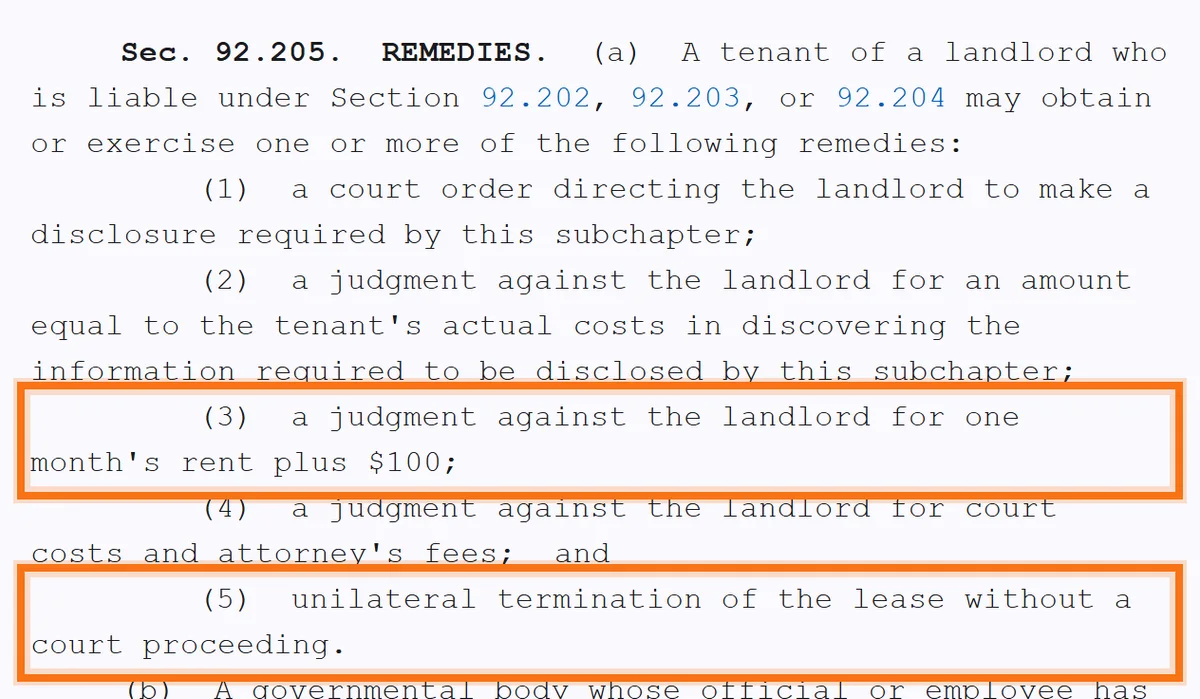
- 92.202 and 92.205: if the landlord does not answer the request, and then lets eight days pass after a written notice from the tenant, the tenant's remedies include a court order, a judgment for one month's rent plus $100, court costs and attorney's fees, and ending the lease without a court proceeding.
- 92.206: a landlord has a defense under 92.202 or 92.203 if the tenant owes rent on the date of the tenant's notice.
Two more sections shape the handoff. Under 92.207(a), a managing agent, on-site or off-site, is the landlord's agent for notices under the subchapter and for government notices about health, safety or nuisance violations, including service of process. Under 92.020(d), a landlord without an on-site office must give the tenant a telephone number for reporting emergencies; the manager's emergency number does that job.
The practical point: the law requires your name and an address, not your phone. Putting the owner and management details in the lease answers the question before it is asked. If a tenant finds your name in the county records, that is the system working, not a leak. This is general information, not legal advice.
What the tenant gets instead of your number
A tenant who cannot call the owner needs something better, not just a different number. A well-run arrangement gives them:
- A portal to pay rent, read the lease and submit repair requests, ideally with photos, so each request is dated and documented.
- An emergency number that works at night and on weekends, the number 92.020(d) requires.
- Written guidance on what counts as an emergency and what to do first, such as where the water shutoff is.
- One contact for lease questions, notices and renewals.
A tenant who has a fast, predictable channel stops looking for a back door to the owner. How a request then moves from the tenant's phone to a vendor, and the Texas repair clock it starts, is in whether a property manager can handle tenant calls and repairs for a Fort Worth rental; this guide stays on the handoff.
What still reaches you, and what does not
You hear about anything that needs your money or your decision:
- a repair above the spending limit in your agreement, with a description, photos and a recommendation;
- a renewal, a rent change or a request to end the lease early;
- a rent problem that has reached the notice stage;
- anything that could become a legal matter, and any government notice about the house.
You do not hear about the garage remote, trash day, a dripping faucet fixed under your limit, or a question the lease already answers. Those show up on the monthly statement or in the owner portal if they cost money or created a record. If you want more visibility, say so when you sign; a manager can copy you on more, but the decisions should still come to you as a summary with a recommendation, not as a forwarded text thread.
When a tenant calls or texts you anyway
It will happen: a long-standing tenant still has your number, or finds your name and address through the disclosure the law requires. The right reply is polite and short: thank them, say the manager handles everything about the house now, give the manager's contact, and forward the message to the manager the same day.
Do not answer the question, approve the repair or discuss the rent, even when it seems harmless. Three things go wrong when you do. A casual yes, such as agreeing to a pet or excusing a late payment, becomes a term the manager has to deal with. The tenant learns that the owner is the faster channel. And the record splits: the manager's file says one thing and your phone says another. A reply you can copy: "Thanks for letting me know. [Manager] handles everything about the house now, including this; please send it to them at [contact] so it is on record. I've forwarded your message."
Why one channel protects the owner
Every request handled through the manager's channel leaves a dated record: what was reported, what was done, by whom and at what cost. If a dispute ever comes up about a repair that was reported, a notice that was delivered or a deposit deduction, that record is the evidence. Messages on your personal phone, half-remembered calls and promises made in the driveway are not.
The second protection is consistency. The same lease terms, the same late-fee steps and the same repair standards apply every time, because one channel applies them. An owner who also answers directly, with good intentions, ends up making exceptions the manager does not know about. And the third is simply your time: the calls you hired the manager to take stop reaching you only when you stop answering them.
An illustrative example: the owner who kept answering
Illustrative only. An owner in Fort Worth hires a manager for a house with a tenant in place but keeps replying to the tenant's texts, because ignoring them feels rude. Within two months the tenant is asking her about a repair the manager has already scheduled, she has agreed by text to a second dog, and a late payment she quietly excused is now the tenant's argument when the manager applies the lease.
The fix is one message from the owner: everything about the house goes through the manager from today, here is the contact. The second dog gets a written pet addendum, the lease terms apply again from the next rent date, and the owner forwards the next two texts without answering them. The tenant adjusts. None of it needs a confrontation, only a boundary and a record.
How Perpetual handles this
Here is what our site states about the handoff and the tenant's channel:
- Taking over with a tenant in place: the lease, deposit and records transfer to us, and tenants get new payment and maintenance instructions, with the handover designed so rent never misses a beat. Our switching page lists what we request: the lease, deposit, keys, tenant ledger and operating records.
- The tenant's channel: our tenant portal, on AppFolio, is where tenants pay rent, review the lease and submit maintenance requests online; requests come in through the portal with photos, which creates a documented record. Every plan on our price sheet includes 24/7 emergency response.
- What reaches you: repairs under your pre-approved limit get fixed; anything larger comes to you with a description, photos and a recommendation. Monthly statements and documents are in your owner portal, and our communication guarantee answers your calls and emails within one business day.
The exact wording of the owner-contact and notice terms is confirmed in writing before you sign. To hand your tenant's calls over, request a free rental analysis on our property management page or call 682-593-7033.
The takeaway: A manager can take every tenant call, but only after a clean handoff: your note naming the manager, new payment and repair instructions, every open request and side promise passed over, and your own phone going quiet. The law asks for your name and an address, never your number.
Questions owners ask
Should I give my tenant my phone number as a backup?
No. A backup number becomes the main number the first time the tenant prefers your answer. Texas law requires the tenant to have an emergency number (Property Code 92.020(d)), and the manager's emergency line is that number. If you want to be reachable in a true catastrophe, give your number to the manager, not the tenant, and let the manager decide when to use it.
What if my tenant complains that the property manager is not responding?
Forward the complaint to the manager in writing and ask for the record of that request: when it came in, what was done and when. Either the record shows it was handled, or there is a gap to fix. If the pattern repeats, raise it with the company directly as a service problem. Answering the tenant yourself only splits the record and teaches the tenant to skip the manager.
Will I be told when my tenant submits a maintenance request?
Only when it needs your decision, unless you ask for more. Requests below your approval limit are handled and appear on your statement with the invoice. Requests above it come to you with a description, photos and a recommendation before the work starts. With us, the documentation of each job is visible in your owner portal.
Can I still visit my rental or talk to the tenant if I want to?
You own the house, so you can, but arrange any visit through the manager, under the access terms of the lease (no Texas statute sets an entry-notice period; the lease governs). Keep conversations with the tenant social rather than about rent, repairs or lease terms. Anything substantive belongs in the manager's channel, where it is recorded once and handled the same way every time.
Can a property manager handle tenant calls for my rental house?
Yes. Under full-service management the manager takes every tenant call, text, email and repair request, gives the tenant a portal and an emergency number, and brings you only what needs your decision. The handoff is the part to get right: your note naming the manager, new payment and repair instructions, and every open request and side promise passed over on day one.
Does Texas law require my tenant to have my phone number?
No. Property Code 92.201 requires that a tenant be able to learn the record owner's name and a street or post office box address, and the off-site management company's name and street address, in writing within seven days of asking, or in the lease. Section 92.020(d) requires an emergency phone number, which can be the manager's. This is general information, not legal advice.
Property management in Keller, North Richland Hills and Fort Worth. How full-service management works in Tarrant County →