Key takeaways
- A manager sends notices for you (late rent, lease violations, non-renewal, notice to vacate, deposit itemization) and receives them for you (repair requests, disclosure requests, city notices).
- A notice to vacate must go out by one of the four methods in Property Code 24.005(f-3): mail, inside the premises in a conspicuous place, hand delivery to a tenant 16 or older, or electronic means agreed in writing.
- Incoming notices start clocks too: seven days to disclose the owner's name and address on request (92.201), five days to answer a written demand for an explanation of a repair delay (92.053).
- Under 92.207, a managing agent is the landlord's agent for disclosure notices and for city notices about health, safety and nuisance violations.
- Whether to renew, at what rent, and whether to file an eviction are decisions that stay with you.
Will a property manager handle formal notices to tenants for you? Yes, and in both directions. On a rental in Fort Worth, Keller or North Richland Hills, the manager writes and delivers the notices you would otherwise send, and is the address where the tenant's and the city's notices arrive. Texas statutes set the form, the delivery method or the deadline for several of them. What stays with you is the decision behind the big ones.
Below: the catalog in one table, the notices you send, delivery as the statutes word it, the notices you receive, what you still decide, and an example.
Every formal notice on a Texas rental, and who handles it
Here are the formal notices that come up on a single-family rental, which way each one travels, and the rule behind it:
| Notice | Direction | The rule | What it requires |
|---|---|---|---|
| Notice to vacate, or notice to pay rent or vacate | You to tenant | Property Code 24.005(a) | At least three days' written notice before filing, unless a written lease sets a shorter or longer period |
| Ending a month-to-month tenancy | Either side | Property Code 91.001 | Ends on the later of the date in the notice or one month after it is given, unless both signed a different period |
| Late fee and late rent notices | You to tenant | Property Code 92.019 and the lease | No late fee unless notice of the fee is in a written lease |
| Lease violation and cure notices | You to tenant | The lease | The cure period and form the lease sets |
| Tenant's repair request | Tenant to you | Property Code 92.052(a), (d) | Goes to the person or place where rent is normally paid; written only if a written lease requires it |
| Demand for an explanation of a repair delay | Tenant to you | Property Code 92.053(b) | A written explanation on or before the fifth day after you receive the written demand |
| Request for owner and manager details | Tenant or official to you | Property Code 92.201 | Name and address of the record owner, and the off-site manager's name and street address, within seven days |
| Deposit refund and itemized deductions | You to tenant | Property Code 92.103, 92.104, 92.107 | Refund within 30 days of surrender, deductions listed in writing, once you have a written forwarding address |
How to read this table: the top four rows are notices you start, and a defect there usually means sending them again. The lower rows are notices the tenant or a government official starts, and the deadline runs against you from the day they arrive, whether or not anyone opened the mail. That second half is where an absent owner gets caught out.
Why a notice either works or has to be sent again
A formal notice is a document with three parts that each have to be right: the content, the delivery method and the date the clock starts. Get one part wrong and the usual result is sending the notice again and losing the days in between.
The failures are predictable. A notice to pay rent or vacate sent as a plain notice to vacate to a tenant who was never late before. A notice left in the mailbox or taped outside the door, when the statute lists other methods. No record of the date it went out. An incoming repair demand that sat unopened while its five days ran. A manager runs the same forms, delivery routine and log on every notice.
Notices you send: from late rent to the notice to vacate
The notice to vacate. Property Code 24.005(a) requires at least three days' written notice to vacate before an eviction suit is filed, unless a written lease sets a shorter or longer period. The form matters: if rent is the only problem and the tenant was not late before the month of the notice, it must be a notice to pay rent or vacate. If the tenant was late before, it may be either. For a tenant holding over after the lease ends, the landlord must also meet 91.001. The notice to vacate in Texas walks through the contents.
Ending a month-to-month tenancy. Under 91.001(b), where rent is paid monthly, the tenancy ends on the later of the day named in the notice or one month after the notice is given. Under 91.001(e), that rule does not apply if both parties signed an instrument setting a different period. Lease termination and non-renewal notices covers fixed-term leases.
Late rent and late fees. Under 92.019(a), one condition for charging any late fee is that notice of the fee is in a written lease. The late notice then states the balance and the fee the lease allows. What happens when rent is late covers the sequence.
Lease violations. No statute sets a cure notice for an unauthorized pet or a car on the lawn; the lease does. The notice names the clause, what was found, the fix and the deadline the lease allows.
After move-out. Under 92.103 the deposit refund is due on or before the 30th day after the tenant surrenders the premises, with a written description and itemized list of deductions under 92.104(c). Under 92.107, that duty waits until the tenant gives a written forwarding address.
Delivery methods, exactly as the statutes word them
Each statute that sets a delivery method words it differently, and the notice works only if it follows that wording.
Notice to vacate: 24.005(f-3). At least one of: (1) mail, including first class, registered or certified mail or a delivery service; (2) delivery to the inside of the premises, in a conspicuous place; (3) hand delivery to any tenant of the premises who is 16 or older; or (4) if the parties agreed in writing, electronic communication such as email. Under 24.005(f-4), those methods do not apply if the tenant actually receives the notice. Posting on the outside of the door is not one of the four; the older delivery subsections were repealed effective January 1, 2026.
Lockout for unpaid rent: 92.0081(d). Only if the lease gives that right and the tenant is delinquent, and only after a written notice locally mailed at least five calendar days before, or hand-delivered or posted on the inside of the main entry door at least three calendar days before. The notice must state, in underlined or bold print, the tenant's right to a key at any hour. Whether your lease includes this remedy is your decision; if it does, the management agreement should say who may use it.
Owner disclosure: 92.201(b). In writing within seven days of the request, by continuous posting as the section allows, or in the lease or written rules beforehand.
Whatever the method, the manager keeps the copy, the method, the date and, where it helps, a photo. This is general information, not legal advice.
Notices you receive, and the clock each one starts
Owners think of notices as something they send. Several of the most important ones arrive instead, and the manager is usually where they land.
Repair requests. Under Property Code 92.052(a)(1), the tenant gives repair notice to the person to whom, or the place where, rent is normally paid. Under 92.052(d), that notice must be in writing only if the lease is in writing and requires it. If the tenant follows up, 92.056(c) treats the notice as received when the landlord or the landlord's agent or employee actually receives it, or when the Postal Service attempted delivery, and 92.056(d) sets a rebuttable presumption that seven days is a reasonable time to repair. Texas landlord repair obligations covers the duties themselves.
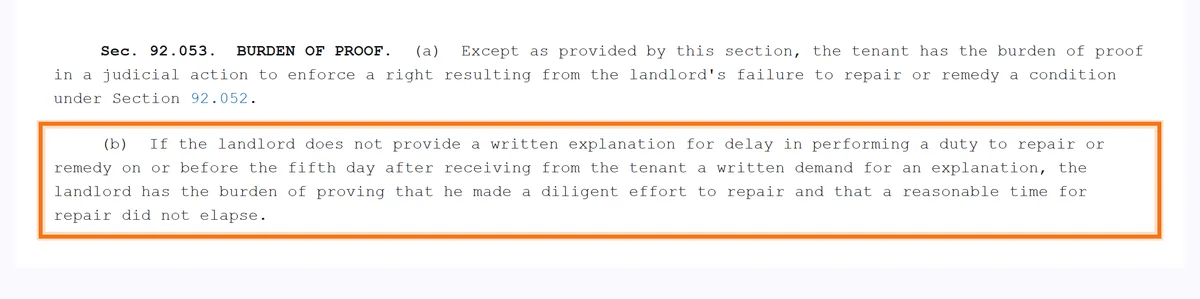
A demand for an explanation. That five-day answer is easy to miss when the demand sits in an owner's mailbox in another city. A manager logs it the day it arrives and answers in writing.
A request for the owner's details. Under 92.201, a tenant or a government official can ask for the name and address of the holder of record title, and the name and street address of an off-site management company. The answer goes in writing on or before the seventh day after the request, or the information can be included in the lease beforehand. Under 92.205, a landlord who fails after a further written warning faces remedies that include one month's rent plus $100.
City notices. Under 92.207(a), a managing or leasing agent is the landlord's agent for notices from a governmental body about health, sanitation, safety or nuisance violations, including fines and service of process. Those land on the manager's desk first.
What you still decide, and who may stand in for you
The manager prepares, sends and logs. Three decisions behind the notices stay yours.
- Renew or not, and at what rent. The manager brings the numbers and a recommendation; you choose. The renewal process exists to bring you that choice in time.
- Whether a notice to vacate becomes a filing. Filing costs money and time, so expect to see the file and the timeline before it goes ahead.
- Policies that change the notices. Whether you allow pets, whether your lease includes a lockout clause, how strict the late process is.
Legally, the duties sit with you. Property Code 92.001 defines the landlord as the owner, lessor or sublessor, and not a manager unless the manager purports to be the owner in the lease. The manager acts under the authority your management agreement gives it. In court, 24.011(a) lets parties to an eviction suit in justice court be represented by authorized agents who need not be attorneys; whether you need to go to court yourself covers that step.
An example: the unauthorized dog
An inspection finds a dog in a house leased with no pets. The same week the manager sends a lease violation notice: the pet clause, the finding, a photo, and a deadline the lease allows to remove the animal or apply for a pet addendum, if you allow pets at all. Most tenants choose one or the other.
If the deadline passes with no cure, you decide whether to end the tenancy over it. If you do, the manager serves a notice to vacate with the period the lease sets for a default, or at least three days under 24.005(a) if the lease is silent, by a method in 24.005(f-3), and logs it. If the tenant leaves, the house is turned over. If not, the file goes to the eviction process with every notice, photo and date in order. You made two decisions: whether to allow the pet, and whether to proceed.
How Perpetual handles this
Perpetual Property Management is broker-owned, with our office in North Richland Hills, and we manage homes in Keller, North Richland Hills, Fort Worth and nearby. What our site states about notices:
- Late rent. A firm, documented late process: reminders, late fees applied per the lease, and escalation steps that are the same for every tenant, every time, moving from reminder to notice on schedule (rent collection).
- Notice to vacate. The notice to vacate that Texas procedure requires, delivered and documented correctly, with the ledger, lease, notices and communication history organized for court. We are not a law firm, and we coordinate with an attorney experienced in landlord-tenant law where appropriate (evictions). The eviction service is included on Full Service and optional at $7.95 per month on the other plans.
- Lease violations. Inspections catch violations such as unauthorized pets, occupants and smoking, and the photo report can include lease-violation follow-ups.
- Repair requests. Tenants report issues through their portal, which creates a documented record.
- Deposits. Returned or properly itemized on the statutory timeline.
Renewal offers come with a recommendation, and the decision is always yours. Who signs which notice, when we check with you before a notice to vacate, and how copies reach you are confirmed in writing before you sign. To talk through a notice problem on your rental, call 682-593-7033.
The takeaway: A notice works only if the right one goes out in the right form, by a method the statute allows, and incoming notices are answered before their clock runs out; a manager runs both directions while the decisions stay yours.
Questions owners ask
Can a property manager sign a notice to vacate on my behalf?
The statutes put the duty on the landlord, which Property Code 92.001 defines as the owner, not the manager. In practice, a manager prepares and delivers the notice under the authority your management agreement gives it, by a method in 24.005(f-3), and keeps the proof. Make sure the agreement says who signs. In a justice court eviction, 24.011(a) allows representation by an authorized agent who need not be an attorney.
How much notice does a tenant get for non-renewal in Texas?
For a fixed-term lease, the lease sets the notice for non-renewal. For a month-to-month tenancy paid monthly, Property Code 91.001(b) ends it on the later of the date in the notice or one month after the notice is given, unless both parties signed a different period under 91.001(e). The manager reads your lease and calendars the deadline.
Will I get a copy of every notice sent to my tenant?
You should get a copy of anything that could lead to court, change your income or end a tenancy. Ask before you sign how copies reach you: in the owner portal, by email, or both, and which notices come to you before they go out rather than after.
Does the manager need my approval before sending a late rent notice?
Usually not. Late notices and late fees follow the lease, and under Property Code 92.019(a) a late fee needs notice of the fee in a written lease. Asking the owner before every reminder would delay it. The notice to vacate and any filing are the points where a manager should check with you, because they carry cost and a decision.
How do you deliver a notice to vacate in Texas now?
Property Code 24.005(f-3) lists four methods, and at least one must be used: mail, including first class, registered or certified mail or a delivery service; delivery to the inside of the premises in a conspicuous place; hand delivery to a tenant 16 or older; or email or other electronic means if both sides agreed in writing. Under 24.005(f-4), the list does not apply if the tenant actually receives the notice.
Does a tenant's repair request have to be in writing in Texas?
Only if the lease is in writing and requires written notice, under Property Code 92.052(d). The request goes to the person or place where rent is normally paid, which is usually the manager. If the tenant sends a written demand for an explanation of a delay, and the landlord has not answered in writing by the fifth day, 92.053(b) puts the burden of proving a diligent effort on the landlord.
Property management in Keller, North Richland Hills and Fort Worth. How full-service management works in Tarrant County →