Key takeaways
- Can you change property managers mid lease? Yes; the lease stays the same and only the manager changes.
- Reconcile six lines on one closing statement: deposits, rent owed, prepaid rent, open invoices, reserve, final payout.
- A manager change is not a sale: you are still the landlord who owes the deposit refund (Property Code 92.103).
- TREC rule 535.146: a broker holds deposits and rent as trust money and disburses it only per the agreement.
- Settle every line in writing before the new manager's first statement, then check it on that statement.
Can you change property managers mid lease? Yes. The lease, the rent and the tenant's deposit stay exactly as they are; what changes is who holds the money and the records. For owners in Fort Worth, Keller and North Richland Hills, the switch goes cleanly when one closing statement from the old manager is reconciled line by line before any money moves.
Below is the six-line reconciliation ledger, an illustrative hand-off with the arithmetic re-added, then each line in turn and what Texas law and TREC's rules say about the deposit and the tenant. For the overall steps and notices, see switching property managers: the complete playbook; this guide is only about the money.
The reconciliation ledger: six lines to settle before the switch
Here are the six lines a mid-lease hand-off has to settle, where each figure comes from, where the money goes, and what to check it against:
| Line | Where the figure comes from | Where it goes | Check it against |
|---|---|---|---|
| 1. Deposits held | The old manager's trust records, per tenant, with any pet deposit shown separately | The new manager, in the full amount | The lease and any move-in receipt |
| 2. Rent owed | The tenant ledger as of the handover date | Stays a balance the tenant owes you; the new manager pursues it under the lease | Late notices already served |
| 3. Prepaid rent | The tenant ledger | To whoever manages the months it covers | The date the switch takes effect |
| 4. Open invoices | Work orders and vendor invoices | Paid from the reserve, or handed to you or the new manager with the paperwork | The approval and the invoice |
| 5. Owner reserve | The last monthly statement | Refunded to you, or moved to the new manager on your written instruction | Your prior monthly statements |
| 6. Final disbursement | Rent collected, minus fees under the old agreement and invoices paid, plus the reserve | You | It must re-add to the closing statement |
How to read this table: lines 1 to 3 belong to the tenancy and follow the lease; lines 4 to 6 belong to you and follow the old management agreement. The new manager's first statement should open with the figures in the last column, so any mismatch shows up in month one, not at the next move-out.
A worked hand-off, re-added twice
Illustrative only, not any company's statement. The switch takes effect at month end. The old manager collected $2,000 rent for the month and has not paid it out, charges 8% under its own agreement, has two open invoices (plumber $415, HVAC service $225) and holds a $1,500 reserve. The tenant paid a $1,800 deposit and a $300 pet deposit, and owes $350 from an earlier partial payment. Here is the old manager's closing statement:
| Closing statement line | Amount |
|---|---|
| Rent collected this month, not yet paid out | $2,000 |
| Old manager's fee under its agreement (8%) | -$160 |
| Plumber invoice paid | -$415 |
| HVAC service invoice paid | -$225 |
| Owner reserve refunded | +$1,500 |
| Final disbursement to you | $2,700 |
| Deposits sent to the new manager (not part of your payout) | $2,100 ($1,800 + $300) |
| Rent the tenant still owes, carried forward (not cash) | $350 |
How to read this table: re-added line by line, $2,000 - $160 = $1,840, - $415 = $1,425, - $225 = $1,200, + $1,500 = $2,700. Re-added the other way, the money out is $160 + $415 + $225 = $800, and $2,000 + $1,500 - $800 = $2,700. The deposits never pass through your payout: they move from the old manager to the new one. The $350 is a receivable, not money anyone holds yet.
Start with one closing statement
Before any deposit moves or any invoice is paid, ask the departing manager in writing for one closing statement showing all six lines above. It is your reconciliation point, and everything the new manager does starts from it.
TREC rule 535.146 requires a broker holding trust money to keep a documentary record of each deposit to and withdrawal from the trust account, to provide an accounting to each beneficiary at least monthly if there has been activity, and to keep trust account documentation for four years. So the figures should exist. Do not let the deposit move before you have seen the ledger; the two have to agree.
The deposit: what Texas law and TREC rule 535.146 say
Three rules, as read today, decide how a deposit moves when only the manager changes:
- You are still the landlord. Property Code 92.103 requires the landlord to refund a deposit on or before the 30th day after the tenant surrenders the premises (subject to 92.107). Section 92.105, the new-owner rule, applies when the owner's interest ends by sale or otherwise; a manager change is not a change of owner, so the refund duty stays with you.
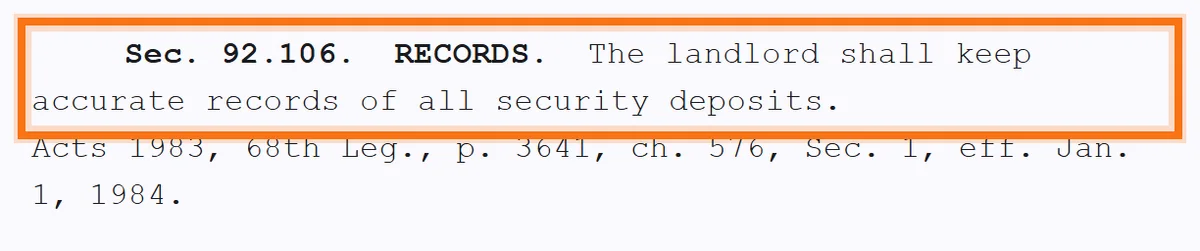
- Records. Section 92.106: the landlord shall keep accurate records of all security deposits.
- Trust money. TREC rule 535.146 defines trust money to include rent and security deposits, requires a broker to hold it in a designated trust account, and lets the broker disburse it only in accordance with the agreement under which it was received. When parties to a real estate transaction make a written demand for payment, the broker must pay within a reasonable time, which TREC has set at no later than the 30th day after the demand.
So give the old manager a written instruction naming where each deposit goes, check the amount against the lease, and keep the transfer letter. If less arrives than the lease shows, you still owe the tenant the full refund. This is general information, not legal advice.
Telling the tenant who now manages the house
Tenants worry about their deposit more than anything in a switch. One short written notice settles it: the lease is unchanged, the deposit in the amount the lease states is now held by the new manager, and here is where to pay rent and report repairs from the switch date.
The Property Code also has a disclosure rule. Section 92.201 requires a landlord to disclose the record owner's name and address and, if an off-site entity is primarily responsible for managing the dwelling, the management company's name and street address. If that information was given in the lease or by posting and a name or address changes, 92.203 makes the landlord liable for failing to correct it within seven days after the tenant's written notice. Who sends the notice is covered in who tells my tenants that the property manager is changing.
Rent owed from before the switch
Rent owed under the lease is owed to you, not to the manager who happened to be collecting, so it carries forward as line 2. The new manager needs the signed lease, the full ledger (not a summary), copies of any notices already served and a balance as of the handover date that both managers agree. If the arrears are large enough that a notice to vacate is on the table, tell the new manager before the welcome letter goes out. The collection steps themselves are in can a new property manager take over collecting unpaid rent.
Which manager earns the fee on old rent
Collected rent is yours, less what your agreements allow. The old agreement may give the old manager its fee on rent that was due during its term even if it arrives later; the new agreement may charge a fee on arrears it collects. Read both before the switch so the same dollar is not charged twice, and agree in writing who keeps late fees when one manager served the notices and the other collects. Who keeps late fees and pet fees explains how agreements usually word it.
Open repair bills: who pays the vendors
Work ordered and finished under the old manager is still your bill: the vendor did the job on your house at your agent's instruction. Usually the old manager pays open invoices from the reserve and lists them on the closing statement; if the reserve is short, it hands you the unpaid invoices with the vendors' contact details. Whoever pays should have the work order, the invoice and the approval.
Watch three things: work started but not finished (get the scope and what has been paid), invoices that appear after the switch for work you never approved (ask for the approval trail first), and warranties on recent work (note who holds them). Original repair invoices and photos shows what a complete paper trail looks like.
The reserve and the final payout
The reserve is the line owners forget. The closing statement should show the opening reserve, every invoice paid from it since the last statement and the amount refunded; match it against your prior monthly statements. When the agreement does not say when the final payout comes, put a demand in writing: under TREC rule 535.146, when parties to a real estate transaction make a written demand for trust money, the broker must pay the party entitled to it within a reasonable time, which TREC has set at no later than the 30th day after the demand.
If the payout or the records do not arrive, write to the broker who holds the license; when your old manager won't release keys or records covers the next steps, and owner reserves and disbursements explains how the reserve and the payout work together. Keeping rent flowing during the change is covered in switching managers without interrupting rent payments.
How Perpetual handles the money side of a switch
Perpetual Property Management is broker-owned, with our office at 5755 Rufe Snow Dr, Suite 155, in North Richland Hills, and we take over rentals in Keller, North Richland Hills and Fort Worth with the tenant in place. Our switching page states:
- What we request: the lease and related documents, security deposit, keys, tenant ledger, property records and open work orders.
- Why the ledger matters: "A balance needs to be understood before it can be carried forward accurately," and open repair bills have to be distinguished from completed work and pending requests.
- The tenant: instructions on where to pay rent and how to submit maintenance requests, with the handover designed so rent never misses a beat.
- The checkpoint: an enrollment inspection (included with onboarding on Full Service, $49 on Standard, $125 on Investor Special), then your first monthly statement in the AppFolio owner portal, the practical place to check transferred balances.
If your current agreement makes waiting the better decision, we will tell you. How we hold deposits once they reach us, and how our fees apply to rent collected after a switch, are confirmed in writing before you sign. See what full-service management covers and every fee on our price sheet, or call 682-593-7033.
The takeaway: Get one closing statement, reconcile all six lines against the lease and the ledger, and move the deposits in full before the new manager's first statement, so the only change your tenant notices is a new phone number.
Questions owners ask
How are security deposits transferred when I change property managers?
The old manager either sends each deposit straight to the new manager's trust account with a letter naming the tenant, the amount and any pet deposit, or refunds it to you with an accounting so you can fund the new manager. Either way the amount must match the lease: under Property Code 92.103 you, the landlord, owe the full refund when the tenant moves out. Tell the tenant in writing who holds it.
Can a new property manager take over collecting unpaid rent from before the switch?
Yes. Rent owed under the lease is owed to you, and the new manager steps into collection as your agent. It needs the signed lease, the full ledger, copies of notices already served and a balance as of the handover date that both managers agree. Settle in writing which manager earns a fee on that old rent.
Who handles outstanding repair bills when I change management companies?
You do, because the work was done on your house at your agent's instruction. Normally the old manager pays open invoices from the reserve it holds and lists them on the closing statement, refunding the rest. If the reserve is short, you pay the difference, or the new manager pays from your new reserve once it has the work order, the invoice and the approval.
How long should the old manager take to refund my reserve and deposit?
Check your management agreement first. If it sets no date, put a demand in writing: TREC rule 535.146 says that when parties to a real estate transaction make a written demand for trust money, the broker must pay the party entitled to it no later than the 30th day after the demand. If nothing arrives, write to the broker who holds the license, then consider a complaint to TREC.
Does the tenant have to pay a new deposit when management changes?
No. The deposit was paid under the lease and simply moves to the new manager. The lease, the rent and the deposit amount stay exactly as written until the lease ends or is renewed; only where rent is paid and who to call for repairs changes.
Can you change property managers mid lease?
Yes. The lease is between you and the tenant, so it stays in force; the management agreement is what changes. Read the old agreement's notice terms, give notice, then reconcile the six money lines (deposits, rent owed, prepaid rent, open invoices, reserve and final payout) on one closing statement before the new manager's first month. The tenant gets one written notice of the new manager and where to pay.
Does Property Code 92.105 apply when I change managers?
No. Section 92.105 covers the end of the owner's interest, by sale or otherwise; when only the manager changes, you are still the owner and the landlord, and you still owe the refund under 92.103. The deposit moves between managers under your written instruction and the old manager's agreement, and a broker handles it as trust money under TREC rule 535.146. This is general information, not legal advice.
Property management in Keller, North Richland Hills and Fort Worth. How full-service management works in Tarrant County →