
Key takeaways
- The year has a shape: a busy move-in, a first repair, two seasons that test the house, a renewal decision, and tax season.
- A late fee needs notice in a written lease and cannot apply until rent is unpaid two full days after the due date (Property Code 92.019).
- Seven days is presumed a reasonable time to repair a condition affecting health or safety (92.056(d)).
- If the tenant leaves, the deposit refund or itemized list is due by the 30th day after surrender (92.103, 92.104).
- Your manager's Form 1099-MISC for rent is due to you by January 31.
Your first year as a landlord follows a predictable calendar: a busy move-in month, the first rent and first repair, a summer and a winter that test the house, a renewal decision around months nine and ten, and tax season in January. Texas law sets several of those dates, whether your rental is in Fort Worth, Keller or North Richland Hills, and knowing them in advance is most of what makes year one calm.
This guide walks the year month by month. If you are hiring a manager, the hand-overs for the first month are in your first 30 days with a property manager, and the manager-versus-owner split for one house is in property management for a first-time landlord with one rental.
The first year as a landlord, month by month
Here is a first year with one rental house, month by month, with the Texas rule or record that sets each date:
| When | What usually happens | The rule or record that sets it |
|---|---|---|
| Before move-in | Lease signed, landlord insurance in place, house checked against the security device and smoke alarm rules | A late fee needs notice in a written lease (92.019(a)(1)) |
| Move-in week | Deposit and first rent collected, condition photos taken, keys handed over | Smoke alarms tested at the beginning of possession (92.258(b)); locks rekeyed by the seventh day after the turnover date (92.156(a)) |
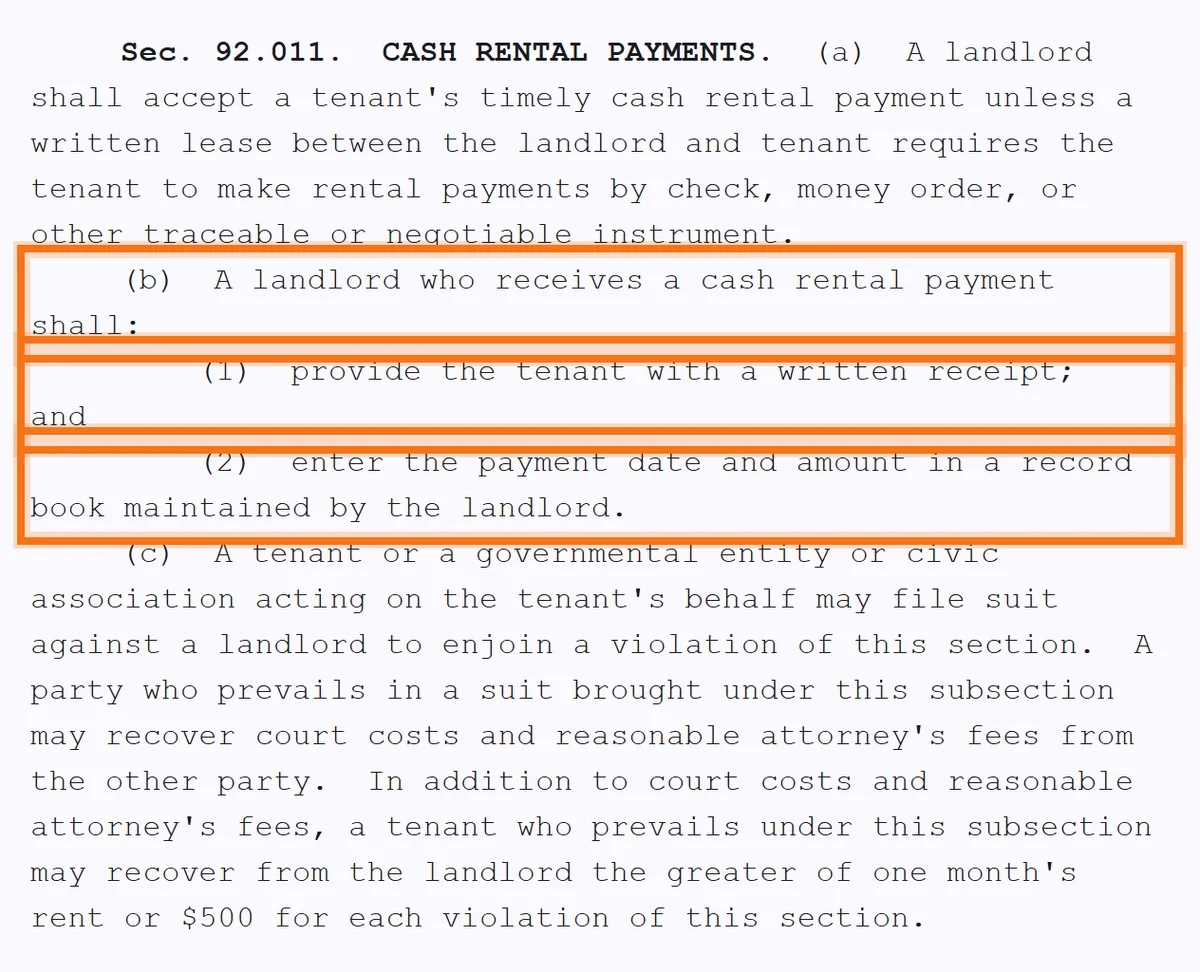
| Month 1 to 2 | First full rent payment, first statement or ledger entry | No late fee until rent is unpaid two full days after the due date (92.019(a)(3)); cash rent needs a receipt and a record book (92.011(b)) |
| Months 2 to 4 | First repair request | Diligent effort to repair a condition that materially affects health or safety once notified (92.052(a)); seven days presumed reasonable (92.056(d)) |
| Summer | First real test of the air conditioning | No Texas statute names A/C; 92.052 and the lease govern |
| Mid-lease | Inspection of the inside of the house | No statute sets an entry notice period; the lease does |
| Winter | First hard freeze | Lease terms on freeze care; the 92.052 repair duty if a burst pipe affects health or safety |
| Months 9 to 10 | Renewal decision and offer | The lease; for a month-to-month tenancy, notice takes effect one month after it is given at the earliest, unless a signed agreement sets another period (91.001(b), (e)) |
| Lease end, if the tenant leaves | Move-out inspection, deposit accounting, turnover | Refund or itemized list by the 30th day after surrender (92.103(a), 92.104(c)), once a written forwarding address is given (92.107(a)) |
| January after | Form 1099-MISC from your manager, records to your CPA | IRS instructions: box 1 rents, statements to recipients by January 31 |
How to read this table: the middle column is the rhythm of the year, and the right column is what turns a calendar into obligations. Most of the dates are set by the Property Code or by your lease, not by habit, which is why the lease you sign before move-in decides how much of the year is routine. This is general information, not legal advice.
Move-in month: the busiest weeks of the year
Everything happens at once: make-ready, photos, listing, showings, applications, screening, the lease, the deposit, the move-in condition record and the keys. Self-managing, it costs evenings and weekends. With a manager, it costs a few decisions and signatures.
Two dates in move-in week come from the statute, not from habit. Property Code 92.258(b) requires the landlord to determine that each smoke alarm is in good working order at the beginning of the tenant's possession, by testing it. Section 92.156(a) requires rekeying the locks at the landlord's expense not later than the seventh day after each tenant turnover date, which 92.151(15) defines as the date a tenant moves in after all previous occupants have moved out.
The move-in condition record matters most later. Photos and notes taken now are the evidence for any deduction at move-out. Prorate the first partial month in writing so the rent ledger starts clean.
Months one to four: the first rent and the first repair
The first rent. Under Property Code 92.019(a), a landlord may not collect a late fee unless notice of the fee is in a written lease, the fee is reasonable, and rent has remained unpaid two full days after the date it was originally due. For a house in a structure with four or fewer units, 92.019(a-1) treats a fee of not more than 12% of the monthly rent as reasonable. If a tenant pays in cash, 92.011(b) requires a written receipt and an entry in a record book. How a manager enforces this is in who sets late fees and makes sure they are collected.
The first repair. Small requests often come early, as a tenant finds what the last occupant lived with. Section 92.052(a) requires a diligent effort to repair a condition that materially affects the physical health or safety of an ordinary tenant, once the tenant gives notice and is current on rent, and 92.056(d) presumes seven days is a reasonable time. Decide now who the tenant calls and what you approve without a conversation. This is general information, not legal advice.
The first summer: the air conditioning test
In North Texas the first summer is the first real test of the house. A system that limped through the previous owner's last season can fail under a tenant's thermostat in July. A capacitor is a service call; a compressor is a decision about the whole system.
No Texas statute names air conditioning; the repair duty in 92.052 and your lease govern. Our maintenance page lists "no AC in extreme heat" among the situations that follow an emergency process, which is how most owners should treat it. Two things make a summer failure manageable: a reserve that already exists, so the repair is approved the same day, and a spring service visit, so you know in advance whether you would repair or replace. Summer can also bring the first HOA letter about the lawn; the lease should say who mows.
The quiet months: inspection, reserve and records
Somewhere in the middle of the lease, little happens. Rent arrives, the statement shows the same lines, the tenant lives in the house. This is when owners drift, and when the best preparation for the busy months gets done.
- Inspect inside the house. No Texas statute sets a notice period for a landlord's entry, so the lease sets it. A dated photo report catches the slow leak and the filter nobody changed.
- Rebuild the reserve if a repair drew it down. Sizing it is in how much reserve to keep per rental.
- Confirm your insurance is a landlord policy, not the homeowner policy you had when you lived there.
- Set up the records so year-end is a download: statements, invoices, the deposit record.
The first freeze
A North Texas winter is mild until it is not. One hard freeze with a tenant who does not know to drip faucets, open cabinet doors or protect hose bibs can mean a burst pipe and an insurance claim. The owners with a bad first winter usually assumed the tenant knew what to do.
Before the first cold snap, send the tenant a short written freeze checklist, make sure the irrigation system is shut off or winterized, and insulate exposed pipes in the garage or attic. Once the tenant reports a burst pipe that affects health or safety, the 92.052 repair duty applies. The full owner checklist is in winter freeze prep for a Texas rental.
Months nine and ten: the renewal decision
The renewal decision is the most important money decision of the year, because a turnover means vacant days, make-ready and a new placement. Start early enough that both outcomes have time: our renewals page says conversations typically start 60 to 90 days before lease end.
- Review the tenant's year: payments, reported problems, condition at the inspection.
- Check what comparable homes leased for recently, not what you set a year ago.
- Offer renewal terms in writing, with time for the tenant to decide.
- If the tenant declines, plan the move-out inspection and the make-ready before the last day.
If neither side signs and the tenant stays month to month, Property Code 91.001(b) says a notice of termination for a monthly tenancy takes effect on the later of the day given in the notice or one month after the notice is given, unless both parties signed an agreement setting a different notice period (91.001(e)). How managers set the number is in how a manager decides how much to raise the rent at renewal. This is general information, not legal advice.
What the money looks like in year one
Year one is often the thinnest year, because it carries the leasing cost. Illustrative only, not a quote, using the Standard plan as our price sheet lists it: a house renting for $2,000 a month for twelve months collects $24,000. The management fee at 9% is $180 a month, $2,160 for the year, and tenant placement at 75% of one month's rent is $1,500. Management lines for year one: $2,160 + $1,500 = $3,660, leaving $20,340 before your mortgage, property tax, insurance and repairs. Re-added: $20,340 + $3,660 = $24,000.
If the same tenant renews, year two drops the placement fee and adds the $200 Standard renewal fee: $2,160 + $200 = $2,360, which is $1,300 less than year one. The final fee is set after the rental analysis and confirmed in writing. The surprises that thin the numbers are usually small ones: a stack of repairs, an HOA increase, the tax bill without the homestead exemption, the insurance renewal.
Lease end, the deposit, and why year two is easier
If the tenant leaves, the deposit clock starts. Property Code 92.103(a) requires the refund on or before the 30th day after the tenant surrenders the house; 92.104(c) requires a written description and itemized list of any deductions; 92.104(b) bars keeping any part for normal wear and tear; and under 92.107(a) the landlord is not obligated to return it until the tenant gives a written forwarding address. The move-in record from month one is your evidence. More in Texas security deposit rules.
In January, if you have a manager, it files Form 1099-MISC for the rent paid over to you, box 1, with your copy due by January 31; see year-end documents for your accountant. IRS Publication 527 says a deposit you plan to return is not income when you receive it.
If the tenant renewed, year two has no leasing cost, a known tenant and a house whose quirks you now know. The first year is where ownership is learned.
How Perpetual runs a first year. Perpetual Property Management is broker-owned, with Justin Brown as Broker/Owner, at 5755 Rufe Snow Dr in North Richland Hills. Our site states:
- a free rental analysis with a written quote before you sign;
- a 360-degree condition inspection at every move-in and move-out;
- repairs under your pre-approved spending limit fixed fast, larger ones sent to you with a description, photos and a recommendation;
- an annual property inspection on every plan;
- renewal conversations typically 60 to 90 days before lease end, with the decision always yours;
- payouts by the 10th of each month or that month's fee is waived, subject to the Guarantee Addendum (price sheet).
Anything else about your first year with us is confirmed in writing in the management agreement. Call 682-593-7033.
The takeaway: Put the year on a calendar before move-in: rekey and alarm test in week one, late-fee and repair rules from month one, an inspection mid-lease, the renewal decision by month ten, the deposit clock at move-out, and the 1099 in January.
Questions owners ask
How much time does it take to be a landlord in the first year?
It depends on who does the work. Self-managing, the time bunches up in the move-in month, at the first repairs and at renewal, and it arrives when the tenant needs it, not when you planned it. With a manager, your part is the decisions: approvals above your limit, reading the statements and inspection reports, and the renewal call. Our guide comparing self-management with a manager goes through the trade.
What usually goes wrong in the first year of renting out a house?
Usually small things: a price that sits too long, a flurry of minor repairs early in the lease, an A/C failure in summer, a freeze the tenant was not ready for, and small cost increases in tax, insurance and HOA dues. The costly mistakes are procedural: a late fee not in the written lease (92.019), a rekey that never happened (92.156), or a deposit not accounted for within 30 days (92.103).
How much money should a new landlord expect to make in year one?
Usually less than later years, because year one carries the leasing cost. Illustrative only: at $2,000 a month and a 9% fee, a year of management is $2,160 plus a placement fee of $1,500 at 75% of one month's rent, $3,660 in all; a renewal year would be $2,160 plus a $200 renewal fee. Your mortgage, tax, insurance and repairs come on top. Your actual quote is confirmed in writing.
When should I think about renewing my tenant's lease?
Early enough that both outcomes have runway. Our renewals page says conversations typically start 60 to 90 days before lease end. Review the tenant's year, check current leased comparables, and offer terms in writing. If the tenant stays on month to month instead, Property Code 91.001(b) sets the earliest end date of a notice at one month after it is given, unless both parties signed an agreement on a different notice period (91.001(e)).
Is the first year a good time to hire a property manager?
It is the year a manager's work shows most, because leasing, the first repairs, the first summer, the renewal and the deposit accounting are firsts for you and routine for a manager. Many owners self-manage year one and switch later, which works too. Whichever you choose, put the fees in writing before you sign.
Can I charge a late fee in my first month as a landlord?
Only if the conditions in Property Code 92.019(a) are met: notice of the fee is in a written lease, the fee is reasonable, and rent has remained unpaid two full days after the date it was originally due. For a house in a structure with four or fewer units, 92.019(a-1) treats a fee of not more than 12% of the month's rent as reasonable. This is general information, not legal advice.
Do I have to accept rent in cash?
Property Code 92.011(a) says a landlord must accept a tenant's timely cash rental payment unless a written lease requires payment by check, money order or another traceable or negotiable instrument. If you do take cash, 92.011(b) requires a written receipt and an entry of the date and amount in a record book.
Property management in Keller, North Richland Hills and Fort Worth. How full-service management works in Tarrant County →