Key takeaways
- A repeat repair is the same symptom in the same system of the same house within a window you choose, such as 12 months, across tenants and across managers.
- The record that catches it: date, the tenant's report and photos, the vendor, the diagnosis and cause, the invoice, the warranty and the component's age.
- A failure soon after a repair is a callback for the vendor, not a new bill, if the vendor's written labor warranty covers it.
- Texas Property Code 92.052 ties the repair duty to a condition and the tenant's notice, not to how many times it was fixed before.
- Compare the running total of repairs on one system with a written replacement quote; IRS Publication 527 lists a new roof, a heating system, central air and a water heater as improvements.
Which DFW property management company tracks recurring maintenance issues by property? Ask any manager to show you one house's repair history: every request, date, vendor, cause and invoice, sorted so the second call about the same AC, drain or roof leak stands out. In Fort Worth, Keller and North Richland Hills, Perpetual documents every job in your owner portal, what was reported, what was done and what it cost, with the original vendor invoice.
This guide covers common repeat patterns and what to ask for each, what a per-house record must hold, warranty callbacks, the repair-or-replace point, the Texas repair rules and a Fort Worth water-bill rule that punishes a second leak.
Common repeat repairs, what they point to, and what to ask for
A repeat is a question about cause. These patterns come up on single-family rentals, and each one has a document that answers it:
| Pattern | What it usually points to | What to ask for |
|---|---|---|
| The same drain clogs every few months | A problem in the line itself, or how the fixture is used | The cause written on each invoice; a camera inspection report if the line is suspect |
| The AC fails each summer, a different part each time | An aging system where parts keep wearing out | The unit's age and model, every past invoice, and a replacement quote next to the repair quote |
| The same repair by the same vendor within weeks | A misdiagnosis or work that did not hold | A callback under the vendor's written labor warranty, with no second trip charge |
| A ceiling stain that returns after each heavy rain | A roof or flashing leak that was patched inside only | A roofer's report with dated photos of the roof, not just drywall repair |
| Water bills that jump again after a fix | A leak that was not fully found | Leak detection and the repair receipt with date and description |
| Breakers that trip or outlets that fail repeatedly | An overloaded or failing circuit | A licensed electrician's diagnosis, not a reset |
| Repeat damage during one tenancy only | Use rather than wear | Photos and the vendor's note on cause, checked against the lease |
How to read this table: the middle column is a starting point, not a diagnosis; only the vendor's finding settles the cause. The right column is what turns a hunch into a decision. If the second invoice for the same symptom does not say what caused it, ask before you approve a third.
What counts as a repeat repair
Pick a rule and apply it the same way every time: the same symptom in the same system of the same house within 12 months is a workable default. A shorter window catches workmanship problems, a longer one catches aging equipment.
Two details make the difference. First, the record belongs to the house, not to the tenant or the manager: a problem that started under the last tenant or the last company is still a repeat. Second, separate repeats across tenants from repeats within one tenancy. A drain that clogs under three different households points to the plumbing; damage that shows up only with one household may point to use, which matters under Texas law (see below) and is covered in how a manager decides whether a repair is the tenant's.
What a per-house repair record should hold
A manager can only spot a repeat if each job leaves the same fields behind. For every work order, ask that the record holds:
- the date reported and the tenant's description and photos;
- the system and component (AC condenser, kitchen drain, water heater), with make, model and install date when known;
- the vendor, the date of the visit and the diagnosis in the vendor's words;
- the cause, if the vendor can state it (wear, failure, use, weather);
- the invoice: parts, labor, trip charge and total;
- the warranty on that work and how long it runs;
- photos after the work.
On a statement a repair is one line; the invoice behind it is what shows the pattern. What a complete invoice and photo set looks like is in repair invoices and photos for owners, and what a portal can and cannot show is in what you can see in the owner portal.
Warranty callbacks: who pays when a repair fails again
When a fix fails soon after the visit, the first question is not "how much" but "is this still under the vendor's warranty?" A callback is a return trip for the same problem; if the vendor's written labor warranty covers it, it should not come back to you as a new bill. That only works if the earlier invoice, its date and the warranty terms are in the record, so the manager can say "you were here on this date for this" before dispatching anyone.
Three other warranties can apply to the same failure:
- The equipment maker's warranty on a new AC, water heater or appliance: keep the registration and the install date.
- A home warranty contract, if you carry one: see working with a home warranty company.
- A builder's warranty on a newer house: see renting out a new construction home.
A manager can also track callbacks per vendor; a vendor whose work keeps coming back costs you twice. How a manager uses that number to keep or drop a vendor is in the vendor bench.
The repair-or-replace point, on your own numbers
No rule says "replace after the third repair." The test is the running total on one system against a written replacement quote, plus the age of the equipment and the cost of the next failure landing on a tenant in July. Our Hurst, Euless and Bedford page puts it this way: installation dates, repair invoices, warranties and inspection records "help distinguish a recurring repair issue from a system approaching replacement."
Illustrative only, not typical prices or a quote: three AC repair invoices on one house in 18 months of $450, $680 and $1,150 add to $2,280 ($450 + $680 = $1,130; $1,130 + $1,150 = $2,280). Against an illustrative written replacement quote of $7,000, the repairs already equal about 33% of it ($2,280 / $7,000 = 0.326). That number, with the unit's age and the vendor's opinion of what fails next, is what you decide on.
Tax treatment changes too. IRS Publication 527 says you must capitalize an improvement, and its Table 1-1 lists a heating system, central air conditioning, a water heater and a new roof among its examples; a repair may generally be deducted if it does not have to be capitalized. Your CPA sorts each invoice. This is general information, not tax advice. More on AC specifically is in HVAC in Texas rentals.
What Texas law says when the same condition comes back
Property Code section 92.052(a) requires a landlord to "make a diligent effort to repair or remedy a condition" when the tenant gives notice, is not delinquent in rent, and the condition materially affects the physical health or safety of an ordinary tenant (or arises from a failure to maintain a device supplying hot water of at least 120 degrees Fahrenheit). The statute speaks of a condition and a notice, not of how many times it was fixed before: a repair that does not hold leaves the condition in place.
Section 92.056(b) sets when a landlord becomes liable, including a subsequent written notice after a reasonable time, or a first notice sent by certified or other tracked mail, and section 92.056(d) presumes seven days is a reasonable time to repair, rebuttable by the severity of the condition and the availability of materials, labor and utilities. A dated record of every notice and visit is what shows diligence.
Section 92.052(b) adds that, unless the condition was caused by normal wear and tear, the landlord has no duty during the lease to repair a condition caused by the tenant, a lawful occupant, a family member or a guest. This is general information, not legal advice; the full set of duties is in Texas landlord repair obligations.
A Fort Worth rule that makes a second leak more expensive
Repeat leaks cost more than the plumber's bill. Fort Worth Water's high water use bill adjustments page says the water leak repair adjustment "is limited to one in a rolling 12-month period," and accounts that receive one "are ineligible for another water leak repair bill adjustment for the next 12 months."
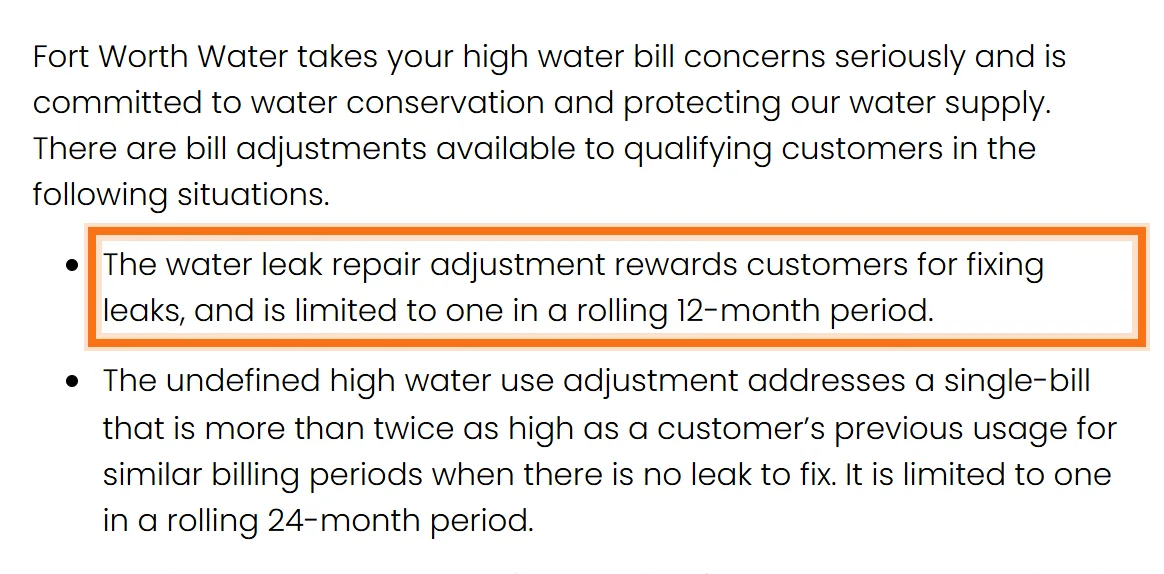
To request it, the page asks for a copy of the repair receipt or paid-in-full invoice, the account number, the property address, the dates of the high bills and the date and description of the repair, within 60 days of the completed repair. If eligible, up to two consecutive billing periods may be adjusted by 50 percent of the difference above average use. The account holder applies: the tenant if the lease puts water in the tenant's name, or you while the house is empty. Either way it needs the invoice your record should already hold. For Keller and North Richland Hills water accounts, confirm with the city.
Does it matter whether the company has its own maintenance crew?
Some owners ask which companies run their own maintenance operation, hoping in-house staff means fewer repeats. What decides repeats is less who employs the worker than whether the work is diagnosed, licensed where Texas requires a license, warrantied and recorded. Ask any company, in-house or not:
- Who will actually do the work on my house, and are they licensed for that trade?
- Is the cause written on every invoice?
- Who pays for a return visit for the same problem, and for how long?
- Can you show me one house's repair history, sorted by system?
- How is the work billed: vendor invoice plus a coordination fee, or an internal rate?
The trade-offs of each model are in in-house maintenance staff or outside contractors. Our site describes coordinating vendors, not an in-house crew, as set out below.
How Perpetual tracks repairs on a rental in Fort Worth, Keller and North Richland Hills
Perpetual Property Management is broker-owned, with our office in North Richland Hills, and manages homes in Keller, North Richland Hills, Fort Worth and nearby. What our site states about repair records:
- Requests on record. Tenants report issues through their portal with photos, which creates a documented record and lets us triage before dispatching anyone.
- Documentation on every job. What was reported, what was done and what it cost, visible in your portal, with the original vendor invoice (maintenance coordination).
- Vendors. Plumbers, electricians, HVAC and general trades we work with repeatedly, accountable for their work.
- Proof. Photo or video proof in your portal for every completed repair over $500, subject to the Guarantee Addendum (the Perpetual Promise).
- Inspections. An annual property inspection on every plan; anything found feeds into maintenance coordination (inspections).
- Larger repairs. Anything above your pre-approved limit comes to you with a description, photos and a recommendation. Our site also notes that repeated work on the same component may warrant a broader repair discussion.
Coordination is a percentage of the vendor's invoice: 4.9% of cost on Standard, 5% on Full Service, and make-ready coordination of 3% to 5% on the Investor Special (price sheet). Our site does not state whether the portal sorts repair history by system or flags a repeat automatically, so how we report repeats on your house is confirmed in writing before you sign. To see what your rental should earn and how we would manage it, request a free rental analysis or call 682-593-7033.
The takeaway: Keep one repair record per house, by system, that survives every tenant and every manager. When a symptom returns, ask for the cause, the earlier invoice and the warranty before anyone fixes it again, and put the running total next to a replacement quote.
Questions owners ask
Which DFW property management company tracks recurring maintenance issues by property?
Any company you consider should be able to show you one house's repair history with dates, vendors, causes and invoices, so a repeat stands out. In Fort Worth, Keller and North Richland Hills, Perpetual documents every job in the owner portal, what was reported, what was done and what it cost, with the original vendor invoice. Ask us how that history is sorted for your house.
Which DFW property management companies have their own maintenance operation?
Ask each company directly who will do the work on your house, whether they are licensed for that trade, who pays for a return visit, and how the work is billed. Those answers matter more for repeat repairs than who employs the worker. Perpetual coordinates vendors: plumbers, electricians, HVAC and general trades we work with repeatedly, with the original invoice in your owner portal.
How many times should I repair something before replacing it?
There is no fixed number. Put the running total of repairs on that system next to a written replacement quote, then weigh the equipment's age and what the next failure would cost you and the tenant. Illustratively, $2,280 of AC repairs against a $7,000 replacement quote is about a third of the replacement already spent.
Who pays when a repair fails again right after it was done?
If the vendor's written labor warranty covers the failure, the return visit should be a callback at no new charge. That depends on the earlier invoice, its date and the warranty terms being in the record before anyone is dispatched. Equipment, home warranty and builder warranties may also apply to the part that failed.
Can I charge the tenant for a repair that keeps happening?
Texas Property Code section 92.052(b) says the landlord has no duty during the lease to repair a condition caused by the tenant, an occupant, a family member or a guest, unless it was normal wear and tear. Whether and how you bill the tenant for it is set by the lease; the evidence is the vendor's written note on cause and dated photos.
What should a repair record include?
The date reported, the tenant's description and photos, the system and component with its age, the vendor and visit date, the diagnosis and cause, the invoice with parts and labor, the warranty on the work, and photos after. With those fields on every job, a repeat is visible in minutes instead of being rediscovered by the next vendor.
Property management in Keller, North Richland Hills and Fort Worth. How full-service management works in Tarrant County →