
Key takeaways
- Read your builder's warranty before the first tenant moves in: it decides who may file a claim, how, and by when. This guide does not describe any builder's terms.
- The tenant reports problems to you or your manager, never straight to the builder; you file the claim and arrange access. Put both in the lease.
- A warranty claim does not pause your repair duty: Property Code 92.052 still applies to a condition that materially affects an ordinary tenant's health or safety.
- If a defect turns into a dispute, Property Code 27.004 requires written notice to the builder by certified mail and gives the builder a chance to inspect: up to three inspections in 35 days if requested.
- An HOA may restrict leasing (209.016(d)) but may not require a tenant to be approved by the association or demand a credit report or rental application (209.016(b)).
Yes, you can rent out a new construction home in Fort Worth, Keller or North Richland Hills, and a brand-new house is easy to lease. What makes the first year different is that three outside parties have rules about it: the builder's warranty, the HOA's documents and, if a defect turns into a dispute, Texas Property Code chapter 27. The tenant lives with the problems, but you, or your manager, are the one who has to deal with each of them.
This guide covers who does what when a tenant lives in a house still under the builder's warranty, what the law says about defects and HOA lease rules, and the first-year items to put on a calendar.
Who does what in a new rental house in Fort Worth, Keller or NRH
Here is who usually notices each first-year issue in a tenant-occupied new build, who acts on it, and what to keep on file:
| Issue | Who notices it | Who acts | What to keep |
|---|---|---|---|
| A defect the builder may cover | The tenant, or an inspection | You or your manager file the claim the way your builder's warranty requires | The tenant's request with photos, the claim and every reply |
| A condition affecting health or safety, or no hot water | The tenant | The landlord: the 92.052 repair duty applies whether or not the builder is involved | The notice date, what was done, the invoice |
| Builder visits to inspect or repair | The builder asks | You or your manager schedule access under the lease | Dates of each visit and the result |
| A defect that becomes a dispute | You, after a claim stalls | You, usually with an attorney: chapter 27 notice by certified mail | The certified-mail receipt, photos, any expert report |
| HOA lease registration and rules | The HOA | You or your manager send what the documents require | The rules, what was sent and when |
| New lawn, drainage and settling items | An inspection or the tenant | You decide; the lease decides who maintains the yard | Move-in photos and dated photos of changes |
How to read this table: the tenant is the first to see almost everything, but almost nothing is the tenant's to fix or file. The right-hand column is what makes a later claim work: a dated record that the problem was reported, sent on and followed up.
Three things to confirm before you list a new house
Before photos and pricing, confirm three things in writing:
- Your loan allows it. If you financed the house as your own residence, read the occupancy terms in your loan documents or ask your lender before you lease it. This guide cannot tell you what your loan says.
- The HOA allows leasing on your terms. Read the declaration, the rules and any leasing amendment, not a sales-office summary. The details are in how to check whether your HOA allows renting.
- How warranty claims are filed. Your builder's warranty says who may file a claim, how and by when. Find out before a tenant is the one who notices the first problem.
If you lived in the house first and are now converting it, the tax and insurance side is covered in converting your home to a rental and the homestead exemption when you rent your home.
The builder's warranty: read it before the tenant moves in
Builder warranties differ, so the only reliable answer about yours is the document itself. Read it with a rental in mind and write down the answers to five questions:
- Who may file a claim: the owner only, or an agent such as a property manager?
- How a claim is filed: a portal, a form, email, or a letter?
- What deadlines apply, and whether coverage periods differ by item.
- Whether anything in it depends on who lives in the house.
- How the builder schedules visits, and who must be present.
Appliances, the water heater and HVAC equipment may carry separate manufacturer warranties with their own registration and terms; read each one. Keep the warranty, the closing documents and the model and serial numbers together, so whoever manages the house can find them in year three. For working with a separate home warranty company, see property managers and home warranty companies.
Warranty claims with a tenant in the house
The tenant notices the problem, the builder fixes it, and you or your manager sit in the middle. The lease should say so plainly: the tenant reports every repair issue to you or your manager, not to the builder or a trade, and gives reasonable access for builder visits. Texas has no statute that sets a notice period for a landlord's entry, so the lease decides how access is arranged.
A sequence that holds up:
- The tenant submits the request with photos.
- You or your manager decide whether it is a warranty item, a tenant-caused item or an ordinary repair.
- Warranty items go to the builder in the form the warranty requires, with the photos, and the date is recorded.
- The visit is scheduled with the tenant, and completion is confirmed with photos.
A warranty claim does not pause your duty to repair. Property Code 92.052(a) says a landlord "shall make a diligent effort to repair or remedy a condition" when the tenant gives notice to the place rent is normally paid, is not delinquent in rent, and the condition "materially affects the physical health or safety of an ordinary tenant" (or is a hot-water device problem). The duty is the landlord's whether or not the builder ever pays. This is general information, not legal advice.
If a defect turns into a dispute: Texas Property Code chapter 27
Most warranty items end with a repair. If one does not, Texas Property Code chapter 27 (residential construction liability) sets the steps before a lawsuit or arbitration against a builder over a construction defect. Section 27.002 applies the chapter to actions arising from a construction defect, with exceptions such as personal injury claims, and to "any subsequent purchaser of a residence who files a claim against a contractor."
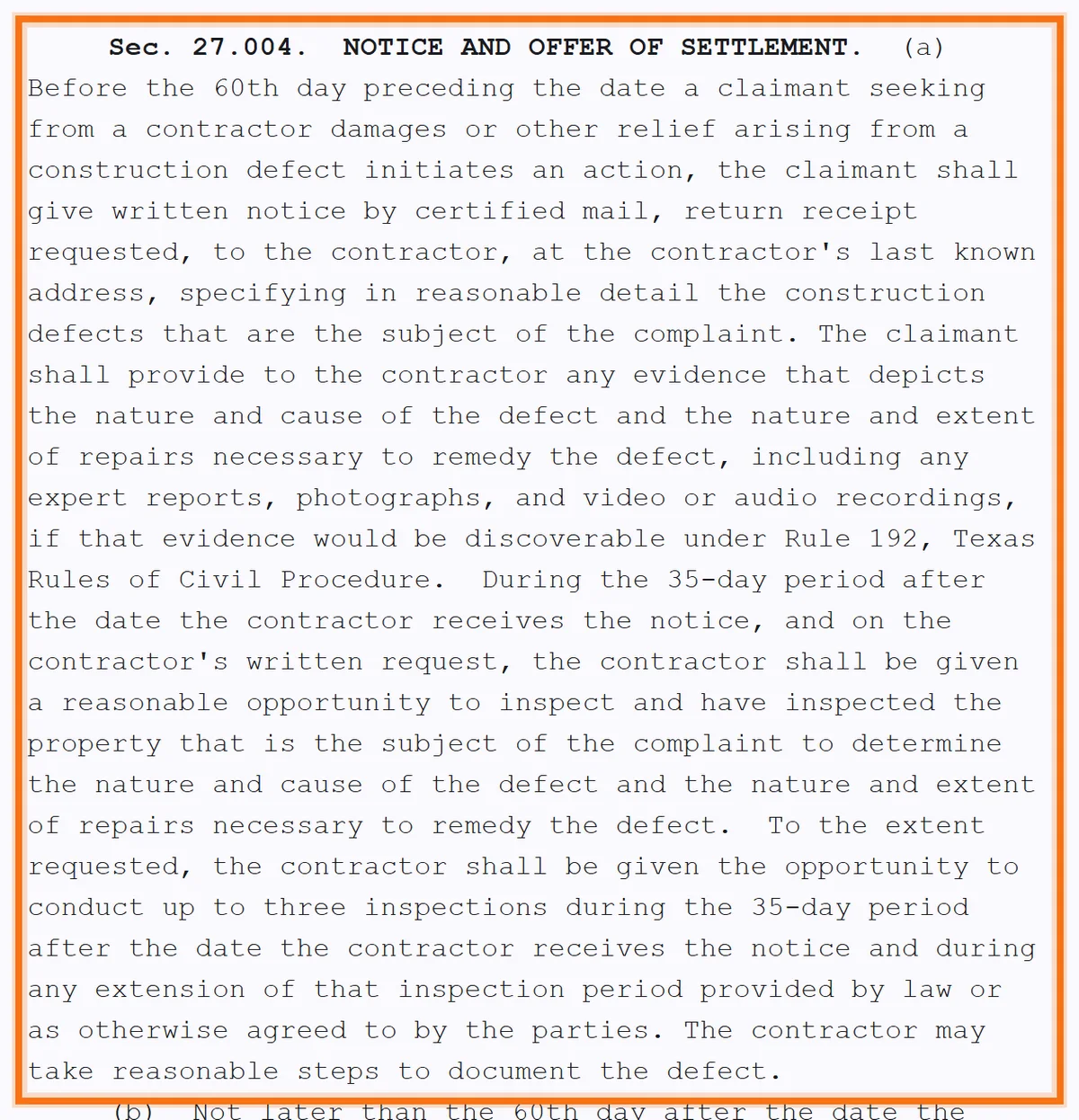
What 27.004 says, in short:
- Notice: before the 60th day preceding the date the owner starts an action, written notice by certified mail, return receipt requested, describing the defects in reasonable detail, with evidence such as photographs and expert reports.
- Inspection: during the 35 days after the builder receives the notice, and on its written request, the builder gets a reasonable opportunity to inspect, up to three inspections if requested.
- Offer: no later than the 60th day after receiving the notice, the builder may make a written settlement offer, which can include an offer to repair.
- Access matters: under 27.004(e), an owner who rejects a reasonable offer, or does not give a reasonable opportunity to inspect or repair under an accepted offer, may recover no more than the statute allows.
Dated photos and a tenant lease that provides for access are what make these steps workable in a rental. If you reach this point, talk to a Texas attorney. This is general information, not legal advice.
The first-year list: lawn, drainage, settling and safety devices
A few first-year items need an owner's decision before the tenant moves in:
- The new lawn. Fresh sod needs watering until it takes, and a tenant who arrives a week after closing may not know that. Decide who handles it, set any sprinkler schedule yourself, write it into the lease, and photograph the yard at move-in. The general split is in lawn care responsibility in rentals.
- Drainage. Watch where water goes in the first heavy rain. Water standing against the slab is worth a dated photo and a call to the builder.
- Settling items. Hairline drywall cracks, nail pops and sticking doors are easy to miss and easy to forget. Keep a dated list from inspections so it is complete when you send it to the builder, in whatever form your warranty asks.
- Security devices. Property Code 92.153 lists devices a dwelling must have without a tenant asking, subject to the exceptions in that section: a window latch on each exterior window, a doorknob lock or keyed dead bolt and a keyless bolting device and door viewer on each exterior door, and a pin lock and handle latch or security bar on each exterior sliding glass door. Check each one in a new house too.
HOA lease rules in a new subdivision
New subdivisions often have detailed leasing rules. Property Code chapter 209 applies to residential subdivisions whose declaration lets a mandatory-membership association collect assessments (209.003; it does not apply to condominiums). Within that, section 209.016 sets the limits:
- The association may not adopt or enforce a provision that requires a tenant or applicant "to be submitted to and approved for tenancy by the property owners' association," or that requires a consumer or credit report or the rental application to be submitted to it (209.016(b)).
- It may request each resident's name, mailing address, phone number and email, and the lease's commencement date and term (209.016(e)).
- Nothing in the section prohibits a restriction relating to occupancy or leasing (209.016(d)), so minimum lease terms and other leasing limits in your documents can still apply.
Read your documents for any registration window and fines, and give the tenant the rules at move-in. More is in HOA rules for Texas rental property. This is general information, not legal advice.
Lease clauses specific to a new build
Beyond a standard Texas lease, add short, clear language for:
- Reporting all repairs through you or your manager, with no direct contact with the builder or its trades.
- Reasonable access for builder inspections and repairs, including inspections a builder requests after a written defect notice.
- Lawn and sprinkler responsibilities during the first season.
- Acknowledging the HOA rules and responsibility for violations the tenant causes.
- No wall mounts or anchors without written approval, so new drywall is not opened up.
- Appliance care per the manufacturer's manual.
The move-in record matters more in a new house than in any other: it is the one time the house has no wear at all. Which addenda belong in a Texas lease is covered in lease addenda for Texas landlords. If this is your first rental, the full checklist is in renting out your house for the first time.
How Perpetual handles a new house
Homes we manage include new construction in Denton, and we manage single-family homes, townhomes and small multifamily across Northeast Tarrant County, with Keller, North Richland Hills and Fort Worth as our main service cities. What our site commits to that matters for a new build:
- Requests with photos. Tenants report maintenance through their portal with photos, which creates a documented record. That record is what a warranty claim is built from.
- Spending limits. Routine repairs under your pre-approved limit get fixed fast; anything larger comes to you with a description, photos and a recommendation.
- Condition records. A 360-degree condition inspection at every move-in and move-out, scheduled interior inspections during the tenancy with photo reports to your portal, and photo or video proof of every completed repair over $500.
- The lease and screening. Texas-compliant leases, and every adult applicant screened against the same written rental criteria.
Who files warranty claims with your builder, and how builder visits are scheduled with your tenant, are confirmed in writing before you sign. To start with the rent and a written quote, request a free rental analysis or call 682-593-7033.
The takeaway: In a new house, the tenant reports, you or your manager file, and the builder fixes, with the lease giving the builder reasonable access. Read your builder's warranty and your HOA's leasing rules before you sign a lease, keep dated photos of every defect, and remember that your own repair duty does not wait for the builder.
Questions owners ask
Does renting out a new construction home void the builder warranty?
It depends on the builder, so read your builder's warranty and ask the builder in writing if anything is unclear. Look for who may file a claim, whether an agent can file for you, and whether anything depends on who lives in the house. Keep the written answer with the warranty and closing documents. This guide does not describe any builder's terms.
Can I rent out my new house right after closing?
Check two things first. If you financed the house as your own residence, read the occupancy terms in your loan documents or ask your lender. Then read the HOA's declaration and rules for leasing restrictions, such as a minimum lease term; Texas Property Code 209.016(d) allows associations to have leasing restrictions. If both allow it, you can lease right away.
Who handles warranty repairs when a tenant is living in the home?
You, or your manager if your agreement and the builder's warranty allow it. The tenant reports the problem to you or the manager, who files the claim the way the warranty requires and schedules the builder's visit with the tenant under the lease. If the condition materially affects an ordinary tenant's health or safety, your repair duty under Property Code 92.052 does not wait for the builder.
Is the tenant responsible if builder sod dies?
It depends on the lease. If the lease did not make the tenant responsible for watering new sod, it is hard to say the tenant caused the loss. New sod needs regular water until it takes, and a new tenant may not know that. Decide who handles it before move-in, set any sprinkler schedule yourself, write it into the lease and photograph the yard at move-in.
What does the HOA need before a tenant moves into a new subdivision?
Whatever its documents require, within limits. Under Property Code 209.016(e) an association may request each resident's name, mailing address, phone number and email, and the lease's start date and term. Under 209.016(b) it may not require the tenant to be approved by the association or require a credit report or rental application to be submitted to it.
What do I have to do before suing a builder over a defect in Texas?
Under Property Code 27.004, send the builder written notice by certified mail, return receipt requested, before the 60th day preceding the date you start the action, describing the defects in reasonable detail with evidence such as photographs. The builder may request up to three inspections in the 35 days after receiving it and may make a written settlement offer within 60 days. Talk to a Texas attorney before you start.
Can the builder come in to fix things while a tenant lives there?
Yes, if the lease provides for access, and it should. Texas has no statute that sets a notice period for a landlord's entry, so the lease decides how visits are arranged. Write in reasonable access for builder inspections and repairs, and schedule each visit through you or your manager so there is a record of it.
Related services
Property management in Keller, North Richland Hills and Fort Worth. How full-service management works in Tarrant County →