Key takeaways
- Leased comparables with dates are evidence; active listings are asking prices.
- A range with a recommended start and reasons beats a single number.
- The condition adjustments must match the house you own, not a nicer one.
- When one estimate sits well above the others, ask which leased home supports it.
- Ask what happens after two weeks without applications, and how the manager's fees move with the rent.
How can you tell if a property manager's rent estimate is realistic? Trace it back to homes that actually leased, check that it comes as a range with reasons, and ask what happens if the market disagrees. For a rental in Fort Worth, Keller or North Richland Hills, an estimate that is a single number, higher than everyone else's, with nothing behind it but confidence, is usually a pitch.
You do not need to be a pricing expert. Below are six checks in the order to run them, a worked comparison of three estimates, and what our own rental analysis shows you.
The six checks at a glance
Here are the six checks, what to ask for, and what a realistic answer and a warning sign look like:
| Check | Ask for | Realistic answer | Warning sign |
|---|---|---|---|
| 1. Comparables | The homes behind the number | Homes that leased, with lease dates, similar in size, age and location | Active listings, no dates, or homes nothing like yours |
| 2. Range | A range and where to start in it | A range, a recommended start, and the reason for that start | One number, or "we like to leave room to come down" |
| 3. Condition | The adjustments made for your house | Adjustments that match your kitchen, floors and systems | Credit for updates you do not have |
| 4. Other estimates | Two or three estimates side by side | Estimates that cluster, or a high one backed by a specific leased home | One estimate far above the rest with no leased support |
| 5. Week two | "What if there are no applications after two weeks?" | Look at inquiries and showings, fix photos or access, then a specific price step with your approval | "It will rent" or "we will revisit it" |
| 6. Incentive | How the manager's fees change with the rent | A plain answer, with the fee schedule in writing | No answer, or fees that are only explained after signing |
How to read this table: an estimate can pass five checks and still fail the sixth; read across each row, not only down the "realistic" column. Checks 1 to 3 test the number itself, check 4 tests it against the market's other opinions, and checks 5 and 6 test the person who gave it to you.
Check one: the comparables leased, and have dates
Ask for the comparable homes behind the number. A realistic estimate rests on several homes, each with the rent it leased for and when, that are a reasonable match for yours in size, age, condition and location.
The question is whether the comps are leases or listings. A listing is an asking price, and asking prices skew high, because the overpriced homes are the ones still sitting there. If the comps are active listings, or there are no dates, the estimate is built on hope. What a rental analysis should include explains why the difference matters.
Check the dates too. Comps from a strong season quoted in a slow one, or comps more than a year old, need an explanation.
Check two: a range, with a recommended start
Rental pricing is not precise enough for one number to be right, so a single number is either a guess or what you hoped to hear. A realistic estimate gives a range, says where in it to start, and says why.
The reasons should be concrete: few competing listings, so start high; a slow season, so start in the middle; updates the comps lack, so the top is justified. If the reason is "we like to leave room to negotiate", the plan is to drop the price after the house sits, and you pay for that in vacant weeks.
A range also shows confidence. A narrow one means good comps; a wide one means an unusual house or thin data, and you should know which. Who has the final say on where to list is covered in whether you or the manager chooses the rental price.
Check three: the condition adjustments match your house
Walk the estimate against your own house. If it adds value for an updated kitchen and yours is original, the estimate is for a different house. If it sits at the top of the range and nobody mentioned the worn carpet, the leaning fence or the aging air conditioner, the same is true.
A realistic estimate often comes with a short list of what to fix before photos, and which items move the rent and which only cost money. Cleaning, painting and yard work before listing covers that list. If you know your house has a weakness and the estimate does not mention it, the estimate is optimistic, not realistic.
Check four: compare it with the other estimates
Get two or three estimates and lay them side by side. When they cluster, the range is probably real. When one sits well above the others, ask its author which leased homes support it. Sometimes there is a good answer: a specific updated home nearby that leased high and matches yours. Often there is not.
The highest estimate is not the best offer. Rent you cannot get is not income, and an overpriced house tends to end up at the market number after it sits, minus the empty weeks. The worked comparison below shows the arithmetic.
Be a little wary of the lowest number too: it can mean pricing to lease fast and move on. The reasoning, not the rank, is what you are judging.
Check five: ask what happens in week two
Ask: if we list at your number and have no applications after two weeks, what do you do? A realistic manager answers right away: look at inquiries and showings to see where interest drops off, fix photos or showing access if that is the problem, and if it is price, recommend a specific step down for your approval.
An unrealistic one says the house will rent, or that they will revisit it. A number with no plan behind it is a number nobody has tested.
The answer also shows how the manager reports while the house is empty, which matters as much as the first number. Updates on inquiries, showings and applications covers what that reporting should contain.
Check six: look at the incentive behind the number
A free estimate is part of a sales conversation, and the manager who quotes highest can win more listings. That is not a reason to distrust everyone; it is a reason to see whether the number is tied to anything besides winning you.
Ask how the manager's fees move with the rent: a monthly fee that is a percentage of rent, and a placement fee that is a share of one month's rent, both rise with a higher number. Ask whether they have leased a home like yours recently, and at what price compared with the asking rent.
Then look at the record. How to tell if a property management company is good and reading property management reviews cover how to check it.
A worked comparison of three estimates
Illustrative only, not a quote. Say three managers price your three-bedroom house: two at $2,250 a month with leased comparables, one at $2,450 with active listings. The difference is $200 a month.
If the house lists at $2,450 and sits an extra month before the price comes down to $2,250, that month is $2,250 of rent you did not receive. A $200-a-month higher rent would need $2,250 / $200 = 11.25 months just to make that back, and only if it leases at the higher number at all. Lost rent is income not received, not cash out of pocket, but it is the number that matters.
Now the incentive. Where placement is a share of one month's rent, the higher estimate raises it: at 50%, $1,225 instead of $1,125, a $100 difference; at 75%, $1,837.50 instead of $1,687.50, a $150 difference. A 9% monthly fee would be $220.50 instead of $202.50. None of that is a reason to distrust a manager; it is a reason to ask for the comparables. How long it takes to rent a house in DFW covers what else moves the timeline.
How Perpetual handles this
Here is what our site states about how we build a rent recommendation:
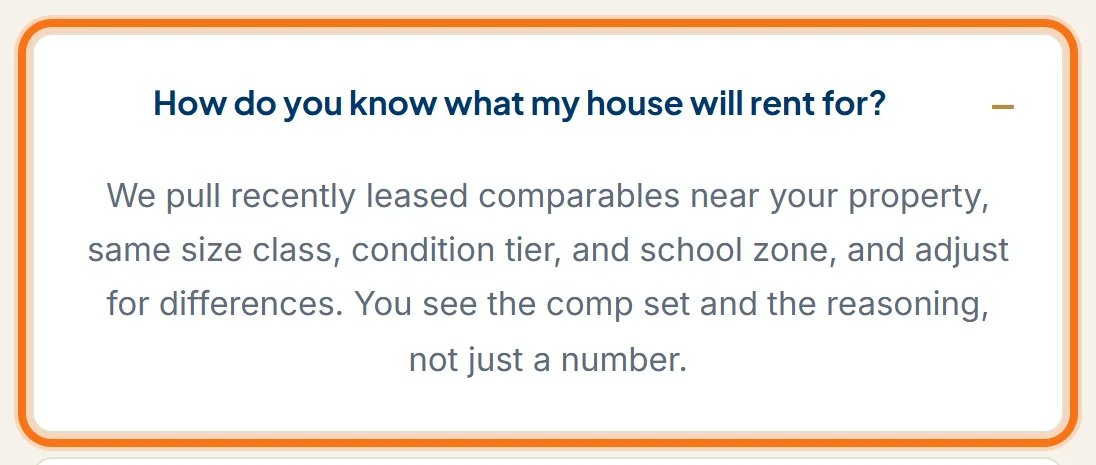
- Leased comparables, not asking prices: what similar homes near yours actually leased for, in the same size class, condition tier and school zone, adjusted for differences.
- Condition and features: updated kitchen, covered parking, yard size and school zone, adjusted against the comps, with the reasoning shown to you.
- A range with a strategy: a recommended range and our advice on where to enter it, aggressive for speed or patient for maximum rent. Final pricing is always your call.
- Week two: showing activity tells us within the first two weeks whether the market agrees; if it does not, you get data and a recommendation. While the house is vacant, our communication guarantee gives you a written activity report every week.
The free rental analysis also includes demand notes, make-ready guidance and a written management quote with every fee in plain English, typically within one business day, with an optional 15-minute call to walk through it. More on the method is on our rental pricing page.
Exactly which comparables, lease dates and condition notes your analysis lists are confirmed in writing before you sign. To run the six checks on a number for your house, request a free rental analysis or call 682-593-7033.
The takeaway: A realistic rent estimate shows dated leased comps, comes as a range with a starting point, matches the house you actually own, agrees roughly with the others, has a week-two plan, and survives the question "how are you paid if I list at this number?"
Questions owners ask
What if two property managers give me very different rent estimates?
Ask each manager for the leased comparables behind the number and compare them side by side. The gap usually comes from one using active listings instead of leased homes, or one adjusting for condition and the other not. Trust the estimate you can trace to recent leased homes that match yours, whichever is higher.
Should I go with the manager who gives the highest rent estimate?
Not on that basis alone. The highest estimate may belong to the manager most eager to win the listing, and a house priced above what renters will pay sits empty until the price comes down. Each extra vacant month is a full month's rent not received. Judge the comps, the reasoning and the week-two plan, then choose the number you can verify.
How accurate are property manager rent estimates in general?
It depends on the data and the method, not on the manager's confidence. An estimate built from recent leased comparables and adjusted for your home's real condition is the one most likely to hold. One built from asking rents or public records alone can miss in either direction. Ask how the number was built, and whether the manager's recent listings leased near their asking rent.
Can I ask a property manager to list at a higher rent than they recommend?
Yes. The owner sets the asking rent, and a good manager will list at your number while telling you plainly what they expect. Agree on a review date and the signals you will watch, such as inquiries, showings and applications, before the listing goes live, so a price change two weeks later is a decision you planned rather than an argument.
Do property managers inflate rent estimates to win the listing?
Some can, because a higher number wins more listings and fees tied to rent rise with it: a percentage monthly fee and a placement fee that is a share of one month's rent. That is why the estimate should come with leased comparables, a range and a week-two plan. Ask every manager how their fees move with the rent, and get the fee schedule in writing.
What should a rental analysis include?
At least: the comparable homes that leased and when, the rent range with a recommended starting point and the reasons, adjustments for your home's condition and features, and notes on current demand. A useful one also lists make-ready items worth doing before photos. Ours adds a written management quote with every fee spelled out.
Is a free rental analysis really free?
Ours is: it is free, with no obligation, and the analysis is yours to keep whether you hire us, self-manage or go elsewhere. That is also why you should treat any free estimate as the start of a conversation and run the six checks on it, ours included. Ask for the comparables, the range and the week-two plan in writing.
What happens if my house gets no applications in the first two weeks?
A realistic plan answers that before you list. Look at inquiries and showings to see where interest stops: few inquiries points to price or photos, showings without applications to condition or price. Fix what you can, then decide on a specific price step. With us, showing activity in the first two weeks tells us whether the market agrees, and if not you get data and a recommendation.
Related services
Property management in Keller, North Richland Hills and Fort Worth. How full-service management works in Tarrant County →