Key takeaways
- The time from keys to signed lease is six stages added together: make-ready, pricing, listing, showings, screening, and lease signing.
- Two stages carry a Texas clock: an applicant is deemed rejected if not accepted by the 7th day after a complete application (Property Code 92.352), and a lease copy is due by the 3rd business day after signing (92.024).
- Price against leased comparables is the stage that most often turns weeks into months; one illustrative week of vacancy on a $2,000 rent is about $461.54 of rent not received.
- We do not publish a days-on-market average because no official source we read gives one for your street; your own listing numbers tell you more.
- Our written promise covers the listing stage: live on every major rental platform within 5 business days of market-ready, or the first month's management fee is waived.
How long it takes to rent a house in Fort Worth, Keller or North Richland Hills depends on six stages: getting the house ready, setting the price, putting the listing live, turning inquiries into showings, screening applicants, and signing the lease. Each stage has its own pace and its own cause of delay. When a house sits, it is almost always stuck in one of them, usually price or make-ready, not "the market."
This guide takes the stages in order: what happens in each, what controls how long it takes, which ones Texas law puts a clock on, and what you can do before the listing goes live to shorten the whole run.
The six stages from keys to signed lease in Fort Worth, Keller and North Richland Hills
Here is each stage of renting a house, what happens in it, what decides how long it takes, and any fixed clock that applies:
| Stage | What happens | What controls how long it takes | Fixed clock, if any |
|---|---|---|---|
| 1. Make-ready | Repairs, paint, cleaning, yard, then photos | Size of the scope, how fast you approve estimates, the trades' calendars | None in law |
| 2. Pricing | A rent range from homes that actually leased nearby | How far the asking rent sits from those leased comparables | None in law; our free rental analysis states delivery within one business day |
| 3. Listing live | Photos, description, syndication to rental sites | Whether the listing waits for photos and copy | Our written promise: live within 5 business days of market-ready |
| 4. Showings | Inquiries become tours | Response speed and how easy it is to get inside | None in law |
| 5. Screening | A complete application is checked against written criteria | Missing documents, employers and past landlords calling back | Property Code 92.352: deemed rejected if not accepted by the 7th day after a complete application |
| 6. Lease and move-in | Lease, deposit, move-in report, keys | The start date you and the applicant agree | Property Code 92.024: a lease copy to the tenant by the 3rd business day after signing |
How to read this table: stages 1 to 4 are where most time is lost, and none of them has a legal deadline, so they run as fast as the decisions behind them. Stages 5 and 6 are short and partly fixed by statute. If your house has been on the market a month, find the row where it stopped moving before you change anything.
Why we do not quote an average number of days
You will see confident "days on market" figures online. We did not find one from an official source that describes your street, your house type and your rent, so we do not quote one. An average also hides the only thing that matters to you: whether your house is the one that leases in the first round of showings or the one that sits.
What you can measure is your own listing. Every stage in the table produces a number you can watch: days from keys to finished make-ready, days from market-ready to live, inquiries and tours in the first two weeks, and days from complete application to decision. When one of those numbers is out of line, that stage is where your time is going. How to read the leasing-period numbers is covered in the numbers that tell you if your rental is performing, and what an empty month costs you is in what a vacant month really costs.
Stage 1: the make-ready decides when the clock can start
Nothing else can start until the house is ready to photograph, so the make-ready sets the earliest possible listing date. The two things that stretch it are scope and approvals: a long handyman list or new flooring adds days, and an estimate that waits a week for your reply adds a week. The fastest make-readies are scoped and approved before the previous tenant hands back the keys, so trades start the day the house is empty.
List after the work is finished, not during it. Photos of a half-painted room, or a listing with no photos "until the cleaners finish," waste the first days of attention a new listing gets. The full turnover sequence, with the order of trades, is in how quickly a manager can get a house ready, and which finishes save time at every future turnover is in paint and finishes for rentals.
Stage 2: price is the stage that turns weeks into months
The asking rent is the stage that most often turns a few weeks into a few months. A house priced at what comparable homes actually leased for gets tours; a house priced above them gets views and silence, and the owner waits. Leased comparables, not other asking prices, are the test: what is on the market today includes the listings that have not rented.
Run the trade-off before you hold out for a higher number. Illustrative only, not a quote: a house that would lease at $2,000 a month is listed at $2,100. The extra $100 is worth $1,200 over a 12-month lease. One week of vacancy at $2,000 is $2,000 x 12 / 52 = $461.54 of rent not received, so three extra weeks on the market is $1,384.62, more than the year's gain, and the higher price is not certain to lease at all. That is rent you never receive, not money paid out; your mortgage, taxes and utilities continue on top.
How the rent range is built is explained in what a rental analysis should include, and who decides the final number in who sets the rent.
Stages 3 and 4: listing live, then showings
Stage 3, listing live. Once the house is market-ready, the listing should be live within days, not weeks: photos in daylight with the lights on, a description that answers pets, move-in costs and availability, and syndication to the sites renters search. Where a listing actually appears is explained in where rental listings get syndicated.
Stage 4, showings. A renter who asks to see the house today and is offered Saturday may have signed elsewhere by Saturday. The fix is access, not salesmanship: same-day tours where possible, including evenings, with a controlled way to verify who is entering. Self-guided tours with identity verification make that possible on a vacant house; an occupied house follows the lease's access terms. How tours run is in how showings work, and the safeguards in whether self-guided showings are safe.
If stage 4 produces tours but no applications, the problem usually sits back in stage 1 or 2: condition or price compared with the homes the renter toured the same day.
Stage 5: screening, and the Texas 7-day rule
Screening is usually the shortest stage, but it has the only legal clock before the lease. Under Property Code 92.352(a), an applicant "is deemed rejected" if the landlord does not give notice of acceptance on or before the seventh day after the applicant submits a completed rental application on the landlord's form. If that seventh day is a Saturday, Sunday or holiday, 92.353(c) extends it to the end of the next day. So a decision that drags past a week does not just lose time: it legally ends that application.
The word that matters is "completed." Most delays at this stage are missing paperwork, not slow checking. Our published criteria ask for pay stubs covering at least 6 weeks and 2 months of bank statements, and the screening covers credit, rental history, employment and income, and a criminal background check on every applicant. An applicant who uploads everything on day one gets a decision days sooner than one who sends a pay stub at a time.
Speed here never means skipping steps. The same written criteria apply to every applicant, which is what fair housing law expects. If several people apply at once, choosing fairly among several applicants explains how the order works.
Stage 6: from approval to signed lease and keys
Once an applicant is approved, the remaining time is mostly the move-in date. An approved applicant may still owe notice to a current landlord, so the start date is a negotiation, not a formality. Agree it in writing before the lease is drafted, and decide in advance how far out you will accept: a date three weeks away is three weeks of rent you do not receive, which may still beat starting the search again.
The lease itself does not take long, but two Texas rules apply at the end. Property Code 92.024(a) requires the landlord to give at least one tenant a complete copy of the lease not later than the third business day after every party has signed. And the move-in condition report should be done before keys change hands, because it is the record every later deposit decision rests on. Who prepares and signs on your behalf is covered in who prepares and signs the lease. This is general information, not legal advice.
Season: a smaller lever than owners expect
Season can change how many renters are looking in a given week, which is why school calendars and holidays come up in every pricing conversation. But it moves the pace at the edges, not at the center: a ready house priced against leased comparables still finds a tenant in a quiet month, and an overpriced one still sits in a busy one.
The lever you control is the lease end date. When you sign or renew, choose a term that ends in a stronger month so the next vacancy starts there. The month-by-month detail for Fort Worth is in whether the time of year affects how quickly a house rents.
How Perpetual handles each stage
Perpetual Property Management is broker-owned and leases homes in Keller, North Richland Hills, Fort Worth and nearby from our office at 5755 Rufe Snow Dr, North Richland Hills. Here is what our site commits to at each stage:
- Pricing: the rent is set from comparable leased homes near yours through a free rental analysis, which also gives make-ready guidance and a written management quote, typically within one business day.
- Listing: your property is live on every major rental platform within 5 business days of being market-ready, or we waive the first month's management fee.
- Showings: self-guided and scheduled showings through ShowMojo, with identity verification and access that is logged and time-limited.
- While vacant: a written activity report every week, with showing feedback and market notes.
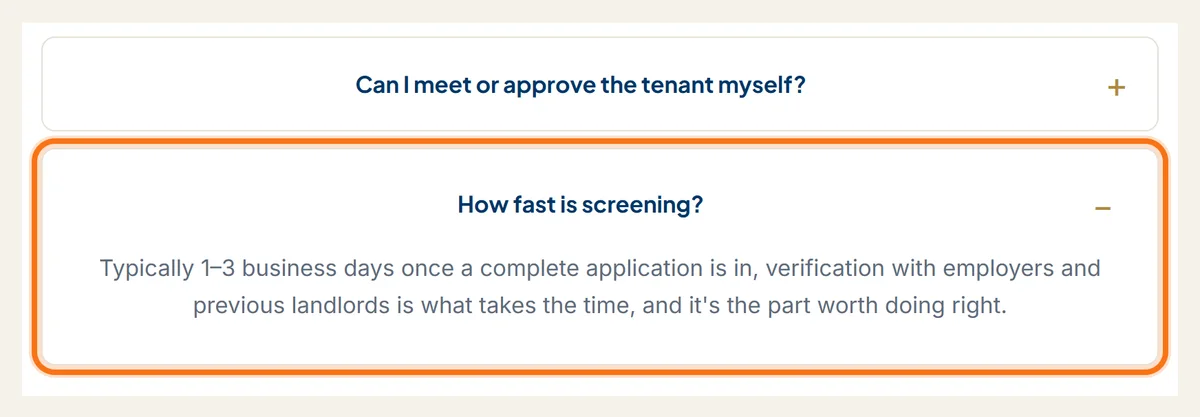
- Screening: typically 1 to 3 business days once a complete application is in, against the same written criteria for every applicant.
The listing and weekly-report promises are part of the Perpetual Promise and subject to its Guarantee Addendum. Tenant placement is 50% of one month's rent on Full Service and Investor Special and 75% on Standard, and if a tenant we place defaults and is removed, or breaks the lease, within the first 6 months, we find a new tenant with no additional leasing fee. How many days your house is likely to take, and how the management fee is handled while it is vacant, are confirmed in writing before you sign. See our tenant placement and leasing page or call 682-593-7033.
The takeaway: Count the time to rent as six stages, find the one that is slow, and fix that one: usually the price or the make-ready, rarely the season.
Questions owners ask
How long does it usually take to rent out a house in North Richland Hills?
It depends far more on the house than on the city, and North Richland Hills behaves like the rest of the area. Count it as six stages: make-ready, pricing, listing, showings, screening and lease signing. The make-ready and the price decide most of the total; screening has a legal clock, because Property Code 92.352 treats an applicant as rejected if not accepted by the 7th day after a complete application. We do not quote an average number of days because no official source gives one for your street.
What is the best month to list a rental in Fort Worth or Keller?
Season can change how many renters are looking in a given week, and school calendars and holidays play a part. You rarely choose when a house becomes empty, but you can choose when the next lease ends: set the term so it ends in a stronger month. A well-priced, ready house still leases in a slow month; our guide on how the time of year affects renting in Fort Worth has the month-by-month detail.
Why is my rental listing getting views but no showings?
Renters are comparing your listing with others on the same screen and deciding not to ask. That points back to stage 2 or 3: the asking rent against what similar homes actually leased for, or photos that do not sell the house. Fix weak photos first because they are cheap, then compare the price with leased comparables and adjust within the first two weeks rather than the second month.
Should I lower the rent if the house has not leased in a month?
Usually the adjustment should have come earlier. Illustrative only: on a $2,000 rent, each week empty is about $461.54 of rent not received, so a month of waiting often costs more than the reduction that would have leased the house. Before cutting, check which stage stalled: no tours points to price or photos, tours without applications to condition or price against the homes renters saw that day.
How long does tenant screening take?
With Perpetual, typically 1 to 3 business days once a complete application is in, because calls to employers and previous landlords take the time. Incomplete files are the usual delay: our criteria ask for pay stubs covering at least 6 weeks and 2 months of bank statements. Texas law adds a limit: an applicant not accepted by the 7th day after submitting a completed application is deemed rejected (Property Code 92.352).
Does Perpetual guarantee how fast my house will rent?
No, and we do not promise a number of days on market. What our written Perpetual Promise covers is the listing stage: your property is live on every major rental platform within 5 business days of being market-ready, or we waive the first month's management fee, and while it is vacant you get a written activity report every week. The guarantees are subject to the Guarantee Addendum.
Property management in Keller, North Richland Hills and Fort Worth. How full-service management works in Tarrant County →