Key takeaways
- The owner sets the rent. The manager's job is a recommendation built from leased comparables, with the reasoning and the trade-offs.
- The management agreement decides how much room the manager has. Look for one sentence on who sets the asking rent and who may change it.
- A pre-authorized reduction (a stated amount after a stated time) lets the manager act fast without deciding for you.
- Once a lease is signed, the lease fixes the rent for its term. Renewal is the next decision, and it is yours.
- Texas lets a city adopt rent control only after a disaster-related housing emergency and with the governor's approval (Local Government Code 214.902).
Who sets the rent, the owner or the property manager? The owner. On a rental in Fort Worth, Keller or North Richland Hills, the manager's job is to tell you what the house will lease for, show you the evidence, and market it at the number you approve. The trouble is that many management agreements never say this in writing, and a manager who treats pricing as their call can cut your rent in a quiet week and tell you afterward.
This guide covers who decides at each stage, how the agreement should word pricing authority, how a reduction should be decided, and what happens when you and the manager disagree. If your question is whether you may pick a price above or below the recommendation, see can I choose the rental price, or does the manager decide.
Who sets the rent at each stage: owner, manager and lease
Here is who decides each rent question, what the manager should give you first and where the answer should be written down:
| Decision | Who decides | What the manager gives you | Where it is written |
|---|---|---|---|
| Asking rent for a new listing | You, the owner | A recommendation from what comparable homes actually leased for, with the reasoning | The management agreement, then your approval in writing |
| A price change while the home is listed | You, unless you pre-authorized a specific change | Showing and inquiry numbers, and a specific new number with the trade-off | Your written approval, or a limit stated in the agreement |
| Rent at renewal | You | Current leased comparables and a recommendation to raise, hold or adjust | The renewal offer, sent only after you approve it |
| Rent during a fixed-term lease | The signed lease | What the lease allows | The lease |
| The late fee | The lease, within Property Code 92.019 | A clause that meets the statute | The written lease |
| A legal cap on rent | Only a city, in the case Local Government Code 214.902 describes | Nothing in ordinary times | A city ordinance after a disaster, approved by the governor |
How to read this table: you decide every number that is still open, the lease fixes it once signed, and the management agreement decides how much room the manager has in between. If the agreement says nothing, that room is undefined.
The owner decides, the manager advises: what that means in practice
A property manager acts for you. Under the Texas Occupations Code, a person who leases real estate for another for compensation, or controls the acceptance or deposit of rent from a resident of a single-family home, falls within the definition of a broker (section 1101.002), and section 1101.351 requires a license to act as one. What the manager may do on your behalf comes from the written management agreement. Setting the price of your property stays with you unless that agreement hands part of it over.
The practical frame is just as clear. You carry the mortgage and the empty months, so you decide what to ask. What the manager owes you is a recommendation you can act on:
- Built from what comparable homes actually leased for, not from asking prices on listings that have been sitting.
- Adjusted for your home: condition, updates, yard, parking, school zone, with the reasoning shown.
- A range, with advice on where to enter it: higher and patient, or lower and faster.
With that in hand, the decision is yours.
How the management agreement should word pricing authority
Pull out the management agreement and look for any sentence about rent, rental rate or pricing. You are likely to find one of three things:
- Nothing. The agreement gives the manager broad authority to lease the property and says nothing about who sets the rent. That silence leaves room for argument. Ask for a sentence to be added.
- Manager discretion. Wording such as "the manager may adjust the rental rate as market conditions warrant". This is the clause behind surprise reductions. Narrow it or remove it.
- Owner approval with a limit. The manager lists at the rate you approve and may not change it without your written approval, except within a range you pre-authorized. This version works for both sides.
The wording to ask for, in plain terms: the asking rent is set by the owner on the manager's recommendation, and the manager will not change it without the owner's written approval, which may be given by email. If you want speed, add a pre-authorized reduction: up to a stated dollar amount after a stated number of days on the market, so the manager does not have to chase you for a decision you already made. This is general information, not legal advice.
How a price reduction should be decided
A reduction is where pricing authority gets tested: the manager is watching the showing count and you are watching an empty house. The sequence that keeps it honest:
- While the home is listed, you get the numbers regularly: inquiries, showings, applications and what prospects said. Counts, not impressions.
- After an agreed interval, the manager tells you whether price, presentation or something else is the problem. A house with plenty of showings and no applications is rarely a price problem.
- If it is price, the manager recommends a specific new number with the reasoning and what the change is expected to buy in time.
- You approve, counter or decline, in writing. The listing changes only after that, or within the limit you pre-authorized.
Two things make this fail: a manager who reduces first and reports after, and an owner who does not answer for a week while the house sits, which is exactly why the pre-authorized limit exists. If showings are happening but applications are not, read why your rental is not renting before you touch the price.
When you want more than the market will pay
Owners sometimes arrive with a number anchored to the mortgage payment, a neighbor's claim or what the house rented for in a stronger year. A manager has three options, and the honest one is the middle one.
The first is to list at your number without comment and let the vacancy do the arguing. That is compliance, not advice. The second is to list at your number after putting the recommendation and the expected cost of the gap in writing: at this price, expect longer on the market, which at your rent means this much income not received. You then decide with the trade-off in front of you. The third, used rarely, is to decline the listing when the number is so far off that the manager cannot market it in good conscience.
The written recommendation is the key. It respects your authority, and if the house sits, the conversation about reducing starts from a document instead of from blame. The cost side is in what a vacant month really costs a rental owner.
A worked example: a disagreement over the asking rent
Illustrative only, not a quote. The manager's analysis of leased comparables puts the house at $2,000. The owner wants $2,200 because the mortgage went up. The manager writes: at $2,200 the house is above every recent lease on comparable homes, and a month longer on the market would cost about $2,000 of rent not received in order to chase $200 a month, which is $200 x 12 = $2,400 over a year, with a real chance of reducing anyway.
The owner decides to test $2,200 for two weeks, with a pre-authorized reduction to $2,100 if showings stay below an agreed number. Week one brings three showings and no applications; week two brings two. The manager reduces to $2,100 under the pre-authorization and reports it the same day. In week three the house gets more showings, two applications, and leases at $2,100.
Assume it leased about a week later than it would have at $2,000. That week is about $2,000 x 12 / 52 = $462 of rent not received, against $100 x 12 = $1,200 more over the first year. The owner tested their number, the manager acted within a written limit, and nothing happened without the owner knowing.
Who sets the rent at renewal
The same rule applies at renewal, and it is easier to overlook because there is no empty house forcing the conversation. The manager should bring you a recommendation well before the lease ends: the current rent, what comparable homes are leasing for now, and a proposed increase, hold or adjustment. You approve the number, then the tenant receives the offer.
Where owners lose money at renewal is usually not who decides but nobody deciding, so the tenant stays on at the old rent because the recommendation never came. Texas adds one limit worth knowing: under Property Code 92.331, a landlord may not raise the rent within six months to retaliate against a tenant who, in good faith, exercised a legal right, requested repairs, complained to a government entity about a building or housing code violation, or took part in a tenant organization.
How much to raise and how to tell the tenant are in raising the rent: how much, when and how to tell the tenant, and how a manager builds the number in how a property manager decides a renewal increase. This is general information, not legal advice.
Questions that settle pricing authority before you sign
- Who sets the asking rent, and where does the agreement say so?
- Will you list at my number if it is above your recommendation, and will you put your recommendation in writing?
- Can you change the price without my approval? Within what limit?
- How often will I see inquiry and showing numbers while the house is listed?
- When do I see the renewal recommendation, and does the tenant see an offer before I approve it?
- Is your recommendation built on leased comparables or on asking prices?

The last question separates managers quickly. A recommendation built on what other landlords are asking is a guess. One built on what homes actually leased for, adjusted for your house, is evidence. A free rental analysis shows you what that looks like for your own home.
How Perpetual handles this
Perpetual Property Management is broker-owned, with our office in North Richland Hills, and we price and manage homes in Keller, North Richland Hills, Fort Worth and nearby. What our site states about who sets the rent:
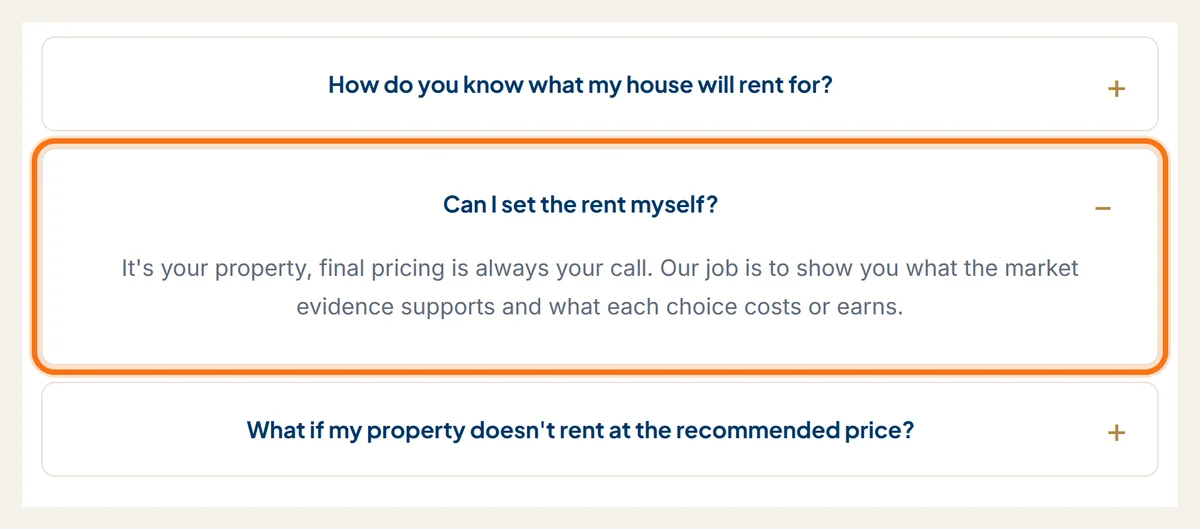
- You decide. On our rental pricing page, the answer to "Can I set the rent myself?" is that final pricing is always your call, and our job is to show you what the market evidence supports and what each choice costs or earns.
- Leased comparables. We use what similar homes actually leased for, adjust for condition and features with the reasoning shown to you, and give a recommended range with advice on where to enter it.
- Numbers while it is listed. You see showing activity and inquiry volume, and if the home does not rent at the recommended price, you get data and a recommendation. While the home is vacant, our communication guarantee includes a written activity report every week.
- Renewals. A market check before every renewal and a recommendation with reasoning, with the decision always yours (renewals page).
The exact pricing-authority wording in our management agreement, including any pre-authorized reduction you choose, is confirmed in writing before you sign. Every fee you pay is listed in your written agreement. For a recommendation on your own home, request a free rental analysis or call 682-593-7033.
The takeaway: The owner sets the rent and the manager earns influence with evidence; put that in one sentence in the agreement, with any pre-authorized limit, before anything is listed.
Questions owners ask
Can a property manager lower my asking rent without checking with me?
Only if the management agreement gives them that authority, and some do through broad wording about adjusting the rate to market conditions. If the agreement is silent, the point is open to argument, so do not rely on silence. Ask for a sentence saying the rent is set by the owner and will not be changed without written approval, and if you want speed, pre-authorize a specific reduction after a set number of days.
Can I choose the rental price, or does the property manager decide?
You choose it. The manager's role is to recommend a price from leased comparables, explain the reasoning and the trade-offs, and then market the house at the number you approve. A good manager will list at your number even above their recommendation, after putting the trade-off in writing. At Perpetual, our rental pricing page says final pricing is always your call.
What if my manager says my rent is too high and I disagree?
Ask for the leased comparables behind the recommendation and the manager's estimate of how much longer the house may sit at your number. Then decide with the cost of the gap in front of you. A reasonable middle path is to test your number for a set period, with a pre-authorized reduction if showings stay below an agreed level.
How often should the manager report while my house is listed?
At least weekly while the house is listed, with inquiries, showings and applications, plus what prospects said. Those counts are what a reduction decision should rest on. A manager who reports impressions instead of numbers cannot tell you whether the problem is price or presentation.
Who decides the rent increase at renewal?
The owner, on the manager's recommendation, which should arrive well before the lease ends with current comparables and a proposed number. The tenant should not receive a renewal offer until you have approved it. Property Code 92.331 also bars raising the rent within six months to retaliate against a tenant for certain good-faith actions, such as requesting repairs.
Can a city in Texas limit how much rent I charge?
Only in a narrow case. Local Government Code 214.902 allows a city to establish rent control by ordinance if its governing body finds that a housing emergency exists due to a disaster and the governor approves the ordinance. In ordinary times the rent is what you ask and the tenant agrees to in the lease. This is general information, not legal advice.
What should the management agreement say about who sets the rent?
One sentence is enough: the asking rent is set by the owner on the manager's recommendation, and the manager will not change it without the owner's written approval. Add any pre-authorized reduction you want, stated as a dollar amount and a number of days, and say that renewal offers go to the tenant only after you approve them.
Property management in Keller, North Richland Hills and Fort Worth. How full-service management works in Tarrant County →