Key takeaways
- Fees belong inside the agreement or attached to it, with a sentence that no fee outside the schedule may be charged.
- Texas exempts property management contracts from the license-law rule requiring a definite termination date (Occupations Code 1101.652(b)(12)), so the term and the exit are whatever the agreement says.
- The leasing authority clause sets the terms the manager may offer; offering a lease on terms the owner did not authorize is a ground for discipline (1101.652(b)(20)).
- Rent and deposits a broker holds are trust money: a trust account, no commingling, paid out only as the agreement says (TREC rule 535.146).
- Read the indemnification clause in both directions: who covers whom, and for whose mistakes.
What should you look for in a property management agreement before signing? Twelve clauses: who the parties and the broker are, the term and renewal, how you terminate and what it costs, every fee, how the management fee is calculated, the manager's leasing authority, repair limits, vendor charges, trust money and payouts, the security deposit, insurance and indemnification, and any sale clause. For a rental in Fort Worth, Keller or North Richland Hills, each should be answered in plain words.
The checklist below is the pass to make on any agreement, including ours. Contract length, renewal, notice and the cost of canceling each have their own guide, linked where they come up.
The checklist: 12 clauses to read before you sign
Here is each clause, what it should say, and the wording that should make you stop and ask:
| Clause | What it should say | Warning sign |
|---|---|---|
| 1. Parties and broker | You as owner, the management company and its Texas broker | A company name with no broker named anywhere |
| 2. Term and renewal | Start date, length, how it renews and how to stop the renewal | Renews for another full term unless canceled in a short window |
| 3. Termination | Notice for each side, any fee and how it is calculated, a handover deadline | A fee equal to the management fees for the remaining months |
| 4. Fee schedule | Every fee, inside or attached, and that no other fee may be charged | Fees "as published on our website" |
| 5. How the fee is calculated | Percentage of rent collected or rent due, and what happens in a vacant month | Silence on vacant months |
| 6. Leasing authority | Rent range, lease length, pets, concessions, who signs the lease | "On such terms as manager deems appropriate" |
| 7. Repairs and emergencies | Your approval limit, what counts as an emergency, prompt notice to you | No limit, or "emergency" left undefined |
| 8. Vendors and charges | Any coordination charge, and whether any affiliate is paid on your repairs | Silence on affiliates, rebates or markups |
| 9. Trust money and payouts | Trust account, reserve amount, payout date, monthly statement | No payout date and no reserve amount |
| 10. Security deposit | Who holds it, in what account, who itemizes it, how it transfers at the end | Not mentioned at all |
| 11. Insurance and indemnity | Your landlord policy, and each side covering its own negligence | You cover the manager even for its own negligence |
| 12. Sale, listing and signs | No sale commission unless you sign a separate listing agreement | A commission if you ever sell, to anyone |
How to read this table: the middle column is what a clear agreement answers, and the right column is the wording to question. A warning sign is not always a reason to walk away; it is a reason to ask for the clause to be rewritten and to see the new wording before you sign.
Term and automatic renewal
Read three things together: how long the first term runs, whether it renews automatically, and how much notice stops the renewal. A one-year term that rolls into another full year unless you cancel in a narrow window is the clause owners regret. If you cannot explain the renewal rule in one sentence, ask for it to be rewritten.
Texas law leaves this to the agreement. Occupations Code 1101.652(b)(12) makes it a ground for discipline to leave out a definite termination date in a contract for licensed services, but it expressly excludes a contract to perform property management services. So the exit is whatever the termination clause says. Typical structures are compared in how long a typical property management contract runs, and renewal wording in do property management contracts renew automatically.
Termination: how you leave and what it costs
The termination clause should say how either side ends the agreement, with how much notice, and what it costs. Read for:
- The notice period for you and for the manager, and how notice must be sent.
- Any termination fee, and exactly how it is calculated. A fee tied to the remaining months of management is a penalty, not payment for work done.
- Whether the manager keeps or claws back a leasing fee for a tenant it placed if you leave mid-lease.
- A deadline for handing over the lease, the deposit, keys, the tenant ledger and your records.
The handover deadline matters because your records should never become a bargaining chip. Texas lists failing to surrender to the owner, without just cause, a document or instrument the owner requests and the license holder has as a ground for discipline (Occupations Code 1101.652(a)(5)). The details are in how much notice you need to give and does it cost anything to cancel.
The fee schedule, and how the fee is calculated
The fee schedule should be inside the agreement or attached to it, not on a web page that can change. Read for the management fee, leasing fee, renewal fee, inspection fees, maintenance or make-ready coordination, eviction service, setup or enrollment, and anything called "administrative." Then look for one sentence: no fee outside this schedule may be charged. If it is missing, ask for it. Read the tenant charges too: late, pet, application and returned-payment fees. The agreement should say whether each goes to you or to the company.
Next, how the management fee is calculated, and what happens in a vacant month. An illustrative example, not a quote: on $2,000 monthly rent at 9%, the fee is $180 a month. If the tenant skips two months and the agreement charges on rent due rather than rent collected, you owe $360 in fees on rent you never received. The fee that hides in plain sight is the coordination charge on repairs, explained in maintenance markups explained.
Repair limits, emergencies and vendor charges
This clause sets how much the manager may spend without calling you: a dollar limit per repair that you choose, plus an exception for emergencies. The emergency language should say what counts, such as an active leak, and require the manager to tell you promptly even when it does not need your approval.
Then read who chooses the vendor and who is paid on the job. Texas lists accepting, receiving or charging an undisclosed commission, rebate or direct profit on an expenditure made for a principal as a ground for license discipline (Occupations Code 1101.652(b)(13)), and TREC rule 535.148 bars a license holder from taking a fee or rebate from someone other than the client without disclosing it and getting the client's consent. A coordination charge written into your agreement is disclosed; an affiliate paid on your repairs and never mentioned is not. Our maintenance coordination page describes how approvals and invoices work with us.
Trust money, the reserve, payouts and statements
The agreement should state the reserve, the amount of your money held to pay bills between rent payments, and what happens when a repair uses it up. Then find the payout date and what the monthly statement shows: rent, fees, repairs with invoices, the reserve balance and the payout.
The Texas rule behind this clause is TREC rule 535.146. Trust money includes rent, security deposits and any money held on behalf of another person. A broker must keep it in a designated trust account, deposit it no later than the close of business of the second working day after receiving it unless the parties agree otherwise in writing, never commingle it with the broker's own money, disburse it only in accordance with the agreement under which it was received, and account to each beneficiary at least monthly when the account has activity. How to read the statement itself is in the owner statement explained.
Who holds the security deposit
The agreement must say who holds the tenant's deposit, in what account, and who itemizes and refunds it, because in Texas the landlord carries the liability. Under Property Code 92.103, the deposit is refunded on or before the 30th day after the tenant surrenders the premises, subject to the forwarding-address rule in 92.107, and under 92.109 a landlord who misses that date without refunding or itemizing is presumed to have acted in bad faith, which can cost $100, three times the amount wrongfully withheld and the tenant's attorney's fees.
If the manager holds the deposit, it is trust money under TREC rule 535.146, and the agreement should say it transfers to you or your next manager when the agreement ends. Read this clause with the move-out inspection process, because a deduction is only defensible if the move-in condition was documented. More on the timeline is in Texas security deposit rules. This is general information, not legal advice.
Insurance and indemnification
Many agreements require you to carry a landlord policy, and some ask you to name the management company as an additional insured; ask your insurance agent what that changes. Then read the indemnification clause slowly: a one-sided clause makes you cover everything, including the manager's own mistakes, while a balanced one has each side cover its own negligence.
Ask what insurance the company carries. Texas requires a business entity licensed as a broker to prove errors and omissions insurance with a minimum annual limit of $1 million for each occurrence when its designated broker owns less than 10 percent of the entity (Occupations Code 1101.355); in other cases, ask. More on who pays when a manager makes a mistake is in property manager insurance and liability for mistakes.
Also look for a cap limiting the company's liability to the fees it was paid, or a short deadline for bringing a claim; either limits what you could recover, so have a Texas attorney read it. Then find every sentence starting "Owner shall" or "Owner agrees": funding the reserve, paying invoices by a deadline, keeping insurance in force. Watch for silence counting as approval. A 48-hour window to answer a repair quote works if you read email daily and fails if you travel, so negotiate it before signing.
Leasing authority, signs and the sale clause
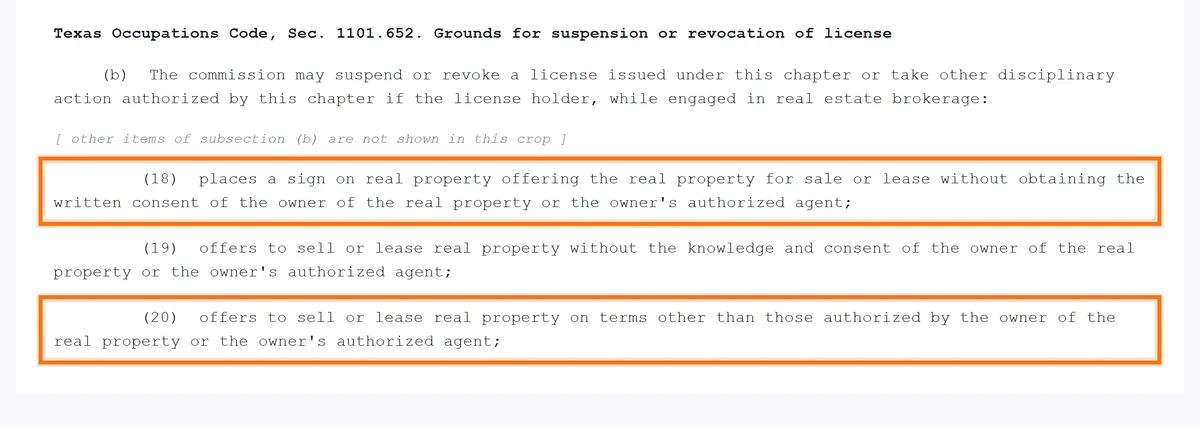
The leasing section should say what the manager may decide alone: the rent range, lease length, pet policy, who signs the lease and whether concessions may be offered. Texas backs those limits: offering to lease property on terms other than those the owner authorized, and placing a sign offering it for lease without the owner's written consent, are both grounds for discipline under Occupations Code 1101.652(b).
Then look for a sale clause. Some agreements give the manager a commission if you sell the property, to the tenant or to anyone, during or after the term. If you may sell later, decide now whether you want that, and strike it if not; if it stays, limit it to buyers the company introduced and to a stated period after the agreement ends. Have a Texas attorney review any agreement you are unsure about. This is general information, not legal advice.
How Perpetual handles this
Perpetual Property Management is broker-owned, with our office at 5755 Rufe Snow Dr in North Richland Hills, and we manage homes in Keller, North Richland Hills, Fort Worth and nearby. What our site states about our management agreement:
- Fees. Our price sheet lists three plans, 7%, 9% and 10% of monthly rent, with every fee. The final fee is set after the rental analysis, plans are negotiable case by case, and whatever we agree goes into the management agreement. If a fee is not in the agreement, you do not pay it.
- The hard questions. Before you sign, we answer in writing, for your property, the questions on our pricing page: whether the fee is charged on collected rent or billed during vacancy, whether invoices are marked up, and what it costs to leave.
- Guarantees. The Perpetual Promise puts five written guarantees in every management agreement, subject to its Guarantee Addendum, including rent disbursed by the 10th of each month or that month's management fee waived.
- Repairs. You set a pre-approved spending limit; larger jobs come to you with a description, photos and a recommendation, and the original vendor invoice is always in your portal.
- Lease renewals. Renewal work starts 120 days before the lease ends. The lease renewal fee is $150, $200 or $149 depending on the plan.
The term of our management agreement, its renewal and notice terms, the reserve amount and who holds the security deposit are confirmed in writing before you sign. To go through any clause with us, call 682-593-7033.
The takeaway: If a management agreement answers the term, the exit, every fee, the leasing and repair limits, where your money sits and who covers whose mistakes in plain language, you can sign it; if it is vague on any of them, ask for the wording before you sign, not after.
Questions owners ask
How long is a typical property management contract?
There is no Texas standard length; it is whatever the agreement says, and Texas exempts property management contracts from the license-law rule requiring a definite termination date. What matters more is what happens after the first term.
Can I cancel a property management contract early?
Usually, with the notice the agreement specifies and sometimes a termination fee. Read how that fee is calculated before signing: a fee equal to the remaining months of management is a penalty worth negotiating out, and so is a clawback of a leasing fee for a tenant who stays. Also check the deadline for handing over the lease, deposit, keys and records.
Who holds the security deposit, the owner or the property manager?
Either can, but the agreement must say which, in what account, and who itemizes and refunds it. If the manager holds it, it is trust money under TREC rule 535.146. The landlord stays responsible for the 30-day refund or itemized list under Property Code 92.103, so you want the clause and a documented move-out process.
How much notice do I need to give before ending a management agreement?
Whatever the termination clause says, so read it before you sign: the notice period for both sides, how notice is sent, what leaving costs, and how quickly the lease, deposit, keys and records transfer.
Do property management contracts renew automatically?
Many do. Automatic renewal is not a problem by itself; the problem is a renewal into another full term unless you cancel inside a short window. A fair agreement renews month-to-month or lets you decline with reasonable notice. If the rule takes more than one sentence to explain, ask for it rewritten.
What should I watch out for in a property management agreement?
The clauses that move money, authority or liability to you without saying so plainly: fees that live on a website instead of in the agreement, tenant charges the company keeps, a termination fee tied to the remaining months, a vague emergency exception to the repair limit, a one-sided indemnity, a sale commission with no time limit, and owner deadlines where silence counts as approval. Each is a line in the checklist or a clause to ask about.
What should be included in a property management agreement so there are no surprises?
Fees with a sentence that no other fee may be charged, the leasing authority, the repair limit and what counts as an emergency, a monthly statement and payout date, the reserve amount, who holds the deposit, and the term, notice and handover deadline. Each is a line in the checklist above.
What is an indemnification clause in a property management agreement?
It is the paragraph that says who pays if a claim or lawsuit arises. A balanced clause has the owner cover claims arising from the property and the owner's own acts, and the manager cover claims arising from its own negligence or misconduct. A clause that makes you cover the manager even for its own negligence is the one to negotiate before signing.
Can I negotiate the terms of a property management agreement?
Yes, before you sign. Common changes are the repair approval limit, an indemnity that excludes the manager's own negligence, a narrower sale clause and the notice period. Get each change in writing, as an edit or a signed addendum; a verbal promise is not part of the contract. Our own price sheet says plans are negotiable case by case and that whatever we agree goes into the management agreement.
Related services
Property management in Keller, North Richland Hills and Fort Worth. How full-service management works in Tarrant County →