
Key takeaways
- Texas landlord duties do not scale down: a single house carries the same lockout, repair, deposit, security device and smoke alarm rules as a large portfolio.
- Each duty has a penalty written into the Property Code, for example one month's rent plus $500 for a repair or security device failure (92.0563, 92.164).
- A deposit kept in bad faith costs $100 plus three times the amount wrongly withheld, plus attorney's fees (92.109(a)).
- With one door, there is no other rent to absorb a vacancy, an unpaid month or a penalty.
- Self-managing still makes sense for a nearby owner with time, a current Texas lease and a plan for each duty.
A property manager is not overkill for one rental if you cannot reliably run the Texas landlord duties on time, because one house carries every one of them and each has a penalty in the Property Code. It is overkill for an owner who lives near the house, has the hours, and has a working routine for repairs, deposits, locks and smoke alarms. That holds whether the rental is in Fort Worth, Keller or North Richland Hills.
This guide looks at the question from the risk side: the five duties that cost one-door owners the most, what the statute says a slip costs, and the time and distance that decide whether you can cover them yourself. Whether the fee pays for itself on your numbers is the separate guide is property management worth it. This is general information, not legal advice; for your own lease and facts, ask a Texas attorney.
Five Texas duties a one-house owner carries, and what a slip costs
Here are the five Texas landlord duties that apply in full to a single rental house, what each requires of you, and what the Property Code says a tenant may recover when the duty is missed:
| Texas duty (section) | What a one-door owner must do | What a slip costs, as the statute states |
|---|---|---|
| No lockouts or removed items (92.0081) | Never shut a tenant out except as 92.0081(b) allows; a lockout for unpaid rent only if the lease gives the right and the written notice in 92.0081(d) was given; never remove doors, locks or landlord-furnished appliances except for a bona fide repair | The tenant may recover possession or end the lease, plus a civil penalty of one month's rent plus $1,000, actual damages, court costs and reasonable attorney's fees, less rent owed (92.0081(h)); one more month's rent if no new key is given (92.0081(i)) |
| Repairs after notice (92.052, 92.056) | Make a diligent effort to repair a condition that materially affects an ordinary tenant's health or safety once the tenant gives notice and is current on rent; seven days is presumed reasonable (92.056(d)) | The tenant may end the lease, repair and deduct, or go to court (92.056(e)); judicial remedies include a civil penalty of one month's rent plus $500, actual damages, court costs and attorney's fees (92.0563(a)) |
| Deposit refund (92.103, 92.104) | Refund the deposit, with a written itemized list of any deductions, on or before the 30th day after the tenant surrenders the house (the duty starts once the tenant gives a written forwarding address, 92.107); no deduction for normal wear and tear | Bad-faith retention: $100, three times the amount wrongly withheld, and attorney's fees (92.109(a)); bad faith is presumed after the 30th day (92.109(d)) |
| Security devices and rekey (92.153, 92.156) | Have the required latches, locks, keyless bolts, door viewers and sliding-door devices in place at your expense, and rekey within seven days after each tenant turnover | The tenant may install or rekey and deduct, end the lease after an unanswered written request, or sue; after a written request goes unanswered, a civil penalty of one month's rent plus $500, actual damages and fees (92.164(a)) |
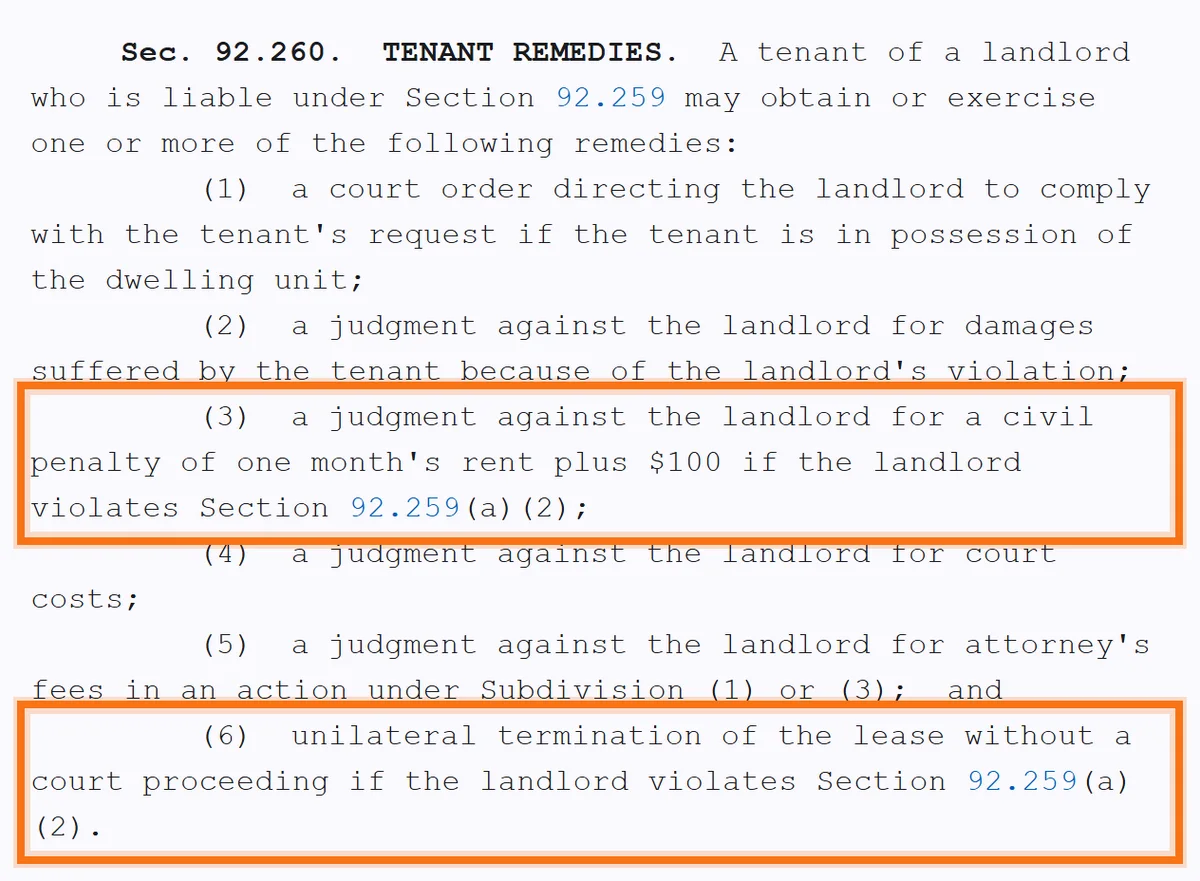
| Smoke alarms (92.255, 92.258) | At least one alarm in each bedroom and as 92.255(a) requires; test at the start of the tenant's possession; inspect or repair after the tenant's notice | Not fixed within seven days of written notice: one month's rent plus $100, damages, court costs, fees, and the tenant may end the lease (92.259, 92.260) |
How to read this table: the middle column is the routine; the right column is what Texas law lets a tenant recover when the routine fails. None of these penalties is reduced because you own only one house, and with one house the penalty, the lost rent and the vacancy that follows all land on the same budget. This is general information, not legal advice.
Why one door carries more risk per house, not less
Every duty in the table applies in full to a single rental. Chapter 92 of the Property Code has no small-landlord exception for the deposit, repair, security device or smoke alarm rules, so a one-door owner who misses the deposit deadline faces the same statute as a company that misses it on one house out of hundreds.
What does change is how much one bad outcome weighs. An extra month of vacancy on one house is a full month of the rental's income. A tenant who stops paying is your entire rent roll. A penalty under one of the sections above comes out of the same account as the mortgage. The downside of one mistake is proportionally larger for you than for an owner with ten houses.
Time: what one rental asks of you in a year
A realistic year on one house, with no turnover, looks like this:
- A handful of repair requests, each needing a call to the tenant, a vendor, access, a check of the work and the invoice paid.
- At least one look inside the home, with photos, so you know its condition.
- A renewal decision, with a rent based on something better than a guess.
- Year-end records for your return.
A turnover year adds the move-out inspection, the deposit accounting against the 30-day clock, the rekey within seven days, the smoke alarm test, make-ready, pricing, listing, showings, screening, the lease and move-in. That is several weeks of work on other people's schedules. If you have the hours and want them, self-managing is viable. How much of the job remains even with a manager is in how passive a rental really is.
Distance: the short-drive rule and the repair clock
Self-managing works when you can be at the house on short notice without losing a workday. If the rental is in Keller and you live in Keller, meeting a plumber is a short errand. If you live in Austin, it is a day off work; out of state, it is a flight or a call to someone you hope tells you the truth.
Distance matters most for the repair duty. Under 92.056(c), the landlord is treated as having received the tenant's notice when the landlord or the landlord's agent or employee actually receives it, and 92.056(d) presumes seven days is a reasonable time to repair. The clock does not pause while you find a vendor from another city. Owners who moved away from a home they lived in will find the remote setup in the out-of-state owner guide.
What those penalties look like on one house
To make the table concrete, take an illustrative house renting for $2,000 a month with a $1,600 deposit. These are illustrative figures only, not a quote and not a prediction of what a court would award:
- Lockout outside 92.0081: one month's rent plus $1,000 is $2,000 + $1,000 = $3,000, before actual damages, court costs and attorney's fees.
- Repair ignored after proper notice: one month's rent plus $500 is $2,000 + $500 = $2,500 under 92.0563(a)(3), plus damages, costs and fees.
- $600 of the deposit kept in bad faith: three times $600 is $1,800, plus $100, for $1,900, plus attorney's fees (92.109(a)).
- Smoke alarm not fixed within seven days of written notice: one month's rent plus $100 is $2,000 + $100 = $2,100 (92.260(3)).
The slips that cause these are rarely dramatic. A repair text sits unanswered over a busy week. The deposit list goes out late because nobody tracked the 30th day after move-out. The locks are not rekeyed because the new tenant moved in fast. Each is a routine missed, not a decision made. The device rules in full are in Texas security device and smoke alarm rules, and the deposit clock in Texas security deposit rules.
When managing your own single rental is the right call
Self-managing one door is a good decision, not a compromise, when most of these are true:
- You live within a short drive and are willing to go when needed.
- You have a reliable tenant in place with a history of paying on time.
- You use a current Texas lease with the addenda your house needs, and you have read it.
- You have a calendar for the 30-day deposit refund, the seven-day rekey after turnover and the smoke alarm test at move-in.
- You have a plumber, an electrician and an HVAC company who answer you, and a reserve to pay them.
- You have the hours for a turnover and are prepared to enforce the lease with someone you know.
- You want to learn the business, perhaps because you plan to buy more.
Owners in this position can manage one home well for years. The honest check is the fourth line: if you would not know today when the rekey is due after the next move-out, build that calendar before the next turnover, or hand it to someone who already has one.
The one-door owners who benefit most from a manager
Our full-service page names the owners this fits: first-time and accidental landlords who "inherited a house, moved for work, or kept the old home as a rental," and out-of-state owners who need "eyes, hands, and honest reporting on the ground." Those are the owners for whom the duties in the table are hardest to run alone, because the house is either new to them or far from them.
For them, a manager buys three concrete things: a tenant placed through written criteria, repairs routed to vendors against an agreed spending limit, and the deposit, lock and alarm steps run at each turnover. The first year for an owner who did not plan to be a landlord is covered in the accidental landlord guide.
What a manager should do differently for one house: nothing
One house should get the same lease, condition record, deposit accounting, rekey and alarm check and monthly statement as a portfolio. If a company describes a lighter service for small owners, ask which of the five duties it leaves to you. In the first meeting, ask who receives the tenant's repair notice, how the 30-day deposit date is tracked, and who schedules the rekey after a move-out. The answers tell you more than the fee. How the first year with a manager runs for a one-house owner is in property management for a first-time landlord with one rental.
Put the risk next to the fee
The cost side has its own guides, and this one does not repeat them: is property management worth it for just one rental works through the fee on a single house, and is property management worth it sets the fee against vacancy.
What this guide adds is a third column for that comparison: the statutory exposure in the table above. Put your yearly management fee from a written quote next to two figures you can work out today on your own rent: one month's rent plus $500 (a repair or security device penalty) and one month's rent plus $1,000 (a lockout). Then ask how likely you are to miss one of the five duties from where you live, with the time you have. That is your decision, and only you can make it.
How Perpetual handles the five duties on one house
Perpetual Property Management is broker-owned, with Justin Brown as Broker/Owner, and manages single-family homes, townhomes and small multifamily across Northeast Tarrant County from our office in North Richland Hills. What our site states that bears on the table:
- Leases and deposits: Texas-compliant lease documents with the addenda your property needs; security deposits "held, accounted for, and returned (or properly itemized) on the statutory timeline" (leasing and move-in).
- Condition records: a photo-documented move-in report, and a 360-degree condition inspection at every move-in and move-out (the Perpetual Promise).
- Repairs: tenants report through their portal; repairs under your pre-approved limit get fixed fast, anything larger comes to you with a description, photos and a recommendation; emergencies follow a 24/7 process (maintenance coordination).
- During the tenancy: an annual property inspection on every plan.
How the rekey and the smoke alarm test are scheduled at each turnover, and what they cost you, is confirmed in writing in your management agreement, together with every fee on the price sheet. To talk through one house, call 682-593-7033.
The takeaway: One rental is the whole landlord job with nothing to cushion a mistake. If you can run the five Texas duties in the table on time, from where you live, self-managing is a fair choice; if not, a manager is not overkill.
Questions owners ask
I only own one rental. Is property management worth it?
It is worth it when you cannot reliably run the Texas duties on one house: repairs after notice, the 30-day deposit refund, locks and a rekey within seven days of turnover, working smoke alarms, and no lockouts outside the statute. Each has a penalty in the Property Code, such as one month's rent plus $500, and with one door nothing cushions it. A nearby owner with time, a current Texas lease and a calendar for those steps can self-manage. The fee math is in our worth-it guides.
How much time does managing one rental take?
In a year without turnover: a few repair coordinations, a look inside the house, a renewal decision and year-end records. In a turnover year, several weeks of work on other people's schedules: move-out inspection, the deposit refund within 30 days, the rekey within seven days, make-ready, listing, showings, screening, the lease and the smoke alarm test at move-in. The turnover year is where most one-door owners decide.
Do property managers take single-property clients?
Yes. Our price sheet describes the Standard plan as for "single homes and small portfolios," at 9% of monthly rent, and Full Service at 10%; every number is confirmed in writing before you sign. With any company, ask whether one house gets the same lease, condition records, deposit accounting and turnover steps as a portfolio.
What is the biggest risk of self-managing one rental?
Missing a routine that the Property Code attaches a penalty to: a repair left after proper notice, a deposit refund or itemized list after the 30th day, locks not rekeyed within seven days of turnover, a smoke alarm not fixed within seven days of written notice, or a lockout outside 92.0081. Each is survivable, but with one door the penalty, lost rent and vacancy land together. This is general information, not legal advice.
When does self-managing a single rental make sense?
When you live close, have a reliable tenant, use a current Texas lease, have vendors who answer you, keep a calendar for the deposit, rekey and smoke alarm deadlines, can spare the hours for a turnover, and actually want the job. If two or three of those are missing, a manager for one rental is not overkill.
What happens if a Texas landlord locks out a tenant illegally?
Under Property Code 92.0081(h), the tenant may recover possession or end the lease and recover a civil penalty of one month's rent plus $1,000, actual damages, court costs and reasonable attorney's fees, less any rent owed. If the landlord also fails to give a key to a changed lock as 92.0081(f) requires, the tenant may recover one more month's rent. This is general information, not legal advice.
Can a tenant end the lease over a broken smoke alarm in Texas?
Yes, if the landlord does not install, inspect or repair the alarm on or before the seventh day after the tenant's written notice (Property Code 92.259(a)(2)). Section 92.260 then allows unilateral termination without a court proceeding, a civil penalty of one month's rent plus $100, damages, court costs and fees. The landlord has defenses if the tenant owed rent when giving notice (92.261).
Property management in Keller, North Richland Hills and Fort Worth. How full-service management works in Tarrant County →