Key takeaways
- Management removes most of the effort, not the responsibility: the house, the loan, the insurance and the decision to hold or sell stay yours.
- What still comes to you is a short calendar: the monthly statement, repairs above your limit, the renewal, the inspection report, insurance, the appraisal notice and the tax return.
- Most of those are decisions, not tasks, and they take less time when the information arrives complete.
- To the IRS, rental activities are generally passive activities even if you materially participate, and that is a rule about losses, not about hours (Topic 425).
- IRS Publication 925 lists approving new tenants, deciding on rental terms and approving expenditures as examples of active participation.
How passive is a rental, really? With a manager, nearly passive in effort and never passive in responsibility. On a house in Fort Worth, Keller or North Richland Hills, the manager handles the tenant, the rent, the showings and the routine repairs. You keep a short list of decisions: repairs above your limit, each renewal, insurance, property tax, the tax return and the decision to sell. Plan for those and the rental fits alongside a full-time job.
Below: the owner's calendar in one table, what a manager takes off it, the decisions and events that stay with you, what "passive" means to the IRS, five ways to shrink your part, and portfolios.
The owner's calendar with a manager: what still comes to you
Here is what still lands on an owner whose Fort Worth-area rental is fully managed, how often, and what you look at:
| What comes to you | How often | What you look at | Your part |
|---|---|---|---|
| The owner statement and payout | Monthly | Rent in, bills out, the payout amount | Read it; question anything odd |
| Repairs above your pre-approved limit | When they happen | A description, photos and a recommendation | Approve, decline or ask for another quote |
| The inspection report | On the schedule in your agreement | Photos, condition notes, recommended actions | Decide on any recommended work |
| The renewal | Once per lease | The rent check against leased comparables and a recommendation | Choose the rent, or let the tenant go |
| A new tenant | At each vacancy | The written criteria every applicant is measured against | Set your standards once, such as pets |
| Insurance renewal | Yearly | Your landlord policy and its terms | Renew, and keep coverage right for a rental |
| The appraisal notice | Yearly | The Tarrant Appraisal District value | Decide whether to protest |
| The tax return | Yearly | The year-end statements for your CPA | File, with your CPA |
| Hold, refinance or sell | Yearly, or when something changes | The year's numbers for that house | Decide |
How to read this table: the "How often" column is the effort; the "Your part" column is the responsibility. Most rows take minutes once the information arrives complete. As an illustration, if you spend 20 minutes on each monthly statement, that is 240 minutes, or 4 hours, a year (12 x 20 = 240). Illustrative only; your time depends on your house and how many decisions come up.
Passive in effort, never passive in responsibility
Two things get mixed up when people say passive. One is effort, the hours spent. The other is responsibility, the decisions and the risk. A manager can take almost all of the first. It cannot take the second, because you own the house: the deed, the loan, the insurance and the choice to hold or sell are yours.
Owners who expect a rental to behave like a dividend get frustrated in the first year. Owners who expect a few decisions a month, made from good information, usually find it fits beside a job and a family. A useful picture is a small business with a general manager: the owner does not open the store, but still approves the big purchases and decides whether to sell.
What a manager takes off your calendar
Self-managing, the time comes in clumps: turnover, late rent, repairs, and the learning curve of doing it the first time. Self-managing vs hiring a manager lays that workload out. With full-service management, most of it leaves your calendar:
- Leasing: pricing, marketing, showings, screening and the lease. You set the standard once.
- Rent: collected online, late rent handled under the lease, the payout sent on a schedule.
- Repairs: requests go to the manager, and work under your pre-approved limit happens without a call.
- Inspections: done on a schedule, with photos.
- Records: statements and invoices in a portal.
What is left for you is reading, approving and deciding.
The decisions that stay with you, and why you should want them
A good manager recommends. These stay with you, and you should want them:
- The rent at each renewal. It balances income against the risk of losing a good tenant, and only you know which matters more to you this year.
- Repairs above your limit. The manager brings the description, photos and a recommendation; you choose.
- Improvements. New flooring now or at the next turnover; whether an upgrade earns its cost in rent.
- Insurance and ownership structure. These belong with your insurance agent, CPA and attorney; the manager supplies records.
- Hold or sell. Every year, with the year's numbers in front of you.
Each is a quicker decision when the information arrives complete. What owner communication should look like covers what a manager should send you so they do.
The events that will still need you
A few events need more than an hour of your attention, and it is better to expect them.
A major system failure. An HVAC system or a roof is a repair-or-replace decision and a funding decision. The manager brings options; you choose and pay.
A storm or freeze claim. The policy is in your name, so the claim is too. Under Property Code 92.054, if a condition results from an insured casualty loss such as fire, smoke or hail, the period for repair does not begin until the landlord receives the insurance proceeds. Working with your insurer during a claim covers the manager's side.
An eviction. If one is ever needed, the decision to file, and the cost, are yours.
A sale, an early lease end or a tenant who wants to buy. Each is a transaction that needs your signature and judgment.
What "passive" means to the IRS, and why it is a different question
Owners searching "is rental income passive" usually mean two different things. One is effort. The other is a tax rule, and the tax rule has nothing to do with how many hours you spend.
IRS Topic 425 says that, in general, rental activities, including rental real estate activities, are passive activities even if you materially participate, unless you qualify as a real estate professional. Generally, passive activity losses that exceed passive activity income are disallowed for the current year and can be carried forward to the next year. Form 8582 is used to figure the deductible loss.
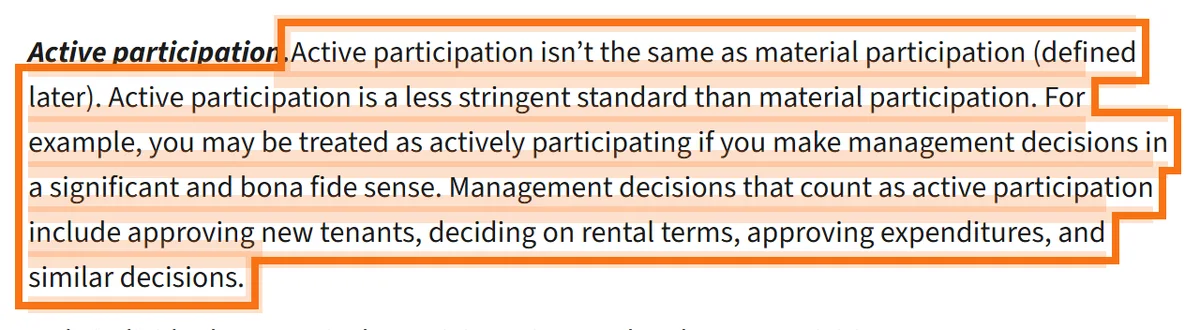
Publication 925 (for 2025 returns) adds a special allowance: if you actively participated in a passive rental real estate activity, you can deduct up to $25,000 of loss from nonpassive income. Active participation is a less stringent standard than material participation, and your interest, including your spouse's, must be at least 10% by value throughout the year. The allowance is reduced by 50% of modified adjusted gross income over $100,000 and is generally gone at $150,000 (lower limits apply to married people filing separately).
In the publication's own example, an unmarried owner with $120,000 of modified adjusted gross income and a $31,000 rental loss can deduct $15,000 ($25,000 minus 50% of $20,000) and carries the other $16,000 to the next year.
Whether your arrangement with a manager counts as active participation is a question for your CPA. This is general information, not tax advice.
Five ways to make your part smaller
Owners who get closest to passive do the same five things.
- Set a spending limit you can live with. Too low and every repair becomes a phone call; too high and you lose visibility. Match it to the age of the house.
- Keep a reserve. Money already set aside means a repair over your limit is a yes or no, not a scramble. How much reserve to keep per rental helps you size it.
- Agree a renewal policy once. Tell the manager how you think about increases for good tenants, and each renewal becomes a confirmation.
- Read the portal on a schedule. Once a month with the statement and any inspection report, not daily.
- Keep the house in good condition. Deferred maintenance is the most reliable source of owner phone calls.
Does it get more or less passive with more houses?
Often more, not less. One house produces its events unpredictably, so each feels like an interruption. Several houses under one manager produce them at a steadier rhythm, the reserves absorb the cost, and the monthly review becomes a habit.
Your time grows slowly, and almost all of it is the same reading and deciding at a larger scale: a renewal decision every month or two instead of once a year. The reporting has to keep each house separate so you can see which one needs attention; our rent collection and accounting page describes per-property reporting for portfolio owners, so each door's performance shows separately.
A simple test before you buy or hand off
Write down what you expect to do as the owner in a typical month and a typical year, then compare it with the calendar table above. If you expected zero, adjust it to a few decisions a month and ask whether that fits. If you expected to take tenant calls, hire vendors and run showings, that is self-management, and it is a job.
If even a short calendar of decisions is more involvement than you want, that points to a different asset, not a different manager. The free rental analysis is a good first step either way: a rent range from leased comparables, make-ready guidance and a written management quote.
This is general information, not legal, tax, insurance or financial advice.
How Perpetual handles this
Perpetual Property Management is broker-owned, with our office in North Richland Hills. What our site states about the owner's part:
- Repairs. Routine repairs under your pre-approved limit get fixed fast; anything larger comes to you with a description, photos and a recommendation (maintenance). Every plan includes 24/7 emergency response.
- Renewals. Renewal work starts 120 days before the lease ends and includes a rent check against leased comparables. The recommendation comes with reasoning, and the decision is always yours.
- Reports. Inspections come with photo reports in your owner portal. The portal holds your statements, documents and disbursement history, and at tax time your CPA gets a clean year-end package.
- Payouts. Rent we collect is disbursed to you by the 10th of each month, or that month's management fee is waived, subject to our Guarantee Addendum.
- Selling. Perpetual Realty Group is our affiliated brokerage, so the hold-or-sell decision has a team behind it.
Your spending limit, the reserve amount and the inspection schedule are confirmed in writing before you sign. To see what the managed version looks like for your house, call 682-593-7033.
The takeaway: A managed rental is passive in effort, not in responsibility: hand off the tenant, the rent and the routine repairs, keep a short calendar of decisions, and treat the IRS meaning of passive as a separate tax question for your CPA.
Questions owners ask
Can I be completely hands-off with a rental property?
In effort, very nearly; in responsibility, no, because you own the house, the loan, the insurance and the choice to hold or sell. With full-service management, leasing, rent, routine repairs, inspections and statements are handled. What remains is a short calendar: the monthly statement, repairs above your limit, each renewal, insurance, the appraisal notice, the tax return and the hold-or-sell decision.
How much time would a property manager realistically save me?
Most of the effort. Self-managed, the time comes in clumps around turnover, late rent and repairs. With a manager, those leave your calendar, and what remains is reading the statement, approving repairs above your limit and deciding renewals. As an illustration, 20 minutes on each monthly statement is 4 hours a year. Events like a roof replacement or an insurance claim add more.
What am I still responsible for after hiring a property manager?
The ownership decisions. You set the rent at each renewal from the manager's recommendation, approve repairs above your limit, decide on improvements, keep your landlord insurance and property tax in order, fund the reserve, file the tax return and decide each year whether to hold or sell. A storm claim is filed under your policy, and an eviction needs your decision to file.
Can I own a rental property while working full time?
Yes. With a manager handling tenants, rent and repairs, your part fits into a monthly review of the statement and a handful of decisions a year. Self-managing alongside a full-time job is possible, but it means taking tenant and vendor calls during work hours.
How do I make my rental property more passive?
Set a repair spending limit that matches the age of the house, keep a reserve so larger repairs are a quick decision, and agree a renewal policy once. Then read the portal on a monthly schedule rather than daily, and keep the house in good condition so maintenance calls are rare.
Is rental income passive income for taxes?
In general, yes in IRS terms: Topic 425 says rental activities, including rental real estate, are passive activities even if you materially participate, unless you qualify as a real estate professional. Publication 925 allows up to $25,000 of rental losses against other income for owners who actively participate, reduced above $100,000 of modified adjusted gross income. Ask your CPA how it applies to you.
Related services
Property management in Keller, North Richland Hills and Fort Worth. How full-service management works in Tarrant County →