
Key takeaways
- Week 1 is rent: collected, posted, and the late process run where the lease and Texas law allow it.
- Under Property Code 92.019, a late fee needs notice in a written lease and can apply only after rent is unpaid two full days after it was due.
- Week 2 is money out: bills paid, the statement closed, the payout sent (ours goes out by the 10th, or that month's fee is waived).
- All month: repair requests are triaged, approved within your limit, and followed up until the invoice matches the work.
- Every month someone checks lease end dates, so renewals start 60 to 90 days ahead instead of in the last week.
What does a property manager do in a month when rent arrives on time and nothing breaks? For a rental in Fort Worth, Keller or North Richland Hills, the month has a calendar: rent and any late steps in the first week, your statement and payout in the second, repairs all month, inspections when they are due, and a monthly check of lease end dates so renewals never start late. The quiet month is the result of that calendar, not the absence of work.
Below is the calendar as a table, then each week explained. The whole life of a tenancy, from listing to move-out, is in property manager for landlords: who does what.
A managed month at a glance
Here is a normal month for an occupied rental, with what the manager does, what you see, and the rule or document that sets the timing. The days assume rent is due on the 1st (illustrative; your lease sets the due date):
| When | The manager | What you see | Rule or document |
|---|---|---|---|
| Days 1-3 | Posts payments, reminds anyone unpaid | Nothing, unless there is a problem | The lease due date |
| From day 4 | Applies the late fee the lease allows, starts the written late steps | A note that a tenant is late | Property Code 92.019; the lease |
| Week 2 | Pays the month's bills, closes the statement, sends the payout | The statement and the deposit to your bank | The management agreement; TREC rule 535.146 |
| All month | Triages repairs, sends vendors, checks the work and the invoice | An approval request only above your limit; invoices on the statement | The spending limit in the agreement |
| When due | Runs the scheduled inspection and files the report | A photo report | The agreement's inspection schedule; the lease |
| Every month | Checks which leases end in the next 60 to 90 days | A renewal recommendation when one is due | The lease term and notice clause |
How to read this table: most rows end in "nothing" or "only when" for you, and that is the point. If the third column of your month is longer than this, ask which row is not working; if it is empty, including no statement, ask for it.
Week 1: rent comes in, or it does not
Rent arrives through whatever payment system the lease and the manager use, and the manager posts each payment to the tenant's ledger. Tenants who paid are done for the month. Anyone who has not paid gets a reminder, and the manager watches the lease's late terms.
Texas sets the floor for late fees. Property Code 92.019(a) allows a late fee only if notice of the fee is included in a written lease, the fee is reasonable, and rent has remained unpaid two full days after the date it was originally due. Illustrative only: with rent due on the 1st, the 2nd and 3rd are the two full days, so the 4th is the earliest a fee can apply.
The amount has a limit too. Under 92.019(a-1), a fee of not more than 12% of the month's rent is considered reasonable for a home in a building with four or fewer units; on $2,000 rent that is up to $240. What happens after that is in what happens when a tenant pays late in Texas. This is general information, not legal advice.
Week 2: the payout and your statement
Once rent has cleared, the manager pays the bills attached to the house: vendor invoices, the management fee, and anything the agreement routes through management, such as HOA dues. The reserve is topped up if a repair drew it down. What is left is sent to you, and the statement closes the month.
A Texas broker holding your rent must give you an accounting at least monthly if there was activity in the trust account (TREC rule 535.146), and the statement is that accounting. It should show rent received, each fee, each repair with its invoice, the reserve and the amount sent. If you cannot trace every dollar from the tenant to your bank on the statement, ask. How to read your monthly owner statement walks through each line, and when will the property manager send me the rent? covers the payout day.
All month: repair requests and the follow-up
Repairs do not follow the calendar. A tenant reports a problem, ideally through a portal with photos, and the manager sorts it: emergency, routine, or the tenant's responsibility. Routine work under your spending limit goes to a vendor; work above it comes to you first with an estimate and a recommendation.
Then comes the part owners rarely see: the follow-up. Did the vendor arrive? Did the tenant let them in? Is the problem fixed, and does the invoice match the work that was approved? The invoice goes on your statement. A good manager also watches for patterns: the third call in a year on the same water heater is a replacement conversation, not another service call. How the limit works is in can a property manager approve expensive repairs without my permission?
When one is due: the inspection
Not every month includes an inspection of your house. The schedule is set in your management agreement and the timing of entry by the lease, since no Texas statute sets a notice period for a landlord's entry. When one is due, the manager schedules it with the tenant, walks the house, and files a report with photos, condition notes and any recommended action.
In the months between, the inspection still matters: its action items feed the repair list and any conversation with the tenant about the lease. Rental property inspections: how often, what gets checked and what you receive covers the schedules and the report.
Every month: the lease-date check and renewals
Every month, someone should look at the calendar of lease end dates. A renewal that starts in the last two weeks leaves no room for a decision or for marketing if the tenant leaves. Illustrative only: for a lease ending June 30, a 60- to 90-day window opens on April 1 and closes on May 1.
When a lease enters that window, the manager checks what comparable homes are leasing for, reviews the tenant's payment history and the inspection reports, and brings you a recommendation. You decide; the offer goes to the tenant in time for either answer. How far ahead of a lease ending does a manager start renewal discussions? and is it better to keep a good tenant at the same rent? go further.
The records that pile up every month
Much of a manager's month is record-keeping you never see until you need it. Each month adds payments and late steps to the tenant ledger, work orders and invoices to the repair file, messages to the tenant file, and inspection photos to the condition history. Notices to the tenant follow the delivery method the lease and Texas law require.
Those records are what decide a deposit dispute, support a late-fee charge, or show a justice court what happened if a tenancy fails. They are also what your CPA needs at year-end: year-end reporting for rental owners lists what to expect.
What you see in a normal month
In a normal month, your part is short:
- one statement and one payout, on a predictable day;
- an approval request, with an estimate and photos, only when a repair is above your limit;
- an inspection report in a month when one was done;
- a renewal recommendation in the month a lease enters its window;
- early in the new year, the year-end records for your taxes.
Anything beyond that list should have a reason. What financial reports should a property manager send each month? lists the full report set.
A month with a vacancy runs on a different calendar
When a tenant moves out, the calendar changes completely. The move-out inspection comes first, then the deposit accounting against the move-in report, then the make-ready, the photos, the listing, showings, applications, screening, the lease and the move-in inspection. Each step waits on the one before it, so the manager's job is to keep the gaps short.
Your part changes too: you approve the make-ready spending, decide the asking rent, and should hear how the listing is doing every week, with the inquiries and showings behind any price recommendation. What a vacant month really costs shows why the gaps matter, and how showings work covers the leasing weeks.
How Perpetual runs the month
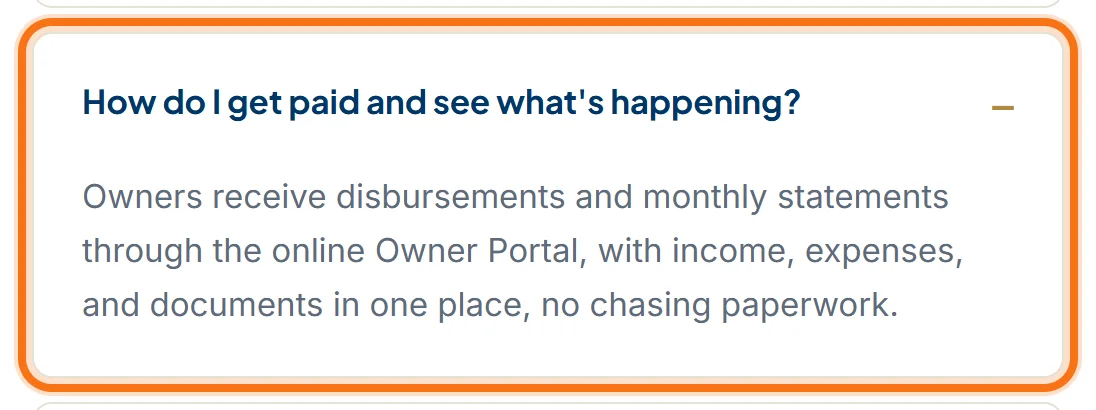
What our site states about each row of the calendar: tenants pay online through their portal, with late fees applied per the lease and the same escalation steps for every tenant (rent collection). Rent we collect is disbursed to you by the 10th of each month or that month's management fee is waived, and we respond to your calls and emails within one business day, both under the Perpetual Promise, subject to the Guarantee Addendum. Routine repairs under your pre-approved limit get fixed fast; anything larger comes to you with a description, photos and a recommendation, and the original invoice is always in your portal.
Every plan includes an annual property inspection, with the in-tenancy schedule set in your management agreement and a photo report in your portal. Renewal conversations start well before lease end, typically 60 to 90 days, and the decision is always yours. While a home is vacant you get a written activity report every week. Anything else, such as the exact payout day, is confirmed in writing before you sign. To see your house's numbers, request a free rental analysis or call 682-593-7033.
The takeaway: A managed month runs on a calendar: rent and late steps first, then the payout and statement, repairs and follow-ups all month, inspections when due, and a lease-date check every month. What you should see is short: one statement, one payout, and an approval request only when a repair is above your limit.
Questions owners ask
What does a property manager actually do for a landlord?
Across the life of a tenancy, the manager prices and leases the house, collects rent, coordinates repairs, inspects, handles renewals, and runs the move-out and deposit. In a single month that means rent and late steps first, then the bills, statement and payout, repair follow-ups all month, inspections when due, and a check of lease end dates. Our guide for landlords shows each stage.
How often should I hear from my property manager?
Every month with a statement and payout, whenever a repair is above your spending limit, after each inspection, and before each renewal. While the home is vacant, expect a written update every week with the inquiries and showings. We respond to your calls and emails within one business day under our written guarantee.
What does a property manager do when nothing is wrong?
The work that keeps it quiet: posting rent, closing the statement, following up open repairs until the invoice matches the work, filing inspection reports, and checking which leases end in the next 60 to 90 days. A quiet month is the result of that routine, not a month in which it was skipped.
Does a property manager arrange repairs or just pass requests on to me?
A full-service manager arranges the repair, not just the message. The request is sorted as emergency, routine or tenant responsibility, routine work under your limit goes to a vendor, and work above it comes to you with an estimate first. Then the manager confirms the work was done and the invoice matches. With us, the original invoice is always in your portal.
When can a late fee be charged on rent in Texas?
Under Property Code 92.019(a), only if notice of the fee is in a written lease, the fee is reasonable, and rent has remained unpaid two full days after the date it was originally due. Illustrative only: rent due on the 1st means the earliest fee day is the 4th. Under 92.019(a-1), a fee of not more than 12% of the month's rent is considered reasonable for a building of four or fewer units.
When will I get my statement and payout each month?
It depends on your agreement; ask for the exact day in writing. With us, disbursements go out on a predictable monthly schedule once rent clears, with the exact dates set out in your management agreement and visible in the portal, and rent we collect is disbursed by the 10th of each month or that month's fee is waived.
Property management in Keller, North Richland Hills and Fort Worth. How full-service management works in Tarrant County →