Key takeaways
- Three seats you use every year: a property manager, a tax preparer and an insurance agent.
- Seats you call for a job: an agent at purchase and sale, an inspector, a lender, an attorney and licensed trades.
- Most rental problems fall between two seats: the claim the agent never heard about, the improvement the tax preparer saw in April.
- The manager sees the house every month, so the manager's records feed everyone else.
- Check each seat before you rely on it: TREC's license search for agents and inspectors, the IRS directory for credentialed tax preparers.
A rental property team is a short list of people who each own one part of the house: a property manager for everything at the property, a tax preparer for the return, an insurance agent for the policy, and the agent, inspector, lender, attorney and trades you call for specific jobs. For a rental in Fort Worth, Keller or North Richland Hills, fill the manager seat first, because the manager's records are what the others work from.
Below: every seat in one table, what each one needs from you, how they hand work to each other, the order to build the team, and how to check each person before you rely on them. This guide describes roles; it is not legal, tax or insurance advice.
Every seat at a glance: when you need it and what to hand them
Here are the seats on a rental owner's team, when each one comes in, and what to hand them so they can do the job without chasing you:
| Seat | When you need it | What to hand them |
|---|---|---|
| Property manager | Before you buy or before the first listing, then every month | The lease and deposit records, keys and codes, HOA documents, warranties, your approval limit, how you want to be paid |
| Real estate agent or broker | At purchase and at sale | Your price range, the rent evidence, your timeline, and for a sale, the lease end date |
| Inspector | Inside the option period of a purchase | Access to the house and the questions the manager raised on the walk-through |
| Lender | Before the offer, and before any refinance | Your plan to rent the house, in writing, so the loan matches it |
| Insurance agent | Before closing or before the first tenant, and at every change | The address, the owner name on the deed, whether it is rented, pool, HOA, any entity |
| Tax preparer (CPA, enrolled agent or tax attorney) | Before the purchase if you can, then every year, and the year you sell | The closing statement, the year's owner statements, improvement invoices, any 1099 forms you receive |
| Texas attorney | When a document needs drafting or a dispute leaves the routine path | The lease, notices sent, the ledger, photos, and the timeline |
| Licensed trades | For repairs, usually through the manager | Access to the house, the tenant's report and photos, your approval for anything over the limit |
How to read this table: the first three rows are the people you deal with every year; the rest come in for a purchase, a sale, a dispute or a repair. The right-hand column is where most handoffs fail. Keep those items in one folder, or in your owner portal, so any seat can be filled quickly.
What stays your own job after you hire a manager is a different list: see what am I still responsible for after hiring a property manager.
Seats you use every year, and seats you call for a job
The seats overlap at the edges, which is where things get dropped. A simple division:
- Every year: the property manager (everything at the house and with the tenant), the tax preparer (how the rental is reported), and the insurance agent (what is covered and for how much).
- For a purchase or sale: a real estate agent or broker, an inspector, a lender and a title company.
- For a specific problem: a Texas attorney, and the licensed trades who do the repairs.
You are the owner of every decision the seats feed into. The team does not replace your judgment; it gives you the facts to use it.
The tax seat: CPA, enrolled agent or tax attorney
Rental taxes have their own vocabulary: depreciation, repairs versus improvements, the year you sell. The IRS lists the kinds of paid preparers as certified public accountants, enrolled agents, attorneys, and many others who do not have a professional credential.
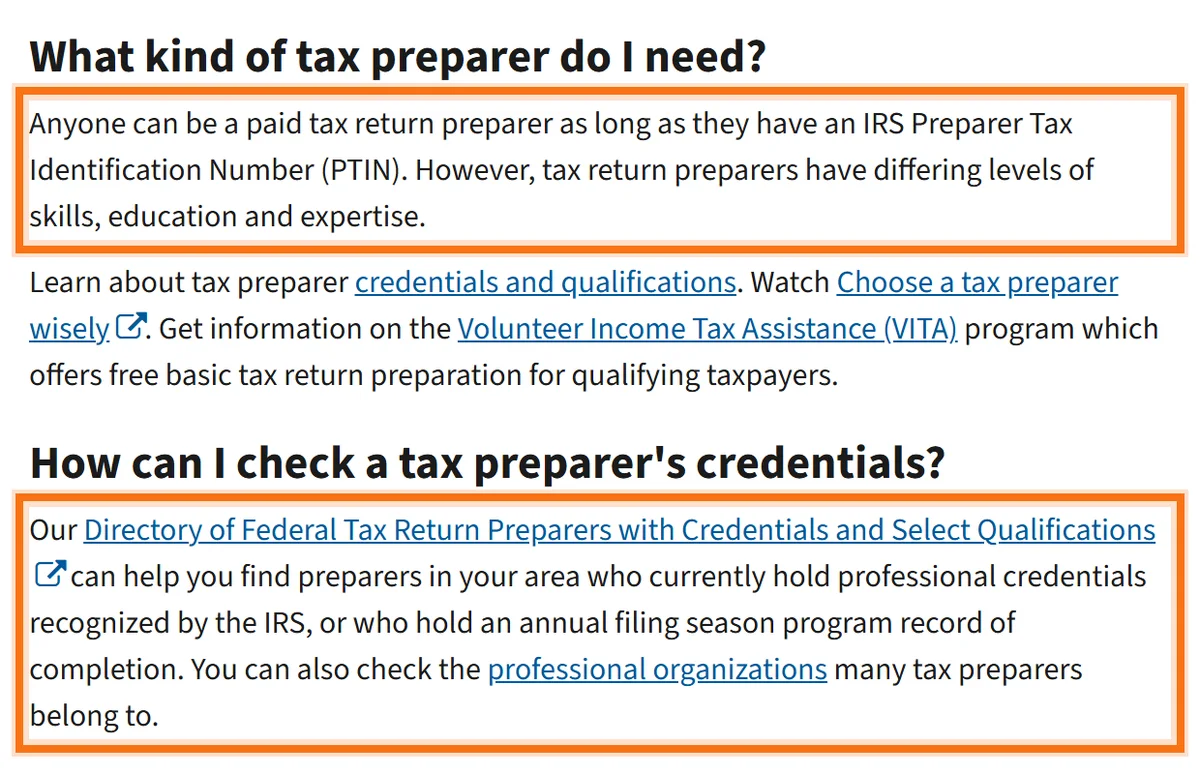
The IRS page is plain about the floor: anyone can be a paid tax return preparer with a Preparer Tax Identification Number. Its Directory of Federal Tax Return Preparers with Credentials and Select Qualifications shows who holds a credential the IRS recognizes. Check it before you hand over the file.
Bring the preparer in before the purchase if you can, then every year with a complete package, and again before you sell. What that package contains is in year-end reporting for rental owners.
The attorney: documents early, disputes when they leave the routine
Most owners meet an attorney only after something goes wrong. A few hours early, on the lease and addenda you will use and on any entity you plan to own the house through, is usually the better use.
After that, the attorney is for situations that leave the routine path: a tenant who disputes a deposit itemization and files a claim, an eviction that is contested or appealed, an injury claim, title moving into or out of an entity, or an HOA or city enforcement action.
Our own eviction page draws the line this way: for contested cases or appeals, attorney involvement is wise, and many uncontested cases proceed without one. The situation-by-situation version is in when do I need a landlord attorney rather than a property manager.
The insurance agent: before the first tenant and at every change
The agent needs to hear from you before the first tenant moves in, at every change (a new property, a pool, a transfer to an entity) and right away after any damage.
Start with the right kind of policy. The Texas Office of Public Insurance Counsel describes dwelling insurance as usually covering the house and other structures such as a garage or fence, and says it does not cover personal items, additional living expenses, medical bills or liability claims: dwelling insurance does not pay for someone else's injuries. Ask the agent how liability will be covered for a rented house, and whether the named insured matches the deed.
The comparison of the policy types is in landlord insurance vs homeowners insurance. This is general information, not insurance advice.
Why the manager is the hub
The tax preparer sees the rental once a year, the attorney when something breaks, the agent when something changes. The manager sees it every month: the rent ledger, the work orders, the inspection reports, the renewal dates.
That is why the manager's records feed the rest of the team:
- Monthly statements and a year-end package go to the tax preparer, with the invoices behind any large repair.
- The lease, the ledger, the notices and the photos go to the attorney if a case needs one.
- Damage reports and photos go to you the day they happen, so you can call the insurance agent.

When you interview a manager, ask what they send your tax preparer at year-end and how they report damage to you. The answers show whether they see themselves as part of a team.
Two handoffs that show how the seats connect
A storm damages the roof. The manager reports the damage to you with photos. You call your insurance agent the same day. The repair goes through the manager within your approval rules, the invoice lands in your records, and in January the tax preparer sees the claim and the repair in the same package. The claim side is in will a property manager coordinate with your insurer.
A tenant disputes a deposit deduction. The manager sends the itemization with the move-in and move-out photos. If the tenant files a claim, the whole file goes to the attorney, who has everything on day one instead of week three.
In both cases the owner made one call and every seat had what it needed. That is the point of building the team before you need it.
The order to build the team for a first rental
For a first rental, this order avoids rework:
- Manager first, before you buy or before you list. A rental analysis sets the rent and the fee lines everything else depends on.
- Lender and agent for a purchase, with the inspector inside the option period.
- Insurance agent before closing or before the first tenant, so the right policy starts on day one.
- Tax preparer before the first return, ideally before closing.
- Attorney when you need documents, which for a first rental is usually a lease review and, if you choose one, the entity.
Owners turning a home they already live in into a rental follow the same order, starting with the rental analysis.
How to check each seat before you rely on it
One check per seat, before you rely on anyone:
- Agent, broker and manager: TREC's License Holder Search. The steps are in how to verify a property manager's Texas license.
- Inspector: the TREC resale contract refers to inspectors licensed by TREC or otherwise permitted by law, so check the license the same way.
- Tax preparer: the IRS directory of preparers with credentials.
- Trades: licensed trades such as plumbers, electricians and air conditioning contractors have their own state license searches; see does the manager check that contractors are licensed and insured.
- Insurance agent and attorney: ask how often they work with rental owners in Tarrant County, and how they want to receive information from your manager.
How Perpetual fits into your team
We fill the manager seat, and our affiliated brokerage, Perpetual Realty Group, can fill the agent seat for a purchase or a sale. For the others, we produce the records and stay inside our lane:
- For your tax preparer: monthly statements in the owner portal, and at tax time a clean year-end package; you can share access or documents with your CPA directly. Your CPA handles tax advice and tax treatment.
- For your attorney: the lease, ledger, notices and communication history, organized. We are not a law firm; for contested cases or appeals we coordinate with landlord-tenant attorneys.
- For repairs: plumbers, electricians, HVAC and general trades we work with repeatedly, and your own vendor where it makes sense if they are insured and reliable, within the spending limit you pre-approve.
How we hand information to your insurance agent and your other advisers is confirmed in writing before you sign. To start with the rent and the written quote, request a free rental analysis or call 682-593-7033.
The takeaway: Fill the manager, tax and insurance seats before the first tenant, keep the job-by-job seats named before you need them, and make sure each one gets the records the others produce.
Questions owners ask
Do I need a CPA for one rental property?
Many owners use one, because depreciation, repairs versus improvements and the year of sale are where guesses cost money. The IRS notes that preparers include CPAs, enrolled agents, attorneys and others without a credential, and that anyone with a PTIN can prepare returns for pay. Check its directory of credentialed preparers, and bring the preparer in before you buy if you can.
When do I need a landlord attorney rather than just a property manager?
When a situation leaves the routine path: a deposit dispute that becomes a claim, an eviction that is contested or appealed, an injury claim, moving title into or out of an entity, or an HOA or city enforcement action. Our eviction page says attorney involvement is wise for contested cases or appeals and that many uncontested cases proceed without one. A lease review early is also time well spent.
Does a property manager replace the need for an attorney or CPA?
No. A manager runs the property and produces the records the tax preparer and attorney work from. Tax treatment stays with your tax preparer, and legal decisions with your attorney. In our words: your CPA handles tax advice and tax treatment, and we are not a law firm.
What should I ask an insurance agent about a rental property?
Ask which policy type fits a rented house, how liability is covered, whether loss of rents is included, what the deductibles are, and whether the named insured matches the deed. The Texas Office of Public Insurance Counsel notes that dwelling insurance does not pay for someone else's injuries, so the liability question matters. Tell the agent about every change.
How do my advisors communicate with each other?
Through you, with the manager supplying the records. Statements and the year-end package go to the tax preparer; the lease, ledger, notices and photos go to the attorney when a case needs one; damage reports and photos reach you the day they happen so you can call the insurance agent. Write down who receives what.
How do I check a tax preparer or a real estate agent before hiring them?
For a tax preparer, the IRS Directory of Federal Tax Return Preparers with Credentials and Select Qualifications lists preparers who hold a credential the IRS recognizes. For a Texas real estate agent, broker or property manager, use TREC's License Holder Search. For an inspector, the TREC resale contract refers to inspectors licensed by TREC or otherwise permitted by law.
Who should be the first person on my rental property team?
The property manager, or at least a manager's rental analysis, before you buy or list. The rent range and the fee lines it gives you are the numbers the lender, the tax preparer and your own decision depend on. Then the insurance agent before the first tenant, the tax preparer before the first return, and an attorney when you need documents.
Property management in Keller, North Richland Hills and Fort Worth. How full-service management works in Tarrant County →