Key takeaways
- In a Texas eviction case in justice court, an owner may be represented by an authorized agent, and a company owner by a property manager (Rule 510.3; Property Code 24.011(a)).
- On appeal, the Property Code lets a non-attorney agent represent only an owner of multifamily residential property, in a nonpayment case (24.011(b)). That is the usual line for a house.
- Call an attorney when the tenant raises a defense, has a lawyer, files bankruptcy, or claims a deposit was kept in bad faith.
- Injuries go to your insurer first, then counsel; LLCs, co-owners and probate go to an attorney.
- The manager keeps running the house and supplies the file while the attorney handles the case.
When do you need a landlord attorney rather than just a property manager? For owners in Fort Worth, Keller and North Richland Hills, the line is whether a matter is routine or contested. A manager handles the lease, notices, rent collection and an uncontested eviction in justice court. An attorney takes over when the case is appealed, the tenant fights it, the stakes go beyond unpaid rent, or the question is about ownership.
Below: what Texas rules let a manager do in court, where that stops, the situations that call for counsel, and how the two work on the same file.
Manager or attorney: situation by situation
Here is where the line usually falls on a single-family rental, and the rule or statute behind it:
| Situation | Manager can handle | Call an attorney when | Rule behind it |
|---|---|---|---|
| Unpaid rent, tenant does not contest | Notice, filing and the justice court hearing | The tenant answers with a defense or a lawyer | Rule 510.3; Property Code 24.011(a) |
| Tenant appeals the judgment | Supplying the file to counsel | Always, for a house | Property Code 24.011(b) covers multifamily owners only |
| Rent owed over $20,000 | The eviction itself | You want the money too | Rule 510.1(a) joins rent claims up to $20,000 |
| Deposit dispute heading to court | The itemized accounting within 30 days | The tenant alleges bad faith | Property Code 92.103, 92.109 |
| Lockout or removed doors, locks or fixtures | Prevention: following the lease and statute | Anything already happened outside them | Property Code 92.0081 |
| Injury or damage claim at the house | Reporting to you and the insurer | After the insurer is notified | Your policy |
| LLC, co-owners, divorce, probate, sale | Records and rent history | Before you sign anything | Ownership documents |
How to read this table: the second column is what a manager does on every file; the third is the moment to stop and get an opinion. When two rows apply, the attorney column wins. This is general information, not legal advice.
What Texas lets a property manager do in an eviction
Texas rewrote its eviction procedure rule in 2026. Rule 510 of the Texas Rules of Civil Procedure is now the only rule that governs eviction cases; the general justice court rules do not apply to them. Rule 510.3 sets who may represent the owner:
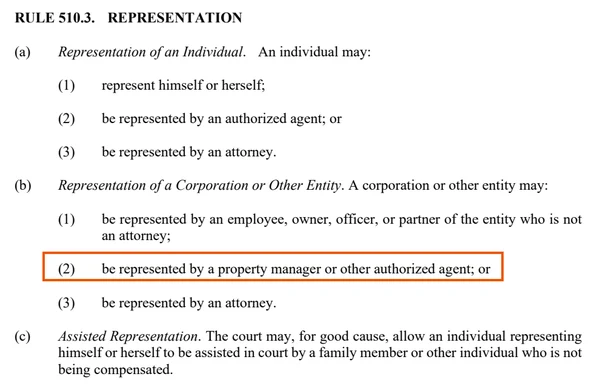
So an individual owner may appear personally, through an authorized agent or through an attorney, and a company owner, such as an LLC, through an employee or officer, a property manager or other authorized agent, or an attorney. Property Code 24.011(a) says the same for the justice court: the parties may be represented by authorized agents who need not be attorneys.
The common thread is that nobody is arguing. The tenant did not pay, the notice was right, the paperwork is clean, and the court decides possession. For that routine, a manager who files these cases is usually enough. Can a property manager handle an eviction? walks the stages; the Texas eviction process guide shows the timeline.
The situations that call for a landlord attorney
Call an attorney, and tell your manager you are doing it, when any of these appear:
- A contested eviction. The tenant files an answer raising a defense, such as a repair dispute or a claim that you accepted rent after the notice, or the tenant has a lawyer.
- An appeal of the justice court judgment, explained in the next section.
- A tenant bankruptcy filing. Stop collection and court steps and get advice before the next notice goes out.
- A deposit dispute in court. A landlord who in bad faith keeps a deposit is liable for $100, three times the amount wrongfully withheld and the tenant's attorney's fees, and keeping it past the 30th day without a refund or itemized list is presumed bad faith (Property Code 92.109).
- Fees or lease clauses in question. Collecting a late fee outside 92.019 carries $100, three times the fee and attorney's fees (92.019(c)), and a lease cannot waive the tenant's right to a jury trial (92.006(h)).
- An injury or property damage claim. Call your insurer first; the policy may provide a defense.
- Ownership questions. Moving the rental into an LLC, co-owner disputes, divorce, inheritance, or selling with a tenant in place.
- A tenant in military service who ends the lease: Property Code 92.017 gives a statutory right to terminate after entering military service or on qualifying orders, and federal law adds protections. Get advice before treating it as a default.
The appeal: where the manager's court role ends
In an eviction case, a party may appeal a justice court judgment by filing a bond, a cash deposit or a Statement of Inability to Afford Payment of Court Costs within 5 days after the judgment is signed, and a tenant who appeals must affirm a good-faith belief in a meritorious defense (Rule 510.19(a)). The case then goes to the county court.
Property Code 24.011(b) lets a non-attorney authorized agent represent the owner on appeal only in a nonpayment case and only for an owner of multifamily residential property. A single-family house or a condo owner is not covered by that sentence, so an appeal is where the owner of a house brings in an attorney. Plan for it as soon as a judgment is signed: the clock is short. Whether you need to be in court yourself covers the owner's own appearance. This is general information, not legal advice.
The gray zone: when a routine case turns legal
Some situations start routine and turn legal in a single step. A tenant who stays after the lease ends is a notice and an eviction, until they say you accepted rent and created a new tenancy (see holdover tenants in Texas). A tenant who disappears looks like an abandonment, until they come back and say they were locked out. A tenant who stops paying over a repair is a nonpayment case, until the judge asks whether the repair request was in writing and how long the repair took.
Self-help is the trap. Texas lets a landlord change the locks for unpaid rent only if that right is in the lease and the written notice steps in Property Code 92.0081 are followed, and otherwise a landlord may not intentionally keep a tenant out except by judicial process, apart from the narrow exceptions the statute lists, such as bona fide repairs or an emergency. The moment the tenant's position could be a defense in court, get an opinion before the next notice goes out. A manager who says they never need a lawyer is telling you how they handle risk. This is general information, not legal advice.
How the manager and the attorney work together
When a case crosses the line, the manager does not step back. They supply what the attorney asks for first: the signed lease and addenda, the rent ledger, every notice with proof of delivery, inspection reports with dated photos, repair records and the message history. A file built during the tenancy is cheaper to work from than one rebuilt after the dispute starts.
During the case, the manager keeps the property running: rent is still collected if it is paid, repairs are still made, the tenant keeps one point of contact, and nothing is said to the tenant that the attorney has not cleared.
Finding an attorney before you need one, and who pays
Do not look for a landlord attorney during an appeal's five-day window. Ask your manager whom they work with on contested residential cases in Tarrant County, and have one conversation now. Ask any attorney for the fee structure in writing before you engage them; fees vary by firm and by case.
The management agreement should say which legal costs are the owner's: attorney fees, court filing and service fees, and whether the manager's time in court is billed separately. Tarrant County's justice court and constable fees are on the county's pages, and eviction costs: what an owner pays sets out the split.
This is general information, not legal advice. For any situation in the table above, speak with a Texas attorney.
How Perpetual handles this
What our eviction service page states:
- Resolution first. We attempt a documented payment conversation, without letting it become stalling.
- Notices. The notice to vacate that Texas procedure requires, delivered and documented correctly.
- The paper trail. Ledger, lease, notices and communication history, organized and complete.
- Counsel when it is needed. Filing logistics and, where appropriate, coordination with an attorney experienced in landlord-tenant law. We are not a law firm and don't pretend to be. For contested cases or appeals, attorney involvement is wise, and we coordinate with landlord-tenant attorneys; many uncontested cases proceed without one, and we'll be straight with you about which situation you're in.
On the price sheet, the eviction service is included on Full Service and optional at $7.95 a month on Standard and Investor Special. Whether we appear at the hearing for you, what the eviction service covers, and which attorney and court costs are yours are confirmed in writing before you sign. Perpetual is broker-owned and manages homes in Keller, North Richland Hills and Fort Worth. Call 682-593-7033.
The takeaway: A manager runs the routine legal machinery of your rental, including an uncontested justice court eviction; an attorney takes over when the case is appealed or contested, the stakes are bigger than the rent, or the question is about who owns the property.
Questions owners ask
Can a property manager file an eviction in Texas without a lawyer?
Yes, in justice court. Texas Rule of Civil Procedure 510.3 lets an individual owner be represented by an authorized agent and a company owner by a property manager or other authorized agent, and Property Code 24.011(a) allows authorized agents who need not be attorneys. On appeal, 24.011(b) allows a non-attorney agent only for an owner of multifamily property in a nonpayment case, so a house owner usually needs an attorney there.
Do I need a lawyer to write my lease if I have a property manager?
Usually not. A manager uses Texas-compliant lease documents with property-specific addenda. You would want an attorney to review a lease for unusual terms, such as an option to purchase, a commercial use, or terms your HOA or lender imposes, or if you are changing a clause the Property Code controls.
Does my landlord insurance cover legal fees?
It depends on your policy and the claim. Liability coverage may provide a defense when someone is hurt at the property and sues you, which is why an injury claim goes to your insurer first. Ask your agent, in writing, what your policy covers for legal costs before you need it. This is general information, not insurance advice.
What does a landlord attorney cost in Texas?
It varies by firm, county and how contested the case is, so ask for the fee structure in writing before engaging anyone. Court filing and constable fees are separate and set by the county. Confirm which legal costs your management agreement treats as the owner's expense.
Can my property manager handle an eviction appeal in Texas?
Usually not for a house. Property Code 24.011(b) lets a non-attorney authorized agent represent the owner on appeal only in a nonpayment case and only for an owner of multifamily residential property. A tenant must appeal within 5 days after the judgment is signed (Rule 510.19(a)), so line up an attorney as soon as an appeal is filed. This is general information, not legal advice.
Does an LLC that owns a rental need a lawyer for an eviction in justice court?
Not under the current rule. Texas Rule of Civil Procedure 510.3(b) lets a corporation or other entity be represented in an eviction case by an employee, owner, officer or partner who is not an attorney, by a property manager or other authorized agent, or by an attorney. An appeal or a contested case is different.
My tenant says they will fight the eviction. Do I need a lawyer now?
That is the moment to get an opinion. A threat alone does not change the case, but an answer filed with a defense, such as a repair dispute or a claim that you accepted rent after the notice, turns a routine nonpayment case into a contested one. Ask your manager for the file (lease, ledger, notices with proof of delivery, repair records) and have a Texas attorney review it before the hearing.
Do I need a lawyer for a security deposit dispute?
Not to account for the deposit: the refund, with a written itemized list of any deductions, is generally due on or before the 30th day after the tenant surrenders the premises (Property Code 92.103, 92.104, 92.109(d)), and a manager handles that. Call an attorney if the tenant sues or claims bad faith, because 92.109 sets $100, three times the amount wrongfully withheld and attorney's fees against a landlord who acted in bad faith.
Property management in Keller, North Richland Hills and Fort Worth. How full-service management works in Tarrant County →