Key takeaways
- Texas Property Code 92.001 defines the landlord as the owner, lessor or sublessor, and leaves out a manager or agent unless the manager claims to be the owner in the lease.
- Bills stay with you: mortgage, property tax, insurance and HOA dues, plus any repair cost above what rent and the reserve cover.
- The manager carries out many landlord duties for you (repairs, deposit accounting, the ownership disclosure), but the duty itself is written on the landlord.
- Decisions above your spending limit, the renewal rent, an eviction filing and a sale need your yes.
- The management agreement is where the split is written down; read it for each duty in the table below.
After hiring a property manager, you are still responsible for the house as its owner and, under Texas law, as its landlord. The manager acts as your agent: it collects the rent, coordinates repairs, handles the tenant and keeps the records, inside the authority your management agreement gives it. The mortgage, property tax, insurance, large repair costs, the big decisions and the information only you have stay with you, for a rental in Fort Worth, Keller, North Richland Hills or anywhere in Texas.
This guide splits the owner's duties into three groups: what stays with you, what you delegate, and what is shared. It shows the Property Code sections behind the split and the sentences to find in your agreement. The hours this leaves you are covered in how passive a rental can really be.
The duty split: what stays with you, what you delegate, what is shared
The table sorts the duties a Texas rental owner carries into three groups and names the sentence the management agreement should contain for each. "Delegated" means the manager does the work for you; it does not mean the legal duty moved:
| Duty | Stays with you, delegated or shared | What the agreement must say |
|---|---|---|
| Being the landlord (Property Code 92.001) | Stays with you | That you are the owner and the manager signs leases and notices as your agent |
| Receiving legal papers if a tenant sues (92.003) | Shared: the management company can be your agent for service | How fast and by what method the manager forwards any papers it receives |
| Telling the tenant who owns and who manages (92.201) | Delegated | Who gives the disclosure, and that you report any change of your name or address |
| Repairs that affect health or safety (92.052) | Shared: the manager coordinates, you pay | Your spending limit, emergency authority and how you are told about larger jobs |
| Security devices and smoke alarms (92.153, 92.255) | Shared | Who checks them at move-in and who pays for missing devices |
| Refunding the security deposit (92.103) | Delegated in practice; the duty is the landlord's | Who holds the deposit, in what account, and who signs the move-out accounting |
| Mortgage, property tax, insurance, HOA dues | Stays with you | Whether the manager pays any bill from rent, and from which funds |
| Renewal rent, capital repairs, eviction filing, sale | Stays with you; the manager recommends | Which decisions need your written approval |
| Loan, insurance and HOA information, known defects | Stays with you | That you report changes promptly, and to whom |
How to read this table: the middle column tells you who acts; the right column tells you where to look before you sign. Where a row says "shared", the manager does the work and you supply the money or the decision. If the agreement is silent on a row, the question is still open, so ask for the sentence in writing. The jobs a full-service plan leaves on your desk are listed one by one in what full-service property management leaves out.
Five groups of duties that stay with the owner
Everything an owner keeps after hiring a manager falls into five groups:
- Money you pay: mortgage, property tax, insurance premiums, HOA dues (unless the agreement has the manager pay them from rent), and any repair or improvement cost above what rent and the reserve cover.
- Decisions that need your yes: repairs above your spending limit, capital projects, the renewal rent, whether to file an eviction, and whether to sell.
- Information only you have: the loan, the insurance policy, warranties, HOA documents, known defects and any change in your plans.
- Legal standing: you are the landlord; the manager is your agent.
- Attention: reading statements, answering approval requests and the year-end work with your CPA.
The sections below take the money, the decisions and the information in turn, then the group owners most often get wrong: who Texas law treats as the landlord once a manager is in place.
The money that stays yours to pay
Rent comes in through the manager, the management fee and any repair invoices come out, and the rest is disbursed to you. The manager does not pay your mortgage, your property tax bill or your insurance renewal unless the agreement specifically says so. Those bills stay yours, on their own due dates, whether the house is occupied or empty.
You also fund the work. Routine repairs are paid from rent and any reserve the manager holds, but a roof, a foundation repair or an HVAC replacement can exceed both, and then the money comes from you. How big a reserve to keep, and where, is covered in how much reserve to keep per rental. Insurance is the bill owners most often forget to change when a home becomes a rental: landlord insurance versus homeowners insurance explains what changes.
The decisions that need your yes
A management agreement sets a spending limit below which the manager can approve a repair without asking you. Above it, you decide. Illustrative only: with a limit of a few hundred dollars, a faucet repair simply happens and shows on your statement, while a water heater replacement arrives as an estimate and a recommendation and waits for your answer. The level is yours to choose.
Beyond repairs, you decide the renewal rent (the manager recommends, you choose), whether to let a tenant end a lease early, whether to file an eviction, and when to sell. These decisions stay with you because they spend your money and set your risk. Renewals in particular are covered in do owners approve lease renewals, and the way repair approvals flow is on our maintenance service page.
The information only you can provide
A manager can inspect a house, but cannot know what you know. Before the first tenant, the manager needs:
- Your loan details, and an answer from your loan documents or your servicer on whether renting the house is allowed.
- The insurance policy, so the manager knows it is a landlord policy and how a claim is reported.
- HOA documents, leasing rules and the association's contact.
- Appliance and system warranties, and any home warranty you intend to keep.
- Known defects and prior repairs.
- Your plans: if you may sell or move back in, the lease term should reflect it.
This is an ongoing duty. A refinance, a new insurer or a change of your name or mailing address needs to reach the manager promptly. Section 92.201 requires the landlord to disclose the name and address of the holder of record title, and the name and street address of an off-site management company, so a stale record becomes the manager's problem and then yours.
Texas law still calls you the landlord
The Texas Property Code answers the question in its definitions. Section 92.001(2) says "Landlord" means "the owner, lessor, or sublessor of a dwelling, but does not include a manager or agent of the landlord unless the manager or agent purports to be the owner, lessor, or sublessor in an oral or written lease." So when the lease names you as owner and the manager signs as your agent, the chapter 92 duties written on "the landlord" are written on you.
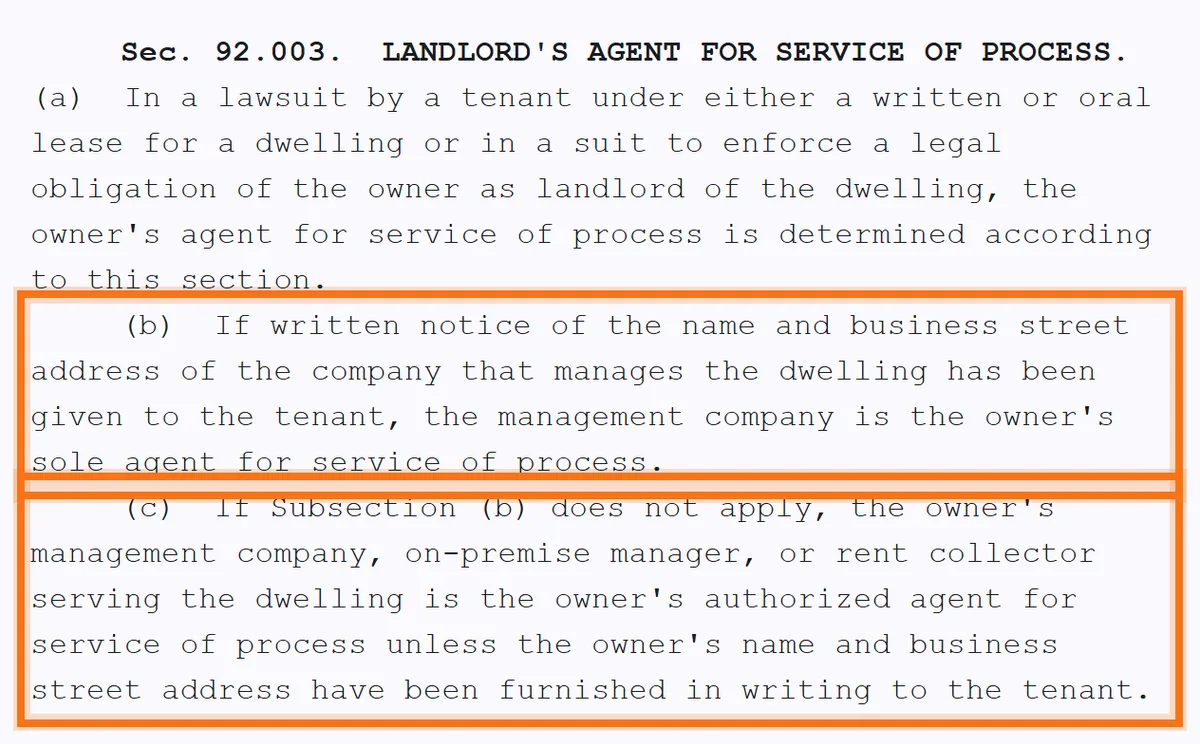
Section 92.003 deals with lawsuits. If the tenant has been given written notice of the name and business street address of the company that manages the dwelling, "the management company is the owner's sole agent for service of process." In plain terms, papers in a tenant's suit to enforce a legal obligation of the owner as landlord can be served on your manager, which is why the agreement should say how fast they reach you.
Good management lowers the chance of a dispute because the lease, the notices, the deposit accounting and the repair records are done in order. It does not change who the landlord is. This is general information, not legal advice; for a question about your own liability, ask a Texas attorney.
Reading what you are sent
The quietest responsibility is reading what you are sent. A statement left unopened for six months is how an owner finds a repeating repair, a rent that never moved or a reserve that ran dry after the chance to act has passed. A few minutes each month with the statement in the owner portal is the whole job; how to read your monthly owner statement walks through the lines.
Answering approval requests promptly matters as much. A repair estimate that sits in your inbox for a week is a tenant living with a problem for a week, and under Property Code 92.052 a landlord must make a diligent effort to repair a condition that materially affects the physical health or safety of an ordinary tenant once the tenant gives the required notice. If you travel, tell the manager how to reach you and consider whether your spending limit fits.
How Perpetual splits the duties with you
Perpetual Property Management is broker-owned, with our office at 5755 Rufe Snow Dr, Suite 155, in North Richland Hills, managing rentals in Keller, North Richland Hills, Fort Worth and nearby cities. What our site states about the split:
- Repairs: spending limits are agreed with you in advance; routine repairs under your pre-approved limit get fixed fast, and anything larger comes to you with a description, photos and a recommendation.
- Renewals: we bring a recommendation with reasoning, and the decision is always yours.
- Deposits: held, accounted for, and returned (or properly itemized) on the statutory timeline, with a 360-degree condition inspection at every move-in and move-out.
- Records: statements, documents and disbursement history in the AppFolio owner portal; rent we collect is disbursed by the 10th of each month.
- Every plan: an annual property inspection, 24/7 emergency response and the online owner portal.
The rest of the split, including whether we pay any bill such as HOA dues from rent, how we forward legal papers and the size of the reserve, is confirmed in writing in the management agreement before you sign. Every fee is in that agreement, and if a fee is not in it, you do not pay it. Read how our property management works, or call 682-593-7033.
The takeaway: A manager takes the daily work and the tenant contact, but you remain the landlord under Texas law: keep paying the house's bills, keep answering the decisions above your limit, and make sure the agreement says which duties the manager carries out in your name.
Questions owners ask
Does a property manager pay my mortgage and property taxes?
Not as a standard service. Rent is collected and disbursed to you after the management fee and any repair invoices, and you pay your own mortgage, property tax and insurance from that. An agreement can arrange for a specific bill, such as HOA dues, to be paid from rent, but it must be written into the agreement, and it does not change whose bill it is.
Can the manager approve repairs without asking me?
Only up to the spending limit in your management agreement, and in emergencies as the agreement defines them. Above the limit, you receive an estimate and a recommendation and the work waits for your approval. You can set the limit higher or lower to match how involved you want to be.
Am I still liable if the manager makes a mistake?
Often, yes. Property Code 92.001 defines the landlord as the owner, lessor or sublessor and leaves out a manager or agent unless it claims to be the owner in the lease, so the landlord's duties stay written on you. Whether the manager must reimburse you for its mistake depends on the management agreement. This is general information, not legal advice; ask a Texas attorney about your situation.
Do I need to keep my own emergency fund if the manager holds a reserve?
Yes. A reserve held by a manager is meant for routine repairs and timing gaps, not for a roof or a foundation. Keeping your own fund for large, infrequent costs turns a major repair into a decision rather than a crisis, and lets you approve the right fix instead of the cheapest one.
If a tenant sues, who gets the papers, me or the manager?
Property Code 92.003 says that if the tenant has been given written notice of the name and business street address of the company that manages the dwelling, the management company is the owner's sole agent for service of process. So the papers may go to your manager. Make sure the management agreement says how quickly and by what method they are forwarded to you.
Who is responsible for returning the security deposit when a manager holds it?
Property Code 92.103 puts the duty to refund the deposit on the landlord, on or before the 30th day after the tenant surrenders the premises, subject to the forwarding-address rule in 92.107. A manager usually does the accounting, but the agreement should say who holds the deposit and who signs the move-out accounting. Our leasing page says deposits are held, accounted for and returned or itemized on the statutory timeline.
Does hiring a property manager change my insurance or mortgage?
The manager does not change either contract, but renting the house can. Read your loan documents or ask your servicer whether renting is allowed, and ask your insurance agent whether your policy covers a rented home. Give the manager a copy of the landlord policy so it knows how a claim is reported.
Property management in Keller, North Richland Hills and Fort Worth. How full-service management works in Tarrant County →