Key takeaways
- Monthly rent and routine repairs under your spending limit can run with no decision from you.
- Repairs above the limit, insurance claims, renewals, turnover budgets and court cases still reach you.
- The fewer standing instructions you give at signing, the more questions you answer later.
- A funded reserve is what lets repairs proceed without waiting for your transfer.
- Hands-off still means reading the monthly statement; the guarantees and limits only help if someone checks them.
You can be nearly hands-off with a rental property, not completely. A full-service manager can run rent, routine repairs, inspections and the paperwork without you, but a short list of decisions stays yours because it is your money or your legal position: large repairs, insurance claims, the renewal, the turnover budget and any court case. Whether the house is in Fort Worth, Keller or North Richland Hills, the goal is few decisions, each arriving ready to answer.
This guide walks a year of events in a table, then the setup that keeps the list short. The jobs of ownership that sit outside management altogether, such as insurance, property tax and the mortgage, are in what full-service property management leaves out.
A year with a managed rental: what runs without you and what comes back
Here is what a year with a managed rental usually contains, event by event, with the part the manager handles and the decision that still comes to you:
| Event over a year | What the manager handles | The decision that still reaches you |
|---|---|---|
| Rent each month | Collects rent, applies late fees as the lease states, pays bills from the reserve, sends the statement and payout | None, beyond reading the statement |
| Routine repair under your limit | Takes the tenant's request, sends a vendor, posts the invoice | None; you set the limit once |
| Repair above your limit | Brings a description, photos and a recommendation | Approve, decline or ask for a second quote |
| Emergency at night | Stops the damage under the emergency process the agreement allows | Any large follow-up repair, and whether to claim on insurance |
| Storm or freeze damage | Photos, the tenant's account, vendor estimates, access for the adjuster | Filing the claim on your policy and paying the deductible |
| Inspection | Inspects inside and posts a photo report with recommended actions | Which recommendations to fund now |
| Renewal | Checks current leased comps and sends a recommendation before lease end | Renew or not, and at what rent |
| Tenant gives notice | Move-out inspection, deposit itemization, make-ready plan, new listing | The make-ready budget and the new rent |
| Rent stops and does not resume | Notices and the eviction process, with the paper trail | Whether to go to court, and hiring an attorney if needed |
| Year-end | The year's statements and records | Your tax return and any property tax protest |
How to read this table: the first two rows happen every month and need nothing from you. Everything below them is a decision about your money or your legal position, which is why it comes back to you. Hands-off means those decisions arrive ready to answer, with the facts attached, not that they stop arriving.
The standing instructions that keep the list short
Hands-off is a set of instructions you give once, at signing, so the manager does not have to ask again. Put each one in the management agreement or a signed addendum:
- A repair spending limit high enough that routine work proceeds without you, plus what the manager may do in an emergency to stop damage before reaching you.
- A funded reserve, sized to the age of the house's systems, so repairs are not held up waiting for your transfer. How to size it is in how much reserve to keep per rental.
- Your renewal preferences, so the recommendation you receive already reflects them, even though the final call stays yours.
- Your contact preferences: email for approvals, a phone call only for emergencies, and a backup person who can approve if you cannot be reached.
Owners who skip this step answer questions a standing instruction would have answered. What happens when an emergency needs approval and you cannot be reached is covered in emergency repair when the manager can't reach the owner.
Set the spending limit and the reserve together
A spending limit only keeps you out of routine repairs if the reserve can pay for them. The two numbers belong in the same conversation. An illustrative example only, not a quote and not a recommendation for your house: say your limit is $400 and, in a bad month, three routine repairs come in at $180, $250 and $320.
- Each is under the $400 limit, so none needs your approval.
- Together they cost $180 + $250 + $320 = $750 (check: $750 - $320 = $430, and $430 - $250 = $180).
- If the reserve holds less than $750 and rent has not yet come in that month, at least one repair waits for your transfer, and you are back in the loop.
So when you raise the limit to hear less, raise the reserve with it. A house with older systems usually needs both set higher. What happens when the reserve runs short is explained in what happens if there isn't enough money in your reserve for a repair.
The decisions that will always reach you
However good the setup, these decisions come back to you, and they should:
A large repair or replacement. A roof, a foundation, a full HVAC system. The manager brings the description, photos, bids and a recommendation; the money and the repair-or-replace choice are yours.
An insurance claim. Hail, a burst pipe in a freeze, a fallen tree. The policy is in your name, so the claim is yours, with the manager supplying photos, estimates and access. Who does what is in property manager and insurance claims.
The renewal and the turnover. Keeping the tenant and at what rent, or the make-ready budget and the new listing price if the tenant leaves.
Legal action. An eviction suit or a deposit dispute in court. You are the party, so you must be reachable and you decide whether to proceed and whether to hire an attorney.
The turnover: the busiest stretch of a hands-off year
If the tenant gives notice, the quiet year gets busier for a few weeks, and that is normal. Expect three things to reach you in a short span. First, the move-out inspection report with photos, compared with the move-in record. Second, the deposit decision: under Property Code 92.103(a), a refund, with a written itemized list of any deductions, is due on or before the 30th day after the tenant surrenders the house, and 92.104(b) bars deductions for normal wear and tear. Third, the make-ready scope and budget, and the rent for the new listing.
You can keep this stretch short by deciding two things in advance: the make-ready amount the manager may spend without asking, and whether you want a renewal or a turnover recommendation first. While the house is vacant, a written weekly report is the minimum you should ask any manager for. This is general information, not legal advice.
Hands-off is not the same as unaware
The owners who regret hands-off ownership are rarely the ones who delegated too much. They are the ones who stopped looking. A manager runs the house, but only you can notice that the rent has not moved in three years, that one repair keeps coming back, or that the reserve has slipped below the agreed level.
The habit takes about fifteen minutes a month: open the statement, scan the repair lines against their invoices, check the reserve balance, and read any inspection report since the last one. Once a year, take the year's statements to your CPA. How to read your monthly owner statement shows what each line means.
Where hands-off goes wrong
Three patterns break a hands-off arrangement, and all three are avoidable:
- The unfunded reserve. The owner wants no calls but keeps a token reserve, so every repair becomes a request for money. Fund it properly and keep your own cushion beyond it.
- The unanswered approval. The owner is hard to reach and has no backup, so the tenant waits on a water heater while the estimate sits unopened. A realistic limit, an emergency clause and a named backup fix it.
- The unread statement. Months of silence feel like success until a pattern that should have been caught becomes a cost. The fifteen-minute habit above fixes it.
The goal is not zero contact but only useful contact; what owner communication to expect describes a healthy rhythm. Why ownership never becomes fully passive is in how passive a rental really is.
Some houses are easier to be hands-off with
A newer house in good condition with a well-screened tenant can run nearly silently. An older house with original plumbing, an aging roof or a pool will produce more decisions no matter who manages it. If you are buying with hands-off ownership in mind, the age of the roof, HVAC and plumbing matters more than the finishes.
If you already own the house, an inspection when management begins tells you which systems are likely to produce decisions, so you can handle them on your schedule rather than the tenant's. Our price sheet lists that enrollment inspection at $125 on the Investor Special, $49 on Standard and included on Full Service. If you live far from the house, the remote setup is in the out-of-state owner guide.
How Perpetual sets up a hands-off owner
Perpetual Property Management is broker-owned and manages homes in Keller, North Richland Hills, Fort Worth and the surrounding Northeast Tarrant County cities. On the items in this guide, our site states:
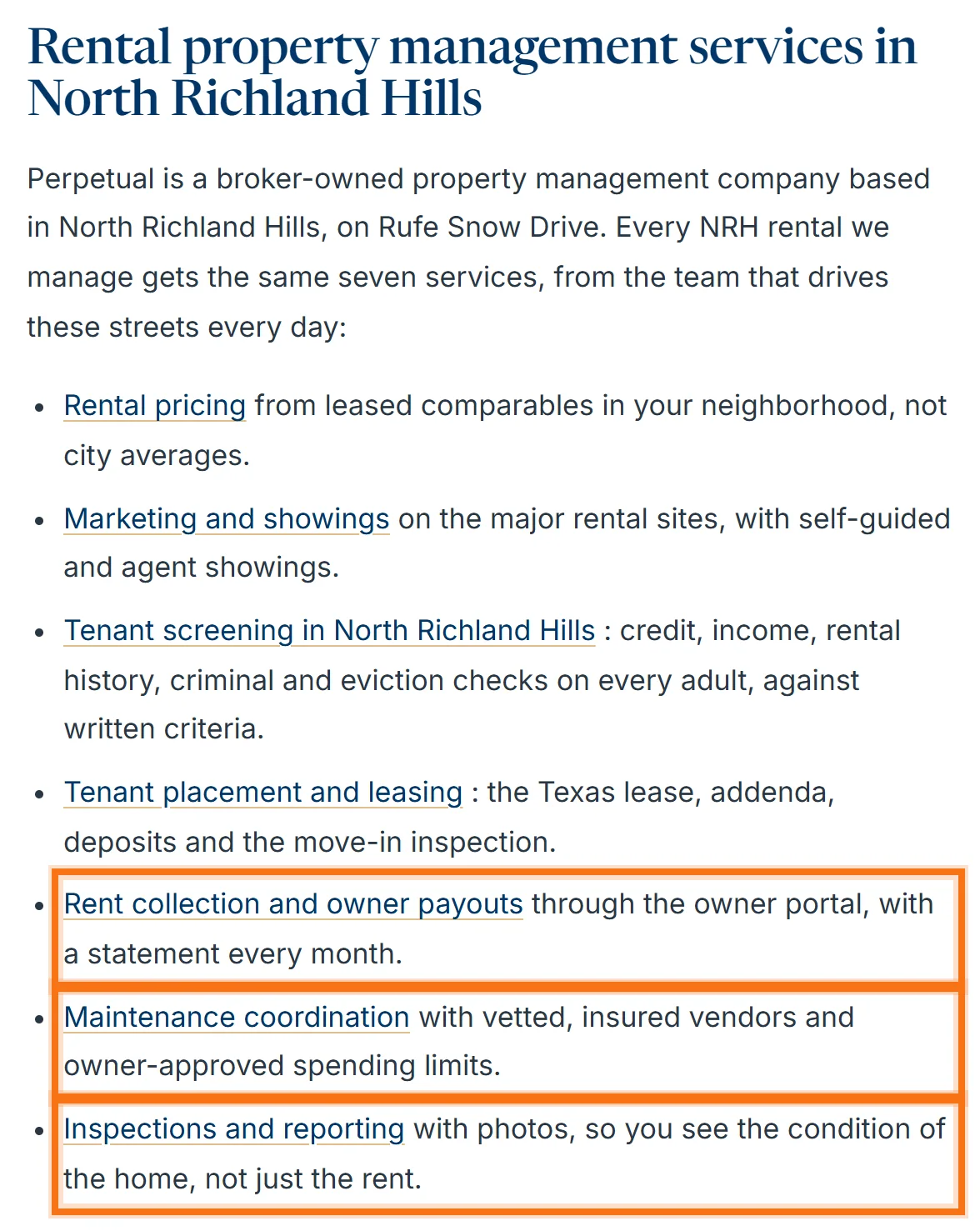
- Repairs: spending limits are agreed with you in advance; routine items get fixed fast, and anything larger comes to you with a description, photos and a recommendation. Tenants report requests through their portal. Emergencies follow a 24/7 process (maintenance coordination).
- Communication: calls and emails answered within one business day and a written activity report every week while the home is vacant, or that month's fee is credited.
- Money: rent disbursed by the 10th of each month, or that month's fee is waived; monthly statements in the Owner Portal.
- Inspections: an annual property inspection on every plan, with a photo report in your portal (inspections and reporting).
- Renewals: conversations typically 60 to 90 days before lease end, with a recommendation; the decision is always yours.
The guarantees are subject to our Guarantee Addendum. Your spending limit, reserve amount and emergency authority are confirmed in writing in your management agreement. Call 682-593-7033 to set them up.
The takeaway: A rental can run nearly silently if you set the spending limit once, fund the reserve, name a backup contact and read the statement each month. Hands-off means few decisions, each one arriving with the facts, not none.
Questions owners ask
What is a reasonable repair approval threshold for a hands-off owner?
High enough that routine repairs such as a plumbing fix, an appliance service call or minor electrical work proceed without a call, and low enough that you see a replacement decision before it happens. The right number depends on the age of the house, the size of your reserve and your comfort. Put it in the management agreement, and raise the reserve if you raise the limit.
Will my property manager contact me every time something breaks?
Not if the agreement sets a spending limit. Repairs under it are handled and show on the monthly statement with the invoice; items above it come to you with a description, photos and a recommendation. That is how our maintenance process works. If you get a message for every small repair, the limit is too low or the agreement is not being followed.
Can I be hands-off if I live overseas or travel often?
Yes, with the same setup and two additions: email or the portal as the approval channel so time zones do not matter, and a backup person who can approve if you cannot be reached for a while. Payouts go to your bank and the owner portal works from anywhere. Taxes for an owner abroad are a question for your CPA.
Is a hands-off rental still a good investment if I never visit the house?
It can be, if you read what the manager sends. Inspection photo reports stand in for your own visits on condition, and the statements show the money. What you give up is your own feel for the street, so ask the manager to explain its renewal and pricing recommendations with the leased comparables behind them.
Which rental decisions can a property manager not make for me?
Usually anything that is your money above the agreed limit or your legal position: a large repair or replacement, an insurance claim on your policy, the renewal rent, the make-ready budget at turnover, filing an eviction and hiring an attorney, and selling the house. The agreement should say which of these the manager may act on and which need your written approval.
Do I need to do anything while my rental is vacant?
A few decisions: the make-ready scope and budget, the listing rent, and any change if the house is not leasing. The manager handles the cleaning, repairs, listing, showings and applications. At Perpetual, a market-ready home is live on every major rental platform within 5 business days or the first month's management fee is waived, and you get a written activity report every week while it is vacant, subject to the Guarantee Addendum.
How often will I hear from my property manager if I want to be hands-off?
With a limit and reserve in place, mainly through the monthly statement and any inspection report, plus a message when a decision above your limit, a claim or the renewal comes up. Under our communication guarantee, calls and emails are answered within one business day, and while the home is vacant you get a written activity report every week.
Property management in Keller, North Richland Hills and Fort Worth. How full-service management works in Tarrant County →