Key takeaways
- Rent and security deposits a Texas broker holds are trust money (TREC rule 535.146(a)).
- A broker may only disburse trust money in accordance with the agreement under which it was received (535.146(d)(1)).
- So the gap is covered from your money: held rent, your contribution, or an advance only if the agreement provides one.
- The tenant's deposit is not a repair fund during the lease.
- A health or safety repair does not wait for the account to balance.
If your reserve is too small for a repair, the repair still gets done and the shortfall is covered from your side: the manager holds back your next rent payout, asks you to send a contribution, or advances funds if your agreement allows it. It cannot be paid with another owner's money or the tenant's deposit. For owners in Fort Worth, Keller and North Richland Hills, the management agreement decides which path comes first.
This guide walks the sequence: the trust-money rules, the three ways to cover the gap, how it looks on your statement, and an illustrative month added up two ways.
What the reserve is for, and why it runs short
The owner reserve is a balance the manager keeps on your ledger so routine repairs can be paid when the invoice arrives, without waiting for rent or for you. It covers the service call and the small part. It was not sized for a water heater, a condenser or a sewer line, so when one of those lands, the reserve runs out and the next few weeks become a cash-flow question.
How the reserve and the monthly payout work together in a normal month is in owner reserves and disbursements. This guide is about the month it does not balance.
What the manager may and may not do with trust money
A Texas real estate broker who holds rent for you is holding trust money. TREC rule 535.146 sets the limits that matter in a short month:
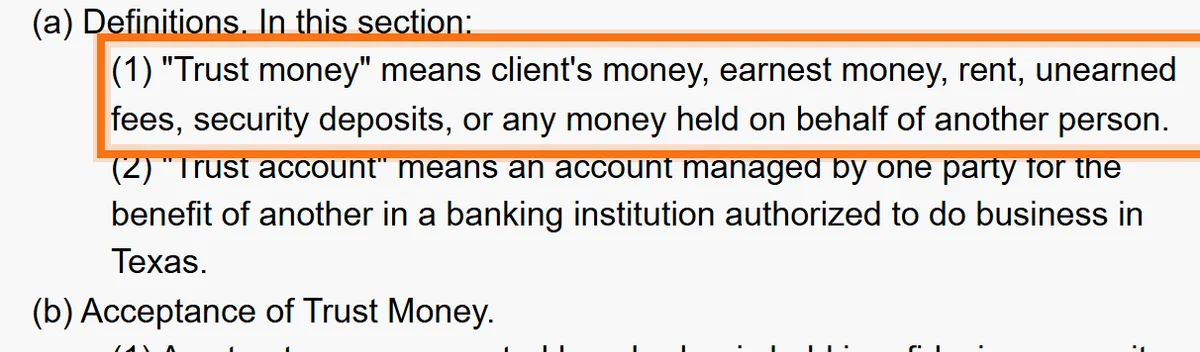
- Disburse only under the agreement. "A broker may only disburse money from the broker's trust account in accordance with the agreement under which the money was received" (535.146(d)(1)). Your rent can pay your vendor because your agreement says so.
- No commingling. The broker may not commingle trust money with the broker's personal money or other non-trust money (535.146(b)(4)).
- One account is allowed. A broker may, but is not required to, keep separate trust accounts for each client (535.146(c)(2)). That is why the ledger matters: each owner's balance is tracked inside the account.
- Monthly accounting. The broker must give an accounting to each beneficiary at least monthly if there has been any activity (535.146(c)(6)).
Read together: when your ledger is short, the money to finish paying your vendor must come from you. Another owner's balance was received under that owner's agreement. How these rules protect your money generally is in how to know your rent and deposit are protected. This is general information, not legal advice.
The shortfall in order, from failed part to restored reserve
Most short months follow the same six steps. Knowing them lets you answer quickly at the one point where the manager needs you:
- The tenant reports the problem. If it affects health or safety, the repair clock is already running, whatever your balance.
- The quote comes in above your spending limit. The manager sends it to you with a recommendation. This is your decision point: approve, ask for a second quote, or choose repair over replacement.
- The work is done and the invoice arrives. The manager compares it with your ledger: reserve on hand plus any rent already received.
- The gap is named. You should get the exact figure and the path the agreement sets: rent held, a contribution, or an agreed advance.
- The statement shows it. The invoice, the fee, a reduced or zero payout, and a negative balance if the gap is still open.
- The reserve is rebuilt. The next rent, or your transfer, brings the balance back to the agreed reserve before payouts return to normal.
Steps 2 and 4 are the only ones that wait on you. A same-day answer at step 2 keeps the tenant's repair moving; a clear instruction at step 4 decides whether your next payout arrives or is held. If you will be hard to reach, say in writing ahead of time which path you prefer and up to what amount.
The three ways a shortfall gets covered
1. Your next rent is held. The manager pays the rest of the invoice from the next rent received and sends you what is left, or nothing that month, until your balance is back to the reserve. This works only when rent is coming in.
2. You send a contribution. The manager asks you to transfer the difference. This is the only path when the house is empty, and the faster one when the invoice is larger than a month's rent.
3. An advance, only if the agreement provides one. Some agreements let the manager advance funds, sometimes with a charge. If yours does not say so, do not assume it; if it does, the charge belongs in the written fee schedule, not on a surprise statement line.
Which path comes first is a term of your management agreement. If it is silent, send a short note saying what you prefer, for example "hold rent first, ask me for a contribution above $1,000," and keep the reply.
How a shortfall shows on your statement
The month of a large repair, your statement shows the rent received, the repair invoice as an expense, the management fee, and a payout that is reduced or zero. If the invoice exceeded rent and reserve together, you see a negative balance, which carries into the next month until rent or your contribution clears it.
That is normal as long as each line is explained: the invoice behind the expense, your approval if it was above your limit, and a reserve that returns to its usual level. A negative balance that lasts for months with no large repair to explain it is a question to put to your manager in writing. Line by line: how to read your monthly owner statement.
One shortfall month, added up two ways
Illustrative only, not a quote. Say the reserve held is $300, rent is $2,000, the manager charges 9% of the rent ($180), and you approve a $2,600 condenser replacement. Money in: $300 + $2,000 = $2,300. Money out: $180 + $2,600 = $2,780. The shortfall is $480. Here are the two usual ways it clears:
| Line | Path A: you send $480 | Path B: next rent is held |
|---|---|---|
| Month 1: reserve + rent in | $2,300 | $2,300 |
| Month 1: fee + invoice out | $2,780 | $2,780 |
| Month 1: your contribution | $480 | $0 |
| Month 1: payout to you | $0 | $0 (balance -$480) |
| Month 2: rent in | $2,000 | $2,000 |
| Month 2: fee, old balance, reserve top-up | $180 + $0 + $300 | $180 + $480 + $300 |
| Month 2: payout to you | $1,520 | $1,040 |
| Two months, net to you | $1,520 - $480 = $1,040 | $1,040 |
How to read this table: both paths leave you $1,040 better off over the two months, and the vendor is paid either way. The difference is timing: Path A costs you $480 now and pays $1,520 next month; Path B sends nothing now and $1,040 next month. Checked twice: $1,520 + $180 + $300 = $2,000, and $1,040 + $180 + $480 + $300 = $2,000.
Three things that should never cover the gap
- Another owner's money. Rent and deposits held for another owner are trust money held on that owner's behalf (535.146(a)), and disbursements must follow the agreement under which the money was received (535.146(d)(1)). A manager who floats your repair on someone else's balance has a bigger problem than your invoice.
- The tenant's security deposit. Texas lets the landlord deduct from the deposit "before returning" it, for damages and charges the tenant is legally liable for (Property Code 92.104(a)). It is held for the end of the tenancy, not as a float for your repairs.
- Waiting on a health or safety repair. Once a current tenant gives notice of a condition that materially affects health or safety, the landlord must make a diligent effort to repair it (92.052(a)), and seven days is presumed reasonable (92.056(d)). A short account does not pause that clock; see Texas landlord repair obligations.
This is general information, not legal advice.
Sizing the reserve so it happens less often
Two separate amounts do two separate jobs. The reserve in the management account covers routine work without a phone call. A larger repair fund, kept by you, covers the systems that fail expensively. How to size each is already worked out in how much reserve to keep per rental and how much money a property manager keeps in reserve.
What this month should teach you: note the age of the roof, HVAC system, water heater and main sewer line from the last inspection, and ask the manager to flag any that are near the end of their life. A vacant month is the riskiest, because there is no rent to hold, so plan the make-ready money before the tenant moves out.
How Perpetual handles reserves and repair invoices
What our site states, and nothing beyond it:
- Spending limits: agreed with you in advance; routine items get fixed fast, and larger items come to you with a recommendation (our FAQ).
- Statements and payouts: disbursements and monthly statements through the online Owner Portal, with income, expenses and documents in one place. Our Owner Portal holds your statements, documents and disbursement history on our secure AppFolio system.
- Invoices: maintenance coordination is a percentage of the vendor's invoice, and the original invoice is always in your portal (our price sheet).
- Fees: every number is confirmed in writing before you sign, and if a fee is not in the agreement, you do not pay it.
The reserve amount, the order in which a shortfall is covered and whether funds are ever advanced are confirmed in writing in your management agreement. Questions about a statement: call 682-593-7033.
The takeaway: When a repair outruns the reserve, the money comes from you: held rent, a contribution or an agreed advance, never another owner's funds or the tenant's deposit. Decide your preferred order in writing before the month it happens.
Questions owners ask
Will a property manager pay for a repair and bill me later?
Only if your management agreement provides for an advance; some do, sometimes with a charge that should be in the written fee schedule. More often the manager holds your next rent payout until the invoice is covered, or asks you for a contribution. Over two months the cost to you is the same; only the timing differs.
Can the manager use the tenant's security deposit to pay for a repair?
No. Texas lets the landlord deduct from a security deposit before returning it, for damages and charges the tenant is legally liable for (Property Code 92.104(a)). The deposit is held for the end of the tenancy, not as a repair fund, and a broker may only disburse trust money under the agreement it was received for (TREC rule 535.146(d)(1)).
What if I cannot send an owner contribution right away?
Tell the manager in writing and agree a plan, such as holding two months of rent instead of one. Do not go silent: the vendor still has to be paid, and a health or safety repair cannot wait for your account to balance. If the house is vacant, there is no rent to hold, so a contribution is the only way through.
Does a vacant house make a reserve shortfall worse?
Yes, because there is no incoming rent to hold. During a vacancy, anything beyond the reserve has to come from you directly, and make-ready work between tenants is often the largest expense of the year. Ask for the make-ready estimate before the tenant moves out, and keep that money ready.
Can a property manager use another owner's money to pay my repair?
No. Under TREC rule 535.146, rent and any money held on behalf of another person are trust money, and a broker may only disburse trust money in accordance with the agreement under which it was received. Your shortfall is covered from your own funds: held rent, your contribution, or an advance your agreement allows.
What does a negative balance on my owner statement mean?
It means more went out of your ledger that month than came in, usually because a repair invoice exceeded the rent and reserve together. The balance carries forward until the next rent or your contribution clears it. Check that a large, explained invoice sits behind it; a negative balance with no such invoice is a question for your manager.
Who decides how a reserve shortfall is covered?
Your management agreement, first. It may say rent is held, a contribution is requested, or funds may be advanced, and in what order. Where it is silent, your written instruction fills the gap: for example, hold rent for amounts under a figure you choose and ask you for a transfer above it. Keep the manager's written reply with your agreement.
Should I keep a bigger reserve with the manager or my own repair fund?
They do different jobs. The reserve with the manager pays routine invoices without a phone call; a repair fund you keep covers the large items, such as a roof or HVAC replacement, that you approve anyway. One workable split is a modest reserve with the manager and a larger fund of your own. Our guide on how much reserve to keep per rental shows how to size both.
Related services
Property management in Keller, North Richland Hills and Fort Worth. How full-service management works in Tarrant County →