Key takeaways
- The manager's part is small: an owner reserve, which stays your money, and any setup or enrollment fee.
- The house's part is larger: make-ready, rekeying and safety items, insurance, utilities, HOA fees and the mortgage until first rent.
- Texas Property Code 92.156 requires rekeying at the landlord's expense within seven days after a new tenant moves in.
- In the illustrative example, a vacant house needs $7,054 on day one; with a tenant in place, $2,049.
- A leasing fee is usually charged when a tenant is placed, not at signing; ask how yours is collected.
How much cash do you need upfront to start with a property manager? For the manager itself, usually just an owner reserve and any setup or enrollment fee. For the house, much more: the make-ready, rekeying and safety items, landlord insurance, utilities and HOA fees while it is empty, and the mortgage until the first rent arrives. For a rental in Fort Worth, Keller or North Richland Hills, list each item with your own quotes.
Below is the day-one list with a column for your numbers, the rules behind the safety items, an illustrative total added up twice, and what changes when a tenant is already in place.
The day-one cash list
Here is every item, who sets the amount, when it is due, an illustrative example and a column for yours:
| Item | Who sets the amount | When it is due | Illustrative | Yours |
|---|---|---|---|---|
| Owner reserve (stays your money) | Your management agreement | At signing | $500 | ____ |
| Setup or enrollment fee | The manager's price sheet | At the start | $49 | ____ |
| Make-ready (cleaning, paint, repairs) | Your vendor quotes | Before listing | $1,800 | ____ |
| Rekeying | Locksmith quote | Within 7 days after the tenant moves in | $150 | ____ |
| Security devices and smoke alarms | Parts and labor quote | Before the tenant moves in | $120 | ____ |
| Landlord insurance, first payment | Your insurer | Before the house is rented | $1,500 | ____ |
| Utilities while vacant | Your utility bills | Each month the house is empty | 2 x $180 = $360 | ____ |
| HOA move-in or transfer fee | Your HOA | If and when the HOA charges it | $100 | ____ |
| Mortgage, tax and HOA dues until first rent | Your mortgage statement | Each month before the first rent | 1.5 x $1,650 = $2,475 | ____ |
| Day-one total | $7,054 | ____ |
How to read this table: the first row is still your money, held for repairs; everything else is spent. The last row is the one owners forget, and in the example it is the largest. If your insurance is escrowed in the mortgage payment, it is already in the last row, so leave the insurance line at zero. Illustrative only, not a quote.
What the manager asks for at the start
Most management agreements ask for one or two things at the start.
- An owner reserve. An amount held so repairs can be paid without waiting for you. It is not a fee: it is your money, held for your house. In Texas, rent and money held for an owner by a real estate broker are trust money under TREC rule 535.146, kept in a designated trust account and not mixed with the broker's own money. The amount is set in your agreement; how much reserve to keep per rental covers sizing.
- A setup, onboarding or enrollment fee, if the manager charges one. It usually pays for the first inspection and setting up your file. Setup and onboarding fees explains what it should buy.
The leasing or tenant placement fee is usually charged when a tenant is placed, not when you sign. Whether it is billed to you or taken from the first rent collected is a question to ask, because it changes how much cash you need in that first month.
What the house needs before a tenant moves in
The bigger number is the house. Before a tenant moves in, plan for:
- The make-ready. Cleaning, paint, repairs and anything else the house needs to rent. This is the line that moves the total most, so get it priced first. The make-ready guide covers what pays and what does not.
- Rekeying. Property Code 92.156(a) says a security device operated by a key, card or combination "shall be rekeyed by the landlord at the landlord's expense not later than the seventh day after each tenant turnover date," which 92.151 defines as the date a tenant moves in after all previous occupants have moved out.
- Security devices. Section 92.153(a) lists what a dwelling must have, including a window latch on each exterior window, a doorknob lock or keyed dead bolt and a keyless bolting device and door viewer on each exterior door, and pin locks and handle latches or security bars on sliding glass doors. Subsection (c) says they are installed at the landlord's expense.
- Smoke alarms. Section 92.255 requires at least one smoke alarm in each separate bedroom, plus more in some layouts, and 92.258(b) requires the landlord to test it at the beginning of the tenant's possession.
An older house may need one or two of these items. The detail is in Texas security device rules for landlords. This is general information, not legal advice.
Insurance, utilities and HOA fees
Insurance. A homeowners policy is written for a home you live in. The Texas Department of Insurance says "most homeowners insurance won't cover damage to a rental property, or it might limit what it pays for," and that landlord insurance is "mainly for traditional, long-term leases." TDI's advice is to ask your agent or insurance company whether to add it to a homeowner policy or get a separate one. Ask before the house is listed, and budget the first payment. What landlord insurance you need before renting out your house goes further. This is general information, not insurance advice.
Utilities. Power and water stay on in your name while the house is empty, for the make-ready, showings and inspections. Budget your own recent bills for the months you expect it to be vacant. How they are handled under management is in who handles utilities while the rental is empty.
HOA fees. Some associations charge a fee when a new occupant moves in or require forms before a lease starts. Ask your HOA, in writing, what it charges and needs from a landlord. How to check whether your HOA allows renting covers the documents to read.
The mortgage until the first rent
From the day the house is empty until the day the first rent is collected, the mortgage, property tax, insurance and HOA dues still come due, and no rent covers them. That makes them day-one cash, even though they arrive month by month.
Work it out from your own mortgage statement. In the illustrative example, the payment including escrowed tax plus HOA dues is $1,650 a month, and the house is expected to be empty for about six weeks, so the line is 1.5 x $1,650 = $2,475. Use your own estimate of the gap: the make-ready time plus the time to lease.
Starting with a manager before the house is empty shortens this line. A make-ready list priced while the current occupant is still there means work can start the day the keys come back. The cost of each empty day, line by line, is in what a vacant month really costs.
The illustrative total, added up twice
For the illustrative vacant house in the table, the day-one lines are a $500 reserve, a $49 enrollment fee, $1,800 of make-ready, $150 to rekey, $120 of security devices and smoke alarms, a $1,500 first insurance payment, $360 of utilities, a $100 HOA fee and $2,475 of mortgage and dues.
Added from the top: $500 + $49 = $549; + $1,800 = $2,349; + $150 = $2,499; + $120 = $2,619; + $1,500 = $4,119; + $360 = $4,479; + $100 = $4,579; + $2,475 = $7,054.
Added from the bottom: $2,475 + $100 = $2,575; + $360 = $2,935; + $1,500 = $4,435; + $120 = $4,555; + $150 = $4,705; + $1,800 = $6,505; + $49 = $6,554; + $500 = $7,054.
Of that, the $500 reserve is still yours, so the money actually spent is $7,054 - $500 = $6,554. If the insurance is escrowed and already inside the mortgage line, the total is $7,054 - $1,500 = $5,554. Then the leasing fee arrives when a tenant is placed: on a $1,900 rent, 50% of one month is $950 and 75% is $1,425. All illustrative only, not a quote.
With a tenant already in place
A house with a tenant already in place needs far less on day one. There is no make-ready, no vacancy and no rekeying triggered by the change of manager, because no new tenant is moving in. Rent keeps arriving, so the mortgage line drops out.
In the illustrative example, the list shrinks to the $500 reserve, the $49 enrollment fee and the $1,500 insurance payment if your policy needs changing: $500 + $49 + $1,500 = $2,049, and added the other way, $1,500 + $49 + $500 = $2,049.
Two things still need cash or attention. The tenant's security deposit is the tenant's money, held until it is refunded or applied under the lease, so it is not money you can spend on the house. And any repair the takeover inspection finds is a cost that comes due early. What moves from the old manager is covered in is there a setup fee when I hire a property manager.
Questions that turn the list into your number
Ask each manager these, and ask for the answers in writing:
- What do I pay at signing, and how much is the reserve?
- Is there a setup, onboarding or enrollment fee, and what does it cover?
- When is the leasing fee charged, and is it billed to me or taken from the first rent?
- Will I get a written make-ready list before I spend anything?
- Who arranges the rekey, the security devices and the smoke alarm test, and how are they billed?
- What do you need from me for the HOA and the insurance before you list?
The answers turn the list into your number. A guide to sizing the cushion beyond day one, for repairs and empty months, is how much to set aside before renting out your house.
How Perpetual handles this
Here is what our site says about the start of management, and nothing beyond it:
- Enrollment line: our price sheet lists the property enrollment inspection at $125 (Investor Special, portfolios of 5 or more units), $49 (Standard) or included (Full Service, "Onboarding and enrollment inspection: included").
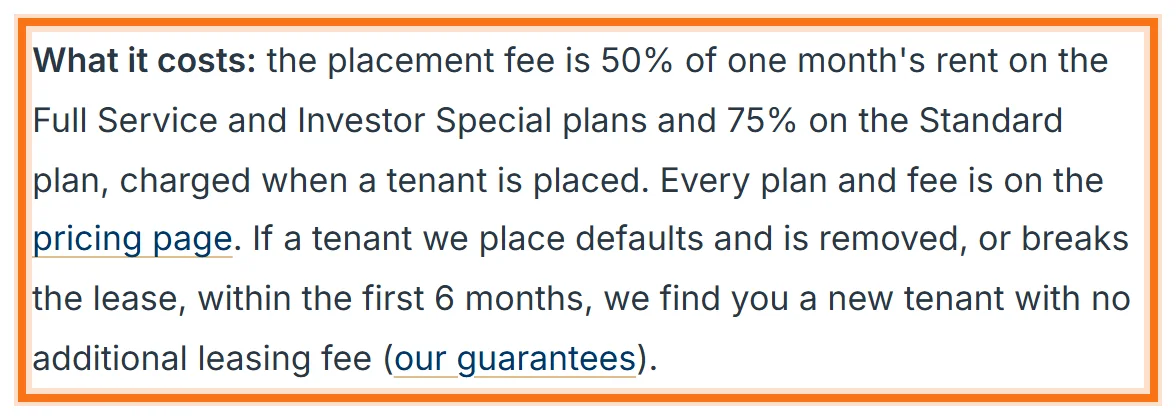
- Leasing fee: tenant placement is 50% of one month's rent on Full Service and Investor Special and 75% on Standard, charged when a tenant is placed.
- Everything in writing: every number is confirmed in writing before you sign, and if a fee is not in the agreement, you do not pay it.
- The make-ready line: the free rental analysis includes make-ready guidance and a written management quote, and arrives within one business day.
The reserve amount we hold, and how the leasing fee is collected, are confirmed in writing in the management agreement before you sign. Perpetual is broker-owned, with our office in North Richland Hills, managing rentals in Keller, North Richland Hills, Fort Worth and nearby. To get your make-ready guidance and written quote, request a free rental analysis or call 682-593-7033.
The takeaway: Budget for the house, not just the manager: list every day-one item with your own quotes, keep the reserve apart because it stays yours, and carry enough to pay the mortgage until the first rent arrives.
Questions owners ask
How much cash do I need upfront to start property management?
For the manager, usually an owner reserve and any setup or enrollment fee. For the house, the make-ready, rekeying and safety items, a landlord insurance payment, utilities and any HOA fee while it is empty, and the mortgage until the first rent. In the illustrative example on this page, a vacant house needs $7,054, of which the $500 reserve stays yours; with a tenant in place, $2,049.
Do I have to pay the leasing fee in advance?
Usually not at signing. A leasing or tenant placement fee is normally charged when a tenant is placed. Whether it is billed to you or taken from the first rent collected depends on the agreement, so ask. On a $1,900 rent, an illustrative 50% placement fee is $950 and 75% is $1,425.
Is the owner reserve a fee?
No. It is your money, held so repairs can be paid without waiting for you, and it is set in your management agreement. Money a Texas real estate broker holds for an owner is trust money under TREC rule 535.146, kept in a designated trust account and not mixed with the broker's own money. It is cash you need on day one, but not a cost.
Can I start with a property manager if the house needs work I cannot afford yet?
Often, yes, if you are honest about the budget at the first meeting. Get a written make-ready list, do the safety items and real repairs first, and leave cosmetic work for a later turnover. The items the law requires, such as rekeying under Property Code 92.156, the security devices in 92.153 and smoke alarms under 92.255, cannot wait.
What does it cost upfront if the house already has a tenant?
Much less: the reserve, any setup or enrollment fee and any insurance change. There is no make-ready, no vacancy and no rekeying triggered by the change of manager. In the illustrative example, that is $500 + $49 + $1,500 = $2,049. The tenant's security deposit transfers too, but it stays the tenant's money.
Can I use the tenant's security deposit for the make-ready?
No. The deposit is the tenant's money until it is refunded or applied to charges the tenant owes under the lease, and a Texas broker who holds it treats it as trust money under TREC rule 535.146. Fund the make-ready from your own cash, and keep the deposit out of your day-one plan.
Do I need landlord insurance before a property manager lists the house?
Ask your insurer before listing. The Texas Department of Insurance says most homeowners insurance won't cover damage to a rental property, or it might limit what it pays for, and suggests asking your agent whether to add landlord coverage to a homeowner policy or get a separate one. Budget the first payment on your day-one list.
Related services
Property management in Keller, North Richland Hills and Fort Worth. How full-service management works in Tarrant County →