Key takeaways
- Under most of Property Code chapter 92, the "landlord" is the owner, not the manager (92.001).
- A manager is your agent for notices about security devices and the ownership disclosure (92.169, 92.207).
- Security devices and the post-turnover rekey are at the landlord's expense (92.153(c), 92.156(a)).
- If the manager tells the tenant in writing that you will not fund a security device, the tenant may terminate the lease (92.168).
- For each rule, ask the manager for the record: the dated invoice, the test, the notice, the itemized list.
A good property manager should help you follow the Texas landlord rules that come up on a schedule: the ownership disclosure, rekeying and security devices, smoke alarm testing, late fees, repairs, the deposit and the notice to vacate. The money and the decisions stay with you, because the Property Code mostly treats the owner as the landlord. For a rental in Fort Worth, Keller or North Richland Hills, the test is simple: for each rule, can the manager show you the record?
This guide splits each rule into the manager's job, your part and the proof. The rules themselves are explained in Texas landlord-tenant law basics. This is general information, not legal advice.
Texas landlord rules: who does what
Here is each rule a manager should run for you, split between the manager's job and yours, with the record that proves it was done:
| Texas rule (section) | What the manager does | What stays with the owner | The record that proves it |
|---|---|---|---|
| Ownership and management disclosure (92.201) | Puts your name and address and the management company's name and street address in the lease, or gives them in writing within 7 days of a request | Keep your record-title name and address current; a change must be corrected within 7 days of the tenant's written notice (92.203) | The lease page with the disclosure |
| Security devices and rekey (92.153, 92.156) | Checks the required devices before move-in; has the locks rekeyed no later than the 7th day after the turnover date | Pays: both are at the landlord's expense | Dated rekey invoice and the make-ready checklist |
| Smoke alarms (92.255, 92.258) | Tests each alarm at the start of the tenant's possession; answers a tenant's repair request | Pays for an alarm in each bedroom and the others the statute requires | The move-in test record |
| Late fees (92.019) | Charges only the fee the written lease gives notice of, only after rent is two full days late | Decides with the manager what fee the lease states | The lease clause and the tenant ledger |
| Lockouts (92.0081) | Never excludes a tenant except as the statute allows, and only with the lease clause and written notice it requires | No side lockouts, no removed doors or appliances | The written notice and proof of delivery, if the remedy is ever used |
| Repairs (92.052, 92.056) | Receives the tenant's notice, dispatches a vendor, logs each date | Approves and funds work above your limit, fast | The work order with dates and the invoice |
| Deposit (92.103, 92.104) | Inspects, itemizes deductions, refunds within 30 days after surrender once there is a forwarding address | Lets the deposit be handled as the agreement says; never takes it out early | Itemized list, photos, mailing date |
| Retaliation (92.331) | Flags a rent increase or non-renewal within six months of a tenant's repair notice | Decides rent and renewal for documented business reasons | Dated renewal recommendation and reasons |
| Notice to vacate (24.005) | Prepares the notice and delivers it by a method 24.005(f-3) allows | Decides whether to proceed to court; hires an attorney when needed | The notice and proof of delivery |
How to read this table: the second column is the work you are paying the manager to do, the third is what no agreement moves off your desk, and the fourth is what you ask to see. If a manager cannot produce the record in the last column, the rule may still have been followed, but you cannot prove it. This is general information, not legal advice.
Why the owner is still the landlord under Texas law
Section 92.001 defines the landlord as "the owner, lessor, or sublessor of a dwelling," and says it does not include a manager or agent unless the manager or agent purports to be the owner, lessor or sublessor in the lease. So for deposits, repairs and late fees, the duty is yours even when a manager does the work.
Two subchapters work differently. For security devices, 92.151(7) defines the landlord to include a management company or managing agent. And for notices, a managing agent is the landlord's agent for security-device communications (92.169) and for the ownership disclosure and certain government notices (92.207). For repairs, 92.056(c) treats the notice as received when the landlord or the landlord's agent actually receives it, so the clock starts at the manager's desk, not yours.
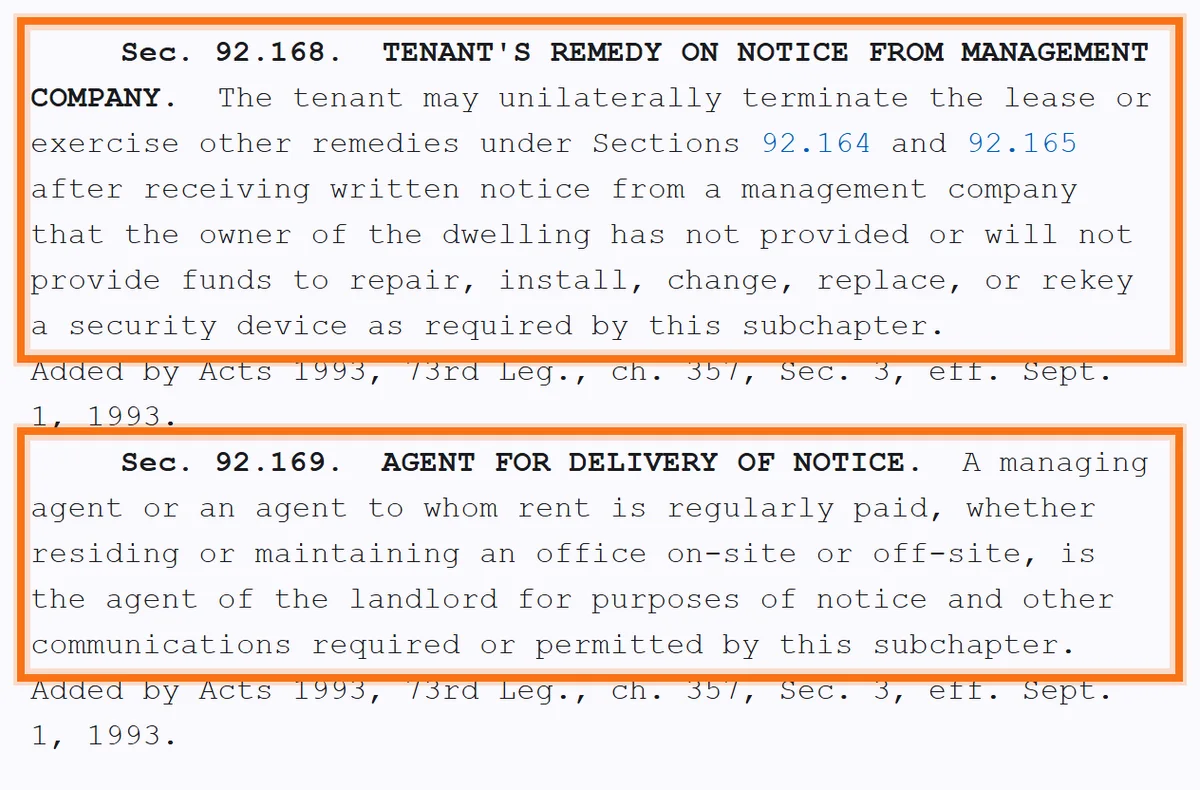
The practical point sits in 92.168: if the manager tells the tenant in writing that you have not provided or will not provide the money for a required security device, the tenant may terminate the lease. The manager can run the process only as far as you fund it. This is general information, not legal advice.
Before move-in: locks, devices, alarms and the disclosure
Three rules land before the tenant gets the keys. Security devices. Without any request from the tenant, the house must have a window latch on each exterior window, a keyless bolting device and a door viewer on each exterior door, a doorknob lock or keyed deadbolt on each exterior door, and a pin lock plus a handle latch or security bar on each sliding glass door (92.153(a)), installed at the landlord's expense (92.153(c)). Rekey. Locks operated by a key, card or combination must be rekeyed at the landlord's expense no later than the seventh day after each tenant turnover date (92.156(a)).
Smoke alarms. At least one in each separate bedroom, plus the corridor and level rules of 92.255(a); the landlord must confirm each works at the beginning of the tenant's possession (92.258(b)). The manager's part is the checklist, the vendor and the dated test. Your part is the invoice. The device-by-device detail is in Texas security device rules for landlords.
The disclosure. 92.201 requires the record-title owner's name and address and, if an off-site company manages the house, the manager's name and street address. Putting both in the lease satisfies it before anyone asks.
The lease clauses that make the rules work
Several rules only work if the lease says the right thing, which is why the lease form a manager uses matters to you:
- Late fee: collectible only if notice of it is in a written lease (92.019(a)(1)).
- Lockout right: only if it is placed in the lease (92.0081(d)(1)).
- Written repair requests: required only if the lease is written and requires written notice (92.052(d)).
- Rekey charge when a tenant breaks the lease: deductible from the deposit only if an underlined or bold clause authorizes it (92.156(e)).
- Notice of move-out as a deposit condition: effective only if underlined or in conspicuous bold print (92.103(b)).
Ask to see the blank form and its addenda before you sign a management agreement. What a Texas lease should contain, clause by clause, is in what a Texas residential lease must cover.
During the tenancy: repairs, late fees and retaliation
Repairs. The duty in 92.052(a) starts when the tenant gives notice to the person or place where rent is normally paid, the tenant is current on rent, and the condition materially affects the health or safety of an ordinary tenant. 92.056(d) presumes seven days is a reasonable time to repair. The manager logs the notice and sends the vendor; you approve and fund anything above your limit, quickly, because the clock does not wait for you. Conditions the tenant or a guest caused are not your duty during the lease unless they are normal wear and tear (92.052(b)). More in Texas landlord repair obligations.
Late fees. A fee is collectible only after rent stays unpaid two full days, and it must be reasonable. For a house or any building of four units or fewer, a fee of no more than 12 percent of the month's rent is considered reasonable (92.019(a-1)). Illustrative only: on $1,900 rent, 12 percent is $228.
Retaliation. For six months after a tenant in good faith exercises a right or gives a repair notice, a landlord may not retaliate by raising the rent, ending the lease, filing an eviction (except on the grounds 92.332 allows) or cutting services (92.331). A manager who sees a repair notice in the file should tell you before you approve a renewal increase, and write down the business reason for the decision.
Move-out and the notice to vacate
The deposit. The refund is due on or before the 30th day after the tenant surrenders the house (92.103(a)), but not until the tenant gives a written forwarding address (92.107(a)). Deductions are allowed for damages and charges the tenant is legally liable for, never for normal wear and tear, with a written, itemized list (92.104). The manager does the inspection and the list; your part is to leave the deposit where the agreement says it is held. The full rules: Texas security deposit rules.
The notice to vacate. Under 24.005(a) as amended effective January 1, 2026, the landlord must give at least three days' written notice to vacate before filing, unless a written lease sets a shorter or longer period. When the only ground is unpaid rent and the tenant was not late before that month, the notice must be a notice to pay rent or vacate. It must go by one of the methods in 24.005(f-3): mail, delivery to the inside of the premises in a conspicuous place, hand delivery to a tenant 16 or older, or electronic communication if agreed in writing.
Who may appear in court for you is covered in can a property manager handle an eviction. This is general information, not legal advice.
What stays on your desk, whatever the agreement says
Some parts of being the landlord never move to the manager:
- The money. Devices, rekeys, alarms and health-and-safety repairs are the landlord's cost. When the reserve is short, the manager asks; you fund.
- Your details. If you sell, refinance into an LLC or move, tell the manager so the 92.201 disclosure stays correct.
- No side deals. A text to the tenant about rent or a repair creates a term the manager does not know about, and it can undo the record above.
- Insurance. The policy is yours; what it covers is a question for your insurance agent.
- Legal advice. A manager is not a law firm. When money is at stake in a dispute, a Texas attorney represents you; see when you need a landlord attorney.
How Perpetual handles the Texas rules
Perpetual Property Management is broker-owned, with Justin Brown as Broker/Owner (TREC broker license 549418-B), managing homes in Keller, North Richland Hills, Fort Worth and nearby. What our site states about these rules:
- Lease: Texas-compliant lease documents, current forms with the addenda your property needs (our leasing service).
- Deposits: held, accounted for and returned or properly itemized on the statutory timeline, per the Texas Property Code.
- Condition records: a photo-documented move-in report, and a 360-degree condition inspection at every move-in and move-out.
- Late rent: late fees applied per the lease, with escalation steps that are the same for every tenant.
- Repairs: repairs under your pre-approved limit get fixed fast; anything larger comes to you with a description, photos and a recommendation (our maintenance coordination).
- Notices: the notice to vacate Texas procedure requires, delivered and documented; where appropriate, coordination with an attorney experienced in landlord-tenant law, because we are not a law firm (our eviction coordination).
How we schedule the rekey and the alarm test at each turnover is confirmed in writing in your management agreement. To go through your house and lease, call 682-593-7033.
The takeaway: Let the manager run the Texas rules that happen on a schedule, keep the money and the decisions on your side, and ask for the record behind each step: the rekey invoice, the alarm test, the dated notice and the itemized deposit list.
Questions owners ask
Does Texas require a landlord to give notice before entering a rental?
No Texas statute sets a notice period for a landlord to enter, so the lease controls. A good lease states when the landlord or manager may enter, how much notice is given for routine visits, and what happens in an emergency. The manager should schedule inspections and vendor visits under those terms and keep the notice with the work order.
How much can a Texas landlord charge for a late fee?
Texas uses a reasonableness test rather than a flat cap. A late fee is collectible only if notice of it is in a written lease, it is reasonable, and rent has stayed unpaid two full days (Property Code 92.019(a)). For a house or a building of four units or fewer, a fee of no more than 12 percent of the month's rent is considered reasonable; in a structure with more than four units, 10 percent (92.019(a-1)). This is general information, not legal advice.
Is my property manager the landlord under Texas law?
Usually not. Property Code 92.001 defines the landlord as the owner, lessor or sublessor and excludes a manager or agent unless the manager purports to be the owner in the lease. For security devices only, 92.151 includes a management company in the definition. Either way, a managing agent is your agent for notices, so a notice the manager receives counts.
What is the difference between a notice to vacate and an eviction?
The notice to vacate is the written notice that must come first: under Property Code 24.005(a), at least three days unless a written lease sets another period, and a notice to pay rent or vacate for a tenant who was not late before that month. It must be delivered by a method in 24.005(f-3). The eviction is the suit filed in justice court after the notice period. This is general information, not legal advice.
Who pays to rekey the locks between tenants in Texas?
The landlord. Property Code 92.156(a) requires locks operated by a key, card or combination to be rekeyed at the landlord's expense no later than the seventh day after each tenant turnover date. A manager arranges it and keeps the dated invoice; the cost is the owner's. If a tenant leaves in breach of a written lease, the rekey cost can come out of the deposit only if an underlined or bold lease clause allows it (92.156(e)).
What records should my property manager keep to show the Texas rules were followed?
For each tenancy: the lease with the ownership and management disclosure, the rekey invoice, the smoke alarm test at move-in, the move-in condition report, every repair request with dated work orders, the rent ledger, any notice with proof of delivery, and the itemized deposit list with its mailing date. Ask to see them for one house before you assume they exist.
Related services
Property management in Keller, North Richland Hills and Fort Worth. How full-service management works in Tarrant County →