Key takeaways
- Texas condo law (Property Code chapter 82) lets the association adopt rules on leasing of units, unless the declaration says otherwise (82.102(a)(7)).
- The HOA rule that bars tenant approval by the association (209.016) is in chapter 209, which does not apply to a condominium (209.003(d)). Read your own declaration.
- The association insures the common elements; your condo policy covers what the declaration leaves to you. Ask who pays the master policy deductible (82.111(k)).
- Dues are your cost, and an unpaid assessment is a lien on the unit and on the rents you receive (82.113(a)).
- Run the numbers with a special assessment in them before you sign a lease.
Should you rent out your condo? In Fort Worth, Keller, North Richland Hills and the rest of DFW, a condo can make a good rental, but the association decides part of the answer before you do. The declaration and rules may limit leasing, the master policy covers only part of the risk, and dues and special assessments stay with you whoever lives there. Check those three, then run the numbers.
This guide is the owner's decision: what to read, what Texas condo law says, how the insurance splits, the dues-versus-rent arithmetic, and which repairs are yours. What a property manager does with the association day to day is a separate guide: how a manager helps rent out a condo with an HOA.
The condo rental decision in five checks
Here is what to check before you rent out a condo, where the answer sits, and what it decides for you:
| Check | Where the answer is | What it decides |
|---|---|---|
| May the unit be leased, and on what terms? | The declaration, the current rules and any recorded amendment | Whether you can rent now, the minimum term, any cap or waiting list, registration steps |
| Who insures what? | The association's master policy and the declaration's unit boundaries (Property Code 82.111) | What your own condo policy must cover, and who pays the master policy deductible |
| Does the rent cover the costs? | Dues, the budget, the reserve figure and approved capital spending (resale certificate items, 82.157) | Whether the unit makes money after dues, tax, insurance, management and a set-aside |
| Which repairs are yours? | The declaration and plats, which describe the unit and the common elements | Who pays and who sends the vendor when something breaks |
| What can the association do about your tenant? | The declaration, including any amendment under 82.067(h) | Whether the board can fine you, evict your tenant or collect rent from the tenant |
How to read this table: the first and last rows can stop a rental entirely, so settle them before you spend money on make-ready. The middle three decide whether the condo is worth renting at all. Each row has its own section below.
Read the declaration, the rules and the resale certificate first
A condo's rules live in its dedicatory instruments: the declaration, the bylaws, the association's rules and every lawful amendment (Property Code 82.003). Get all of them, plus the most recent amendment recorded in the county records, and search for lease, rent, tenant, occupancy and transient.
Two tools help. If you bought recently, the resale certificate you received lists, among other things, any restraint on transfer in the declaration, the dues and any unpaid assessments, capital expenditures approved for the next 12 months, the reserves, and the insurance coverage provided for owners (82.157(a)). And as an owner you may request the association's books and records in writing by certified mail; the association must respond within 10 business days (82.1141(b), (d)).
Check the recording date too. Chapter 82 applies in full to condos whose declaration was recorded on or after January 1, 1994; for older ones only the sections listed in 82.002(c) apply unless the owners opted in. Either way, read your own documents. This is general information, not legal, tax or insurance advice.
What Texas condo law lets the association decide about leasing
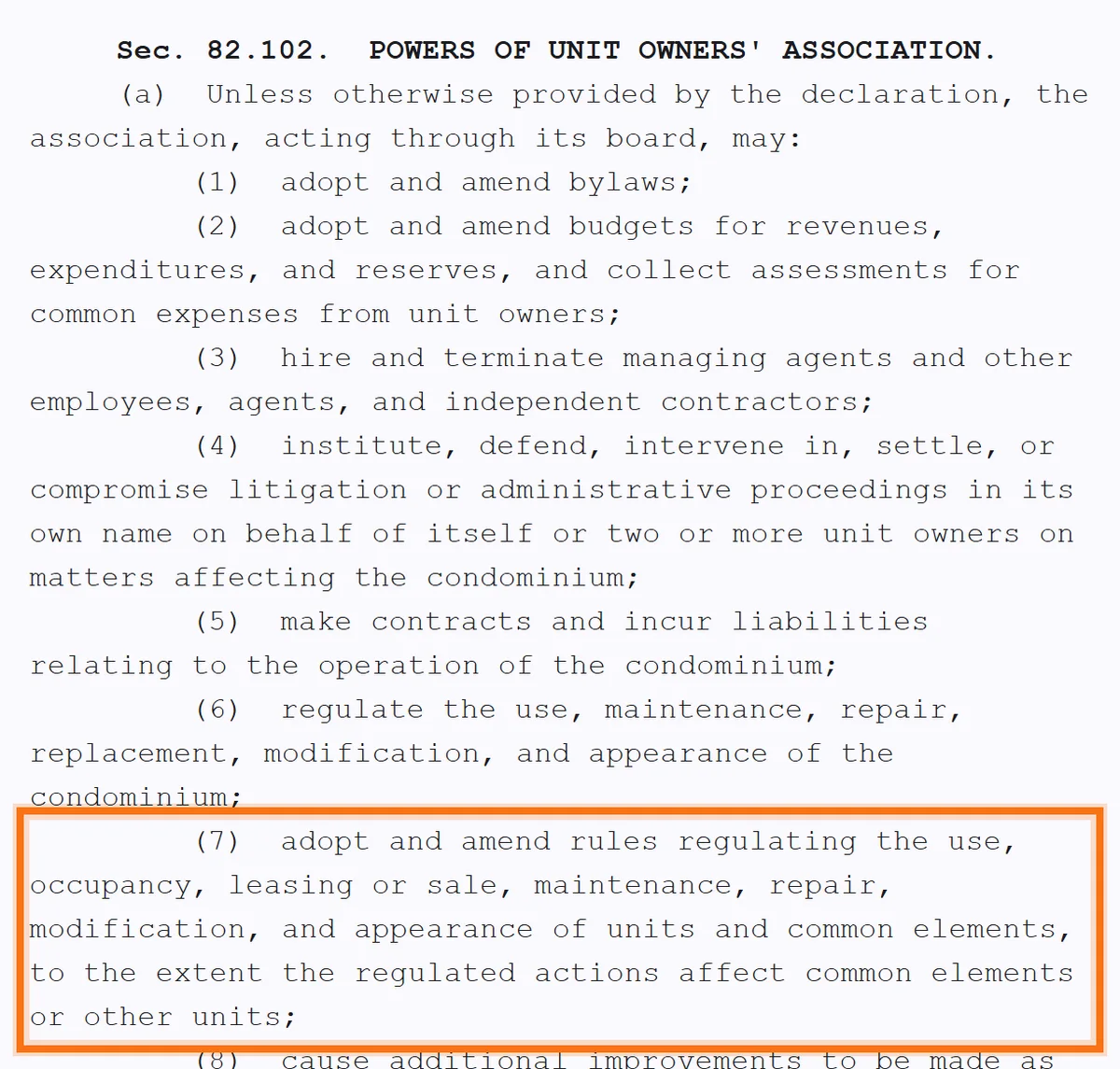
Unless the declaration provides otherwise, a condo association may adopt rules regulating the use, occupancy, leasing or sale of units, to the extent those actions affect common elements or other units (82.102(a)(7)), and a rule must not be arbitrary or capricious to be enforceable (82.102(c)):
So the rules, not just the declaration, can set a minimum lease term, a ban on short stays, a registration step or a limit on how many units are leased. Whether yours do is in your documents. If there is a cap and it is full, ask in writing where you sit on any waiting list and whether the documents allow exceptions, and do not sign a lease until the answer is yes.
One trap for owners who have read our HOA guides: the Property Code rule that an HOA may not require a tenant to be approved by the association (209.016) is in chapter 209, and chapter 209 does not apply to a condominium (209.003(d)). For a house in a subdivision, see how to check whether your HOA allows renting. Declarations can also be amended later, generally by owners holding at least 67% of the votes (82.067(a)), so a rule that allows leasing today can change. This is general information, not legal, tax or insurance advice.
Condo association insurance vs your own policy
Texas law requires the association to keep, to the extent reasonably available, property insurance on the common elements and liability insurance for them (82.111(a)). If the units have horizontal boundaries in the declaration, that property insurance must include the units but need not include improvements and betterments owners installed (82.111(b)). Read your declaration and ask the association for the master policy summary; whether your condo is in Tarrant, Dallas or Denton County, this is the condo association insurance question to settle first.
The deductible is where owners get surprised. If a repair costs less than the master policy deductible, whoever would be responsible without insurance pays (82.111(j)). Above the deductible, the dedicatory instruments decide who pays it; if they are silent, the board decides by resolution, or it is a common expense (82.111(k)). If the damage is due wholly or partly to an owner, or a guest or invitee of the owner, the association may assess the deductible against that owner (82.111(l)).
Your own policy covers the rest. The Office of Public Insurance Counsel describes condominium insurance as usually covering the inside of the condo, such as appliances, counters, flooring and fixtures, personal items and liability, but not the outside of the building, though it may cover property you are responsible for under your association agreement. Many agents call this an HO-6. Tell your agent the unit is rented and ask about loss of rent and your share of a master deductible; landlord vs homeowners insurance covers the switch. Then require renters insurance from the tenant. This is general information, not legal, tax or insurance advice.
Dues, special assessments and the association's lien
Dues and assessments are yours. Chapter 82 says the owner shall pay assessments and other charges properly levied against the owner or the unit (82.117(1)), and an assessment is a personal obligation of the owner, secured by a continuing lien on the unit and on rents and insurance proceeds the owner receives relating to the unit (82.113(a)). The lease cannot move that obligation to the tenant.
Special assessments are the larger risk. The cost of repairs beyond insurance proceeds is a common expense the board may assess (82.111(i)). Before you rent, look at the budget, the reserves and any capital spending already approved, and ask the board whether a project is under discussion. The worked example below shows what one assessment does to a year's rent.
Dues and special assessments against the rent: a worked example
The question is not whether the rent is higher than the dues, but what is left after every monthly cost and whether that cushion can absorb a special assessment. The figures below are illustrative only, not a quote: an $1,800 rent, $350 monthly dues, management at 9% on our Standard plan, and owner costs you would replace with your own numbers:
| Monthly line (illustrative) | Amount | Running total of costs |
|---|---|---|
| Rent | $1,800 | |
| Association dues | $350 | $350 |
| Management fee, 9% of $1,800 | $162 | $512 |
| Your condo policy (your quote) | $60 | $572 |
| Property tax set-aside (your tax statement / 12) | $300 | $872 |
| Repair set-aside you choose | $90 | $962 |
| Left before your mortgage payment | $1,800 - $962 = $838 |
How to read this table: in this example, $838 a month is left before any mortgage payment. A one-time special assessment of $2,400 (illustrative) would take about 2.9 months of that cushion ($2,400 / $838). If your mortgage payment is close to the cushion, one assessment puts the unit underwater for the year.
Two more lines belong in the first year: the tenant placement fee in the month a tenant is placed (on the Standard plan, 75% of one month's rent, so $1,350 at $1,800) and any make-ready. On taxes, IRS Publication 527 says that if you rent out your condominium you can deduct dues or assessments paid for maintenance of the common elements, but not special assessments for improvements, which you may be able to recover through depreciation. Ask your CPA how that applies to you. This is general information, not legal, tax or insurance advice.
The repair line: your unit vs the common elements
In a house, every repair is yours. In a condo, the declaration and its plats describe where your unit ends and the common elements begin, and that line decides who pays and who sends the vendor. Before the first tenant, find the answers in your documents for:
- Plumbing inside your walls versus lines that serve several units.
- Your air conditioning equipment, including any unit on the roof or a pad.
- Windows, glass, exterior doors and balconies, which some declarations treat as limited common elements.
- The water heater, and what happens when it leaks into the unit below.
- Roof, structure, hallways, grounds and amenities.
Write the answers on one page for whoever takes the tenant's call. Chapter 82 also makes the owner pay for damage to the condominium caused by the negligence or wilful misconduct of the owner or an occupant of the unit (82.117(3)), which is why a leak from your unit can become your bill. Leaks and mold in rentals generally are covered in water leaks and mold in Texas rentals.
Putting the association's rules into the lease
The owner is liable to the association for violations of the declaration, bylaws or rules by an occupant of the unit, and for the association's costs of obtaining compliance (82.117(4)). Your tenant has no agreement with the association, so the lease has to carry the rules: attach them, require the tenant to follow them, and say that a fine caused by the tenant's conduct is charged to the tenant.
Know what the association can do if that fails. An association may amend its declaration to let the board evict an owner's tenant for violating the declaration, bylaws or rules, evict a tenant who does not pay the association for substantial damage to common elements, or collect rent from the tenant of an owner who is at least 60 days delinquent to the association (82.067(h)). Check whether yours has. Parking, pets, amenity access and move-in rules go in the same addendum; lease addenda for Texas landlords covers the standard set. This is general information, not legal, tax or insurance advice.
How Perpetual helps a condo owner decide
Perpetual Property Management is broker-owned and manages homes in Keller, North Richland Hills, Fort Worth and nearby from our office on Rufe Snow Drive. What our site states that bears on a condo:
- The property type. We manage single-family homes, townhomes and small multifamily, and our free rental analysis request lists a condo as a property type.
- Association documents first. Before leasing, we ask owners for the association documents and any rental-related requirements, review them for the specific home, and do not build a leasing plan on assumptions about restrictions.
- The lease. Texas-compliant lease documents with the addenda the property needs, HOA rules among them.
- The price sheet. Management at 7%, 9% or 10% of monthly rent (the 7% Investor Special is for portfolios of 5 or more units), placement at 50% or 75% of one month's rent, and an annual property inspection on every plan. See pricing.
Who handles the association's registration paperwork, and how any association move-in fee or fine is passed through, is confirmed in writing before you sign. For a rent range on your condo and the numbers in the table above worked out with real figures, call 682-593-7033.
The takeaway: Read the declaration and the current rules for leasing, ask who pays the master policy deductible, buy a condo policy written for a rented unit, run the rent against dues, tax, insurance, management and a special assessment, and put the association's rules into the lease.
Questions owners ask
Can an HOA stop me from renting out my condo?
It can, if your documents allow it. Unless the declaration provides otherwise, Texas Property Code 82.102(a)(7) lets a condo association adopt rules regulating the leasing of units to the extent leasing affects common elements or other units. Read the declaration, the current rules and the latest recorded amendment, and ask the association in writing where you stand before signing any lease. This is general information, not legal advice.
What is a condo leasing cap and what happens if it is full?
A cap limits how many units may be leased at one time; it exists only if your declaration or rules create one. When it is full, owners usually wait on a list. Ask in writing for the cap, how many units are leased now, your place on any list and whether the documents allow exceptions. Never sign a lease while you are waiting.
What insurance do I need to rent out a condo?
A condominium policy that covers what the master policy does not: OPIC describes condo insurance as usually covering the inside of the unit, personal items and liability, not the building's exterior. Tell your agent the unit is rented, ask about loss of rent and your share of a master deductible (Property Code 82.111(k)-(l)), and require renters insurance from the tenant. This is general information, not insurance advice.
Who pays HOA dues when a condo is rented?
The owner. Property Code 82.117(1) makes paying assessments the owner's obligation, and 82.113(a) secures an assessment with a lien on the unit and on the rents the owner receives. Build dues into your numbers as a cost, and check the budget, reserves and approved capital spending for a coming special assessment.
Who repairs a leak in a rented condo?
It depends on where the leak starts and where your declaration draws the line between your unit and the common elements. If the repair costs less than the master policy deductible, whoever would be responsible without insurance pays (82.111(j)). The tenant reports to you or your manager, so keep the repair line on one page.
Can a property manager help me rent out a condo with an HOA?
Yes. The manager's part is reading the association's documents before listing, putting the rules into the lease, handling the association's move-in steps and answering violation notices on time. Our guide on how a manager helps rent out a condo with an HOA walks through it. Perpetual asks owners for the association documents before leasing and reviews them for the specific home.
Does the Texas HOA rule against tenant approval apply to my condo?
Not by itself. Property Code 209.016 bars an HOA from requiring tenant approval, but chapter 209 does not apply to a condominium (209.003(d)). Condos are governed by chapter 82 and their own declaration, so whether your association may approve tenants depends on your documents. This is general information, not legal advice.
Can the condo association evict my tenant?
Only if the declaration allows it. Property Code 82.067(h) lets an association amend its declaration to authorize the board to evict an owner's tenant for violating the declaration, bylaws or rules, or for not paying for substantial damage to common elements, and to collect rent from the tenant of an owner 60 or more days delinquent. Check your declaration and amendments.
Related services
Property management in Keller, North Richland Hills and Fort Worth. How full-service management works in Tarrant County →