Key takeaways
- A single-family rental puts the whole property on you: roof, foundation, fence, yard and every system inside.
- A townhome often moves exterior upkeep to an HOA, paid for with dues you owe every month, rented or empty.
- Under Property Code 209.016, an HOA may restrict leasing or occupancy, but it may not require your tenant to be approved by the HOA or demand the tenant's credit report or application.
- As an owner, you or an agent you designate in writing can examine the HOA's books and records, including financial records (209.005).
- Compare the net, not the rent: rent minus dues, minus the upkeep the dues do not cover.
Is a single-family house or a townhome the better rental in DFW? It depends on how much of the property you want to own. In Fort Worth, Keller and North Richland Hills, a house gives you control, no dues and usually fewer leasing rules, but every repair inside and out is yours. A townhome often hands the exterior to an HOA in exchange for dues and a second set of rules that apply to you and your tenant.
This guide compares the two side by side, explains how maintenance and upkeep work on a single-family rental, what Texas law lets an HOA do about leasing, and how to compare the numbers. We manage both types across Northeast Tarrant County. If you are deciding whether your HOA allows renting at all, start with how to check whether your HOA allows you to rent out your house.
Single-family house vs townhome rental: side by side
Here is how the two property types compare for a rental owner, and what to check before you decide:
| Factor | Single-family house | Townhome | What to check |
|---|---|---|---|
| Exterior upkeep: roof, walls, yard | Yours as the owner | Often the HOA's, paid for by dues | The declaration: who maintains which parts |
| Interior systems: HVAC, water heater, plumbing, appliances | Yours | Usually yours | Age and condition of each system |
| HOA dues | None, or whatever an HOA charges if there is one | Owed whether the unit is rented or empty | Current dues, past increases, the budget |
| Leasing rules | Only what an HOA's documents impose, if there is one | Possible minimum terms, caps or other leasing restrictions | The declaration and rules; Property Code 209.016 |
| Tenant violations | City rules and the lease | HOA rules too, with fines charged to you as owner | The fine schedule and how notices reach you |
| Lawn and yard | The lease decides whether you or the tenant handles it | Often common areas maintained by the HOA | The lease and the declaration |
How to read this table: the townhome column moves cost from lumpy repairs to a monthly dues line, and moves some decisions from you to the association. Neither is cheaper by default. The documents decide which parts are yours.
How maintenance and property upkeep work for single-family rentals in Dallas-Fort Worth
On a single-family rental, upkeep splits three ways: what Texas law puts on you, what the lease assigns to the tenant, and what you choose to do before it breaks.
- What the law puts on you. Property Code 92.052 requires a landlord to make a diligent effort to repair a condition that materially affects the physical health or safety of an ordinary tenant, once the tenant gives notice and is not delinquent in rent. That duty cannot be waived except as section 92.006 allows.
- What the lease can assign. Lawn care, filters and similar routine items are set by the lease. Under 92.006(f), a written lease can also make the tenant pay for damage to doors, windows or screens and for wastewater stoppages caused by improper objects, if the clause is underlined or in bold, specific and clear, and agreed knowingly, voluntarily and for consideration.
- What you plan for. Our maintenance page notes that much of Northeast Tarrant's housing stock is 30 to 50 years old, and that planned attention to aging HVAC, water heaters and roofs beats emergency pricing.
Who mows and who pays is covered in lawn care and landscaping in rentals, and the repair rules in Texas landlord repair obligations. This is general information, not legal advice.
Who rents each, and what that means for turnover
A detached house with a yard and a garage tends to draw households that want space: families with children in the local schools, often with a dog. Those households usually move for reasons that take time, such as a new job or buying a home, and a house that is kept up and priced fairly at renewal gives them a reason to stay. Our areas page describes Keller as a family-oriented suburb with strong long-term tenant demand for larger single-family homes.
A townhome draws a wider mix: people starting out, couples, downsizers and people relocating who want low upkeep while they settle. Their reasons to move can be lighter. That does not make them worse tenants; it means planning for the possibility of more frequent turnover in your numbers. Whoever applies, the same written criteria apply to every applicant.
Pets follow the floor plan. A shared wall and no yard make a large dog a harder fit, while a fenced yard is one reason a household with a dog picks a house. How long good tenants stay, and what keeps them, is in is it better to keep a good tenant at the same rent.
Townhome upkeep: what the HOA covers and what stays yours
A townhome HOA often handles the roof, exterior walls, common landscaping and sometimes the fence or driveway, funded by the dues. You still own the inside: the HVAC, the water heater, plumbing inside the walls and the appliances. The practical effect is fewer surprise exterior bills and a fixed dues line instead. Exactly which parts are yours depends on the declaration, so read it rather than assuming.
The risk is an association that defers its own maintenance and later charges owners a special assessment. Before you buy, ask for the budget, the dues history and any reserve study. Once you own, Texas gives you a way to look:
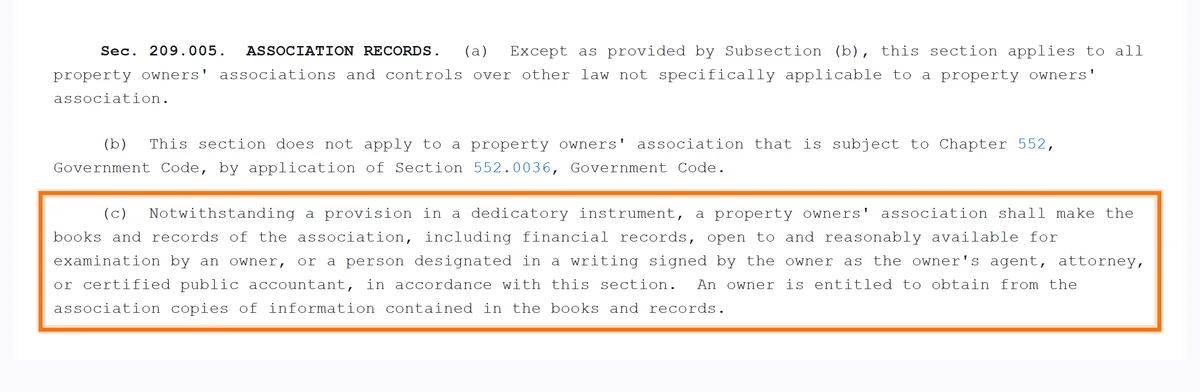
Section 209.005 sets out how to ask: a written request sent by certified mail to the address on the association's most recent management certificate. Chapter 209 does not apply to condominiums (209.003), so if your townhome is legally a condominium unit, different statutes govern; see HOA rules and your rental property.
HOA leasing rules in Texas: what an association can and cannot do
With a townhome, the association is a second set of rules over you and your tenant. Property Code 209.016 draws the lines for associations under chapter 209:
- It may adopt or enforce restrictions relating to occupancy or leasing, such as a minimum lease term or a cap on rentals, if its documents provide for them.
- It may not require your applicant or tenant to be submitted to and approved by the association, or require a consumer or credit report or the rental application.
- It may request contact information for each person who will live there, and the start date and term of the lease.
Before an association levies a fine for a rule violation, section 209.006 requires written notice to the owner by certified mail. The fine is charged to you, not to your tenant, so the lease should make the tenant responsible for following the HOA rules. How a manager handles those notices is in will a property manager handle HOA notices and violations. This is general information, not legal advice.
Turnover, make-ready and timing
Every move-out means a make-ready, marketing, showings, screening and, with a manager, a placement fee, plus the vacant days. A tenancy that lasts several years spreads that cost thin; one that turns every year carries it more often. That is where the two types can differ most, depending on who rents them.
The make-ready differs too. A house turn after a long tenancy can include yard recovery, fence repair and exterior touch-ups on top of paint, cleaning and flooring. A townhome turn is usually interior only, because the HOA handles the outside. Timing matters for both: our rental pricing page notes that the same house rents differently in June than in December. How the season affects your own listing is in does the time of year affect how quickly a house rents in Fort Worth.
Rent, dues and the number that matters
Compare the net, not the rent. A townhome's rent may look close to a house's, but the dues come off the top every month whether the unit is occupied or not, and the dues can rise. A house has no dues, or smaller ones, but carries the exterior and yard costs the dues would have covered, in lumps rather than monthly.
Illustrative only, not a quote. Assume a house rents for $2,100 with no dues, and a townhome rents for $1,900 with $250 a month in dues. Before any other costs, the house brings $2,100 a month and the townhome $1,900 - $250 = $1,650. Over 12 months: $2,100 x 12 = $25,200 against $1,650 x 12 = $19,800, a gap of $5,400. The house still has to fund its roof, fence and yard out of that gap, so set a repair reserve for each before you compare.
For the rent range on a specific property rather than a rule of thumb, request a free rental analysis. How much to hold back for repairs is in how much reserve to keep per rental.
Which one fits which owner
- Choose a single-family house if you want control over the whole property, no dues and few or no leasing restrictions, and you can fund the roof, foundation and yard over time.
- Choose a townhome if you want less exterior responsibility and a predictable monthly cost, and you are comfortable with an HOA setting some of the rules.
- Avoid either if the HOA's documents restrict leasing in a way that does not fit your plan, the association's finances look thin, or the house has deferred foundation or plumbing work the numbers do not support.
If you are choosing between two specific properties, the rent side belongs in the decision before you close. Our brokerage can help you find and buy an investment property with that in view.
How Perpetual handles this
Perpetual Property Management is broker-owned, with our office at 5755 Rufe Snow Dr in North Richland Hills. Our site states that we manage single-family homes, townhomes and small multifamily across Northeast Tarrant County. What that means for either type:
- The lease fits the property. Our leasing page describes Texas-compliant lease documents with the addenda your property actually needs, such as HOA rules, pool, pets and smart devices.
- Maintenance within your limit. Tenants report requests through their portal; repairs under the spending limit you pre-approve go ahead without waiting, and anything larger comes to you with a description, photos and a recommendation. See maintenance coordination.
- Inspections. Every plan includes an annual property inspection, and every move-in and move-out gets a 360-degree condition inspection.
- Buying the next one. Perpetual Realty Group is our affiliated brokerage, so the rent side can be part of the conversation before you buy.
How HOA notices about your rental reach you, and who answers them, is confirmed in writing before you sign. To compare two specific properties, request a free rental analysis or call 682-593-7033.
The takeaway: Houses trade more upkeep for control and no dues; townhomes trade dues and HOA rules for less exterior work. Read the HOA documents, compare the net after dues and upkeep, and choose the one that matches how much you want to own.
Questions owners ask
Do townhomes or single-family houses rent faster in DFW?
There is no reliable rule by property type. Speed depends mostly on price, condition, presentation and timing; our rental pricing page notes that the same house rents differently in June than in December. A townhome's make-ready is usually smaller because the exterior is the HOA's, which can shorten the gap between tenants. A house needs more exterior work at turnover.
Are townhome HOA dues a problem for rental owners?
They are a fixed cost that comes off the rent every month, rented or empty, and they can rise, so they must be in your numbers. The bigger risks are leasing restrictions in the HOA's documents and an association with thin finances that leads to a special assessment. Read the declaration, rules and budget before you buy; once you own, 209.005 lets you examine the books and records.
Which has lower maintenance costs, a house or a townhome?
A townhome usually has fewer exterior surprises because the HOA maintains the roof and exterior through dues, though which parts are covered depends on the declaration. A house puts roof, foundation, fence and yard on you. Interior systems such as the HVAC, water heater and appliances are your responsibility in both.
Do families rent townhomes?
Some do, and who applies depends on size, location, school zone, yard and pet rules more than on the label. You do not choose tenants by household type: the same written criteria apply to every applicant. Plan your numbers for the turnover pattern the property is likely to have, not for one kind of tenant.
How do maintenance and property upkeep typically work for single-family rentals in Dallas-Fort Worth?
The owner carries the whole property: roof, foundation, fence, yard and every system inside. Texas Property Code 92.052 requires a diligent effort to repair conditions that materially affect a tenant's health or safety after notice, and the lease assigns routine items such as lawn care. Much of Northeast Tarrant's housing stock is 30 to 50 years old, so planned attention to HVAC, water heaters and roofs matters.
Can a townhome HOA approve or reject my tenant in Texas?
Not for an association under Property Code chapter 209. Section 209.016 bars an HOA from requiring a tenant or applicant to be submitted to and approved by the association, or from requiring a credit report or the rental application. It may restrict leasing or occupancy and may ask for each resident's contact details and the lease start date and term. Condominiums follow different statutes.
Property management in Keller, North Richland Hills and Fort Worth. How full-service management works in Tarrant County →