Key takeaways
- Decide who may sign and spend before deciding whether to keep or sell.
- The tenant needs only three facts: the lease is unchanged, who to call, and where to pay.
- If the owner of record or the owner's address changes, correct the disclosure to the tenant (Property Code 92.201).
- If the house is sold, the buyer is liable for the deposit from the date title is acquired and must give the tenant a signed statement of the exact amount (92.105).
- Ownership and division questions in a divorce go to your attorney, not to your manager.
You keep a rental through a divorce, a job loss or a big move by settling four things early and in writing: who may sign and spend, whether the house still pays for itself, who the tenant contacts and pays, and what changes on title. The rental keeps sending bills while everything else is uncertain, so the order matters more than the speed. For a rental in Fort Worth, Keller or North Richland Hills, the Texas Property Code adds two specific steps when the owner or the owner's address changes.
This guide gives you the changes in one table, then a short section for each situation. The keep-or-sell decision itself is in should I sell or rent my house in DFW.
What each life change does to a rental, and who to tell
Here is what each life change does to a rental, who needs to hear about it, and the document that records it:
| Life change | What changes on the rental | Who to tell | The document |
|---|---|---|---|
| Divorce or separation, house still co-owned | Title unchanged for now; who may sign and spend is whatever both owners agree in writing; rent should land in one documented account | Your attorney first, then the manager; your insurance agent and lender if they ask | A written instruction to the manager signed by both owners naming one contact |
| Decree or deed puts the house in one name | The holder of record title changes; the lease and deposit stay with the house | The tenant (corrected owner disclosure, 92.201), the manager, your insurance agent and lender | The recorded deed, an updated disclosure to the tenant, an updated management agreement |
| House sold as part of the change | The buyer becomes the owner and is liable for the deposit from the date title is acquired (92.105(a)) | The tenant, the buyer and the manager | The buyer's signed statement to the tenant stating the exact deposit (92.105(b)) and the deposit transfer record |
| Job loss or a drop in income | Title and contact unchanged; the cash cushion changes: reserve, payout, ability to fund a large repair | Your mortgage servicer early if a payment may slip; the manager about the reserve | Twelve months of rent and expenses, the reserve balance, the servicer's written options |
| A big move out of the area | Your mailing address changes; approvals move to email or the portal; someone local holds the keys | The tenant (who to call, where to pay, corrected owner address), the manager, the HOA and your insurance agent | The handoff list, the written notice to the tenant, an updated disclosure |
How to read this table: the second column is the reason the change matters to the rental, the third is the order in which people should hear about it, and the last is what you will need if anyone later disagrees about who decided what. The tenant appears only where the rental itself changes: owner, address, contact or payment instructions. This is general information, not legal advice; how a divorce decree or a sale affects your title is a question for your attorney.
Decide who can act before deciding what to do
Whatever the change, the first question is not keep or sell. It is who may sign, spend and instruct the manager right now. A repair invoice does not wait for a mediation date, and a tenant's notice does not wait for a job offer.
In a divorce, who has authority over a jointly owned house is a question for your attorney. What you can do on the rental side is agree, in writing, on one point of contact until the larger questions are settled. In a job loss there is no authority problem but there may be a bandwidth problem, so a spending limit the manager can act within keeps the house from stalling. Before a long-distance move, set up approvals by email or the portal while you are still in town.
One contact, one account the rent lands in, one written instruction to the manager. Everything else can wait a few weeks.
Does the house still carry itself after the change?
Run the numbers you already know, not projections: rent in; mortgage, escrow, management and repairs out; what is left. Then ask what the change does to that line. A divorce may remove a second income that was quietly covering a shortfall. A layoff may make the rental reserve your only reserve. A move adds the cost of handling from a distance what you used to drive to.
Three honest answers come out of it:
- It carries itself and leaves something. Keep it, and avoid spending its cash flow on personal bills.
- It roughly breaks even. Keep it if the long-term case is strong, but plan the next vacancy now.
- It needs money from you every month. Decide whether that money exists for the next year. If not, selling on your own schedule beats selling under pressure.
During a life change, the right answer is often to defer the big decision while making sure the house can wait with you.
Divorce: one contact, one account, clean records
How a rental is divided in a divorce is for your attorney. What the management side can do is make it easy to divide, whatever the outcome. Easy means rent landing in one documented account, one monthly statement both owners can read, the tenant's deposit recorded with its amount and where it is held, and every repair backed by an invoice. Hard means rent paid into one spouse's personal account, repairs on a joint card with no receipts, and a deposit nobody can locate.
If a decree or deed puts the house in one name, the lease and the deposit stay with the house, and the tenant should receive corrected owner information (see the disclosure section below). If the house will be sold, read selling a rental with a tenant in place before anyone lists it, and see how 92.105 moves the deposit duty to the buyer. A manager who already holds the records gives both sides the same numbers; how to read your monthly owner statement shows what both should be able to see. This is general information, not legal advice; how a divorce decree or a sale affects your title is a question for your attorney.
Job loss: protect the cash flow, do not raid it
After a layoff, the rental's cash flow and reserve look like savings. Treat them as the house's money, or the next failed water heater becomes a choice between the repair and your own bills.
- Leave the reserve alone. Treat it as belonging to the house; the reasoning behind the number is in how much reserve to keep per rental.
- Call the mortgage servicer early if a payment may slip, and get its options in writing.
- Do not look to the tenant to fill the gap. A fixed-term lease sets the rent for its term; a change waits for the renewal.
- Weigh a renewal carefully. A reliable tenant renewing at a modest increase may protect you more than a higher rent with a vacancy first.
In this period the tenant's reliability is your most valuable asset, and prompt repairs are how you keep it.
A big move: the handoff before you go
Moving across the state or the country with a rental behind you turns small tasks into logistics: who meets the plumber, who walks the house when the tenant gives notice, who shows it. Do a formal handoff before the truck leaves:
- Keys, garage remotes, gate codes and mailbox keys to the manager, counted and logged.
- Warranties, the HOA contact, your insurance agent and your loan servicer in one document.
- Your new mailing address to the manager, so the owner disclosure to the tenant can be corrected.
- A written repair spending limit, so routine work does not wait on your time zone.
- A written notice to the tenant saying who to call and where to pay.
The before-you-leave decisions, such as your loan's occupancy terms and the homestead exemption, are in renting out your home when you relocate. Day-to-day ownership from a distance is in the out-of-state owner guide.
What to tell the tenant, and the disclosure Texas requires
Tenants do not need the story. They need three facts: whether the lease is unchanged, who to contact, and where to pay. A short written notice covering those keeps the relationship steady; more detail invites worry, and a worried tenant starts looking at listings.
Texas law adds one requirement. Under Property Code 92.201(a), a landlord must disclose to a tenant the name and a street or post office box address of the holder of record title, and, if an off-site entity is primarily responsible for managing the house, the management company's name and street address. It can be given in writing within seven days of the tenant's request, or in the lease or written rules before the tenant asks (92.201(b)).
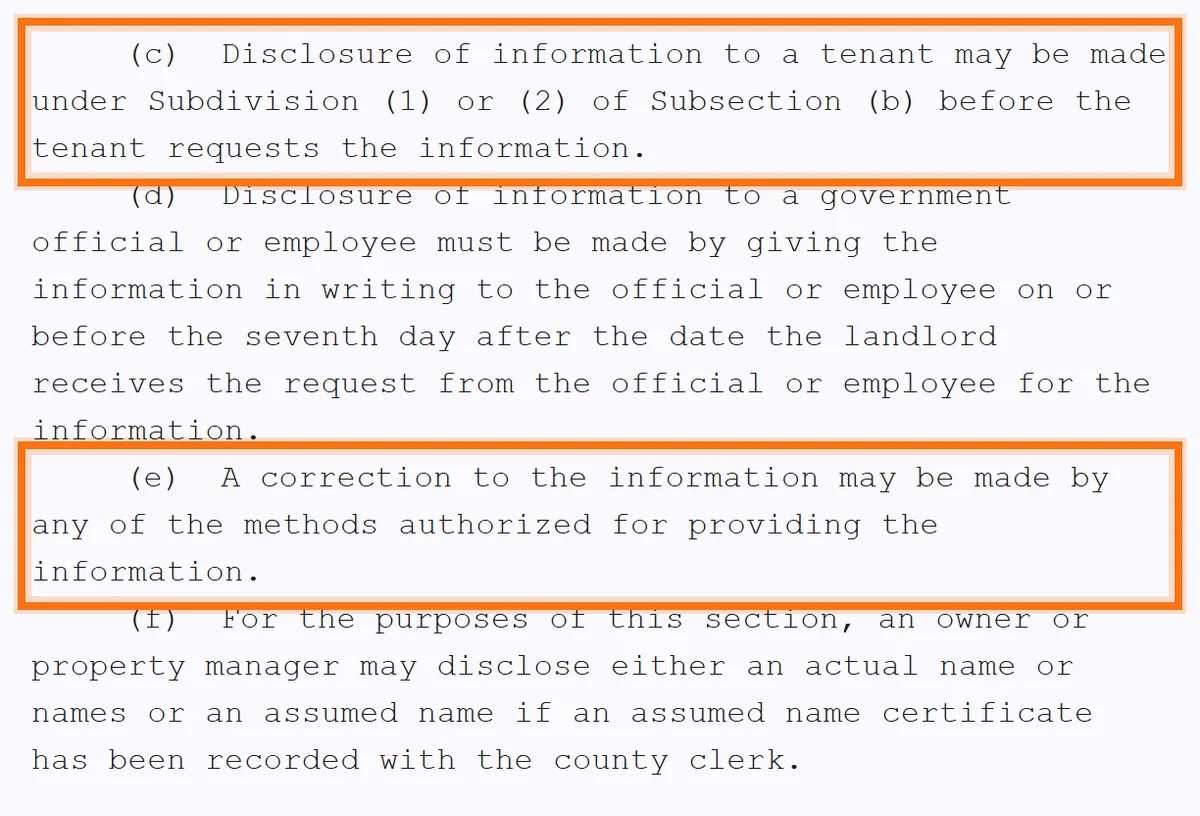
A decree that changes the owner of record, a sale or your move to a new address can make that information wrong. A correction may be made by any of the same methods (92.201(e)), and 92.203 makes a landlord liable if the information becomes incorrect because a name or address changes and is not corrected by the seventh day after the tenant's written notice. If a new manager takes over, see who tells the tenant the property manager is changing. This is general information, not legal advice.
The documents to gather this week
Whatever you decide later, you will need these, and they are easier to find now:
- The current lease and every signed addendum.
- The deposit amount and where it is held.
- Twelve months of rent received and expenses paid, with receipts.
- The mortgage statement, the insurance declarations page and the property tax record.
- The HOA account status and the association's contact.
- The move-in condition report and photos.
- Any written instruction between co-owners about who decides.
The deposit record and the move-in condition report are the two that are hardest to rebuild later, and they are the two any buyer, attorney or new manager will ask for first. A free rental analysis is a simple way to check what the house earns today before you decide anything.
When letting it go is the right call
Keeping the rental is not a badge. If it needs cash you no longer have, if co-owning it with a former spouse keeps you tied to someone you are separating from, or if managing it from another state costs more than it earns, selling can protect the rest of your finances. The tax side matters, especially if the house was once your home, so talk to a CPA before listing.
If you sell, plan around the tenant's lease and the deposit transfer under 92.105 (see the FAQ below), and let your attorney and CPA confirm anything that touches ownership, division or taxes.
How Perpetual helps an owner through a life change
Perpetual Property Management is broker-owned and manages homes in Keller, North Richland Hills, Fort Worth and the surrounding Northeast Tarrant County cities. What our site states that matters during a life change:
- Moving away: our full-service page describes what out-of-state owners need as "eyes, hands, and honest reporting on the ground," with portal access, photo inspections and statements.
- Statements: monthly statements in the AppFolio Owner Portal, with statements, documents and disbursement history; you can share access or documents with your CPA directly. Whether a second owner or an attorney can get their own portal access is confirmed in writing in your management agreement.
- Money: rent disbursed by the 10th of each month, or that month's fee is waived; calls and emails answered within one business day (both subject to our Guarantee Addendum).
- A tenant already in place: we take over occupied properties, and the lease, deposit and records transfer to us.
- Selling or a hardship: our rent-or-sell page lays out four options and short sale assistance for owners facing job loss or another provable hardship, on a discovery call with no fee.
Every fee is confirmed in writing before you sign. Call 682-593-7033, or start with a free rental analysis to see what the house earns today.

The takeaway: Settle who signs, whether the house carries itself and who the tenant calls, in that order, and put each in writing. Correct the owner disclosure when your name or address changes, and let your attorney handle anything about title.
Questions owners ask
What happens to a rental property in a Texas divorce?
How the house is divided is decided in the divorce, so that question is for your attorney. On the rental side, the lease and the tenant's deposit stay with the house. Until the division is final, agree in writing on who makes day-to-day decisions, keep rent in one documented account, and keep every expense backed by an invoice. If the owner of record changes, correct the disclosure to the tenant (Property Code 92.201).
Should I sell my rental if I lose my job?
Not automatically. If the house carries itself and the reserve is intact, keeping it preserves the asset and the income. If it needs money from you every month and that money is gone, selling on your own timeline beats selling under pressure. Talk to your mortgage servicer early if a payment may be at risk, and get a sale figure and a rent figure before you choose.
Do I have to tell my tenant about my divorce or job loss?
No. The tenant needs to know whether the lease is unchanged, who to contact and where to pay. If the owner of record, the owner's address or the managing company changes, Texas Property Code 92.201 requires that information to be disclosed, and a correction can be given in writing or through the lease or written rules. This is general information, not legal advice.
Can a property manager work with both spouses during a divorce?
Yes, if both are owners and the manager has written direction, signed by both, on who gives instructions. One statement both owners can read, rent in one documented account and an invoice behind every repair give both sides the same numbers. What either owner may decide while the divorce is pending is a question for your attorneys.
How do I keep a rental running after moving out of state?
Do a formal handoff before you leave: keys and codes to a local manager, contacts and warranties in one document, your new mailing address so the owner disclosure stays correct, a written repair spending limit, and a notice to the tenant naming the new contact. After that, the monthly statement and inspection reports keep you informed from a distance.
What happens to the tenant's deposit if I sell the rental during a divorce?
Under Property Code 92.105, the new owner is liable for returning the deposit from the date title is acquired and must give the tenant a signed statement acknowledging that and stating the exact amount. The seller stays liable for a deposit received while owner until the buyer has received it or assumed the liability, unless a written contract says otherwise. This is general information, not legal advice.
Do I have to tell my tenant my new address after I move?
If your address is the one disclosed as the holder of record title, it should be corrected. Property Code 92.201 lets the correction be made by any method allowed for the original disclosure, and 92.203 makes a landlord liable if the information becomes incorrect and is not corrected by the seventh day after the tenant's written notice. A manager can send the update for you.
Property management in Keller, North Richland Hills and Fort Worth. How full-service management works in Tarrant County →