Key takeaways
- Texas requires printed notice of the tenant selection criteria when an application is provided (Property Code 92.3515(a)).
- No notice and a rejection means the application fee and any application deposit go back (92.3515(e)).
- No acceptance by the seventh day after a completed application means the applicant is rejected (92.352).
- Fair housing law bars refusing to rent or setting different terms because of a protected class (42 U.S.C. 3604; Property Code 301.021).
- At Perpetual, you set the standards with us; we apply them without exceptions.
Property managers screen tenants in Texas inside a short list of rules: the Property Code sections on rental applications (92.351 to 92.355), the federal and Texas Fair Housing Acts, and the federal rule on adverse action notices. Each one tells the manager what to do and leaves a record behind. For a rental in Fort Worth, Keller or North Richland Hills, the question for an owner is not whether a manager screens, but whether every one of those records exists.
The step-by-step order of a single application is in how tenant screening works, and the owner's timeline from listing to lease is in the rental application process explained. This guide is the rulebook. This is general information, not legal advice; for anything beyond the text of a statute, ask a Texas attorney.
Tenant screening rules for a property manager in Texas
Here are the rules a manager screens under, what each requires as the text reads, what the manager does about it, and the record that proves it was done:
| Rule | What it requires, as read | What the manager does | The record that proves it |
|---|---|---|---|
| Property Code 92.3515(a) | Printed notice of the tenant selection criteria and grounds for denial when the application is provided | Publishes the criteria and gives them with every application | The criteria in force on that date |
| 92.3515(b)-(d) | The applicant signs an acknowledgment; unsigned means a rebuttable presumption the notice was not made available | Collects the signed acknowledgment, or puts it in the application with the notice underlined or bold | The signed acknowledgment |
| 92.3515(e) | Rejected without the notice: return the application fee and any application deposit | Never rejects an applicant who was not given the criteria without refunding | Refund record, if it ever applies |
| 92.351, 92.352 | Fee is nonrefundable, deposit refundable on rejection; no acceptance by the 7th day after a completed application = rejected | Decides inside the window; treats a rejected co-applicant as rejecting all | Submission date and decision date |
| 92.353, 92.354, 92.355 | Notice by phone or mail by the required date; bad-faith failure to refund costs $100 + 3x + fees; waivers are void | Gives notice by a method the statute presumes; no waiver language in the application | Call log or postmark; the application form |
| 42 U.S.C. 3604 | No refusal, different terms, discriminatory ads or false "not available" statements because of a protected class | One written standard and one script for every inquiry | The listing text and the criteria |
| Property Code ch. 301 | The Texas Fair Housing Act says the same for Texas (301.021 to 301.025) | Same as above | Same as above |
| 15 U.S.C. 1681m(a) | Adverse action based in whole or part on a consumer report: notice, agency details, dispute rights | Sends the notice with every report-based denial or condition | A copy of the notice |
How to read this table: the last column is what to ask a manager to show you. A rule that leaves no record behind cannot be proven later, and screening disputes are decided on what can be proven. This is general information, not legal advice; for anything beyond the text of a statute, ask a Texas attorney.
Who decides: the owner sets the standard, the manager applies it
Screening has two jobs, and they belong to different people. The standard is the owner's decision: what income multiple, what history, what grounds for denial. Applying it is the manager's job, and it has to be the same for every applicant.
Our tenant screening page answers the owner who asks to meet or approve the tenant personally this way: "We recommend decisions stay criteria-based, that's what protects you legally. You set the standards with us; we apply them without exceptions." Who has the last word on a specific applicant is covered in who makes the final tenant decision.
The Texas application rules, as the Property Code reads
Subchapter I of Property Code chapter 92 is short. Section 92.3515(a) requires that, when an applicant is provided with a rental application, the landlord "shall make available to the applicant printed notice of the landlord's tenant selection criteria and the grounds for which the rental application may be denied," including criminal history, previous rental history, current income, credit history, or failure to provide accurate or complete information.
The applicant signs an acknowledgment that the notice was made available, and the acknowledgment must say, in substance, that the criteria may include criminal history, credit history, current income and rental history, and that an applicant who does not meet them or gives inaccurate or incomplete information may be rejected without a refund of the application fee (92.3515(b), (c)). It may be part of the application if the notice is underlined or in bold (92.3515(d)).
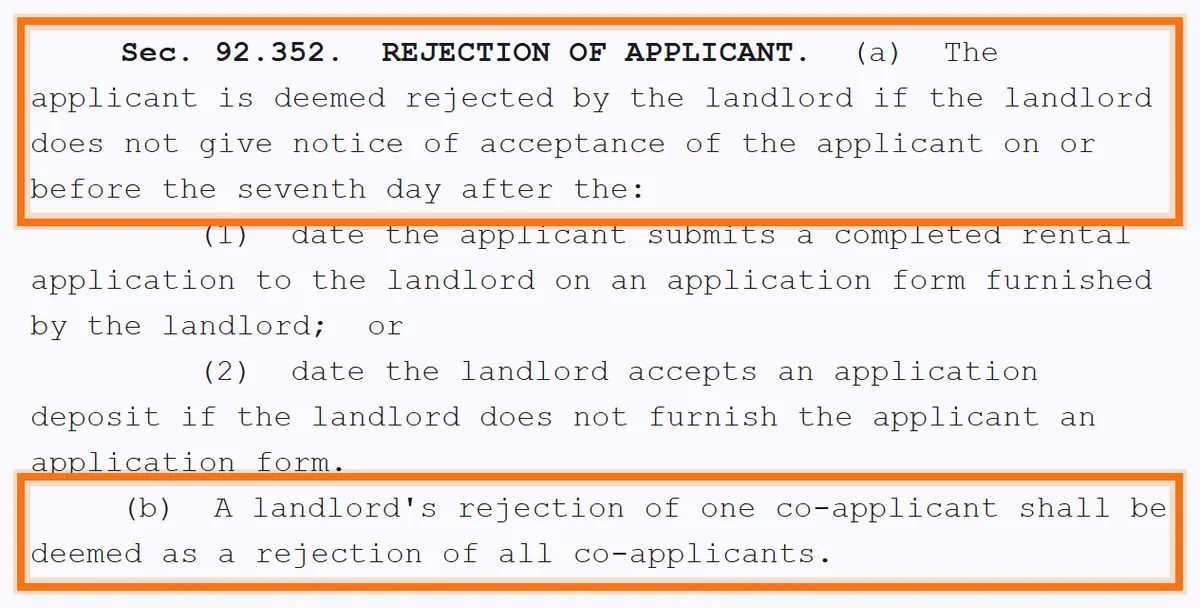
Under 92.352(a), an applicant is deemed rejected if the landlord does not give notice of acceptance on or before the seventh day after the completed application is submitted on the landlord's form. A rejection of one co-applicant is a rejection of all (92.352(b)). This is general information, not legal advice; for anything beyond the text of a statute, ask a Texas attorney.
Fees, deposits and refunds
Section 92.351 separates two kinds of money. An "application fee" is a nonrefundable sum "to offset the costs of screening an applicant." An "application deposit" is refundable to the applicant if the applicant is rejected. Perpetual charges an application fee: $60.00 per applicant, and our criteria state that denied or canceled applications are non-refundable.
Notice of acceptance or rejection is presumed given by telephone to the applicant, a co-applicant or a person living with them on or before the required date, or by U.S. mail postmarked by then (92.353(a)); a weekend or holiday deadline moves to the end of the next day (92.353(c)). If the applicant asks, a refund check must be mailed to the address the applicant gave (92.353(b)).
A landlord who in bad faith fails to refund an application fee or deposit in violation of the subchapter owes $100, three times the amount wrongfully retained, and the applicant's reasonable attorney's fees (92.354). A provision in an application that tries to waive these rights is void (92.355).
Fair housing: the federal text
The federal Fair Housing Act, 42 U.S.C. 3604, lists what is unlawful. Subsection (a) bars refusing to rent or otherwise making a dwelling unavailable "because of race, color, religion, sex, familial status, or national origin." Subsection (b) bars discriminating "in the terms, conditions, or privileges" of rental on the same grounds. Subsection (c) bars any notice, statement or advertisement that indicates a preference, limitation or discrimination based on those grounds or handicap, and (d) bars telling someone a dwelling is not available for inspection or rental when it is.
Subsection (f) covers handicap, and under 3604(f)(3)(B) discrimination includes "a refusal to make reasonable accommodations in rules, policies, practices, or services, when such accommodations may be necessary to afford such person equal opportunity to use and enjoy a dwelling." For screening, that means a written process for requests, decided case by case. The fuller picture for an owner is in fair housing for Texas landlords. This is general information, not legal advice; for anything beyond the text of a statute, ask a Texas attorney.
The Texas Fair Housing Act, chapter 301
Texas has its own Fair Housing Act in Property Code chapter 301; the powers once held by the Commission on Human Rights now sit with the Texas Workforce Commission (301.0015). Section 301.021(a) bars refusing to rent or making a dwelling unavailable because of race, color, religion, sex, familial status, or national origin, and 301.021(b) bars different terms, conditions or privileges on the same grounds. Section 301.022 bars discriminatory notices and advertisements, including on disability, 301.023 bars false statements that a dwelling is not available for inspection, and 301.025 covers disability in sale or rental.
One line in 301.021(c) is specific: the section "does not prohibit discrimination against a person because the person has been convicted under federal law or the law of any state of the illegal manufacture or distribution of a controlled substance." Anything a criminal background check is used for beyond the written criteria is a question for a Texas attorney, not the manager.
Consumer reports and the adverse action notice
Credit and background results usually come from a consumer report, and that brings in the Fair Credit Reporting Act. The FTC's guide for landlords says, "You can only get a consumer report if you have a permissible purpose," and once the file is used, "you must securely dispose of the report and any information you gathered from it."
If any adverse action is based in whole or in part on a consumer report, 15 U.S.C. 1681m(a) requires notice of the action, the name, address and telephone number of the reporting agency, a statement that the agency did not make the decision and cannot give the specific reasons, and notice of the right to a free copy of the report within 60 days and to dispute its accuracy.
The FTC counts requiring a co-signer or a larger deposit as adverse action too, not only a denial. The notice timeline from the owner's side is in the rental application process explained. This is general information, not legal advice; for anything beyond the text of a statute, ask a Texas attorney.
How Perpetual screens tenants
Perpetual Property Management is broker-owned (Perpetual Realty Group, LLC, TREC broker company license 9008702-BB) and manages homes in Keller, North Richland Hills, Fort Worth and nearby from our office at 5755 Rufe Snow Drive. Our rental criteria are public, so applicants know what we verify before they pay a fee:
- A separate application from each applicant and co-applicant 18 or older, $60.00 per applicant; applications must include all necessary paperwork and fees before processing can begin.
- A driver's license, passport or government-issued photo ID.
- Income at least 3x the rent from the 2 highest earners, with pay stubs (minimum 6 weeks) and 2 months of bank statements; screenshots of balances are not accepted.
- Credit history evaluation, rental history verification, employment and income verification, and a criminal background check on all applicants.
"All applicants are evaluated against the same written criteria," and we support and comply with the Fair Housing Act, as our disclosures page states. Screening is part of tenant placement; the fee is on our price sheet, and what you receive about each applicant is confirmed in writing in the management agreement. See our tenant screening service, or call 682-593-7033.

The takeaway: Tenant screening by a property manager in Texas is rule-bound: criteria in print with the application, a decision inside seven days, refunds when the law requires them, the same terms for every applicant, and an adverse action notice when a report played a part. Ask for the record behind each one.
Questions owners ask
How long does tenant screening take?
Texas sets an outer limit: an applicant not accepted on or before the seventh day after submitting a completed application on the landlord's form is deemed rejected (Property Code 92.352). Within that, our tenant screening page says screening is "Typically 1–3 business days once a complete application is in," because verification with employers and previous landlords takes the time. An incomplete application does not start processing under our criteria.
Can I see the applicant's credit report and background check?
Not as a matter of course. The FTC's landlord guide says a consumer report may be obtained only for a permissible purpose and "You may not use the consumer report for another purpose." What an owner receives about each applicant is confirmed in writing in our management agreement; ask us. A decision measured against the written criteria does not need the raw report.
What if an applicant has no credit history at all?
Our published criteria do not address an applicant with no credit file, so it is set out in the written criteria or confirmed in writing; ask us before assuming either way. Whatever the answer, it must be the same for everyone in that position, whatever their background. The case of an applicant arriving from another country is covered in <a href="/resources/screen-someone-moving-texas-another-country">how to screen someone moving to Texas from another country</a>.
Do property managers screen each adult separately?
Yes. Under our criteria, a separate rental application must be completed, dated and signed by each applicant and all co-applicants age 18 or older. Texas treats the household as a unit at the decision: rejecting one co-applicant is a rejection of all of them (Property Code 92.352(b)).
Does Texas law require a landlord to give applicants the rental criteria?
Yes. Property Code 92.3515(a) requires the landlord, when an applicant is provided with a rental application, to make available printed notice of the tenant selection criteria and the grounds for denial. The applicant signs an acknowledgment, and if the landlord rejects an applicant without having made the notice available, the application fee and any application deposit must be returned (92.3515(e)). This is general information, not legal advice; for anything beyond the text of a statute, ask a Texas attorney.
Who decides the screening standard, the owner or the property manager?
The owner, with the manager. Our tenant screening page puts it this way: "You set the standards with us; we apply them without exceptions." Once the standard is written and published, it is applied the same way to every applicant, including ones the owner meets personally. The standard itself is described in <a href="/resources/tenant-screening-criteria-texas">tenant screening criteria in Texas</a>.
Property management in Keller, North Richland Hills and Fort Worth. How full-service management works in Tarrant County →