
Key takeaways
- You decide the standard: income ratio, history limits, pets, rent and lease terms. The manager applies it to every applicant the same way.
- Texas requires the landlord to make the written selection criteria available with the application (Property Code 92.3515).
- An applicant is deemed rejected if no acceptance is given by the seventh day after a completed application (92.352), so a slow owner veto can lose a good applicant.
- An objection to one applicant should become a change to the criteria for everyone, not a choice between two people who both qualify.
- Who signs the lease and whether you may object to a specific approval are set by your management agreement.
Who makes the final decision on a tenant, you or the property manager? You make the decision that matters most: the standard. On a rental in Fort Worth, Keller or North Richland Hills, you agree the screening criteria, pet rules, rent and lease terms before the house is listed, and the manager then measures every applicant against them and approves or declines on that basis. You keep control of the rules; the manager keeps the rules consistent.
This guide covers what you decide and when, the Texas rules that shape an approval, a worked example with real arithmetic, how to object to an applicant without creating risk, and what you should see before the lease is signed.
Who decides what in tenant selection
Here is how the decisions split between you, the manager and the paperwork, and when each one is made:
| Decision | Who makes it | When | Where it is written |
|---|---|---|---|
| Screening criteria (income ratio, credit, rental and criminal history) | You, with the manager's advice | Before the house is listed | The published rental criteria |
| Pets allowed or not, and on what terms | You | Before the house is listed | The listing and the criteria |
| Rent and lease terms | You | Before the house is listed | The listing, then the lease |
| Whether one applicant meets the criteria | The manager, applying your standard | Within days of a complete application | The screening file |
| A request outside the listing, such as a later start date | You, as a business decision | While applications are open | Your written answer to the manager |
| Who signs the lease | Set by the management agreement | Before management starts | The management agreement |
How to read this table: every row you own is decided before the first application arrives or is a business question about terms, never about a person. The one row the manager owns is applying the standard you set, which is why the standard deserves your time.
What you decide, and when
Everything that defines an acceptable tenant is yours to decide, and the time to decide it is before marketing starts. With the manager you set:
- Screening criteria. The income ratio, how the income is counted, and the limits on credit, rental, eviction and criminal history.
- Pets. Allowed or not, and if allowed, which kinds, how many, and the fees and pet rent.
- Rent and lease terms. The asking rent, the lease length and the move-in window you can accept.
- What counts as complete. Identification, proof of income and a separate application for each adult.
Those choices become the published criteria. From then on, every applicant is measured against the same standard, which is what makes it enforceable and defensible. Changing the rules after an applicant you dislike has applied is the thing to avoid. Pricing has its own guide: who sets the rent, the owner or the manager.
Why the criteria, not a preference, decide each applicant
The point of written criteria is that the decision on each applicant becomes a check, not a judgment. Income meets the ratio or it does not; the eviction history is inside the limit or it is not. When the same check is run on every adult, two good things happen: weak applications are caught before a lease is signed, and every approval and denial has a reason you can point to later.
That is also why the person applying the standard should not be choosing between people. An owner who reads the applications and picks the one they like better has replaced a documented check with a preference, and a preference is hard to explain if a decision is ever questioned. The manager's job is the opposite: the same reports on everyone, the same rules, and a written reason for each outcome. How the criteria are built is covered in tenant screening criteria in Texas.
Texas rules that shape every approval
Three rules decide how the approval step has to run, whoever makes it.
- Criteria made available up front. Property Code 92.3515 says that when an applicant is given a rental application, the landlord shall make available printed notice of the tenant selection criteria and the grounds for denial, including criminal history, previous rental history, current income, credit history, or inaccurate or incomplete information. If the landlord rejects an applicant without having made that notice available, the application fee and any application deposit must be returned.
- The seven-day clock. Under 92.352, an applicant is deemed rejected if the landlord does not give notice of acceptance on or before the seventh day after the applicant submits a completed application. Rejecting one co-applicant counts as rejecting all of them.
- Adverse action notices. The Consumer Financial Protection Bureau explains that a landlord who denies an application because of information in a tenant screening report must say so in an adverse action notice, naming the company that provided the report and the applicant's right to a free copy and to dispute errors.
One more sentence belongs here: fair housing law forbids basing a rental decision on race, color, religion, national origin, sex, familial status or disability. Written criteria applied the same way to everyone are the practical way to show that a decision rested on something else. This is general information, not legal advice; for a specific dispute, ask a Texas attorney.
Can you still say no to a specific applicant?
Read the management agreement, because it answers this. Some agreements authorize the manager to approve applicants who meet the agreed criteria and sign the lease on your behalf; others require your approval of each lease, or give you a short window to object. Know which one you signed before the first application arrives.
The useful question is what a legitimate objection looks like. "The report shows something the criteria did not cover" is legitimate, and the fix is to update the criteria for everyone. "I have a bad feeling" is not a reason a manager can act on, because it is an unexplained rejection of a qualified person. If you want more control, tighten the criteria in writing: a higher income ratio, a stricter history window, a renters insurance requirement. Each one then applies to every applicant. A guarantor question is handled in accepting a co-signer or guarantor.
A worked example: one week, three applications
Illustrative only, not a quote. A house asks $2,000 a month. The owner's criteria require household income of at least three times the rent, $2,000 x 3 = $6,000 a month, counting only the two highest earners, plus no prior eviction. Three complete applications arrive in one week:
- Applicant A, two adults earning $3,500 and $2,800: $3,500 + $2,800 = $6,300, which clears $6,000. No eviction. Meets the criteria.
- Applicant B, three adults earning $3,000, $2,400 and $1,500: only the two highest count, $3,000 + $2,400 = $5,400, short of $6,000. Does not meet the income rule, even though all three together earn $6,900.
- Applicant C, one adult earning $7,000: clears the ratio but has a prior eviction. Does not meet the criteria.
The manager approves A, sends B and C notices that cite the criterion they missed, and tells the owner. Suppose the owner had wanted to decide between A and C personally and took ten days to answer. By the seventh day after A's completed application, A is deemed rejected under 92.352 and may already have signed elsewhere. If the owner thinks the eviction rule is too strict, the fix is to change it for the next vacancy, in writing, for everyone.
What you should see before the lease is signed
Before the lease is signed, a short written summary is reasonable to ask for: that the household met each criterion, the household income against the ratio, the number of adults and occupants, any pets, the proposed start date and lease term, and any terms that differ from the listing. Agree with the manager in advance what the summary contains and how quickly you will answer if your approval is needed, so the seven-day clock in 92.352 never runs out on a good applicant.
What you do not need is the raw credit report or the applicant's personal records. The screening file stays with the manager, and the summary tells you what you need to know about the lease you are entering. When several complete applications arrive at once, the order and method for handling them should be written down too; that is covered in when several applicants want your rental.
Where your input genuinely helps
Keeping applicant selection criteria-based does not keep you out of leasing. Your input is valuable on the house itself: what has been a problem before, whether the yard suits a large dog, whether the HOA restricts anything, whether a longer lease is worth more to you than a slightly higher rent. Those are policy inputs, and the manager wants them early.
You also help by answering quickly when a business question comes up mid-leasing, for example whether to accept a qualified applicant who wants to start three weeks later than listed. That is a decision about vacancy cost, not about the person, and it is properly yours. The line to hold: decide about the house and the terms, and let the standard decide about the applicant.
How Perpetual handles this
Perpetual Property Management is broker-owned; Justin Brown is a Texas Broker and the owner. From our office in North Richland Hills we manage homes in Keller, North Richland Hills, Fort Worth and nearby. What our site states about tenant decisions:
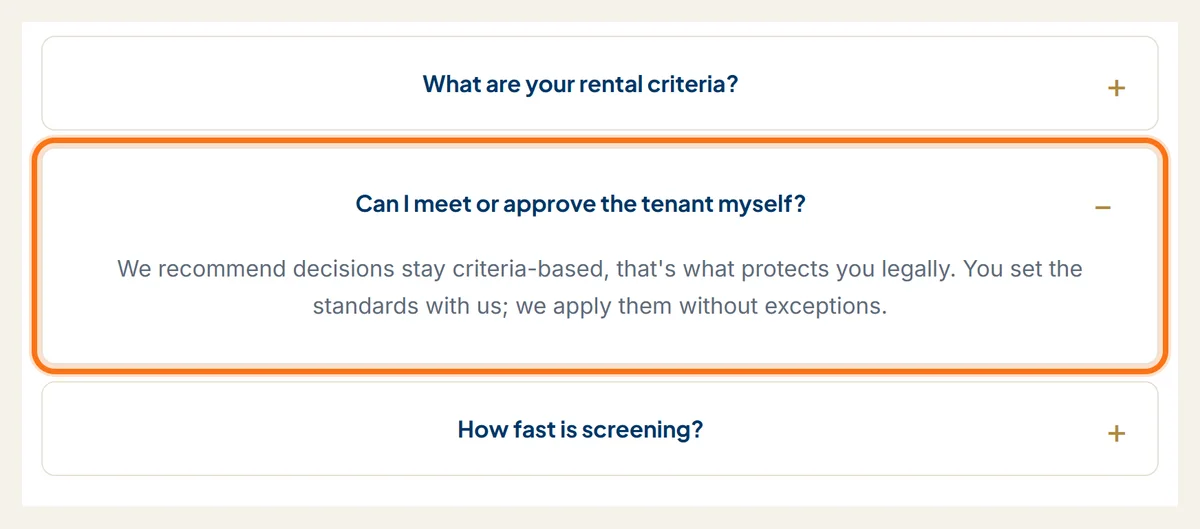
- You set the standard. On our tenant screening page, the answer to "Can I meet or approve the tenant myself?" is that we recommend decisions stay criteria-based, because that is what protects you legally: you set the standards with us, and we apply them without exceptions.
- Every adult, every time. We screen every adult against written criteria, and approval decisions are documented against objective standards. Our published rental criteria require income of at least 3x the rent, count only the two highest earners, and charge $60 per applicant. Pets are permitted at the owner's discretion.
- The rent is yours. Our rental pricing page says final pricing is always your call.
- The lease file. We use Texas-compliant lease documents, and you receive a copy of everything through the Owner Portal.
Whether your agreement with us gives you an approval step on each lease, and who signs it, are confirmed in writing before you sign. Every fee you pay is listed in your written agreement. To set your criteria with us for a home in Fort Worth, Keller or North Richland Hills, call 682-593-7033.

The takeaway: Decide the standard before the house is listed, put your approval rights in the management agreement, and change the criteria for everyone rather than overruling one qualified applicant.
Questions owners ask
Can I meet the tenant before the lease is signed?
You can, but it changes your role from setting the standard to judging a person, which is the part that is hard to defend later. If you meet applicants, meet every one under the same terms. If what you want is comfort, a written summary gives it more safely by showing how the approved household met each criterion.
What if I disagree with the manager's choice of tenant?
Ask which criterion the applicant met or missed. If the criteria were applied correctly, the decision stands, and the useful step is to change the criteria in writing for future applicants. A manager who approves applicants outside the agreed criteria is the real problem, and that is a conversation about the management agreement.
Can I set stricter screening criteria than the manager suggests?
Yes. You can require a higher income ratio, a stricter credit standard or a longer clean rental history. Ask the manager how the change may affect the number of qualified applicants, and put the stricter rule in the published criteria so it applies to every applicant from the start.
Does the owner sign the lease or does the manager?
It depends on the management agreement. Some authorize the manager to sign the lease as your agent; others require your signature on each lease. Check the agreement before the house is listed, and if your signature is required, agree how fast you will sign so a qualified applicant is not lost.
How long does a landlord have to approve a rental application in Texas?
Under Property Code 92.352, an applicant is deemed rejected if the landlord does not give notice of acceptance on or before the seventh day after the applicant submits a completed application. If your approval is part of the process, answer well inside that window.
Do I have to give applicants my screening criteria?
Property Code 92.3515 requires the landlord to make printed notice of the tenant selection criteria available when an applicant is given a rental application. If an applicant is rejected without that notice having been made available, the application fee and any application deposit must be returned.
Property management in Keller, North Richland Hills and Fort Worth. How full-service management works in Tarrant County →