Key takeaways
- Owning rentals gives a manager real experience of vacancy and repair judgment; it is a tie-breaker, not a qualification.
- The conflicts are concrete: their vacancy against yours, the same applicants, the same vendors after a storm, and an offer to buy your house.
- TREC rule 535.144: a license holder acting on their own behalf must disclose it in writing and may not use their expertise to your disadvantage.
- TREC rule 535.156: a license holder must put the principal's interest above their own.
- License, written criteria, documented systems and transparent money matter more; ask each conflict question and keep the answer in writing.
Should your property manager own rental property too? It helps a little and decides nothing. A manager who has carried a rental through a vacancy understands what an empty month costs, but a manager with homes near yours in Fort Worth, Keller or North Richland Hills can also compete with you for the same tenants, vendors and buyers. The fix is not to avoid such managers; it is to ask each conflict question directly and get the answer in writing.
Below is a conflicts table with the question to ask and what a good written answer says, the Texas license rules on a licensee's own interest as TREC words them, and how to weigh ownership against what matters more. A full interview method is in a weighted scorecard for interviewing property managers.
The conflicts table: what to ask and what the answer should say
Here are the conflicts that come with a manager who owns rentals in your market, the question that brings each one into the open, and what a written answer worth trusting should say:
| Conflict | Question to ask | What a written answer should say |
|---|---|---|
| Their vacancy against yours in the same month | "When one of your homes and one of mine are empty at once, how do you decide which is marketed and shown first?" | One process for every listing; pricing from the same kind of analysis; showings scheduled as inquiries arrive; they tell you which of their own homes are listed. |
| An applicant who fits both houses | "If an applicant could rent either house, where does the application go?" | To the house the applicant applied for, judged against that house's written criteria, with the application record kept. |
| One vendor, two jobs after a storm | "Whose repair is dispatched first, and do I get the same vendor rate as you?" | Work orders handled in a documented order; the same rates for client homes; the original vendor invoice visible to you. |
| An offer to buy your rental | "Would you, a relative or your company ever buy a client's property, and how?" | Written disclosure that they are acting for themselves, as TREC rule 535.144 requires, and a suggestion that you get an independent opinion of value. |
| Selling your house through their own brokerage | "If I sell, must I list with you, and who represents whom?" | No obligation unless the agreement says so; who represents whom stated in writing. |
| Money from vendors or referrals | "Do you receive anything from vendors you hire for my house?" | Either nothing, or every payment disclosed; under Occupations Code 1101.652(b)(13), accepting an undisclosed commission, rebate or direct profit on an expenditure made for a principal is a ground for discipline. |
How to read this table: the third column is the standard, not a guess about any one company. A manager who answers in a sentence and offers to put it in writing has thought about the conflict; a manager who says "it never comes up" has not. Keep the written answers with your management agreement.
The short answer: it helps, it does not decide
If two managers are otherwise equal, the one who has carried a rental through a vacancy and a difficult tenant will probably make better judgment calls for you. That is the case for it. The case against is that a manager with rentals in the same market is, at the margin, competing with you for the same applicants and the same vendor on the same Saturday, and a management agreement may not say whose house comes first.
So do not choose on ownership. If the manager owns rentals, ask the conflict questions in the table above and listen to how comfortable they are answering. "When your rental and mine are both vacant, which is shown first?" is the one that tells you the most in a single sentence.
What a manager who owns rentals understands from the inside
Four things tend to be sharper in a manager who has paid a rental's mortgage from their own account:
- Vacancy is a cost, not a status. They price to lease, because an extra empty month usually costs more than a slightly lower rent.
- Repair judgment. They know when a water heater should be replaced rather than patched again, because they have made that call with their own money.
- The value of a good tenant. They treat a renewal as a retention decision, not only a rent-increase formula.
- What a statement should show. They have read statements as an owner and know which lines matter.
None of this requires ownership, and a manager who has never owned a rental can think exactly this way. What you are testing for is whether the manager thinks like an owner about your money; how property managers get paid explains why the fee structure matters to that.
The conflict to raise first: their vacancy against yours
The practical version: a manager owns a three-bedroom in North Richland Hills, you own a similar one a mile away, and both are empty in the same month. Every applicant who sees both is choosing between the manager's house and yours, and the manager controls both listings, both showing calendars and both price recommendations.
An honest owner-manager handles this with a rule, and the rule sounds like the first row of the table: one process for every listing, pricing from the same kind of analysis, showings in the order inquiries arrive, and a willingness to tell you which of their homes are listed. The same conflict appears with vendors on a busy day, which is why the vendor process should be the same for every house; the vendor bench shows what a documented one looks like.
What Texas license rules say about a licensee's own interest
Texas does not forbid a property manager from owning rentals, but TREC's rules set out what a license holder owes a client and what they must disclose when acting for themselves. As read today on TREC's rules page:
- Rule 535.156(b): "The license holder must put the interest of the license holder's principal above the license holder's own interest."
- Rule 535.156(c): a license holder has an affirmative duty to keep the principal informed at all times of significant information applicable to the transaction.
- Rule 535.2(b): a broker "owes the highest fiduciary obligation to the principal."
- Occupations Code 1101.652(b)(16): acting "in a dual capacity as broker and undisclosed principal in a real estate transaction" is a ground for discipline.
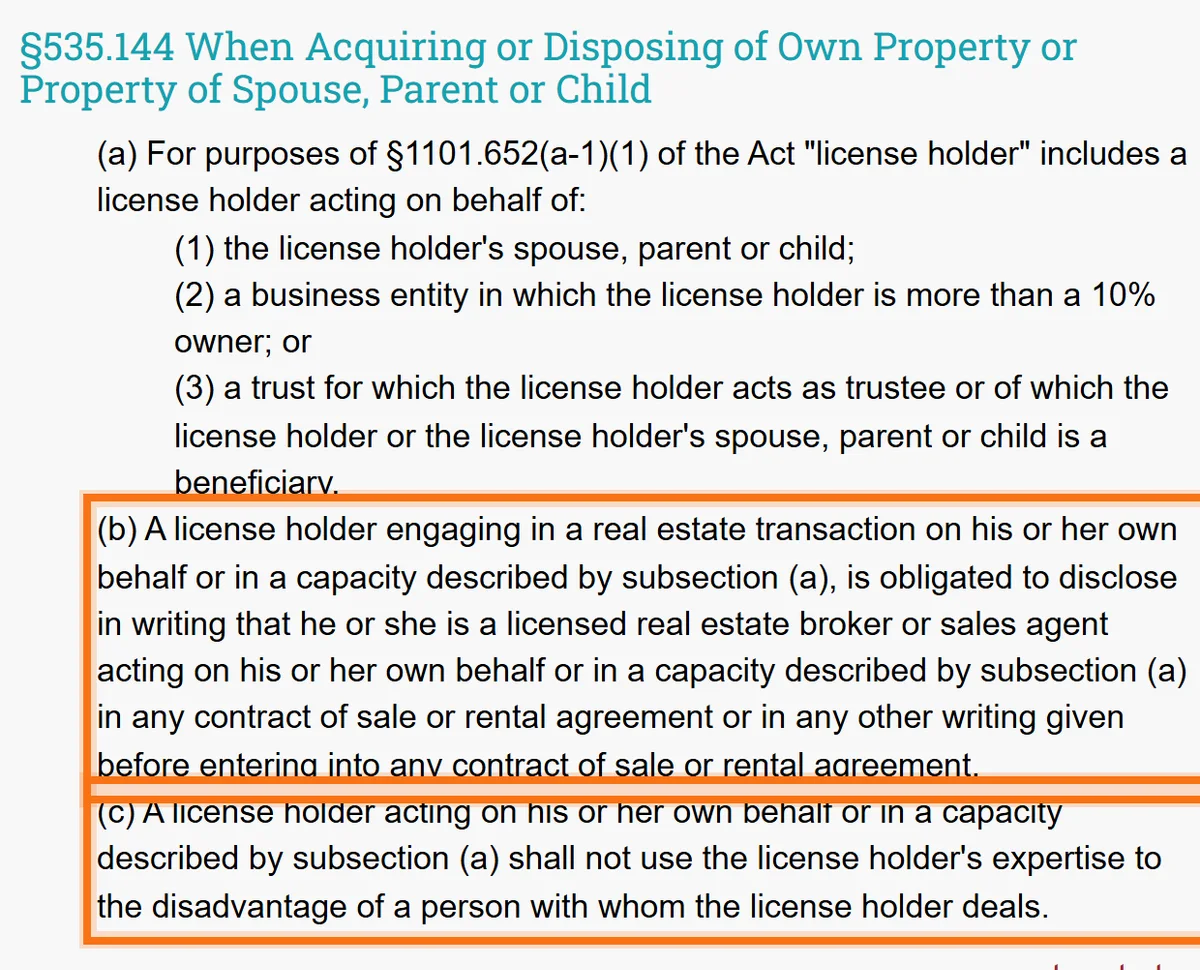
That matters most if your manager ever offers to buy your rental: the person with the best knowledge of your house, your tenant's rent and your reasons for selling is on the other side of the deal. Get the disclosure in writing and an independent opinion of value. This is general information, not legal advice.
What matters more than whether they own rentals
Rank the things that predict a good management outcome and ownership sits well down the list. Above it:
- Licensing and accountability. Under Occupations Code 1101.002, a person who for compensation controls the acceptance or deposit of rent from a resident of a single-family home for another person is acting as a broker. Check the license first; how to verify a property manager's Texas license shows the search.
- Written criteria applied to every applicant.
- Documented systems for maintenance, inspections and renewals.
- Transparent money: monthly statements, original vendor invoices, a clear reserve.
- A local office you can visit.
A manager with all five and no rentals of their own will usually serve you better than an owner-manager missing two of them. The traits are what you hire; ownership is a bonus.
A simple way to weigh ownership
Score each manager you interview pass or fail on the five traits above. Any manager who fails one is out, whatever they own. Among those who pass all five, rental ownership counts in their favor only if they answered the conflict questions comfortably and offered to put the answers in writing. If they own rentals and could not answer, count it against them: an unmanaged conflict is worse than no experience.
Write the scores down in the room, not from memory on the drive home. The interview scorecard gives you weights and a filled example, and broker-owned versus franchise property management explains what the company structure changes.
The investor friend who manages a few houses on the side
Some owners do the opposite and hire an investor friend who manages "a few houses on the side" precisely because that person owns rentals and seems to get it. The risk there is not ownership; it is that the systems may be missing: a trust account for your money, written criteria, a lease with the required statements, a maintenance process and statements you can audit.
Ask the same questions you would ask a company, including the license question, and expect the same written answers. Management company versus an agent who manages rentals covers that comparison in detail. Experience without process is how deposits get mishandled and leases go unsigned.
How Perpetual answers these questions
Perpetual is broker-owned. Justin Brown is a Texas Broker (TREC Broker License 549418-B) and the owner of both Perpetual Property Management and our affiliated brokerage, Perpetual Realty Group, LLC (TREC Broker Company License 9008702-BB), which helps investors and homeowners buy and sell. Our office is at 5755 Rufe Snow Dr, Suite 155, in North Richland Hills. What the site states that bears on these conflicts:
- Screening: "All applicants are evaluated against the same written criteria."
- Pricing: rental pricing from leased comparables, with a free rental analysis.
- Vendor money: coordination is a percentage of the vendor's invoice, and the original invoice is always in your portal; every fee you pay is listed in your written agreement.
- Buying and selling: managed owners get one team across buying, leasing, managing and eventually selling, through the affiliated brokerage, with TREC's Information About Brokerage Services notice on our disclosures page.

Whether anyone at Perpetual owns rentals near yours is not something our site states: ask us, and the answer, like every term of your management, is confirmed in writing before you sign. Read about Justin Brown, see what full-service management covers, or call 682-593-7033.
The takeaway: Hire for the license, the written criteria, the systems and the transparent money; treat rental ownership as a tie-breaker, and get every conflict answer in writing.
Questions owners ask
Should I choose a property manager who also owns rental properties?
Not on that basis alone. Ownership gives a manager real understanding of vacancy, repair judgment and tenant retention, but it can also mean competing with you for applicants, vendors and buyers when their home and yours are both empty. Ask how they decide which house is shown first and whether every listing follows the same process, get the answer in writing, then weigh the license, written criteria, systems and statements, which matter more.
Is it a conflict of interest for a property manager to own rentals in the same area?
It can be, at the margin, because the manager controls the listing, showings and pricing for both homes when both are vacant, and may share vendors on a busy day. It is manageable when the manager has a rule: one process for every listing, applications judged against each house's own criteria, the same vendor rates, and disclosure of their own listings when you ask.
What matters more than whether a manager owns rental property?
A verified Texas license with an accountable broker, written criteria applied to every applicant, a documented maintenance and inspection process, monthly statements with original invoices, and a local office. A manager with all of those and no rentals of their own will usually serve you better than an owner-manager missing two of them.
Should I let my property manager buy my rental when I sell?
Only with your eyes open. TREC rule 535.144 requires a license holder acting on their own behalf, or for a spouse, parent, child or a business entity they own more than 10% of, to disclose that in writing before the contract, and says they shall not use their expertise to your disadvantage. Get the disclosure, an independent opinion of value and, for a large sale, your own attorney.
Is an investor friend who manages a few houses a good property manager?
Usually not, for a reason unrelated to ownership: the systems may be missing. Experience with vacancies does not replace a trust account, written criteria, a lease with the required statements, a maintenance process and statements you can audit. Ask an investor friend the same license and process questions you would ask a company, and expect written answers.
What does Texas require when a property manager buys or rents for themselves?
TREC rule 535.144(b) requires a license holder engaging in a real estate transaction on their own behalf, or for a spouse, parent, child, a business entity they own more than 10% of, or a related trust, to disclose in writing that they are a licensed broker or sales agent acting in that capacity, in the contract or rental agreement or in a writing given before it. Rule 535.144(c) bars using their expertise to your disadvantage.
Property management in Keller, North Richland Hills and Fort Worth. How full-service management works in Tarrant County →