Key takeaways
- There is no single DFW percentage: every company sets its own, and an online "average" is either one company's number or a guess.
- Perpetual publishes 10% of monthly rent (Full Service), 9% (Standard) and 7% (Investor Special, 5 or more units); the final fee follows the free rental analysis.
- Multiply the percentage by your rent and by 12, then add placement, renewal and other fees outside it, to get a number you can compare.
- Ask what the percentage is charged on: rent collected, rent due or scheduled rent produce different bills in a bad month.
- Every number should be in the management agreement. On our price sheet: if a fee is not in the agreement, you do not pay it.
Property managers in DFW charge a monthly fee set as a percentage of rent, and the percentage differs by company and by plan, so there is no one figure to look up. Our own is published: 10%, 9% or 7% of monthly rent depending on the plan, for rentals in Fort Worth, Keller, North Richland Hills and nearby cities. What the number costs you depends on your rent, on what the percentage is charged on, and on the fees that sit outside it.
This guide turns percentages into dollars with an illustrative table, shows what our price sheet says the percentage applies to, and lists the questions that make two quotes comparable. Every fee type in DFW quotes is explained in property management cost in DFW.
The percentage in dollars: a conversion table
Here is what 7%, 9% and 10% of rent come to per month and per year at three illustrative rents. These are arithmetic only, not a quote and not a market survey; the three percentages are the ones on our price sheet:
| Monthly rent (illustrative) | 7% (Investor Special, 5+ units) | 9% (Standard) | 10% (Full Service) |
|---|---|---|---|
| $1,800 | $126 a month, $1,512 a year | $162 a month, $1,944 a year | $180 a month, $2,160 a year |
| $2,200 | $154 a month, $1,848 a year | $198 a month, $2,376 a year | $220 a month, $2,640 a year |
| $2,600 | $182 a month, $2,184 a year | $234 a month, $2,808 a year | $260 a month, $3,120 a year |
How to read this table: each cell is rent times the percentage, then times 12 for a fully let year (for example $2,200 x 9% = $198, and $198 x 12 = $2,376). The plans are not interchangeable: Investor Special is for portfolios of 5 or more units, and the plans differ in what sits outside the percentage, so the monthly fee alone never decides which applies. A worked month on a $2,500 rent is in house rents for $2,500: what you receive after fees.
Why management is priced as a percentage of rent
A percentage ties the manager's income to the rent. It scales the fee to the house, so a higher-rent home pays more in dollars for broadly similar work, and it gives the manager a reason to price the house well and keep it let. How strong that link is depends on the base: a fee charged only on rent actually collected stops when no rent arrives; a fee charged on scheduled rent does not.
Flat monthly fees are the main alternative; flat fee versus percentage property management compares the two models. Perpetual publishes percentage plans, not a flat fee, so this guide stays with the percentage.
What Perpetual publishes, and what the percentage applies to
Our price sheet lists three plans, each as a percentage "of monthly rent": Full Service 10%, Standard 9% and Investor Special 7% for portfolios of 5 or more units. The same numbers appear in the cost table on our switching page:
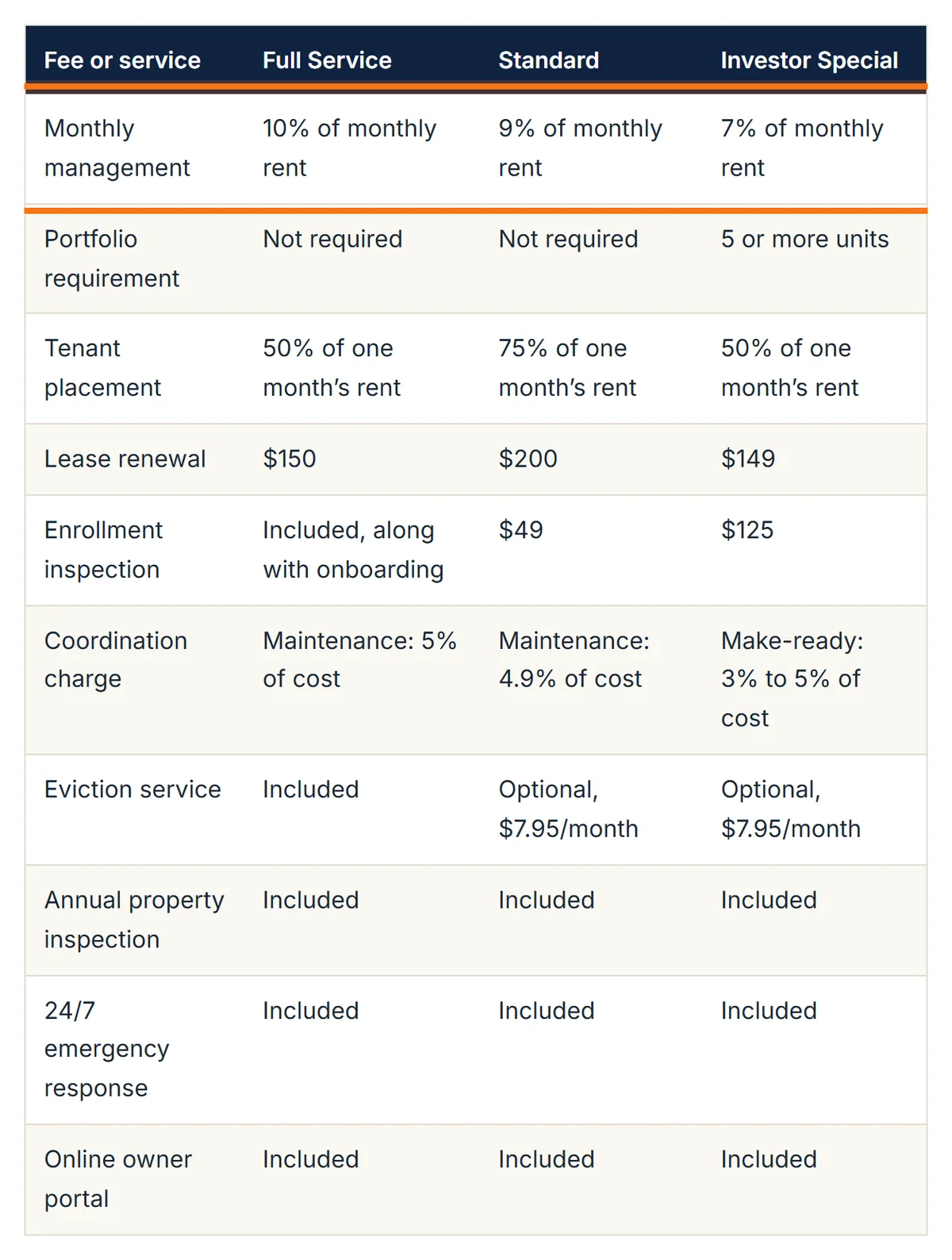
Two sentences on the price sheet matter as much as the percentages. "The final fee is set after the rental analysis: a newer home that needs no turn work can come in lower, an older home that needs permits and repairs at every turn can carry a premium." And: "Plans are negotiable case by case, and every number is confirmed in writing before you sign." So the published rate is the starting point, and your written quote is the number. The rental analysis is free.
What sits inside the percentage, and what sits outside it
The monthly percentage pays for running an occupied house; the one-time events are priced separately. On our price sheet, every plan includes an annual property inspection, 24/7 emergency response and the online owner portal. Listed outside the percentage, by plan:
- Tenant placement: 50% of one month's rent (Full Service, Investor Special), 75% (Standard).
- Lease renewal: $150 (Full Service), $200 (Standard), $149 (Investor Special).
- Enrollment inspection: included with onboarding (Full Service), $49 (Standard), $125 (Investor Special).
- Coordination: maintenance 5% of cost (Full Service), 4.9% (Standard); make-ready 3% to 5% of cost (Investor Special). It is a percentage of the vendor's invoice, and the original invoice is always in your portal.
- Eviction service: included (Full Service), optional at $7.95 per month (Standard, Investor Special).
Two companies can quote the same percentage and put different items inside it, so ask for the whole list in writing. Hidden property management fees shows where the extras usually sit in an agreement.
Rent collected, rent due or scheduled rent: three different bills
The same percentage gives three different yearly costs depending on its base. Rent collected: a share of money that actually arrived. Rent due: a share of what the tenant owed, paid or not. Scheduled rent: a share of the lease amount every month the agreement runs, occupied or not. The agreement's wording decides, so find the clause before you compare numbers. Our price sheet tells owners to ask any manager exactly this: "Is the management fee charged on collected rent, or billed even during vacancy?"
Illustrative only: a $2,000 house at 9% is $180 a month. In a year with two vacant months, a collected-rent basis charges 10 months, $1,800; a scheduled-rent basis charges 12, $2,160. The gap is $360 (check: $1,800 + $360 = $2,160). How a vacancy is treated is covered in do you pay management fees when your rental is empty.
Checking the percentage on your monthly statement
Once you have signed, the percentage shows up as one line on every owner statement, and it takes a minute to check. Take the rent figure the agreement uses as the base for that month, multiply it by your percentage, and compare the result with the management fee line. Illustrative: a $2,200 rent at 9% should show $198. If the line shows a different amount, look for one of four causes: a different base (rent due instead of rent collected, or the reverse), a partial payment, a fee charged on something other than rent, or a rate that differs from the agreement.
Keep the other lines separate in your head. A placement fee, a renewal fee or a coordination charge on a vendor invoice is not part of the monthly percentage, even when it lands on the same statement. Owner statements explained walks through every line, and how to spot mistakes on your owner statement gives a reconciliation check you can run each month.
Why the lower percentage can cost more
Illustrative only, two made-up quotes, not any company's prices and not ours. Rent is $1,800 and a new tenant is placed at the start of a fully let year. Quote A is 10% with a leasing fee of half a month and inspections included: $180 x 12 = $2,160, plus $900, is $3,060. Quote B is 7% with a leasing fee of a full month and two inspections billed at $100 each: $126 x 12 = $1,512, plus $1,800, plus $200, is $3,512.
The lower percentage costs $452 more in that year (check: $3,060 + $452 = $3,512). In a renewal year without a placement the order could reverse, so run both years. This is not an argument for a high percentage; it is an argument for doing the arithmetic on the whole quote. The fee comparison worksheet gives you the layout.
How your rent level changes the comparison
Because the fee scales with rent while the work stays broadly similar, the same percentage means different dollars at different rents: in the table above, 10% is $2,160 a year at $1,800 rent and $3,120 at $2,600. At the higher rent, a percentage can come out above a flat fee; at a low rent, some agreements set a minimum monthly fee, which makes the effective percentage higher than the quoted one. Ask whether a minimum applies.
Several houses change the picture too. Our Investor Special plan is for portfolios of 5 or more units, and portfolio pricing for multiple rentals explains how a quote for several homes is built.
Six questions that make a percentage quote comparable
- Is the percentage charged on rent collected, rent due or scheduled rent, and what happens in a vacant month?
- Is there a minimum monthly fee?
- What does the percentage include: inspections, emergency response, statements, the portal?
- What is charged outside it: placement, renewal, setup or enrollment, coordination, eviction, move-out?
- Are maintenance invoices passed through at cost or marked up, and will I see the original invoice?
- What does it cost to leave, and is any leasing fee refunded if a tenant fails early?
A company that answers all six in writing has given you a quote you can compare in dollars. Whether a percentage can move is covered in can you negotiate property management fees.
How Perpetual quotes the percentage
Perpetual Property Management is broker-owned, with our office at 5755 Rufe Snow Dr, Suite 155, in North Richland Hills, managing rentals in Keller, North Richland Hills, Fort Worth and nearby Tarrant County cities. How we quote:
- Published percentages: 10% of monthly rent (Full Service), 9% (Standard), 7% (Investor Special, portfolios of 5 or more units).
- Final fee after the rental analysis: a newer home that needs no turn work can come in lower; an older home that needs permits and repairs at every turn can carry a premium.
- Every other fee listed on the price sheet, with coordination as a percentage of the vendor's invoice and the original invoice always in your portal.
- In writing: plans are negotiable case by case, every number is confirmed in writing before you sign, and if a fee is not in the agreement, you do not pay it.
How our percentage applies in a month without rent, whether a vacancy or a tenant who has not paid, is confirmed in writing in the management agreement before you sign. See every line on our price sheet, or call 682-593-7033.
The takeaway: Turn every percentage into a yearly dollar figure for your own rent, add the fees outside it, and get the base it is charged on in writing; only then are two quotes comparable.
Questions owners ask
Is a lower management percentage always a better deal?
No. A lower percentage paired with a higher leasing fee, billed inspections or a maintenance markup can cost more over a year than a higher percentage that includes those items. Convert every quote into yearly dollars for a placement year and a renewal year, using your own rent, and compare those totals rather than the headline rate.
Do property managers charge a percentage during vacancy?
Only if the agreement charges on scheduled rent or rent due rather than rent collected. Under a collected-rent clause, a vacant month produces no management fee, though utilities, lawn care and insurance continue. Find the clause and confirm the base in writing before signing. At Perpetual, how the percentage applies in a month without rent is confirmed in writing in the management agreement.
Can I negotiate the management percentage?
Ask. Our price sheet says plans are negotiable case by case and that the final fee is set after the rental analysis: a newer home that needs no turn work can come in lower, and an older home that needs permits and repairs at every turn can carry a premium. Whatever is agreed goes into the management agreement in writing.
Does the percentage include finding a tenant?
Usually not. Placing a tenant is normally a separate fee charged when a lease is signed, and a renewal often has its own fee. On our price sheet, tenant placement is 50% of one month's rent (Full Service, Investor Special) or 75% (Standard), and lease renewal is $150, $200 or $149 by plan.
What percentage of rent does Perpetual charge?
Our price sheet lists 10% of monthly rent on Full Service, 9% on Standard and 7% on Investor Special, which is for portfolios of 5 or more units. The final fee is set after the free rental analysis, plans are negotiable case by case, and every number is confirmed in writing before you sign.
Why can an older house carry a higher management fee?
Because it usually means more work at every turnover. Our price sheet says the final fee is set after the rental analysis: a newer home that needs no turn work can come in lower, and an older home that needs permits and repairs at every turn can carry a premium. The analysis is free, and the agreed fee is written into the management agreement.
How do I convert a management percentage into a yearly cost?
Multiply your monthly rent by the percentage, then by the number of months the fee applies; for a fully let year that is 12. Illustrative: $2,200 x 9% = $198 a month, and $198 x 12 = $2,376 a year. Then add the fees outside the percentage that the year will trigger, such as a tenant placement or a renewal.
Property management in Keller, North Richland Hills and Fort Worth. How full-service management works in Tarrant County →