Key takeaways
- A fee charged on rent collected stops in a vacant month. A fee on scheduled rent, or a flat fee, can keep running.
- The management fee is rarely the big cost of vacancy: utilities, lawn care, make-ready and the leasing fee continue either way.
- Ask one question in writing before you sign: is the management fee charged on collected rent, or billed even during vacancy?
- Our published plans are 10%, 9% or 7% of monthly rent, and if a fee is not in your management agreement, you do not pay it.
- While a home we manage is vacant, the owner gets a written activity report every week, and a market-ready home is listed within 5 business days or the first month's management fee is waived.
Usually not, but only if the agreement says the fee is a percentage of rent collected. Under that wording a vacant month on a rental in Fort Worth, Keller or North Richland Hills produces no rent and therefore no management fee. Under a flat fee, or a percentage charged on scheduled rent, the fee can continue while the house sits empty, which is exactly the month you can least afford it.
The answer therefore lives in one clause of the management agreement, and this guide shows you how to find it, what you will still pay during vacancy even when the management fee stops, and what two empty months look like under each wording.
Management fees on an empty rental, by fee type
Here is what each way of charging a management fee means for a month with no tenant, and for a month when the tenant does not pay:
| How the fee is charged | Vacant month | Tenant in place but not paying | Wording to look for |
|---|---|---|---|
| Percentage of rent collected | No fee | No fee | "rents actually collected" or similar |
| Percentage of scheduled rent or rent due | Fee can still be charged | Fee charged on rent you never received | "gross scheduled rent", "rents due" |
| Flat monthly fee | Fee continues unless the agreement pauses it | Fee continues | "payable for the term of this agreement" |
| Separate vacancy fee or monthly minimum | A reduced charge applies | Depends on the clause | "vacancy fee", "vacant property fee", "minimum monthly fee" |
How to read this table: find the fee clause in the agreement, match its wording to the last column, then read across. If the wording does not clearly match the first row, ask the company to state in writing what you pay in a vacant month before you sign.
The three ways a fee can be charged, and what each means for an empty month
A management fee is charged on one of three bases, and the agreement names which:
- Rent collected. The fee is a share of money that actually arrived. Vacant month, no rent, no fee. Non-payment month, same.
- Rent due or scheduled rent. The fee is a share of the lease amount whether or not it was paid, and under some agreements whether or not a lease exists. A vacant month can still carry a fee.
- Flat fee. A fixed amount each month the agreement is in force. Some flat agreements pause during vacancy; many do not.
This page starts with the vacant month, then covers the parts of the same clause owners miss: partial payments, back rent, minimum fees and a full year worked under each wording.
What you still pay during vacancy, even with no management fee
A rent-collected clause stops the management fee, not the cost of an empty house. Expect these to continue or appear:
- Utilities in your name so the house can be shown, cleaned and kept at a safe temperature.
- Lawn care, because an overgrown yard loses applicants and draws city notices. The City of Fort Worth requires grass and weeds to be kept at 12 inches or less on developed and vacant lots; the lawn care guide has the details.
- Make-ready work: cleaning, paint, repairs and anything the move-out inspection identified.
- Vacant-property checks if the agreement provides them, which are worth having for insurance and security reasons.
- The leasing fee once a tenant signs, which is the cost of ending the vacancy.
- Your mortgage, taxes, insurance and HOA dues, which never pause.
The guide to what a vacant month really costs adds up the whole picture; the management fee is often the smallest line in it, which is why the real way to save on vacancy is to shorten it. At $2,000 a month in rent, every week of avoidable vacancy costs about $460.
Why no rent, no fee matters beyond the money
A manager paid only on rent collected has the same month you do when the house is empty: a bad one. That alignment is why the clause matters even to owners who could afford a flat fee during vacancy. A manager with no income from a vacant house is motivated to price it correctly, market it hard, show it promptly and screen quickly, because every week of vacancy costs them too.
A manager paid on scheduled rent or a flat fee is not harmed by vacancy, and while most companies act professionally regardless, the structure removes the pressure. If you are choosing between two companies and one charges nothing during vacancy, that is evidence about how the hard months will go. The marketing service describes what shortening a vacancy actually involves.
The wording to look for, and the wording that catches owners
Find the fee clause and read the base it names. Favorable wording says the fee is a percentage of rents actually collected, or similar. Wording that catches owners includes a fee on gross scheduled rent, a fee on rents due, a flat monthly fee payable for the term of this agreement, or a minimum monthly fee that applies regardless of occupancy. Each of these can mean paying during vacancy.
Also look for a vacancy fee or a vacant property fee listed separately. Some companies charge a reduced monthly amount while the house is empty, sometimes framed as covering vacant checks and utility coordination. That is not necessarily unfair if it buys real work, but it should be on the written quote, not discovered on the first vacant statement. The pricing and fees page shows how a complete fee list should present this.
The sentences to ask for before you sign
The fee base is usually one phrase in the compensation section. If it is unclear, ask the manager to add these, in plain terms:
- The management fee is calculated on rent and other recurring charges actually received during the month.
- "Rent" for the fee means: (list what counts, and whether late fees, pet rent and utility reimbursements are included).
- No management fee is charged for a month in which the property is vacant, or: the vacancy fee is $X.
- Any minimum monthly fee is $X, and it does or does not apply during vacancy.
- The fee on back rent is taken once, when it is collected.
A manager whose agreement already works this way can confirm it in writing quickly. The rest of the contract is covered in the property management agreement: what to look for.
Two empty months, under each wording
The figures below are illustrative only, chosen to make the arithmetic visible. They are not a quote for your home and not an industry average.
Say the house rents for $2,100 and the tenant leaves at the end of the lease. It takes two months to make the house ready and place the next tenant. Under a fee of 9 percent of rent collected, those two months carry no management fee; the owner pays utilities, lawn care and the make-ready, then a leasing fee when the new lease is signed. Under the same 9 percent charged on scheduled rent, the two months carry $189 each, or $378, on top of everything else. Under a flat fee of $160 that does not pause, it is $320.
Over several years of ownership with a turnover every two or three years, that clause is worth more than a point of percentage. It is also the clause owners least often read, because the first statement they see is for an occupied house.
The related question: a tenant who does not pay
The same clause governs a month when the house is occupied but the rent does not arrive. Under rent collected, no fee. Under rent due, the fee is charged on money you never received, so you pay the manager for a month the tenant did not pay you. Under a flat fee, the same.
Ask how the company handles the fee during a non-payment month and during the eviction process that may follow, and whether eviction coordination is a separate charge. The honest arrangement is that the manager's fee follows the rent, so the manager is working to recover it rather than being paid regardless. The sequence that follows a missed payment is the same whether the fee is owed or not; the difference is who is paying for the delay.
Partial payments, back rent and what counts as rent
Real months are messier than all or nothing. Suppose, as an illustrative example at a 10% rate used only for the arithmetic, a tenant pays $1,200 of a $2,000 rent in March and the remaining $800 in April, along with April's full $2,000:
- Collected basis: $120 in March (10% of $1,200), then $280 in April (10% of $2,800). Total $400, the same as two full months.
- Due basis: $200 in March on the $2,000 owed and $200 in April. Total $400 if the agreement says no second fee is taken on the $800 when it arrives, $480 if it does not.
So read what the agreement says about back rent: on a collected basis the fee is normally taken once, when the arrears are actually collected through a payment plan or a judgment, and it should never be charged both when rent was due and again when it is collected. Then check what counts as "rent" for the fee. Pet rent and other recurring monthly charges are often included; late fees are handled in different ways. Who keeps those charges is covered in who keeps late fees and pet fees.
A worked year with one empty month and one missed month
Here is one illustrative year totaled under four wordings: rent of $2,000, a 10% example rate, month seven empty with no lease in force, and month ten unpaid and never recovered. Leasing and repair costs are left out so the comparison isolates the management fee:
| Wording | Months with a fee | Fee for the year |
|---|---|---|
| Of rents collected | 10 months at $200 | $2,000 |
| Of scheduled rent, no fee while no lease is in force | 11 months at $200 | $2,200 |
| Of scheduled rent, plus a $100 vacancy fee | 11 months at $200 + $100 | $2,300 |
| Of rents collected, but not less than $150 a month | 10 months at $200 + 2 months at $150 | $2,300 |
How to read this table: in a good year every wording costs about the same. The gap comes from the bad months: $20,000 of rent collected gives $2,000 on the first line, eleven fee months give $2,200, and a vacancy fee or a $150 minimum ($2,000 + 2 x $150) brings it to $2,300. It grows with each extra month of vacancy or non-payment. Illustrative only, not a quote.
How Perpetual handles this
Perpetual Property Management is broker-owned, with our office at 5755 Rufe Snow Dr in North Richland Hills, and we manage homes in Keller, North Richland Hills, Fort Worth and nearby. Our published plans are priced as a percentage of monthly rent: 10% on Full Service, 9% on Standard and 7% on Investor Special for portfolios of 5 or more units. Our own pricing page tells owners to ask any manager whether the fee is charged on collected rent or billed even during vacancy, and we answer that in writing for your specific property before you sign. If a fee is not in the management agreement, you do not pay it.
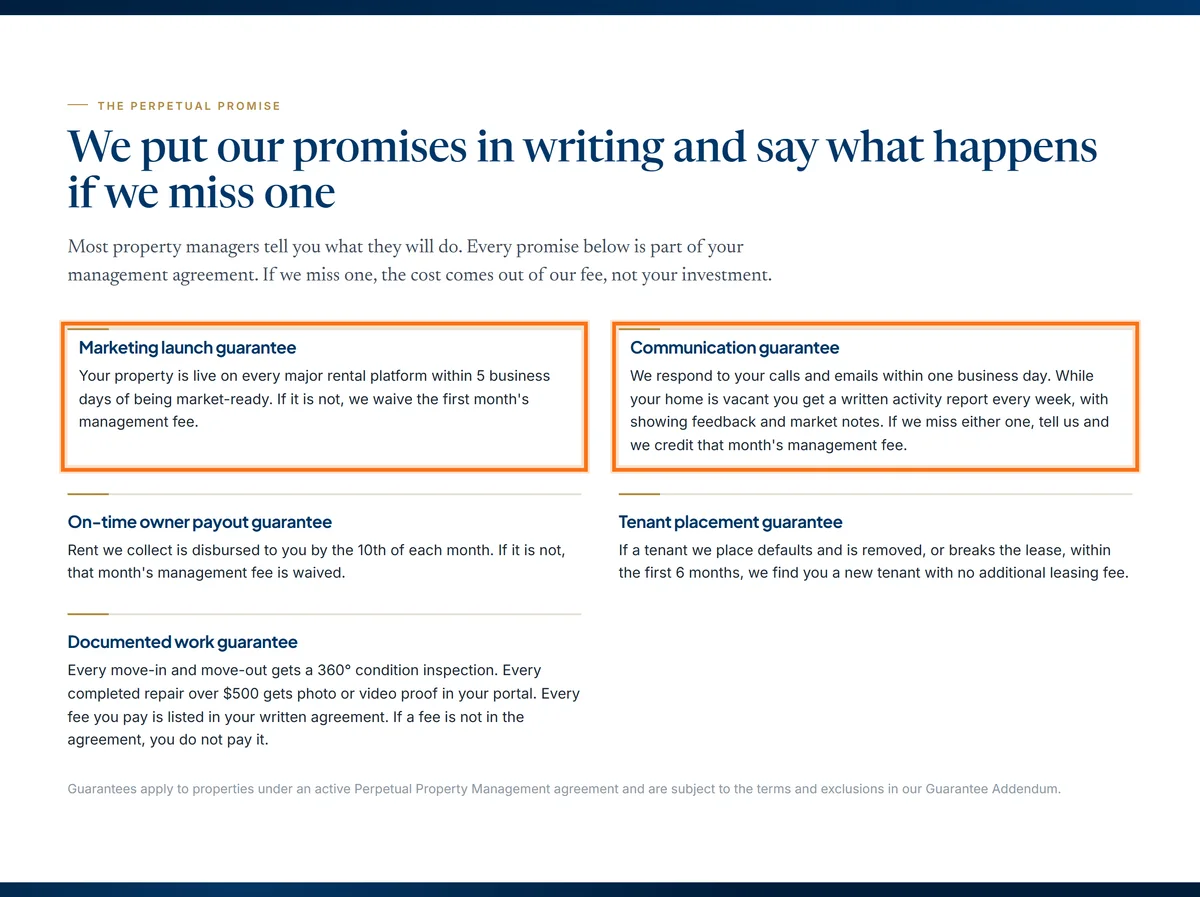
When a house is empty, the work is to make it not empty. A market-ready home is live on every major rental platform within 5 business days, or we waive the first month's management fee. While it is vacant you get a written activity report every week, with showing feedback and market notes, or that month's management fee is credited. The tenant placement fee that ends the vacancy is 50% of one month's rent on Full Service and Investor Special and 75% on Standard. These commitments are in The Perpetual Promise, subject to its Guarantee Addendum.
The full-service management page covers the rest of the process, from the move-out inspection to the next lease. To get the vacant-month answer in writing for your house, call 682-593-7033.
The takeaway: Whether an empty month costs you a management fee depends on one clause, rent collected versus scheduled or flat, and that clause is worth more over the life of the rental than a small difference in the percentage.
Questions owners ask
What is a vacancy fee in property management?
A reduced monthly charge some companies apply while a house is empty, often described as covering vacant-property checks, utility coordination and showings. It is not universal, and it should be listed on the written quote rather than discovered later. Ask whether one applies, what it buys, and whether it is credited against the leasing fee when a tenant is placed.
Do I pay a leasing fee every time the house is vacant?
You pay a leasing fee each time a new tenant is placed, which follows each vacancy. It is the cost of ending the vacancy rather than a charge for the vacancy itself. Ask whether any part of it is protected if the tenant leaves early. Perpetual's placement fee is 50% or 75% of one month's rent depending on the plan, and if a tenant we place defaults and is removed, or breaks the lease, within the first 6 months, we find a new tenant with no additional leasing fee, subject to our Guarantee Addendum.
Who pays the utilities while a rental is empty?
The owner, because the house must be shown, cleaned and kept at a safe temperature, and because a house without power or water cannot be made ready. The manager usually coordinates the transfer into the owner's name at move-out and back to the tenant's name at move-in. The cost appears on your monthly statement.
Does the management fee stop if my tenant stops paying rent?
Under a rent-collected clause, yes, because there is no rent to take a percentage of. Under a rent-due or flat-fee clause, the fee can continue through a non-payment month and the eviction that may follow. Check the clause and ask the company directly how the fee is treated when rent is late or unpaid.
Does Perpetual charge a management fee while my house is vacant?
Our published plans are priced as a percentage of monthly rent: 10% on Full Service, 9% on Standard and 7% on Investor Special. How a vacant month is treated for your property is confirmed in writing before you sign, and if a fee is not in the management agreement, you do not pay it. Ask us and you will get the answer in the written quote, not on a statement.
How much does a vacant month cost a rental owner?
Start with the rent you are not collecting: at $2,000 a month, each vacant week costs about $460. Add utilities, lawn care, any make-ready work, and the leasing fee when the next tenant signs, on top of the mortgage, taxes, insurance and HOA dues that never pause. The management fee, if one applies at all, is usually the smallest line.
What is a minimum management fee?
A clause such as "10% of rents collected, but not less than $150 per month" sets a floor. In a month with full rent the percentage applies; in an empty or unpaid month the minimum applies instead of zero. In the illustrative year on this page, a $150 minimum turned a $2,000 collected-basis total into $2,300. Read whether the minimum applies during vacancy.
Are management fees based on rent collected or rent that's due?
It depends on the agreement. A fee "of rents collected" is calculated on money the manager actually received that month, so an empty or unpaid month produces no percentage fee. A fee "of monthly rent" or "scheduled rent" can be charged on what the lease says is owed, whether or not the tenant paid. Find the words right after the percentage and ask for the answer in writing.
Related services
Property management in Keller, North Richland Hills and Fort Worth. How full-service management works in Tarrant County →