Key takeaways
- Every statement line has a source document: the lease, the management agreement, a vendor invoice or the disbursement history.
- A fee is only right if the agreement names it and the rate and base work out; recompute one each month.
- Duplicate invoices, a fee on the wrong base and a reserve top-up that was not needed are the errors that repeat.
- In the worked example, three errors cut one month's payout by $293.
- Ask in writing, one line per question, with the document you compared it to.
How can I spot unexpected deductions or mistakes on my owner statement? Match every line to the document that justifies it: rent and pet rent to the lease, every fee to the management agreement, every repair to the vendor's invoice, and the payout to the disbursement history and your bank deposit. For a rental in Fort Worth, Keller or North Richland Hills, that check takes ten to fifteen minutes a month, and a line you cannot match is a question to send the same day.
Below: the reconciliation table, the mistakes that repeat, the lines that look wrong but are not, a worked example with the arithmetic, and what to do when you find an error.
The reconciliation check: each statement line and its source document
Here is each kind of line on an owner statement, the document it must match, and the mistake to look for:
| Statement line | Check it against | What must match | Mistake to look for |
|---|---|---|---|
| Rent | The lease | The lease amount, or a line explaining a proration, partial or returned payment | Less than the lease with no explanation |
| Pet rent, late fees, other tenant charges | The lease and the management agreement | The lease amount, and who keeps it under the agreement | A charge kept by the manager that the agreement gives to you |
| Management fee | The fee schedule in the agreement | The rate times the base the agreement names | The fee computed on a bigger base, such as rent plus pet rent |
| Leasing or placement fee | The agreement and a newly signed lease | Charged once, when a new tenant signs | Charged on a renewal, or twice |
| Renewal fee | The agreement and a signed renewal | Charged once per renewal | Charged in two months in a row |
| Maintenance | The vendor's original invoice | Invoice total, plus only a fee the agreement names | The same invoice posted twice, or posted to the wrong house |
| Reserve | The reserve amount in the agreement | A top-up only when the balance is below that amount | A top-up when the reserve was already full |
| Utilities | The lease and the move-in date | Paid by you only for days the lease makes yours | A bill paid from your rent after the tenant should hold the account |
| Payout | Disbursement history and your bank | Same amount, same date | A payout that does not match the statement total |
How to read this table: work down the rows once a month. Each row has one document; if you cannot find that document, ask for it before you question the number. Rows 3, 6 and 7 are where the repeating errors live, because a software setting or a habit gets them wrong every month until someone checks.
The mistakes that repeat
- The management fee calculated on rent plus pet rent or late fees when the agreement names rent only.
- A leasing fee charged on a renewal, or a renewal fee charged twice.
- A vendor invoice posted to the wrong property, which only owners of more than one house can catch, and only by opening the invoice.
- The same invoice posted twice, often when a vendor sends an estimate and an invoice with the same number.
- A reserve top-up in a month when the reserve was already at the agreed amount.
- A utility bill paid from your rent for days after the tenant should have had the account.
- A fee whose name does not appear in the agreement: administrative, technology, processing, compliance.
- A late fee or pet fee kept by the manager when the agreement gives it to you; see who keeps late fees and pet fees.
None of these needs bad intent. Most are a software default or a bookkeeping slip. They still cost money every month until someone asks. The hidden fees guide lists the fee names to look for in the agreement before they ever reach a statement.
Lines that look wrong but usually are not
Some lines look wrong and are not. The first statement after a new tenant is often small because a leasing or placement fee comes out of the first rent and a reserve may be funded. A move-in proration makes the first rent an odd number. A returned tenant payment shows as income one month and a reversal the next. Repairs under the spending limit in your agreement appear without a prior call because you agreed they would.
Knowing these keeps you from chasing ghosts and makes the real errors stand out. If one of them surprises you, reread the agreement before you question the statement. The layout of a statement, section by section, is in how to read your monthly owner statement.
The reserve line: roll it forward once a month
The reserve is the line owners skip most, because it is neither income nor a bill. One sum checks it: the beginning reserve balance, plus any top-up, minus anything paid from it, should equal the ending balance, and the ending balance should match the amount your agreement sets.
Illustrative only, not a quote. A reserve set at $300 starts the month at $300. A $120 repair is paid from it, so it drops to $180; a $120 top-up from rent brings it back: $300 - $120 + $120 = $300. If the statement instead shows a $200 top-up, the reserve ends at $300 - $120 + $200 = $380, which is $80 above the agreed amount, and that $80 would otherwise have reached you. Ask whether it is a mistake or a change you agreed to.
How a reserve and the monthly payout work together is covered in owner reserve and disbursements.
A worked example: three errors, one month
Illustrative only, not a quote. The lease is $2,000 a month rent plus $50 pet rent. The management agreement in this example charges 8% of the monthly rent, with pet rent outside the fee base, a 5% coordination charge on vendor invoices, and a $300 reserve that was already full last month. The statement shows:
| Line | Statement shows | Source document says | Correct amount |
|---|---|---|---|
| Rent and pet rent | $2,050 | Lease: $2,000 + $50 | $2,050 |
| Management fee | $164.00 (8% x $2,050) | Agreement: 8% of rent only | $160.00 (8% x $2,000) |
| Plumbing repair | $189 | Invoice $180 + 5% coordination ($9) | $189 |
| Plumbing repair (second line) | $189 | Same invoice number as the first | $0 (duplicate) |
| Reserve top-up | $100 | Reserve already at $300 | $0 |
| Payout | $1,408 | $2,050 - $160 - $189 | $1,701 |
How to read this table: the payout shown is $2,050 - $164 - $189 - $189 - $100 = $1,408. The corrected payout is $2,050 - $160 - $189 = $1,701. The $293 gap is $4 on the fee base, $189 for the duplicate and $100 for the reserve top-up. The $4 is the error that matters most over time: left alone, it repeats every month.
Each finding becomes one written question with the line, the date, the amount and the document you compared it to.
What to do when a line does not match
Send the question in writing through the portal or by email, one line per question, with the amount and the document you compared it to. Ask for the invoice where one is missing. Then check the next statement for the correction, and make sure it is visible as its own line rather than a quiet change to a total.
Two Texas rules stand behind a broker's statements. TREC rule 535.146 requires a broker holding trust money to keep a documentary record of each deposit or withdrawal and to provide an accounting to each beneficiary at least monthly if there has been activity in the account, and to keep trust account records for four years. Occupations Code 1101.652(b)(24) lists, as a ground for discipline, a license holder who withholds from or inserts into a statement of account or invoice a statement the license holder knows makes it inaccurate in a material way.
If the same error comes back, or the answer is vague, escalate to the broker. A complaint to TREC must be written and filed within four years, and TREC states it cannot order a license holder to pay damages; money claims go to another forum. This is general information, not legal advice. If the pattern continues, read how to switch property managers.
Set up so mistakes are rare
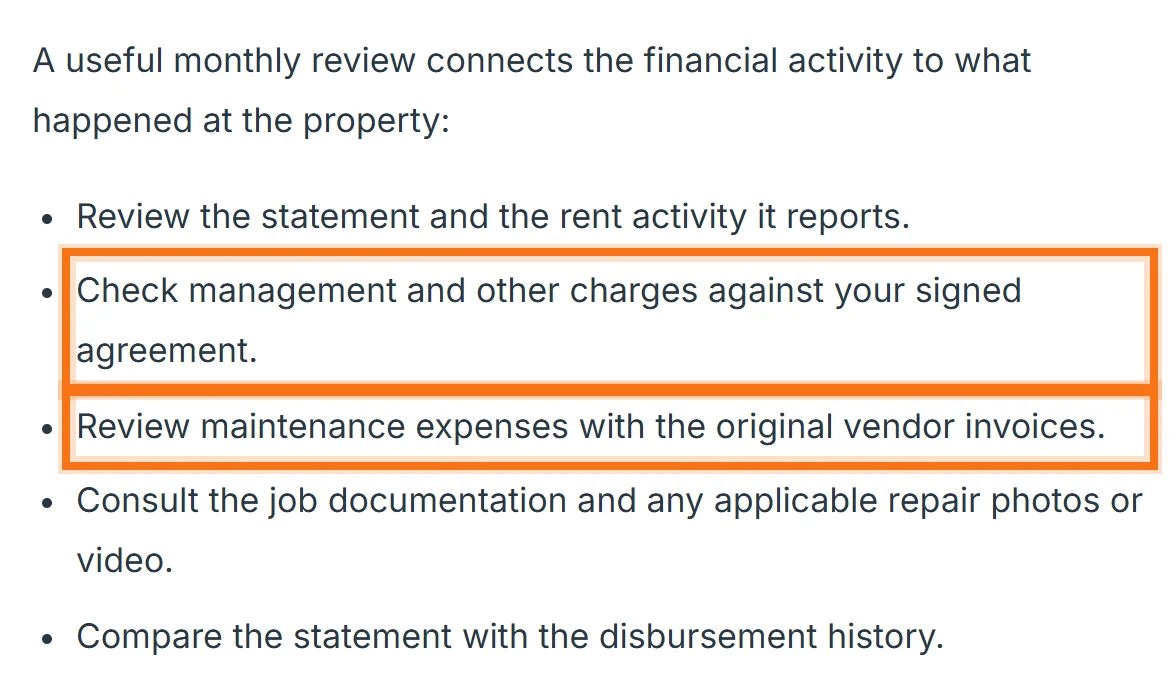
Most of this is decided before the first statement. Insist on a management agreement that names every fee, its rate and the base it is calculated on. Insist on the vendor's original invoice behind every maintenance line. If you own more than one house, ask how each property's income and expenses are shown so you can catch an invoice posted to the wrong one.
Then reconcile the year. In January, add up the twelve statements and compare the total with the year-end summary your manager provides. A year of small errors finally shows up as one number. What your CPA needs is in year-end reporting for rental owners.
How Perpetual handles this
Here is what our site states that bears on checking a statement:
- Fees: every fee is on our price sheet, the final numbers go into the management agreement, and if a fee is not in the agreement, you do not pay it.
- Invoices: maintenance coordination is a percentage of the vendor's invoice, and the original invoice is always in your portal, so you can recompute it.
- The portal: statements, documents and disbursement history in one secure place, on AppFolio (owner portal).
- Payout: rent we collect is disbursed to you by the 10th of each month, or that month's management fee is waived.
- Answers: we respond to calls and emails within one business day, or we credit that month's management fee.
Both promises are part of the Perpetual Promise and subject to the Guarantee Addendum.
The rate and base of each fee on your house, the reserve amount and how a correction appears on your statement are confirmed in writing before you sign. To see a written quote for your rental, request a free rental analysis or call 682-593-7033.
The takeaway: Reconcile, do not just read: match each statement line to the lease, the agreement, the vendor invoice or the disbursement history, recompute one fee each month, and send every line you cannot match as a written question that day.
Questions owners ask
What lines should I see on each monthly owner statement?
The period, the beginning balance, every income line with its source, every fee by name, every maintenance charge with the vendor, any reserve movement, the amount paid to you and the ending balance. A statement that gives totals without lines, or lines without documents behind them, cannot be checked. Ask for a sample before you sign. The layout is explained in our guide to reading your monthly owner statement.
How long does a property manager have to send the owner statement?
The management agreement sets the day. For a licensed broker holding your money, TREC rule 535.146 requires an accounting to each beneficiary of trust money at least monthly if there has been activity in the account. A manager who keeps missing its own schedule is telling you something about its bookkeeping. Ask for the statement and payout dates in writing.
Can I ask my property manager for the original repair invoices?
Yes, and you should not have to ask twice. The invoice is the document that justifies the charge. Compare its total with the statement line and recompute any coordination or markup charge the agreement names. On our plans the original vendor invoice is always in your owner portal.
What if my property manager refuses to correct a mistake on the statement?
Put the request in writing with the documents, escalate to the broker who holds the company's license, and keep the correspondence. A written complaint to TREC is possible within four years of the incident, but TREC states it cannot order a license holder to pay damages, so a money dispute goes to the agreement's dispute terms or a Texas attorney. This is general information, not legal advice.
How do I check the management fee on my statement?
Find the rate and the base in your management agreement, multiply, and compare. If the agreement says a percentage of monthly rent and the statement applies it to rent plus pet rent or late fees, the fee is on the wrong base. Do this once a month; the error repeats until someone catches it.
What if the same repair invoice appears twice on my statement?
Open both lines in the portal and compare the vendor, invoice number, date and amount. If they match, ask the manager in writing to reverse the duplicate and show the reversal as its own line on the next statement. A vendor's estimate and final invoice sometimes share a number, which is a common way duplicates happen.
Related services
Property management in Keller, North Richland Hills and Fort Worth. How full-service management works in Tarrant County →