Key takeaways
- A lower monthly fee is a saving you can measure: the difference per month times 12 is your "saving budget".
- Nine other lines can spend that budget: leasing, renewal, maintenance markups, inspections, setup, monthly admin fees, eviction, vacancy or minimum fees and termination.
- In our illustrative year, a 6% quote saves $720 on the monthly line and costs $1,060 more in total than a 9% quote.
- Each line sits somewhere specific in the agreement: the fee schedule, an exhibit, the maintenance clause or the termination section.
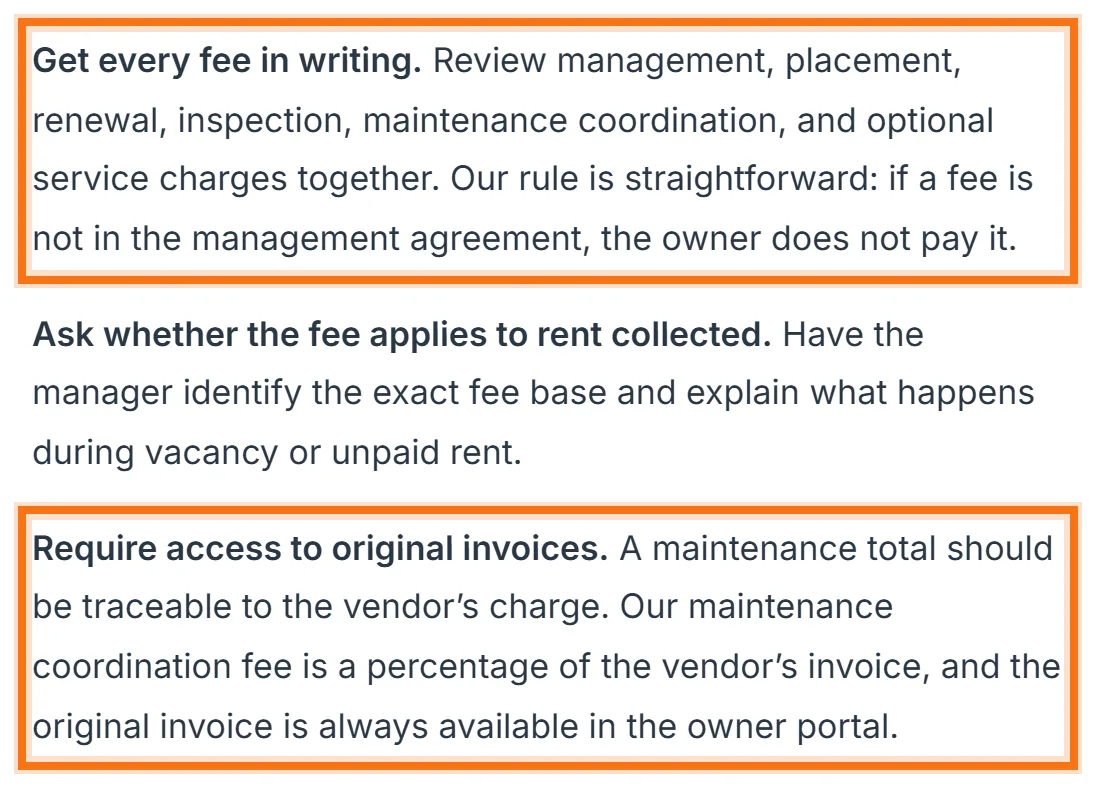
- Get every line in writing; on our price sheet, if a fee is not in the agreement, you do not pay it.
When a manager quotes a low monthly fee, check the charges outside it: the leasing fee, renewal fee, maintenance markup or coordination charge, inspection and trip fees, setup fee, any monthly technology or administrative fee, the eviction fee, any minimum or vacancy fee, and what it costs to leave. Turn the lower monthly fee into a yearly saving first, then see how much of it those lines take back over a year with one new tenant. The test is the same for a rental in Fort Worth, Keller or North Richland Hills.
This guide gives you the nine lines, what to ask about each and where each sits in an agreement, then works one illustrative year. The full catalog of fee names is in hidden property management fees.
Nine charges to check against a low monthly fee
Each row is a line that can take back what a low monthly fee saves you, the question that pins it down, and the part of a management agreement where it is usually written:
| Fee line | How it can take back the saving | What to ask | Where it hides in the agreement |
|---|---|---|---|
| Leasing (tenant placement) | A higher share of a month's rent each time a tenant is placed | What is it in dollars on my rent, and is any of it refunded if the tenant fails early? | The fee schedule, or a separate leasing addendum |
| Lease renewal | Charged every time the tenant re-signs | Is it a flat amount or a share of rent, and what does it buy? | The fee schedule or the renewal clause |
| Maintenance | A markup, a coordination percentage or a per-order fee on every repair | Will I see the original vendor invoice, and what is added to it? | The maintenance or repairs clause |
| Inspections and trips | A charge per visit, per vacant check or per trip to the house | Which inspections are included, and what does an extra one cost? | An exhibit or the inspection clause |
| Setup or onboarding | A one-time charge in the first month | What does it cover, and is an initial inspection part of it? | The fee schedule or the first-month terms |
| Technology, portal or admin | A fixed amount every month on top of the percentage | Are there any monthly charges besides the management fee? | The fee schedule, sometimes in small print |
| Eviction | A manager's own fee to handle a nonpaying tenant, besides court costs | Is eviction handling included, optional or billed per case? | The default or legal-services clause |
| Vacancy or minimum fee | A fee charged in months with no rent coming in | Is the fee charged on rent collected, or billed even during vacancy? | The definition of the management fee |
| Termination or sale | A charge to leave early, or a commission if you sell | What does it cost to leave, and does a sale trigger any fee? | The term and termination section |
How to read this table: you will not find every line in every quote, and a line that is present is not wrong in itself. The point is to price each one for your house and add them up. The questions on the leasing, vacancy and termination rows follow the list of questions to ask any property manager on our own price sheet.
Turn the low fee into a saving budget
The monthly percentage is the number owners compare, so it is the number managers compete on. A lower one is a real saving, and you can measure it. Take the difference between two monthly fees and multiply it by 12. Illustrative: on a $2,000 rent, 6% is $120 a month and 9% is $180, so the lower quote saves $60 a month, or $720 a year. That $720 is your saving budget.
Every other line in the lower quote is spent from that budget. If the extras for the year come to less than $720, the low quote is cheaper; if they come to more, it is not. That turns a vague worry about "hidden fees" into one subtraction you can do with any two quotes. A lean company can honestly charge less per month; the test is whether the rest of its schedule is equally lean.
The lines that spend the saving fastest
In the example, three of the nine lines decide the result, because they are large or they repeat:
- The leasing fee. It is charged in full each time a tenant is placed. On a $2,000 rent, the gap between half a month and a full month is $1,000, more than the whole $720 saving budget in the example. Leasing fees explained covers what it should buy.
- Monthly add-ons. A $15 technology fee is $180 a year, a quarter of the budget, and it is charged whether or not anything happens.
- Maintenance markups. They scale with your repair bill, so an older house spends the budget faster. How to tell whether your repair bills carry a markup shows how to read an invoice against a statement line.
Then check the base of the monthly fee itself. A low percentage charged even while the house is empty, or with a minimum, can cost more than it looks; see do property managers have a minimum monthly fee.
A worked year with one turnover
Here is one illustrative year with two made-up quotes, not any company's prices and not ours. Rent is $2,000; a new tenant is placed at the start of the year and pays all twelve months; repairs at vendor cost come to $1,500:
| Line | Low quote (6% headline) | Other quote (9% headline) |
|---|---|---|
| Monthly fee x 12 | $1,440 | $2,160 |
| Technology fee ($15 a month) | $180 | $0 |
| Leasing fee | $2,000 (a full month) | $1,000 (half a month) |
| Maintenance markup (10% of $1,500) | $150 | $0 |
| Two inspections at $100 | $200 | Included |
| Setup fee | $250 | $0 |
| Total for the year | $4,220 | $3,160 |
How to read this table: the low quote saves $720 on the monthly line and spends $1,780 on the others, so it costs $1,060 more for the year. Checked twice: $1,440 + $180 + $2,000 + $150 + $200 + $250 = $4,220, and $4,220 - $3,160 = $1,060; and $1,780 - $720 = $1,060. In a year when the tenant renews instead, the leasing fee drops out and the order could reverse, so run both years.
A structured version of this exercise is the fee comparison worksheet, and putting two full quotes on the same assumptions is covered in how to compare two property management quotes fairly.
The renewal year, on the same two hypothetical quotes, with a renewal fee of $300 on the low quote and $150 on the other: the low quote is $1,440 + $180 + $300 + $150 + $200 = $2,270, and the other is $2,160 + $150 = $2,310. Here the low quote is $40 cheaper (check: $2,270 + $40 = $2,310). Over the two years together, the low quote still costs $1,020 more ($4,220 + $2,270 = $6,490 against $3,160 + $2,310 = $5,470). How often your tenants change decides how much the leasing line weighs.
The request that shows the real fee structure
Ask each manager for a sample owner statement with the address removed, ideally for a month with a repair and a month with a new lease. Every recurring charge has to appear on a statement, so a sample shows the fee structure in a way a brochure cannot. Look for lines you were not told about, repair charges with no vendor invoice, and fees that appear every month besides the management fee.
If a manager cannot share one, ask what its statement lines are and get the answer in writing. Can I see a sample owner statement before signing up lists the tests to run on a sample.
What the total is buying
After the arithmetic, ask what the total buys. Two quotes with the same yearly total can include very different work: whether inspections are included, whether repairs come with the original invoice, whether eviction handling is covered, and whether there are written promises with a remedy if the manager misses one. The cheapest total is only a bargain if it covers the service you need.
The decision is easier once you know the rent, because every line in the table is calculated on it. A free rental analysis gives you that number from leased comparables, and from there the comparison is a list of dollars rather than percentages. How the different income sources of a manager can pull against an owner is covered in how property managers get paid.
How Perpetual lists its charges
Perpetual Property Management is broker-owned, with our office at 5755 Rufe Snow Dr, Suite 155, in North Richland Hills, managing rentals in Keller, North Richland Hills, Fort Worth and nearby cities. Our price sheet lists every line by plan, so you can run the nine-line check on us too:
- Monthly management: 10% (Full Service), 9% (Standard), 7% (Investor Special, portfolios of 5 or more units) of monthly rent.
- Tenant placement: 50% of one month's rent (Full Service, Investor Special), 75% (Standard). Renewal: $150, $200 or $149.
- Enrollment inspection: included with onboarding (Full Service), $49 (Standard), $125 (Investor Special); an annual property inspection on every plan.
- Coordination: maintenance 5% of cost (Full Service), 4.9% (Standard), make-ready 3% to 5% of cost (Investor Special), a percentage of the vendor's invoice with the original invoice always in your portal.
- Eviction service: included (Full Service), optional at $7.95 per month (Standard, Investor Special).
Plans are negotiable case by case, and every number is confirmed in writing before you sign. How our management fee applies in a month without rent, and any cost to end the agreement, are confirmed in writing in the management agreement. Request a free rental analysis for a written quote with every fee in plain English, or call 682-593-7033.
The takeaway: Turn the lower monthly fee into a yearly saving, add every other line for a year with one new tenant, and keep the quote only if the saving survives; then get each line in writing.
Questions owners ask
What is a setup fee in property management?
A one-time charge for bringing a property under management: collecting documents, setting up the owner's account and records, and sometimes an initial inspection. Some managers charge one, some include it. Ask what it covers and whether an inspection report is part of it. Our price sheet lists an enrollment inspection of $125 (Investor Special) or $49 (Standard), and includes onboarding and the enrollment inspection on Full Service.
Is a technology fee normal in property management?
It appears on some fee schedules as a monthly charge for software, a portal or administration. Whatever it is called, it adds to the real monthly cost without changing the quoted percentage. Ask whether any monthly charge exists besides the management fee, and add it to the yearly total. A $15 monthly fee is $180 a year.
Should I choose the property manager with the lowest fees?
Choose the one with the lowest full-year total for the service you actually want, not the lowest monthly percentage. Turn the monthly difference into a yearly saving, add every other line for a year with one new tenant and a year with a renewal, and compare what each total includes before you decide.
Can I negotiate property management fees?
Often, yes. Ask about the lines that change the yearly total most: the leasing fee, any monthly add-on and how repairs are billed. Owners with several houses usually have more room. Our price sheet says plans are negotiable case by case and every agreed number goes into the agreement in writing.
How much do the other charges have to be to cancel out a lower monthly fee?
Exactly the monthly difference times 12. Illustrative: 6% against 9% on a $2,000 rent is $60 a month, so $720 a year. If the low quote's extra lines for the year, such as a larger leasing fee, a technology fee and a repair markup, add up to more than $720, the low quote costs more.
Does Perpetual mark up maintenance invoices?
Our price sheet lists maintenance coordination as a percentage of the vendor's invoice: 5% on Full Service and 4.9% on Standard, with make-ready coordination at 3% to 5% of cost on Investor Special. The original invoice is always in your portal, and how maintenance billing works is answered in writing in your management agreement.
Property management in Keller, North Richland Hills and Fort Worth. How full-service management works in Tarrant County →