Key takeaways
- Ask every manager for a sample statement with another owner's details removed, before you sign.
- Eight tests tell you whether you will be able to check your own statements later.
- The first test is arithmetic: beginning balance plus money in, minus money out, must equal the ending balance.
- Read the sample with the management agreement beside it; every fee line must match a clause.
- Our site does not publish a sample statement, so ask us, as you would ask anyone.
Yes. Any manager you are considering should be able to show you a sample owner statement with another owner's name and address removed, and you should ask for one. For a rental in Fort Worth, Keller or North Richland Hills, the sample is the best preview of how your money will be reported, and eight quick tests show whether you could check it yourself.
Below: the eight tests in one table, an illustrative statement that passes them, the warning signs, the questions to ask, and what our site says about our statements.
The eight tests for a sample owner statement
Here are the eight tests, what to look for on the sample, and the question to ask when the sample cannot answer it:
| Test | What to look for on the sample | If it is missing, ask |
|---|---|---|
| 1. Balances add up | A beginning balance and an ending balance, and the lines between them account for the difference | How do I check that nothing is missing from the month? |
| 2. Reserve | The amount held back for repairs, shown with any draw and refill | How much will you hold, and where does it appear? |
| 3. Each fee line | Management, leasing, renewal or coordination fees on separate lines, each matching a clause in the agreement | Which clause sets this fee, and how is it calculated? |
| 4. Invoices | A vendor and description on each repair, with the original invoice attached or in the portal | Where will I open the invoice behind each repair? |
| 5. Payout date | The amount sent to you and the date it was sent | What day is the payout, and what happens if rent is late? |
| 6. Year to date | A column with totals since January 1 | How do I see the year so far without adding months? |
| 7. 1099 basis | The rent collected for the year, so you know what the year-end form will be built from | Which figure will Form 1099-MISC report? |
| 8. Security deposit | The tenant's deposit shown as held, apart from your balance | Where is the deposit held, and how is it shown? |
How to read this table: tests 1 to 5 tell you whether a single month can be checked, and tests 6 to 8 whether the year and the money held for others can. A sample that fails a test is not proof of a bad manager, but each failure is a question to answer in writing before you sign.
How to ask for a sample, and why it beats the quote
A fee schedule is a promise; a statement is the record of the promise being kept. The sample shows whether every fee from the quote appears as its own line, whether any charge appears that was not in the quote, and whether the numbers are detailed enough to check.
Ask for it at the first meeting, in writing if you can: "Before I sign, please send a recent owner statement for a house like mine, with the owner's name, address and bank details removed." A statement for a demo property is acceptable if it is produced by the same system your statements will come from. A slide or a dashboard screenshot is not a statement.
The sample is one of the documents to see before signing. Your first consultation with a property manager lists the others: the agreement, the fee schedule, the rental analysis and the lease form.
Tests 1 to 6: reading the month and the year
Lay the sample beside the written quote and work down the first six tests.
Balances. Find the beginning and ending balance. Add the money in, subtract the money out, and you should land on the ending balance. If you cannot, the statement is leaving something out.
Reserve. The amount the manager holds back for repairs should be visible, with any draw from it. If the sample has no reserve line, ask where yours will appear.
Fees. Each fee should be its own line with a name you can find in the agreement, not one "fees" line. Recompute any percentage fee yourself.
Invoices. A repair line needs a vendor, a description and an invoice you can open. "Maintenance: $350" tells you nothing; "kitchen faucet replaced, vendor invoice attached" lets you judge it.
Payout and year to date. The disbursement should carry a date, and a year-to-date column saves you adding twelve statements in January.
An illustrative statement that passes the tests
Here is a simplified statement for March on an illustrative house renting for $2,100, with a 9% management fee and one repair. It is generic, not any company's statement and not ours:
| Line | This month | Year to date |
|---|---|---|
| Beginning balance (reserve) | $500.00 | $500.00 on January 1 |
| Rent received (March 3) | $2,100.00 | $6,300.00 |
| Management fee, 9% of rent | -$189.00 | -$567.00 |
| Repair: kitchen faucet, vendor invoice attached | -$260.00 | -$260.00 |
| Owner disbursement (sent March 9) | -$1,651.00 | -$5,473.00 |
| Ending balance (reserve) | $500.00 | $500.00 |
| Security deposit held for the tenant (not owner funds) | $2,100.00 | Shown apart |
How to read this table: the month adds up, $500 + $2,100 - $189 - $260 - $1,651 = $500, and the year does too, $6,300 - $567 - $260 - $5,473 = $0 change from January 1. Illustrative only, not a quote.
Check it the other way: money out this month is $189 + $260 + $1,651 = $2,100, exactly the rent received, so the reserve ends where it began. For the year, $567 + $260 + $5,473 = $6,300, again the rent received. When a real sample does not add up both ways, ask which line is missing.
Warning signs on a sample, and the questions they raise
Some patterns should slow you down: expenses grouped into categories with no detail, repairs with no vendor, one line that combines several fees, no reserve information, no year-to-date column, and a payout that does not equal money in minus money out with nothing explaining the difference.
With the sample in hand, the questions get specific:
- Is this repair amount the vendor's price, or the price plus a markup or coordination fee, and where is that shown?
- Who keeps the late fee or pet fee on this statement, and which clause says so? (See who keeps late fees and pet fees.)
- How does a vacant month look, when there is no rent to offset the bills?
- If I own two houses, do I get figures for each one?
A manager who answers by pointing to a line on the statement or a clause in the agreement is showing you how the relationship will work.
Read the sample with the agreement beside it
The sample only means something next to the management agreement. The agreement defines each fee, the reserve and the payout schedule; the statement should be consistent with it line by line. If the two disagree, ask which one is right, and get the answer in writing before you sign.
Ask also where the statements will live. A portal that holds statements, invoices and payout history lets you run the same tests every month; what you can see in the owner portal covers what to look for. Once you are a client, the same eight tests become a monthly habit, and how to read your monthly owner statement walks through every line.
Tests 7 and 8: the year-end figure and the deposit
The last two tests matter most later, at tax time and at move-out.
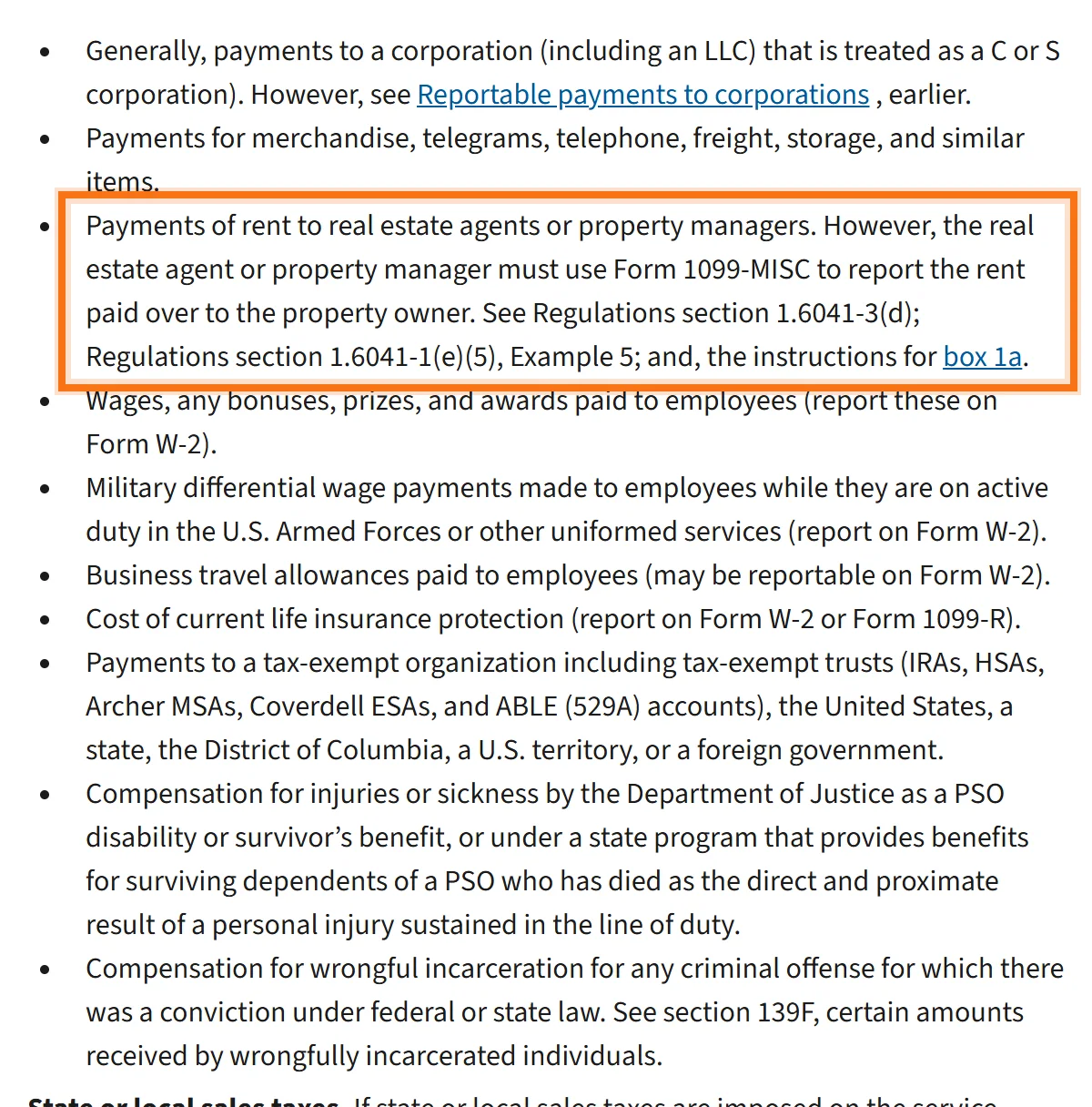
The year-end figure. The IRS Instructions for Forms 1099-MISC and 1099-NEC say that "the real estate agent or property manager must use Form 1099-MISC to report the rent paid over to the property owner." A sample with a year-to-date rent line lets you ask which figure the form will report and compare it with your own records in January. How the form and your statements fit together is in year-end reporting for rental owners. This is general information, not tax advice.
The deposit. TREC rule 535.146 lists rent and security deposits as trust money that a Texas broker must keep in a designated trust account (or deliver to an authorized escrow agent), not commingled with the broker's own money, with an accounting to each beneficiary at least monthly when there is activity. The deposit belongs to the tenant until it is applied or refunded, so a good sample shows it apart from your balance. More on how that money is protected: how your rent and deposit money are protected.
What our site says about Perpetual statements
Our site does not publish a sample owner statement, so ask us to show you what a statement looks like before you sign, as you would ask any manager. Here is what the site does state:
- Statements and payouts: owners receive disbursements and monthly statements through the online Owner Portal, with income, expenses and documents in one place (our FAQ).
- The portal: statements, documents and disbursement history, on our secure AppFolio system (our owner portal page).
- Test 4, invoices: maintenance coordination is a percentage of the vendor's invoice, and the original invoice is always in your portal (our price sheet).
- Test 5, payout date: rent we collect is disbursed to you by the 10th of each month; if it is not, that month's management fee is waived (our guarantees, subject to the Guarantee Addendum).
- Test 3, fees: fees are confirmed in writing before you sign, so the agreement is the basis for reviewing every charge on a statement.
- Several houses: per-door reporting for portfolio owners; our portfolio page suggests identifying leasing, renewal, management and maintenance charges by property and reviewing disbursement history alongside the month's statement.
How much reserve we hold for your house is confirmed in writing in the management agreement before you sign. Perpetual is broker-owned, with our office in North Richland Hills, managing rentals in Keller, North Richland Hills, Fort Worth and nearby. To get a written quote, request a free rental analysis or call 682-593-7033.
The takeaway: Ask for a sample statement before you sign, run the eight tests with the agreement beside it, and treat any test the sample cannot pass as a question to answer in writing first.
Questions owners ask
What should be on a property management owner statement?
A beginning and ending balance, rent received with its date, each fee as its own line, every repair with a vendor and an invoice you can open, the reserve, the payout with its date, and a year-to-date column. The tenant's security deposit should be shown apart from your balance. If any of those is missing, ask why before you sign.
Is it normal for a property manager to refuse to show a sample statement?
It should not be. Removing another owner's name, address and bank details takes minutes, and a statement from a demo property works too. If a manager refuses, or offers to show you one only after you sign, ask why, and keep comparing managers until you have seen how each one reports.
What other documents should I see before signing with a property manager?
The management agreement with every fee defined, the written quote or fee schedule, the sample owner statement, the lease form and a look at the owner portal. Read the sample with the agreement beside it: every fee line on the statement should match a clause.
How do I compare sample statements from two property managers?
Run the same eight tests on each sample and put each one beside that company's quote. Count which tests each sample passes, then check that every fee on each statement appears in that company's quote. The sample you can fully reconcile, both ways, usually belongs to the manager whose statements you will not have to argue about.
What does a vacant month look like on a sample statement?
With no rent coming in, the month shows only money going out: utilities, lawn care, any repair and any fee your agreement charges for an empty month. Those lines are paid from the reserve, so the ending balance falls, and the payout line may be zero. Ask to see a vacant month on the sample, because it shows how fees and reserve draws work when there is no rent to cover them.
Does Perpetual show a sample owner statement before I sign?
Our site does not publish one, so ask us before you sign, as you would ask any manager. The site states that owners receive monthly statements and disbursements through the online Owner Portal, that the original vendor invoice is always in the portal, and that every fee is confirmed in writing before you sign.
Should a sample owner statement show the security deposit?
It should show the deposit as held for the tenant, apart from your own balance. TREC rule 535.146 treats security deposits as trust money that a Texas broker must keep in a designated trust account or deliver to an authorized escrow agent, never mixed with the broker's own money. If the sample does not show the deposit, ask where yours will be held and how it will appear.
Related services
Property management in Keller, North Richland Hills and Fort Worth. How full-service management works in Tarrant County →