Key takeaways
- You can leave, but the agreement decides how: notice, any fee and any for-cause exit.
- Match the problem to the move. Slow replies can often be fixed with one written request; money that is not accounted for is a reason to leave and to act.
- Give the manager one specific written request with a date. How they answer is your evidence either way.
- TREC can discipline a license holder who fails to account for or remit money, but it says it generally cannot address contractual disputes and cannot order damages.
- Line up the next manager before you give notice, so the tenant always knows where to pay and who fixes things.
Can you leave a property management company if you are unhappy with the service? Yes. No Texas law forces you to stay with a company you no longer trust. For an owner in Fort Worth, Keller or North Richland Hills, the better question is whether this problem is worth fixing or worth leaving over, because leaving costs time and sometimes a fee, and staying costs money if the problem is real. The answer usually comes from one written request and the agreement you signed.
This guide covers how to match the problem to the move, the one-letter test, what to document, what Texas law and the Texas Real Estate Commission can do, and how to leave without a gap in rent or repairs.
Fix it or leave: match the problem to the move
Here are the common reasons owners are unhappy, what to try first, when leaving makes sense, and what to keep as a record:
| Problem | Try first | Leave when | Keep as a record |
|---|---|---|---|
| Calls and emails go unanswered | One written request naming the response time you expect | Replies stay slow after the request | Dates sent and dates answered |
| Charges you did not expect | Ask which clause of the agreement allows each charge | A charge has no clause behind it and is not reversed | Statements and the fee section |
| Owner payouts late or irregular | Ask for the disbursement date the agreement promises | Payouts keep missing that date | Each payout date against the promised date |
| Repairs without invoices or photos | Ask for the vendor invoice on every job | Invoices are refused or do not match | Requests, invoices, photos |
| Rent or deposit not accounted for | A written demand for an accounting, with a date | Right away, with a written record | Ledger, statements, your demand letter |
How to read this table: the first four rows are service problems, and a manager who fixes them after one clear request may be worth keeping. The last row is different. Money held for you that is not accounted for is a reason to leave and to consider the steps in the attorney section below, whatever else is going well.
Unhappy is not the same as breach, and the difference changes the exit
Two owners can leave the same company for the same bad experience and have very different exits. The difference is whether they are leaving because they want to, or because the company failed to do something the agreement actually lists.
Leaving because you want to is the ordinary exit: notice as the agreement states, plus any charge the agreement sets for leaving before a term ends. Leaving for cause means the company did not perform a written duty, such as sending statements, remitting rent by a stated date, or carrying out inspections the agreement promises. Many agreements let the owner terminate for an uncured breach on different terms, often after written notice and a cure period.
Breach has to be provable against the agreement's own words. A manager who is slow and unpleasant has not necessarily breached anything. A manager who has not sent a statement in three months, when the agreement promises one every month, has. Read the duties section before you decide which door you are leaving through.
The one-letter test: give the problem one fair chance
Before you decide, send one written request. Keep it short and specific: what is wrong, with dates; what you want instead, in measurable terms; and the date by which you expect it. "Please answer owner emails within one business day" is measurable. "Please communicate better" is not.
Illustrative only, not a quote. Say your agreement promises owner payouts by the 15th, and the last three arrived on the 22nd, the 19th and the 25th. That is 7, 4 and 10 days late, 21 days in total, an average of 21 / 3 = 7 days late per month. Your letter lists those three dates, quotes the clause and asks that next month's payout arrive by the 15th. If it does, and the next one too, you may have fixed the problem for the price of a letter. If it does not, you now have a dated, written record of a failure against the agreement's own words, which is exactly what a for-cause exit needs.
Document the problems before you say anything
Before you call the company, build a short file. It takes an hour, and it changes the conversation from feelings to dates:
- Every statement you received, and the months you did not.
- Repair requests, how long each took to be answered and closed, and the invoices and photos.
- Emails or portal messages that went unanswered, with dates.
- Inspection reports promised against those received.
- Payout dates against the date the agreement promises.
The file tells you whether you have a breach or a bad fit, gives you specifics for the one-letter test and any termination letter, and is the evidence you will need if the company later charges a fee you believe is not owed.
What to look for in the termination clause
Open the agreement and find the termination section. You are looking for five answers: Is there a fixed term, and when does it end? What notice is required, and in what form? Is there a fee for leaving early? Can you terminate for cause, and what counts as cause? What must the company return to you, and by when?
Also look for clauses that survive termination, such as a leasing fee if the tenant the company placed renews after you leave, or a commission if that tenant buys the house. What each clause can cost is worked through in does it cost anything to cancel property management, and counting the notice days in how much notice you need to give. If the agreement renews on a date that is close, ending on that date may be the cheapest exit.
Giving notice in a way that holds up
Deliver the notice the way the agreement says. If it requires written notice to a mailing address, send a letter with proof of mailing and an email copy. Date it, state the termination date, and if you are terminating for cause, list the failures with dates and the clause each one breaches. Keep the tone flat: you are creating a record, not venting.
In the same letter, ask for the handover items with a date for each: the tenant's security deposit with an accounting, the signed lease and addenda, the move-in condition report and photos, the tenant ledger and contact details, keys and access codes, open repair tickets, and a final owner statement with any reserve balance. If they do not arrive, see when the old manager won't release keys or records.
Protecting the tenant and the rent during the change
Your tenant did not choose the manager and should not be hurt by the change. The two risks are a missed rent payment, because nobody told the tenant where to pay, and an unanswered repair, because a ticket fell between companies. Both are avoided by having the next manager ready before the old one stops.
Say you own a house in Keller with a tenant halfway through the lease. The clean sequence is: sign with the new manager, give notice to the old one, have the new manager send the tenant written payment and repair instructions effective on the termination date, and confirm the deposit has moved. The lease itself continues unchanged; the new manager needs the existing lease and its file, not a new signature. More on this in switching managers without interrupting rent payments and who tells the tenants.
What Texas law and TREC can and cannot do
Managing a rental for someone else in Texas requires a real estate license, so your manager answers to the Texas Real Estate Commission. Occupations Code 1101.652 lets TREC discipline a license holder who fails, without just cause, to surrender to the owner a document the owner requested (subsection (a)(5)); who fails within a reasonable time to properly account for or remit money belonging to another person (b)(9); or who commingles that money with their own (b)(10). The same section exempts property management contracts from the rule that a license holder's service contracts must carry a definite termination date not subject to prior notice (b)(12), so a management agreement can run until notice is given, on its own terms.
TREC's own complaint page sets the limits. A complaint must be in writing and signed, it must be filed within four years of the incident, contractual disputes with a license holder generally are not matters the Commission can address, and the Commission cannot order a license holder to pay damages. In short: poor service is a contract question, while money that is not accounted for is a licensing question. This is general information, not legal advice.
When it is worth involving an attorney
Most exits do not need one. Talk to a Texas real estate attorney if the company is holding your rent, reserve or the tenant's deposit and will not account for it, if it is charging a termination fee the agreement does not support, or if you believe trust money was mishandled. A TREC complaint is a separate route for licensing violations, as described above; mention it in your letter only if it is true and relevant.
Before you hire anyone new, check for the warning signs that brought you here; red flags when choosing a property manager lists them, and when your property manager won't respond covers the most common complaint.
How Perpetual handles this
Perpetual Property Management is broker-owned, with our office in North Richland Hills, and we manage homes in Keller, North Richland Hills, Fort Worth and nearby. Owners come to us unhappy with another company often enough that our switching page starts there:
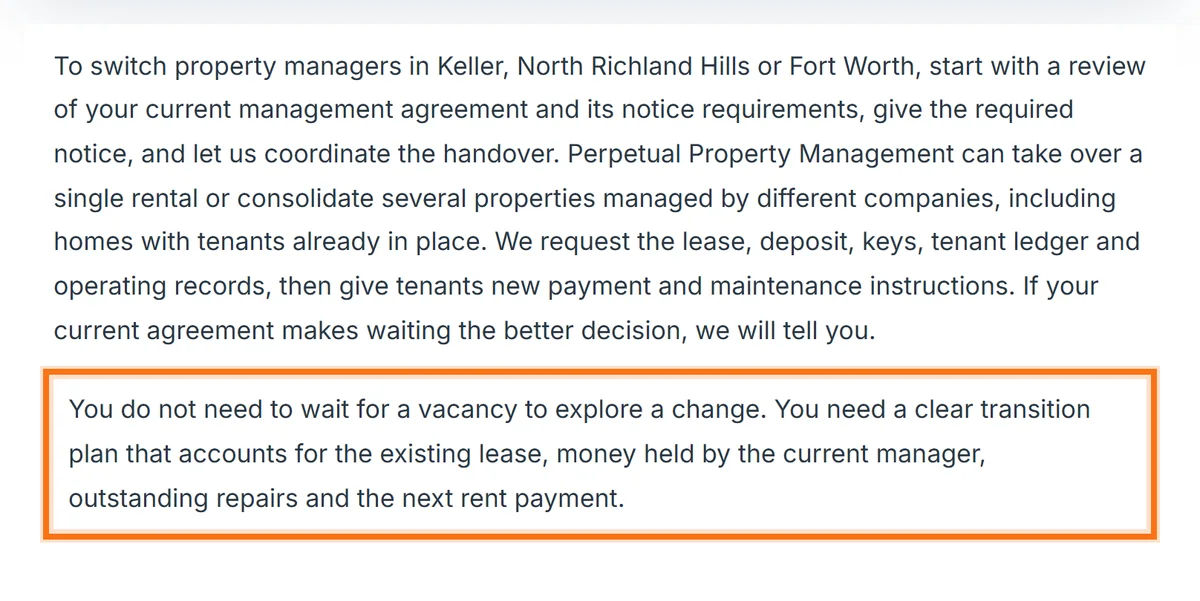
- Your current agreement first. We start with its notice terms and termination provisions, and we will be honest if it makes waiting worth it.
- The handover. After you give notice, we coordinate with your current manager, request the lease, deposit, keys, tenant ledger and records, and give tenants new payment and maintenance instructions. We design the handover so rent never misses a beat.
- A way to measure us. Calls and emails answered within one business day, rent disbursed by the 10th, photo or video proof of every completed repair over $500, each with a stated remedy in our written guarantees, subject to the Guarantee Addendum.
Our pricing page lists "What does it cost to leave if you're unhappy?" among the questions we answer in writing for your property before you sign. Our own term and notice period are not published on the site, so they are confirmed in writing before you sign. Call 682-593-7033.

The takeaway: Decide first whether one specific written request can fix the problem; if it cannot, document the failures against the agreement, give notice exactly as it requires, and have the next manager ready before the old one stops.
Questions owners ask
Can I fire my property manager in the middle of a tenant's lease?
Yes. The management agreement and the tenant's lease are separate contracts, and ending one does not end the other. The tenant stays on the existing lease, and the departing manager should transfer the deposit, the lease and the file to you or the new manager. The main risk is a gap in rent collection or repairs, which you avoid by lining up the next manager before giving notice.
Will I get my security deposit and reserve funds back when I leave?
They should come back to you or move to your next manager with a written accounting. A broker holds rent and deposits as trust money under TREC rule 535.146, and Occupations Code 1101.652(b)(9) lets TREC discipline a license holder who fails within a reasonable time to account for or remit money belonging to another person. Put your request in writing with a date; the agreement may set the timing.
Can a property manager charge me a fee for leaving?
Only if the agreement says so. Early termination fees, leasing fee clawbacks and file transfer charges are enforceable when they are written into the agreement you signed. If a fee is not in the agreement, ask which clause allows it. If you are terminating for a documented breach, read whether the agreement treats that exit differently.
Should I try to fix things before I leave my property manager?
Usually, once. Send one specific written request listing the problem with dates, what you expect instead and by when. If the manager fixes it, you avoid the cost of a switch. If not, you have a dated record of a failure against the agreement, which supports a for-cause exit.
Can I file a complaint with TREC about bad property management service?
You can file a written, signed complaint within four years of the incident, but TREC says contractual disputes generally are not matters it can address and it cannot order damages. It can discipline license holders for violations such as failing to account for or remit money, commingling funds, or refusing to surrender an owner's documents.
Related services
Property management in Keller, North Richland Hills and Fort Worth. How full-service management works in Tarrant County →