Key takeaways
- A late fee is collectible only if notice of it is in the written lease, it is reasonable, and rent is two full days late (Property Code 92.019(a)).
- The lease can set a shorter or longer notice to vacate than the default three days (24.005(a)).
- No lockout clause in the lease means no lockout for unpaid rent (92.0081(d)(1)).
- A repair request must be in writing only if the lease is written and requires it (92.052(d)).
- Some clauses are void whatever the lease says: deposit, security-device and smoke-alarm duties, the 92.016 and 92.017 exit rights, a jury trial (92.006).
You know your lease protects you by testing it against the events you will actually face, not by its length or its tone. For an owner in Fort Worth, Keller or North Richland Hills, that means six scenarios: late rent, tenant damage, a holdover, an unauthorized occupant, an early move-out and a repair request. For each, find the clause, check what the Texas Property Code adds or overrides, and note any gap.
This guide is the test. What a Texas lease must contain, clause by clause, is in what a Texas residential lease must cover, and the add-on documents in lease addenda every Texas landlord should consider.
The six-scenario test for a Texas lease
For each event, here is the clause that should answer it, what the Property Code adds or limits as the statute reads, and what happens if your lease is silent:
| Scenario | The clause that answers it | What the Property Code adds or limits | If the lease is silent |
|---|---|---|---|
| Rent is late | Due date, late fee, lockout right, notice method | Fee needs notice in a written lease, must be reasonable, starts after two full days (92.019(a)); lockout only if the right is in the lease (92.0081(d)(1)) | No late fee; no lockout; the default notice rules apply |
| The tenant damages the house | Tenant liability, move-in condition report | Deposit deductions only for what the tenant is liable for under the lease or a breach, never normal wear and tear (92.104) | Harder to prove what the tenant owes |
| The tenant stays past the end | Holdover rent, notice to vacate period | At least three days' written notice to vacate unless the lease sets a shorter or longer period; also 91.001 (24.005(a)) | Three-day default and month-to-month rules |
| Someone not on the lease moves in | Named occupants, guest limit, default | Occupancy cap of three adults per bedroom (92.010(a)); a breach can support a notice to vacate (24.005(a)) | Little to enforce beyond the statute |
| The tenant leaves early | Early termination, reletting charge, notice | Required 92.016 and 92.017 statements, or the tenant who leaves under them is released from delinquent rent (92.016(f), 92.017(g)); duty to mitigate (91.006) | You prove your actual losses |
| A repair request arrives | How and where requests are made | Must be in writing only if the lease is written and requires it (92.052(d)) | A phone call can start the repair duty |
How to read this table: the third column applies whatever your lease says; the second column is what you control. The last column is the cost of a missing clause. This is general information, not legal advice; for a specific clause, ask a Texas attorney.
How to run the test on your own lease
Get the signed lease and every addendum, not the blank form. Then, for each of the six scenarios:
- Find the clause that answers it and note the page.
- Check it against the statute in the table: does it give notice of the fee, state the period, name the occupants?
- Mark it: answered, answered but doubtful, or missing.
Four other events are worth the same check: pets, insurance, entry for repairs and showings, and the deposit at move-out. Pets and insurance usually live in addenda; entry is a lease clause, because no Texas statute sets a landlord-entry notice period, as landlord entry rights in Texas explains. A lease already running stays in force as written; the gaps are fixed at renewal, with the tenant's signature.
Late rent: the clauses that protect your income
Three clauses carry your income. The late fee. Under 92.019(a), a landlord may not collect a late fee unless notice of it is in a written lease, the fee is reasonable, and rent has remained unpaid two full days after it was due. For a dwelling in a structure of not more than four units, a fee of up to 12 percent of that period's rent is considered reasonable (92.019(a-1)). Illustrative only: on $2,100 rent, 12 percent is $252 (checked: $252 divided by 0.12 is $2,100). A lease clause that tries to waive 92.019 is void (92.019(d)).
The lockout right. A landlord may change the locks of a tenant who is delinquent in rent only if that right is in the lease and the written notice steps of 92.0081(d) are followed. The default and notice clause. 24.005(a) sets three days' written notice to vacate unless the lease sets another period; a tenant who was not late before that month gets a notice to pay rent or vacate. How it plays out: what happens when a tenant pays late in Texas and our rent collection page.
Damage and repair requests: the clauses that protect the house
Damage. 92.104(a) lets a landlord deduct from the deposit the damages and charges the tenant is legally liable for under the lease or as a result of breaching it, and 92.104(b) bars deductions for normal wear and tear. A clause making the tenant responsible for damage by household members and guests, plus a signed move-in condition report, is what turns that into money you can keep. During the lease, the landlord has no duty to repair a condition caused by the tenant, a lawful occupant, a family member or a guest, unless it is normal wear and tear (92.052(b)).
Repair requests. The repair duty in 92.052(a) starts when the tenant gives notice to the person or place where rent is normally paid. Under 92.052(d), that notice must be in writing only if the lease is in writing and requires written notice. A clause that names the portal or address for requests gives you a dated record. Say your Fort Worth tenant reports a leak by phone and the lease is silent: the clock can already be running. More on the duty: Texas landlord repair obligations.
Holdover, extra occupants and early move-out
Holdover. Under 24.005(a), a landlord must give a tenant who holds over beyond the end of the rental term at least three days' written notice to vacate before filing an eviction suit, unless the parties contracted for a shorter or longer notice period in a written lease, and must also comply with the tenancy-termination requirements of 91.001. A holdover clause that states the notice period and the rent while the tenant stays answers this scenario. More in holdover tenants in Texas.
Extra occupants. 92.010(a) caps occupancy at three adults per bedroom, a ceiling rather than a house rule. Your protection is a clause naming who may live there, setting a guest limit and making a breach a default. See roommates, co-signers and occupants.
Early move-out. The lease should state the notice and any reletting charge. It must also contain the statements 92.016 and 92.017 describe, or a tenant who ends the lease under those sections is released from delinquent rent. And if the tenant abandons the house, you have a duty to mitigate damages, which a lease cannot waive (91.006). Options: when a tenant wants to break the lease. This is general information, not legal advice; for a specific clause, ask a Texas attorney.
What a lease cannot do, however it is written
Some owners want a lease that waives everything, and that is not protection either. Under 92.006(a), a landlord's duties and a tenant's remedies on security deposits, security devices, disclosure of ownership and management, and utility cutoffs cannot be waived, nor can the duty to install a smoke alarm. Two more limits are less known:
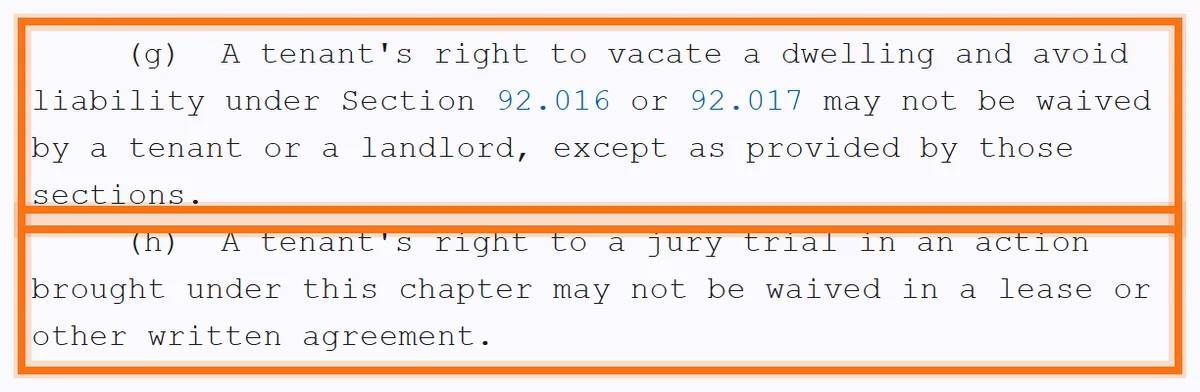
The late-fee rules (92.019(d)), the lockout rules (92.0081(j)) and the duty to mitigate (91.006(b)) carry their own no-waiver language. A clause that crosses one of these lines does not bind the tenant, and some, such as an unlawful late fee, carry penalties of their own (92.019(c)). Enforceable and moderate beats aggressive and void. The rules above any lease: Texas landlord-tenant law basics. This is general information, not legal advice; for a specific clause, ask a Texas attorney.
The form, the addenda and who signs
Once the six scenarios pass, check the document itself. Is it a current Texas form, or something assembled from a download? Are the house-specific terms (HOA, pool, pets, lawn) in addenda, so the main clauses stay standard? Is the lead-based paint disclosure attached if the house was built before 1978? And who signs as landlord: you, or a manager as your agent under the management agreement?
If a manager will use its own lease for your next tenant, ask to see the blank form and the addendum list. If a tenant is already in place on a lease you wrote, it stays in force until it ends; how a new manager reads it is in will a new property manager review your existing lease.
How Perpetual handles this
Perpetual Property Management is broker-owned and manages homes in Keller, North Richland Hills, Fort Worth and nearby. What our site states about leases:
- The lease. Texas-compliant lease documents: current forms with the addenda your property actually needs (HOA rules, pool, pets, smart devices), not a generic template. You receive a copy of everything through the Owner Portal (our leasing service page).
- Late rent. Reminders, late fees applied per the lease, and escalation steps that are the same for every tenant, every time.
- Notices. When a tenancy fails, the notice to vacate that Texas procedure requires, delivered and documented correctly.
- Tenant in place. We take over occupied homes: we collect the lease and deposit records, introduce ourselves to the tenant, inspect the home and move rent collection into the owner portal, usually within the first month.
Which lease form we use for your house, and whether you see it before signing the management agreement, are confirmed in writing before you sign. To have your lease looked at, call 682-593-7033.
The takeaway: Read your lease once with six events in hand. Where a clause answers the event and fits the Property Code, you are protected; where the lease is silent or tries to waive what Texas will not let it waive, fix it at the next signature.
Questions owners ask
What is the most important clause in a residential lease for the landlord?
The default and notice clause, because enforcing every other term depends on it. It says what counts as a breach and how much notice to vacate the tenant gets; under Property Code 24.005(a) the default is three days' written notice unless the lease sets a shorter or longer period. Close behind are the late fee (92.019), the lockout right (92.0081) and the tenant-damage clause. This is general information, not legal advice.
Can a landlord write any rule into a Texas lease?
No. Property Code 92.006 lists duties and remedies a lease cannot waive, including those on security deposits, security devices, ownership disclosure, utility cutoffs and smoke alarms, the right to vacate under 92.016 or 92.017, and a jury trial. The late-fee and lockout sections void waivers of their own rules. Such clauses do not bind the tenant, and an unlawful late fee carries a penalty.
Is a lease I downloaded online enforceable in Texas?
Parts of it may be, but downloaded forms often miss what Texas requires for a clause to work: notice of the late fee in the lease, the lockout right, the 92.016 and 92.017 statements, and a deposit notice condition in bold or underlined if you use one (92.103(b)). Test it against the six scenarios and replace it at the next signature.
Should the lease require renters insurance?
It is your choice, and the lease is where the requirement lives: whether a policy is required, the minimum liability amount, and proof at move-in and renewal. What a renters policy covers is a question for an insurance agent; our guide on requiring renters insurance covers the lease side.
Can a Texas lease set a shorter notice to vacate than three days?
Yes. Property Code 24.005(a) requires at least three days' written notice to vacate before an eviction suit "unless the parties have contracted for a shorter or longer notice period in a written lease or agreement." The notice must be delivered by a method in 24.005(f-3), such as mail, hand delivery to a tenant 16 or older, or email if agreed in writing. This is general information, not legal advice.
Does a tenant's repair request have to be in writing in Texas?
Only if the lease is in writing and requires written notice (Property Code 92.052(d)). If your lease is silent, a phone call to the place where rent is normally paid can start your repair duty for a condition that materially affects health or safety. A clause naming the portal or address for requests gives you a dated record.
Property management in Keller, North Richland Hills and Fort Worth. How full-service management works in Tarrant County →