Key takeaways
- The review checks each clause against the Texas Property Code: late fee (92.019), deposit (92.103, 92.104), lockout (92.0081), early termination statements (92.016, 92.017), waivers (92.006).
- A clause that waives what 92.006 says cannot be waived does not bind the tenant; the manager enforces the rest of the lease.
- Without a lockout clause in the lease, the locks cannot be changed for unpaid rent (92.0081(d)(1)).
- Nothing changes mid-lease without the tenant's written agreement; the fixes go into the renewal.
- Ask for the findings in writing: terms enforced, gaps, doubtful clauses, dates.
Will a new property manager review your existing lease for problems? A good one will, before the first rent is collected. For owners in Fort Worth, Keller and North Richland Hills switching managers or hiring one for the first time, the review checks each clause against the Texas Property Code, lists what is missing, and maps the dates. The lease stays in force as written; the gaps are fixed at renewal.
This guide is the review itself: the clause-by-clause checklist, the clauses Texas law will not enforce, what cannot change mid-lease, and how the fixes reach the tenant.
The lease review, clause by clause
Here is what a takeover review checks in each part of a Texas residential lease, the rule it is measured against, and what happens if it is wrong today:
| Clause | What the review checks | Texas rule, as the statute reads | If it is wrong or missing today |
|---|---|---|---|
| Rent, due date, late fee | Amount, due date, when the fee starts, how much | A late fee needs notice in a written lease, must be reasonable, and can start only after rent is unpaid two full days (92.019(a)); up to 12% of the month's rent is reasonable for a building with four units or fewer (92.019(a-1)) | Charge only what the lease and 92.019 allow; fix the clause at renewal |
| Security deposit | Amount held vs the lease, who holds it, any notice-of-surrender condition | Refund on or before the 30th day after surrender (92.103(a)); an advance-notice condition counts only if underlined or in bold (92.103(b)); no deduction for normal wear and tear (92.104(b)) | Account for the deposit by the statute regardless of the lease wording |
| Lockout for unpaid rent | Is the right to change locks in the lease? | Required before a lockout for nonpayment, with written notice steps (92.0081(d)) | No clause, no lockout; add it at renewal |
| Early termination statements | Family violence and military language | Without language substantially equivalent to the statute, a tenant who ends the lease under them is released from delinquent rent (92.016(f), 92.017(g)) | Add the statements at renewal |
| Repairs moved to the tenant | Who pays for what | Allowed at the tenant's expense only under 92.006(e) (one rental dwelling, written, underlined or bold) or for the three items in 92.006(f) | The landlord's repair duty stands; fix at renewal |
| Waivers | Deposit, security devices, ownership disclosure, utility cutoff, smoke alarm, jury trial | Cannot be waived (92.006(a), (h)) | The clause does not bind the tenant; do not rely on it |
| Addenda and dates | Pets, HOA, pool, lead disclosure; end date, renewal, notice | Pre-1978 housing needs the federal lead disclosure (40 CFR 745); the rest is the lease | Enforce what exists; add the rest at renewal |
How to read this table: the third column is the Texas rule as the statute reads, and it applies whatever your lease says. The last column is the point of the review: a problem found today is either enforced around or fixed at renewal, never by rewriting the lease mid-term. This is general information, not legal advice; a specific clause is a question for a Texas attorney.
What a takeover lease review is actually for
The review has two jobs. The first is to let the manager enforce the lease you have: they need the rent, the due date, the late fee, the pet terms and the notice period before they can collect a dollar or answer a tenant's question correctly. The second is to find the gaps that will cost you money later, so they can be closed at the first renewal.
What the review is not is a reason to tear up the lease. A signed lease is a contract between you and the tenant, and it stays in force on its own terms until it ends. The manager steps into your shoes under that lease. The checklist above is the review; the sections below explain the clauses that need more than a line.
The gaps the review finds first: missing addenda
Self-managed leases and older forms tend to be short on addenda, and addenda are where the specific rules live. The review checks whether the lease has, in some form:
- A pet addendum or a clear no-pets clause, with any pet deposit or pet rent spelled out.
- A signed move-in condition report or inventory, which the move-out will be compared against.
- An HOA addendum passing the association's rules to the tenant, if the house is in one.
- The federal lead-based paint disclosure if the house was built before 1978: before renting pre-1978 housing, lessors must disclose known lead-based paint and hazards, and the tenant must receive the federal pamphlet.
- Pool or other hazard terms if the property has them.
- Clear maintenance duties: lawn, filters, pest control and minor repairs.
A missing addendum is not a crisis. It means the manager enforces what the lease says and nothing more, and notes the addendum for renewal. Lease addenda every Texas landlord should consider explains each one.
Clauses Texas law will not enforce
Some clauses look firm on paper and do not hold up. Property Code 92.006 is the place to start, because it lists what a lease cannot take away:
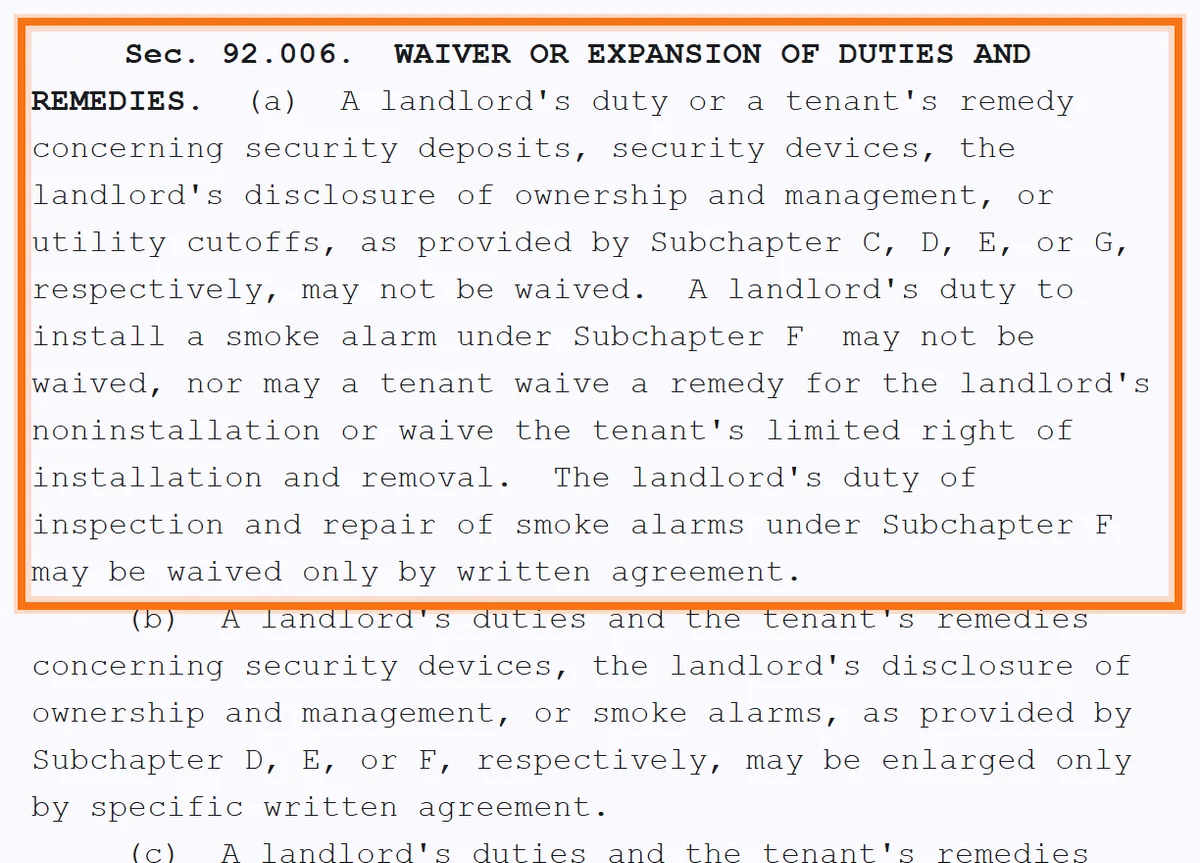
Beyond that list, 92.006 lets a landlord and tenant agree that the tenant repairs a health-or-safety condition at the tenant's expense only if every condition in 92.006(e) is met, including that the landlord owns only one rental dwelling at the start of the lease and the agreement is underlined or in bold. A lease cannot waive the tenant's right to a jury trial (92.006(h)). And a late fee charged before rent has been unpaid two full days, or one the lease never mentioned, cannot be collected (92.019(a)).
When the review finds a clause like these, the right response is not to try to enforce it and not to pretend it is fine. It is to tell you plainly that the clause is doubtful, enforce the rest of the lease, and replace the clause at renewal. This is general information, not legal advice; a specific clause is a question for a Texas attorney.
Deposit terms and the move-in record
The deposit gets its own read, because deposits are where takeovers go wrong most often. The manager checks the amount in the lease against what was actually collected and transferred, whether a pet deposit is separate, what the lease says can be deducted, and whether there is a signed record of the condition at move-in.
Texas law fills in the rest whatever the lease says: the refund is due on or before the 30th day after the tenant surrenders the premises (92.103(a)); deductions are for damages and charges the tenant is legally liable for, never normal wear and tear (92.104); and the tenant may not withhold the last month's rent on the grounds that the deposit covers it (92.108(a)). See Texas security deposit rules.
The condition record matters more than the wording. A good deductions clause is worth little without a move-in report to compare against. If none exists, the manager should inspect and photograph the house as soon as the takeover allows, so there is a dated record from that point on. It will not prove the condition at move-in, but it draws a line.
What the manager cannot change mid-lease
Owners sometimes hope a new manager can fix everything on day one. They cannot, and you should be wary of one who says otherwise. Mid-lease, the manager cannot raise the rent, add a pet fee, shorten the notice period, add a new addendum or change who pays for the lawn, unless the tenant agrees in writing. Any of those changes without agreement would be a breach on your side.
What the manager can do mid-lease is enforce the lease as written, document the house, build a relationship with the tenant and prepare the renewal. A tenant who has had a good first few months with the new manager is far more likely to sign the updated lease than one who was handed a stack of new rules in week one. Patience here is a strategy, not a weakness.
A concrete example: say the old lease allows a dog with no pet deposit and the tenant has one. The manager cannot add pet rent in month three. What they can do is note the dog in the file, photograph the yard and flooring, confirm the HOA allows it, and build a pet addendum into the renewal package with terms you approve. The tenant keeps the dog, you get the protection, and nobody feels ambushed.
How the problems get fixed at renewal
Renewal is where the review pays off. The renewal package is a current Texas lease plus the addenda the review flagged as missing, with the rent checked against current leased comparables. Deposit terms, the late fee, the lockout clause and the early termination statements are brought in line with the Property Code; maintenance duties and the entry notice, which the lease itself sets, follow your instructions; and the tenant signs the new terms.
Done well, the tenant sees a normal renewal, not a crackdown. The manager explains what changed and why in one conversation and gives reasonable time to sign. If the tenant declines, the notice dates are already mapped and the listing can start. Starting early matters: see how lease renewals work so the new lease arrives before the old one lapses.
Can you change property managers mid lease?
Yes. The lease is between you and the tenant, so a change of manager does not end it or change its terms. The new manager steps into the existing lease; what changes on day one is where rent is paid and whom the tenant calls. What the management agreement you are leaving requires before you switch, and what stays the same for the tenant, is covered in will a new manager honor my tenant's lease, and the handover itself in taking over a property with a tenant in place.
The review is what makes a mid-lease switch safe: it tells the new manager what can be enforced before a late fee, a pet or a repair dispute comes up. Whether the new manager will keep using your lease form for the next term is a separate question, answered in can a manager use my existing lease.
What you should receive from the review
Ask for the findings in writing, even if the manager also walks you through them by phone. A useful summary fits on a page:
- Terms the manager will enforce: rent, due date, late fee, deposit held, pets, end date.
- Missing documents and addenda, with a note on which matter most for your house.
- Clauses that look doubtful under the Property Code, by section, and how they will be handled until renewal.
- The calendar: end date, notice deadlines, when the renewal offer goes out.
- What is still needed from you or the old manager, such as the move-in report or the deposit ledger.
If a manager cannot produce that page, they have not read the lease. If you want to know what a review of your lease would find before you commit to anything, send it to us.
How Perpetual handles this
Perpetual Property Management is broker-owned and manages homes in Keller, North Richland Hills, Fort Worth and nearby. What our site states about taking over a home with a lease in place:
- Takeovers. We take over occupied homes regularly: we collect the lease and deposit records, introduce ourselves to the tenant, inspect the home and move rent collection into the owner portal, usually within the first month.
- Problem files. When a tenancy is already in trouble, the first step is assessing the file: lease, ledger and notices already sent.
- The next lease. Current Texas-compliant lease documentation with property-specific addenda, and you receive a copy of everything through the Owner Portal.
- Renewals. Conversations start well before lease end, typically 60 to 90 days, with a market check and a recommendation; the decision is yours. The renewal fee is $149 (Investor Special), $200 (Standard) or $150 (Full Service) on our price sheet.
Whether the written lease review is part of onboarding or priced separately is confirmed in writing before you sign; if a fee is not in the agreement, you do not pay it. To have your lease looked at, call 682-593-7033.
The takeaway: A new manager should read your lease clause by clause against the Property Code before collecting a dollar, enforce it as written, tell you in writing what is missing or doubtful, and fix it at renewal with the tenant's signature.
Questions owners ask
Will a new property manager review my current lease for problems?
A good one will, before the first rent payment, and will give you the findings in writing. The review covers the terms they will enforce, missing addenda such as pet or HOA terms, clauses that may not hold up under the Property Code (late fees, waivers, lockout, repairs), deposit terms, whether a move-in condition record exists, and the end date and notice deadlines. Problems are fixed at renewal, not mid-term.
Can the new manager make my tenant sign a new lease right away?
No. The signed lease is a contract and stays in force on its own terms until it ends. A manager cannot raise rent, add fees or add addenda mid-lease unless the tenant agrees in writing. The manager enforces the current lease, documents the house and presents an updated Texas lease at renewal.
What happens if my old lease has a clause that is not enforceable in Texas?
The manager should tell you plainly that the clause is doubtful, not enforce it, enforce the rest of the lease normally and replace the clause at renewal. Property Code 92.006 lists duties and remedies a lease cannot waive, such as those on security deposits and security devices. For a specific clause, confirm with a Texas attorney; this is general information, not legal advice.
My lease has no move-in condition report. Is that a problem?
It limits what can be deducted from the deposit at move-out, because there is nothing to compare against. The manager should inspect and photograph the house as soon as the takeover allows, so there is a dated record from that point on, and make a signed condition report part of the renewal package.
Does the review cost anything?
Ask, and get the answer in the written quote. Our price sheet lists an enrollment inspection ($125 Investor Special, $49 Standard, included on Full Service) and a renewal fee, but no separate lease-review line. Whatever is agreed goes into the management agreement, and if a fee is not in the agreement, you do not pay it.
Can I change property managers mid lease?
Yes. The lease is between you and the tenant, so it stays in force when the manager changes; the tenant gets new instructions for paying rent and requesting repairs. Check the notice terms in the management agreement you are leaving, and have the new manager review the lease before the first rent is collected.
My lease has no lockout clause. Can the manager change the locks for unpaid rent?
No. Under Property Code 92.0081(d), a landlord may not change the locks of a tenant who is behind on rent unless that right is in the lease, and the written notice steps in the statute are followed. A review that finds no clause notes it for the renewal lease. This is general information, not legal advice.
Related services
Property management in Keller, North Richland Hills and Fort Worth. How full-service management works in Tarrant County →