Key takeaways
- Under Property Code 92.001 the landlord is the owner, so most tenant claims arising from a manager's mistake are claims against you.
- Contain the damage first: send the late deposit accounting, rescind the wrong charge, give back the key. Mitigating lowers both losses.
- Then document, read the agreement's liability, indemnity and claims clauses, and send a written demand to the broker.
- TREC cannot order a license holder to pay you damages; a complaint must be written, signed and filed within four years.
- TREC's recovery trust account pays certain court judgments; the suit must be brought within two years (Occupations Code 1101.605).
If your property manager makes a costly mistake, the tenant's claim usually comes to you first, because Texas law treats the owner as the landlord, and your own claim then runs against the manager and the broker who supervises it. For rentals in Fort Worth, Keller and North Richland Hills, the order matters: contain the tenant's loss, document yours, read the management agreement, demand payment in writing, and only then go to court or to the Texas Real Estate Commission.
This guide sets out who owes the tenant for each common mistake, the recovery steps in order, and what TREC can and cannot do for you. Insurance and liability limits in more depth are in property manager insurance and liability for costly mistakes.
Common mistakes: who owes the tenant, and what to keep
Here are the mistakes that most often cost owners money, who the tenant can pursue under the Property Code as written, what to read in your management agreement, and the evidence to keep:
| Mistake type | Who owes the tenant | What to read in the agreement | Evidence to keep |
|---|---|---|---|
| Deposit refund or itemized accounting sent late | The landlord. A landlord who in bad faith retains a deposit is liable for $100, three times the amount wrongfully withheld and attorney's fees (92.109(a)); missing the 30-day mark is presumed bad faith (92.109(d)). | Who holds the deposit and who sends the accounting | Move-out date, date of the tenant's written forwarding address, postmark of the accounting (92.1041) |
| Late fee the lease did not allow, or above the statutory limit | The landlord: $100, three times the late fee collected in violation and attorney's fees (92.019(c)). | Who sets and who keeps late fees | The lease late-fee clause and the tenant ledger |
| Lockout or removal of doors, locks or appliances outside the rules | The landlord: the tenant may recover possession or end the lease, plus a civil penalty of one month's rent plus $1,000, actual damages, court costs and attorney's fees (92.0081(h)). | What the manager may do on a delinquent account | Every notice, text and work order from those days |
| Locks not rekeyed or required security devices missing at move-in | "Landlord" in this subchapter includes a management company or managing agent (92.151(7)); remedies include a civil penalty of one month's rent plus $500 after a written request (92.164(a)(4)). | Who orders the rekey at turnover | The dated rekey invoice and the move-in report |
| Notice to vacate delivered the wrong way, so the eviction stalls | Usually no tenant claim; your loss is the extra weeks of rent and the refiling. | The eviction service terms and who prepares notices | A copy of the notice, its date and the delivery method used (24.005(f-3)) |
| Rent or reserve not accounted for or paid out | Not a tenant matter: this is your money held in trust (TREC rule 535.146). | The payout date and statement terms | Monthly statements and every bank deposit you received |
How to read this table: the second column tells you who the tenant can pursue, which is usually you even when the manager made the error. The last two columns are your case against the manager: the clause it broke and the paper that proves the date. Collect that evidence before you write a single demand.
A mistake or an ordinary risk: the line that decides who pays
A manager acts as your agent, and TREC rule 535.2 says a broker "owes the highest fiduciary obligation to the principal." Occupations Code 1101.652(b)(1) makes acting "negligently or incompetently" while engaged in real estate brokerage a ground for discipline. Losses that usually fall on the mistake side:
- Missing the 30-day deadline for a tenant's deposit refund or itemized accounting.
- Delivering a notice to vacate in a way the statute does not allow, so the case is delayed or refiled.
- Approving an applicant who did not meet the company's own written criteria.
- Skipping an inspection or a repair step the agreement promised, so damage went unnoticed.
Losses that usually fall on the ordinary-risk side: a tenant who met every criterion and later lost a job; a repair that was reasonable on the information available; a rent price that proved a little high. The test is whether a competent manager following the agreement would have done the same thing. If yes, the loss is part of owning a rental. If no, it is a claim.
Step 1: contain the tenant's loss, because it is yours
Property Code 92.001 defines the landlord as "the owner, lessor, or sublessor of a dwelling," and leaves out a manager or agent unless it holds itself out as the owner, lessor or sublessor in the lease. So when a manager misses a deposit deadline or charges an unlawful fee, the tenant's claim is usually against you, and your claim is against the manager. (The security-device subchapter is an exception: its definition of landlord includes a management company.)
So act first on the tenant's side: send the overdue accounting, refund the improper fee, hand back the key, finish the repair. Every dollar of the tenant's loss you prevent is a dollar you do not have to recover later, and a claim is cleaner when you can show you mitigated. Then write down the timeline while it is fresh. Texas security deposit rules explains the deadline behind most of these claims.
Step 2: read the agreement's liability and claims clauses
Before you write to anyone, find four clauses in the management agreement. A limitation of liability may cap what the company owes, for example at the fees paid over a period, or exclude lost rent. An indemnification clause may make you cover the company's costs of managing your property; check whether it excludes the company's own negligence. A notice-of-claim clause may require written notice within a set time. A dispute-resolution clause may require mediation before a lawsuit.
If a notice deadline exists, meet it first, in writing, even before you have a final number. If the clauses are one-sided, that is worth knowing now and worth negotiating at renewal; what to check in a property management agreement walks through each one. How these clauses apply to your facts is a question for a Texas attorney.
Steps 3 to 6: demand, insurance, court, complaint
- Written demand to the broker. Address it to the broker, not only the agent you deal with: under TREC rule 535.2 a broker is responsible for the authorized acts of its sales agents and for any property management activity by them that requires a license, and Occupations Code 1101.803 makes a broker liable to clients for conduct by the broker or an associated sales agent. State what happened, the clause or duty breached, the amount and how you calculated it, and what you want (a statement credit, a refund, payment of the tenant's claim). Attach the evidence and give a reasonable deadline.
- Insurance. Ask whether the company carries errors and omissions coverage and whether it will notify its insurer. Texas requires it only of some brokerages: a business entity must provide proof of errors and omissions insurance with a minimum annual limit of $1 million per occurrence if its designated broker owns less than 10 percent of the entity (1101.355(a)(2)).
- Court. A justice court hears civil matters where the amount in controversy is not more than $20,000, exclusive of interest (Government Code 27.031(a)(1)); larger claims go to county or district court, usually with an attorney.
- TREC complaint. Where a license rule was broken, file in writing; the next section explains what that can and cannot achieve.
Keep copies of everything you send, and send it in a way you can prove. This is general information, not legal advice.
What TREC can and cannot do for an owner
The Texas Real Estate Commission licenses brokers and sales agents; under Occupations Code 1101.002, a person who for compensation controls the acceptance or deposit of rent from a resident of a single-family home for another person is acting as a broker. Its complaint page is plain about the limits: "The Commission does not have the authority to order a license holder to pay damages to another person." A claim for money belongs in court.
What TREC can do is discipline: its page lists a formal reprimand, suspension or revocation of a license and an administrative penalty among the possible outcomes. A complaint must be in writing and signed, and TREC cannot investigate an incident that occurred four or more years ago.
The same page notes that TREC maintains a Real Estate Recovery Trust Account "to pay for certain judgments obtained in court." Under Occupations Code 1101.602, an aggrieved person is entitled to reimbursement when the license holder's conduct is described by section 1101.652(b), which includes acting "negligently or incompetently" and failing "within a reasonable time to properly account for or remit money" belonging to another person. Payments for claims arising out of a single transaction may not exceed $125,000 (1101.610(a)). The deadline is short:
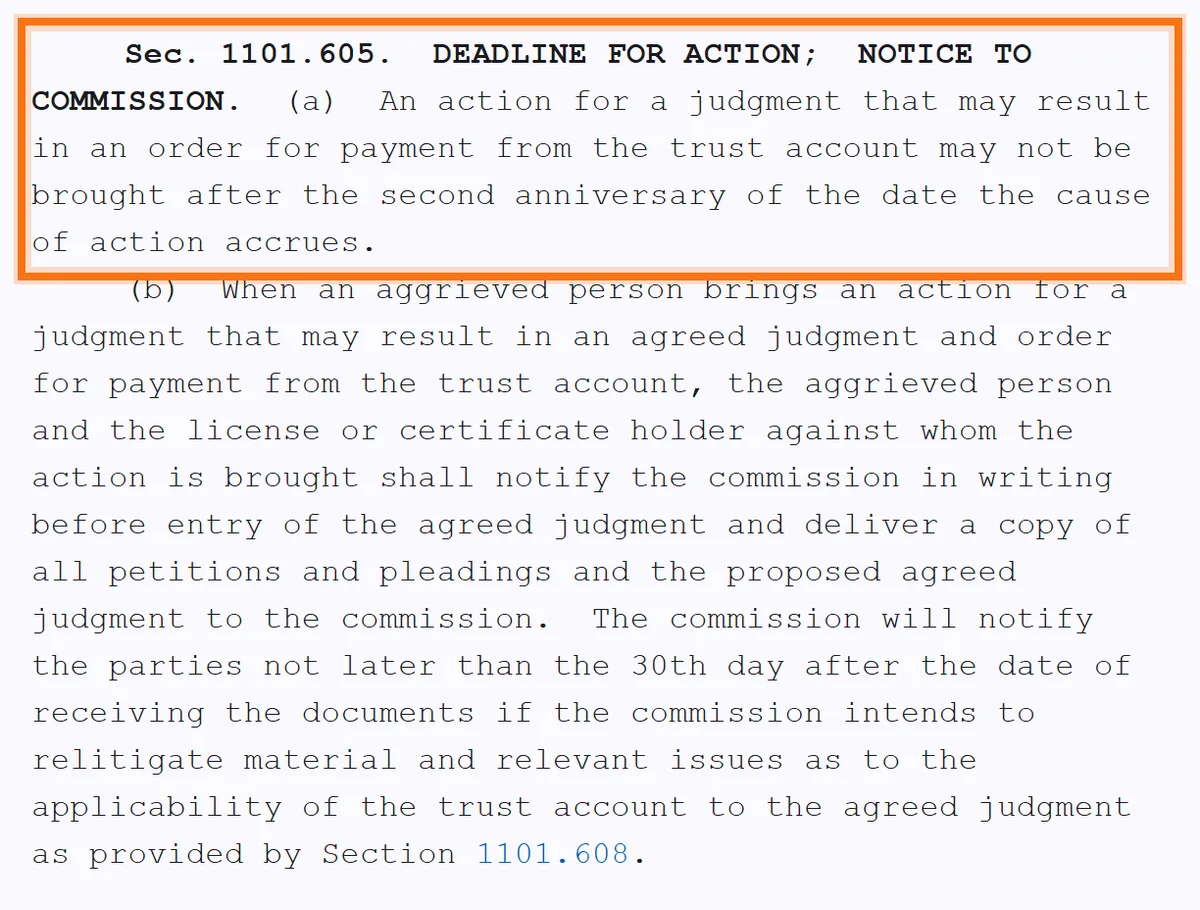
A claim against a business entity license holder is also a claim against its designated broker (1101.6011). Before relying on any of this, check the license on TREC's search (see how to verify a property manager's Texas license) and ask a Texas attorney. This is general information, not legal advice.
Catching mistakes early on your statements
Most costly mistakes cluster where there are deadlines and discretion: deposit accounting, notices, late fees, rekeying and repair approvals. The cheapest protection is reading your own monthly statement: an odd charge, a missing deposit line or a payout that arrives late is easier to fix in month one than in month twelve. How to spot mistakes and deductions on your owner statement gives a line-by-line check.
Ask any manager, before you sign, how it tracks move-out deadlines, who reviews a notice before it is delivered, how late fees are set against the lease, and where you will see the original vendor invoice. Answers in writing are worth more than answers on a call.
How Perpetual stands behind its work
Perpetual Property Management is a registered assumed name of Perpetual Realty Group, LLC, TREC Broker Company License 9008702-BB; Justin Brown, Broker/Owner, holds TREC Broker License 549418-B, licensed since 2006. Our office is at 5755 Rufe Snow Dr, Suite 155, in North Richland Hills, and we manage rentals in Keller, North Richland Hills and Fort Worth. What we put in writing:
- Five written guarantees in every management agreement, each with a stated remedy: "If we miss one, the cost comes out of our fee, not your investment," subject to the Guarantee Addendum.
- On-time payout: rent we collect is disbursed by the 10th of each month, or that month's management fee is waived.
- Documented work: a 360° condition inspection at every move-in and move-out, photo or video proof in your portal for every completed repair over $500, and every fee listed in your written agreement.
- Records you can check: monthly statements, documents and disbursement history in the AppFolio owner portal, with the original vendor invoice always available.
Our liability and claims terms, and whether and how the company is insured for errors and omissions, are confirmed in writing before you sign. Read the guarantees and the price sheet, or call 682-593-7033.
The takeaway: Contain the tenant's loss, document your own, read the agreement's claims clauses, and put a dated written demand in front of the broker; court and TREC come after that, on their own deadlines.
Questions owners ask
Can I sue my property manager for negligence in Texas?
Yes, a lawsuit is possible, and TREC rule 535.2 says a broker owes the highest fiduciary obligation to the principal. Before suing, read the agreement for a limitation of liability, a notice-of-claim deadline or a mediation requirement, and send a written demand to the broker. Justice court hears claims of not more than $20,000 (Government Code 27.031). Have a Texas attorney review a significant claim.
Does errors and omissions insurance cover property management mistakes?
It depends on the policy, so ask the company whether it has one, the limits, and whether it will notify the insurer of your claim. Texas requires errors and omissions insurance with a minimum annual limit of $1 million per occurrence only for a licensed business entity whose designated broker owns less than 10 percent of it (Occupations Code 1101.355).
Is the property manager responsible if the tenant they chose stops paying rent?
Not for the default itself, if the tenant met the company's written criteria. A tenant who loses a job after move-in is an ordinary risk of owning a rental. The question changes if the company approved someone who did not meet its own criteria or skipped a verification step it promised; then it is a mistake you can raise with the broker in writing.
Who pays if a property manager misses the security deposit deadline in Texas?
The tenant's claim is against you as the landlord (Property Code 92.001), and a landlord who misses the 30-day deadline is presumed to have acted in bad faith (92.109(d)), which can mean $100, three times the amount wrongfully withheld and attorney's fees. Send the accounting at once, then recover your loss from the manager with a written demand that cites the agreement.
Can TREC make my property manager pay me back?
No. TREC's complaint page states that the Commission does not have the authority to order a license holder to pay damages; a claim for money belongs in court. TREC can discipline a license holder, and it maintains a Real Estate Recovery Trust Account that pays certain court judgments, up to $125,000 per transaction (Occupations Code 1101.610). The lawsuit must be brought within two years (1101.605).
What should my demand letter to a property manager include?
Address it to the broker. Say what happened and when, the clause or duty you believe was breached, the amount you lost and how you calculated it, and what you want: a credit, a refund or payment of the tenant's claim. Attach the agreement, the statements, notices and dates, and set a reasonable deadline. Send it in a way you can prove, and keep a copy.
Property management in Keller, North Richland Hills and Fort Worth. How full-service management works in Tarrant County →