Key takeaways
- A listing's job is to make the right renter apply and the wrong one move on before a showing.
- Facts filter; adjectives do not. Put rent, deposit, date, beds, baths, pets and the school district first.
- Describe the home, not the tenant: 42 U.S.C. 3604(c) and Texas Property Code 301.022 bar ads that indicate a preference.
- Summarize the screening criteria and link the full text; Texas requires the criteria to be made available with the application.
- State the quirks; the showing reveals them anyway.
To write a rental description that gets more applications, stop writing it to impress and write it to answer. A renter scrolling listings in Fort Worth, Keller or North Richland Hills wants the facts that decide whether to tour: rent, date, bedrooms, pets, garage, school district, and whether they qualify. A description that gives those plainly, describes the house rather than the tenant and ends with one clear next step turns more of its readers into qualified applicants.
Below: a block-by-block table, the headline, the facts block, the fair housing rule in the statute's own words, the criteria summary, quirks, the next step, a before-and-after example and keeping the listing accurate. Photos are the other half of the listing; rental listing photos that rent faster covers them.
The listing, block by block: what to write and what to leave out
Here is each block of a rental description in the order a renter reads it, what belongs in it, and what to leave out:
| Listing block | What to write | What to leave out |
|---|---|---|
| Headline | Beds, baths, home type, one standout feature, the city or school district | All capitals, exclamation points, "stunning", "must see" |
| First two lines | Rent, availability date and the feature that sets the house apart | Anything that pushes the facts past the search preview |
| Facts block | Rent, deposit, fees, date, lease term, size, garage, yard, appliances, pets, utilities | Vague words where a number belongs ("spacious", "great price") |
| About the home | Layout, kitchen, outdoor space and recent updates, in a few short sentences | Who the home is "perfect for"; any picture of the ideal tenant |
| Location | City, school district by name, main roads and parks nearby | Descriptions of the neighbors or of who lives in the area |
| Quirks | Busy road, single garage, small yard, no tub, HOA rules, stated plainly | Hiding them for the showing to reveal |
| Criteria and next step | A short criteria summary, the fee, how to tour and how to apply | Promised exceptions, or a different process for different people |
How to read this table: the middle column is what turns a reader into an applicant, and the right-hand column is what turns a showing into a wasted hour, or a fair housing problem. If a sentence fits neither column, it can usually go.
The listing's job: filter, not flatter
Every showing costs something: your time or your manager's, the current tenant's patience, and a slot that a qualified renter could have used. The listing is the cheapest place to prevent wasted showings. A renter who learns from the description that the home allows one dog under a stated weight, requires income at a stated multiple of rent and is available on a stated date will either inquire knowing they fit or move on.
That reframing changes the writing. Adjectives do not filter; facts do. Specifics make the listing more attractive to the right renter and less attractive to the wrong one at the same time. It also sets the tone of the tenancy: a renter who was told the truth in the listing starts the lease trusting the landlord, and that trust is worth more than any clever headline.
The headline, the first line and the phone screen
Listing sites show a headline and the first line or two in search results and alerts. For most renters, that is the whole listing. Spend it on the words they typed: bedrooms, bathrooms, home type, the feature that sets it apart, and the city or school district by name.
Weak: Stunning home in a great neighborhood, must see!
Better: Single-story 3-bed, 2-bath with fenced yard and two-car garage in Keller ISD, available the first of the month.
The second version answers four questions before the click, uses search words and makes no claim a showing could contradict. Then format for a phone: short paragraphs, a bulleted facts block before any prose, numbers as digits, no symbols as decoration. Read it once on your own phone before publishing; if the facts a renter needs are below the first screen, move them up.
The facts block renters scan for
After the opening line, give the facts in a short, scannable block before any paragraph. Renters look for these in this rough order:
- Monthly rent, security deposit and any pet deposit or pet rent, with the application fee stated.
- Availability date and lease term offered.
- Bedrooms, bathrooms, approximate square footage and number of stories.
- Garage or parking, yard and whether it is fenced.
- Appliances included: refrigerator, washer, dryer, and whether hookups exist if they are not.
- Pet policy, with type, number and any size limit.
- Utilities and services: what the tenant pays, what the owner covers, whether lawn care is included.
- School district by name, and HOA amenities the tenant can use.
- Flooring and recent updates, stated plainly.
The paragraph that follows can describe the layout, the kitchen, the outdoor space and the location in a few sentences. Keep paragraphs to three or four lines; many renters read on a phone. If an item is not included, say so. A renter who assumed a refrigerator and finds none at the showing is a lost applicant and a wasted hour.
Describe the home, not the tenant: the fair housing rule in the statute's words
Fair housing law reaches the ad itself. The federal Fair Housing Act, 42 U.S.C. 3604(c), makes it unlawful "to make, print, or publish, or cause to be made, printed, or published any notice, statement, or advertisement, with respect to the sale or rental of a dwelling that indicates any preference, limitation, or discrimination based on race, color, religion, sex, handicap, familial status, or national origin". The Texas Fair Housing Act says the same for Texas in Property Code 301.022, with disability in place of handicap.
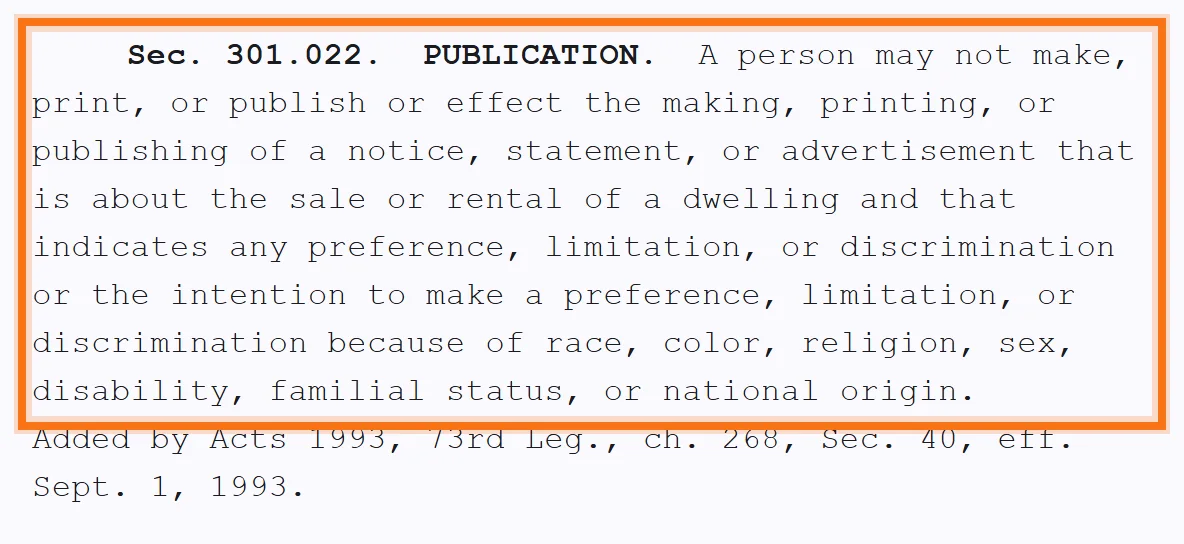
The working habit that follows: every sentence is about the home, the terms or the process, never about who should live there. "Adults only" speaks to familial status; "Christian home" speaks to religion. Write the feature instead: four bedrooms, a fenced yard, single-story with no steps, two blocks from the park.
Whether a particular phrase crosses the line is a legal question; this is general information, not legal advice, so ask a Texas attorney about anything you are unsure of. The full statute-based checklist is in our fair housing guide for Texas landlords.
Put a criteria summary in the listing
Texas Property Code 92.3515(a) says that at the time an applicant is given a rental application, the landlord "shall make available to the applicant printed notice of the landlord's tenant selection criteria and the grounds for which the rental application may be denied". Under 92.3515(e), a landlord who rejects an applicant without having made that notice available must return the application fee and any application deposit.
The full criteria go with the application, but a short summary in the listing saves everyone a fee and a showing: the income standard as a multiple of rent, the checks run on every adult (credit, rental history, income and employment, background), the pet policy and the application fee. Link the full written criteria, state them as facts rather than warnings, and apply them to every applicant exactly as written. How to set the criteria themselves is in tenant screening criteria in Texas.
State the quirks; the showing reveals them anyway
Every home has something a renter would rather know before driving over: it backs to a busy road, the garage is a single, the yard is small, the primary bedroom is upstairs, there is no bathtub, the HOA does not allow trucks in the driveway. Owners are tempted to leave these out and let the showing handle it. The showing does handle it, by producing a renter who feels misled and does not apply.
State the quirk plainly and, where it is fair, pair it with the trade-off: backs to the main road, with a privacy fence and a larger lot than the interior homes. A renter who inquires after reading that is a renter who has already accepted it. The result is fewer showings and a higher share that turn into applications, which is exactly what you want.
One clear next step
End the listing with exactly what a renter should do next, and make it the same path for everyone. State how to schedule a showing, how to apply, what documents the application requires, and how quickly they can expect a response. If self-showings are available for verified prospects, say so and explain the verification in one sentence.
A single process also protects you. When every inquiry gets the same instructions and every applicant follows the same steps in the same order, there is no room for an argument that one renter was treated differently. How an application moves from inquiry to decision should be as fixed as the listing itself.
A before-and-after example
Here is a listing opening rewritten, with illustrative figures that are not a recommendation for any house.
Before: Beautiful home in a wonderful family neighborhood! Updated kitchen, huge backyard, close to everything. Won't last long, call today!
After: Single-story 3-bed, 2-bath brick home with fenced backyard and two-car garage in Keller ISD. Rent $2,100, deposit $2,100, available the first of the month on a 12-month lease. Refrigerator, washer and dryer included; tenant pays electric, gas and water and handles lawn care. One dog considered; pet fee and pet rent apply. Backs to a collector road, with a privacy fence. Screening: income of at least three times the rent; credit, rental history and background checks for every adult; full criteria linked. Tour by appointment or self-guided booking; apply online after viewing.
The second version is longer, plainer and far more useful. It answers the right renter's questions, tells the wrong renter not to call, and nothing in it will be contradicted at the showing. The "before" also opened with "family neighborhood", which describes people rather than the house. The rent itself should come from a rental analysis, not from the listing writer.
Keeping the listing accurate while it is live
A listing is a promise that lives on several sites at once. When the rent changes, the availability date moves, the pet policy is adjusted or an application is approved, every copy of the listing needs to change the same day. A stale rent on one portal produces inquiries at the old number and arguments at the application. A listing that stays live after the home is leased wastes renters' time and invites the scam copies that reuse old listings.
Keep one master version and push changes from it. If a manager handles the listing, that is part of the job: one source of truth, updated everywhere, taken down the day the lease is signed. The mechanics of where the listing travels and how to control it are in where your rental listing actually shows up, and the full launch sequence is covered under our marketing service.
How our listings handle this
What our site states, and nothing beyond it:
- The description. Our marketing page lists professional photography and a written-to-sell description, syndicated across the major rental sites plus our own available rentals page.
- The fee and the criteria. Our rental criteria page tells applicants to be prepared to pay the application fee listed on the property listing, and our showing page says our written rental criteria are public, so renters know what we verify before they pay a fee. All applicants are evaluated against the same written criteria.
- Pets. Pet-friendly homes are marked in the listing; where pets are permitted at the owner's discretion, the published terms are a one-time non-refundable $350 fee plus $25 monthly pet rent per pet.
- One path. Every home we manage is on our own listing page, never on Facebook Marketplace or Nextdoor.
What your house's description leads with is agreed with you when the house is ready to list, and every fee is confirmed in writing before you sign. To get the rent number the listing starts from, call 682-593-7033.
The takeaway: A rental description gets more applications when it states the facts, the criteria and the quirks plainly, describes the home rather than the tenant, and ends with one next step, so the right renter applies and the wrong one moves on before a showing.
Questions owners ask
What should a rental listing description include?
A specific headline, a facts block with rent, deposit, availability, lease term, bedrooms and bathrooms, garage, yard, included appliances, pet policy, utilities and school district, a short description of the layout and outdoor space, a summary of the screening criteria, any quirks stated honestly, and one clear next step for showings and applications. Keep the paragraphs short and the facts first, because many renters read it on a phone.
Can I say a rental is great for families or professionals?
It is a risk. 42 U.S.C. 3604(c) and Texas Property Code 301.022 bar ads that indicate a preference, limitation or discrimination based on protected characteristics, and familial status is one of them. Describing who the home is for invites that reading; describing the home does not. Write four bedrooms, fenced yard, single-story with no steps instead. This is general information, not legal advice.
Do I have to publish my tenant screening criteria?
Texas Property Code 92.3515(a) requires the landlord to make printed notice of the tenant selection criteria available when an applicant is given a rental application, and 92.3515(e) requires the fee and any application deposit to be returned if an applicant is rejected without that notice. A summary in the listing is not what the statute requires, but it saves fees and showings for renters who do not qualify.
Should I mention a rental's drawbacks in the listing?
Yes. A busy road, a single garage, a small yard or an upstairs primary bedroom will be discovered at the showing anyway, and a renter who feels misled does not apply. Stating the quirk plainly brings fewer showings and a higher share that turn into applications.
How long should a rental listing description be?
Long enough to cover the facts block, a few short paragraphs about the home, the criteria summary and the next step, which is often a few hundred words. Keep paragraphs to a few lines and put the most important facts first, because many renters read on a phone and previews cut off.
How do I make my rental listing more attractive to tenants?
Lead with facts rather than adjectives, put the photos in walking order with the best room first, state the pet policy and the availability date, name the school district, and remove anything a showing would contradict. Attractive to the right renter matters more than attractive to everyone: a plain, complete listing brings applications from people who qualify.
Related services
Property management in Keller, North Richland Hills and Fort Worth. How full-service management works in Tarrant County →