Key takeaways
- A leasing agent finds and signs the tenant. A property manager runs the house after move-in: rent, repairs, notices, renewals and the deposit.
- Leasing or collecting rent for someone else for pay is broker work in Texas (Occupations Code 1101.002), and a sales agent must act for a sponsoring broker (1101.351).
- Under TREC rule 535.146, a sales agent may not keep a trust account: rent or a deposit they receive goes immediately to their sponsoring broker.
- Leasing only means you self-manage from day two. Keep the photo move-in report, because it decides most deposit disputes.
- Compare the cost of the eleven months after the lease is signed, not just the placement fee.
Should you use a real estate agent or a property manager to rent out your house? If all you want is a tenant found and a lease signed, an agent can do that. If you want the house run after the tenant moves in, with rent collected, repairs handled, notices sent and the deposit accounted for, you want a property manager. For owners in Fort Worth, Keller and North Richland Hills, the agent's job usually ends at the signature; the manager's job starts there.
This guide is for the owner whose listing agent says "I can rent it out for you." It compares leasing only with ongoing management, the Texas rules behind each, the cost math and what to ask. If the agent is offering to manage the house too, read management company vs. an agent who manages on the side.
Leasing only vs property management: what each covers
Here is what each option usually covers, and who does each job after move-in if you choose leasing only:
| Task | Leasing only | Ongoing management | Texas rule that applies |
|---|---|---|---|
| Pricing, listing and showings | Agent | Manager | Done for you for pay: broker work (Occupations Code 1101.002) |
| Screening applicants | Agent, under criteria you agree | Manager, under written criteria | Printed notice of selection criteria with the application (Property Code 92.3515) |
| Lease signing and move-in report | Agent, then the file passes to you | Manager, and the file stays with the manager | What the lease says governs the tenancy |
| Rent collection and late fees | You | Manager | Late fee only with notice in a written lease, after two full days (92.019) |
| Repairs and the after-hours call | You | Manager, within a limit you set | Diligent effort to repair health or safety conditions after notice (92.052) |
| Deposit at move-out | You | Manager | Refund within 30 days, deductions itemized in writing (92.103, 92.104) |
| Renewal or turnover | You, or a new leasing engagement | Manager recommends, you decide | No retaliatory rent increase within six months of a protected act (92.331) |
How to read this table: the first three rows are the leasing work an agent sells. Every row after that lands on you with leasing only, starting the day after the lease is signed. The right-hand column applies to whoever does the job, which is you if no one else is hired for it.
What your listing agent is offering when they say "I can rent it out"
When a listing agent offers to rent out your house, the offer is usually the leasing work: pricing, listing, showings, collecting applications and preparing a lease for signature. That is real work with real value, and in Texas it is licensed work. Occupations Code 1101.002 defines a broker to include a person who, for pay, leases or offers to lease real estate for another, lists it for lease, or procures a prospect to lease it. Section 1101.351 requires a license, and a sales agent may act only when sponsored by a licensed broker and acting for that broker.
Two things follow for you. First, the agent acts for their sponsoring broker, so ask which broker's name is on the agreement. Second, money: under TREC rule 535.146, a sales agent may not keep a trust account, and any trust money, such as a deposit or first month's rent, must be delivered immediately to the sponsoring broker. Ask in writing who holds those funds and when they reach you.
When the house did not sell and the agent suggests renting it
The offer often comes at a specific moment: the house has been listed for sale, it has not sold, and the agent suggests renting it out instead. That is a sale decision and a landlord decision at once, and they deserve separate answers.
First, decide whether renting is the right backup at all: what the house would rent for, what it would cost to hold and how a tenant affects a later sale. That comparison is in house not selling? whether renting it out is a sensible backup plan. Our brokerage page describes four routes for a house that is not selling: leasing it through Perpetual Property Management, listing it yourself on the MLS through DirectList, a creative exit such as owner finance, or a full-service listing with Perpetual Realty Group.
Second, if you rent it, decide who runs the tenancy. An agent who was paid to sell the house is offering a different job when they offer to lease it, and the questions in this guide apply from the start.
What a property manager does that a leasing agent does not
A property manager does the leasing too, but over a year the leasing is a small share of the work. Our FAQ describes the job as pricing and marketing the home, showing it, screening applicants, writing the lease, collecting rent, coordinating maintenance, running inspections, sending monthly statements, handling renewals and managing any problem situations, so the property performs without you being on call.
The manager is also the person the tenant deals with, which changes the relationship. Tenants tend to negotiate with a landlord they know personally and follow a process when a company runs it. Where the rent goes and how it reaches you under a manager is explained in do tenants pay rent to me or to the property management company.
The gap most owners miss: the day after the lease is signed
Owners who choose an agent are usually picturing the leasing, which an agent handles well. They are not picturing the eleven months that follow. Say the rent is late in month three. Do you know what your lease says about the late fee, and that Texas allows one only if notice of it is in a written lease? Say the AC fails in July. Do you have a vendor who answers? Say the tenant moves out next summer. Can you return the deposit with an itemized list within 30 days?
The one document that decides most of those arguments is the move-in condition report. Our leasing page puts it plainly for owners who will run the tenancy themselves:
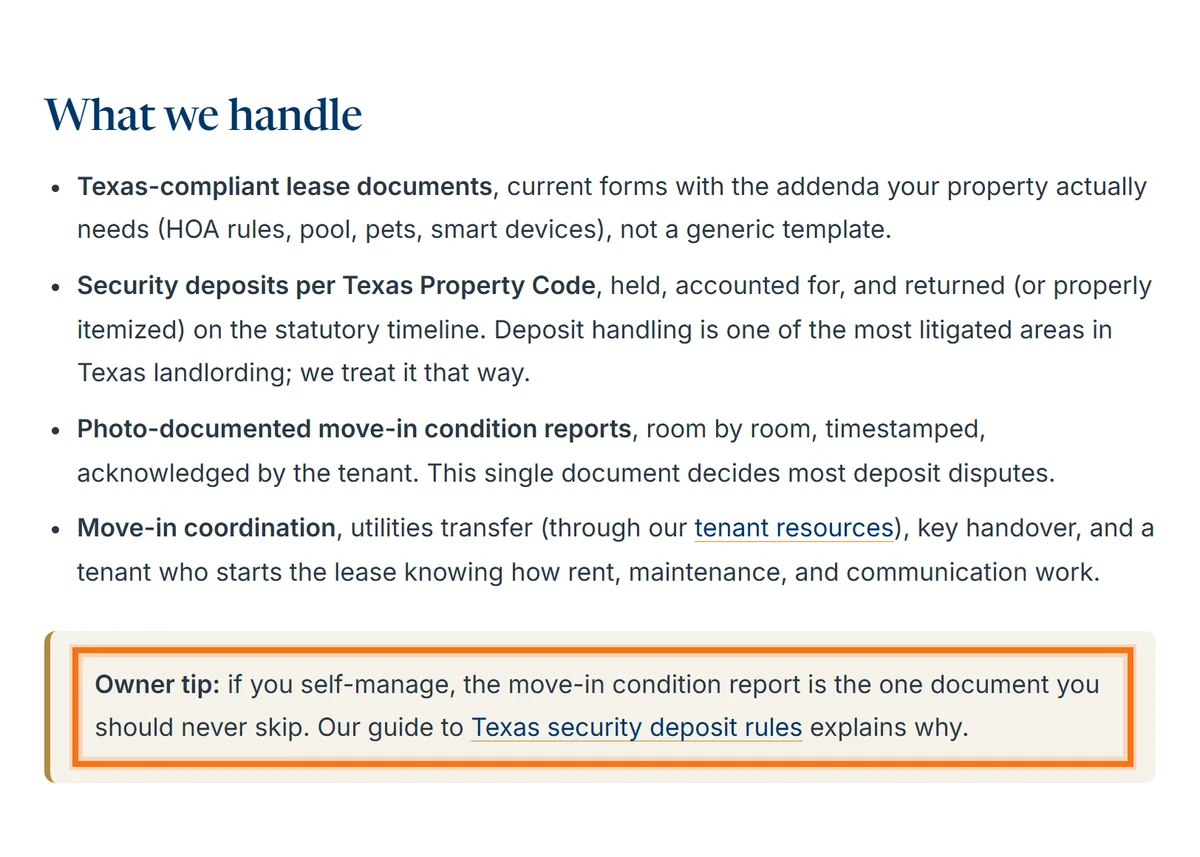
None of this is impossible to learn, and the self-manage vs. property manager guide is honest about who does it well. But choosing an agent for leasing only is a decision to self-manage, and it should be made on purpose.
When leasing only through an agent is the right choice
Leasing through an agent and then managing the house yourself makes sense when most of the following are true:
- You live within a short drive of the house and can get there on a weeknight.
- You have a plumber, an electrician and an HVAC company who already answer your calls.
- You have read your lease and understand the Texas late-fee, repair and deposit rules, or you are willing to.
- You want to be the person your tenant knows, and you are comfortable saying no.
- The house is in good condition, so repair calls should be rare in the first year.
If that describes you, leasing only is a sound route. Agree the screening criteria in writing before the first application arrives, so every applicant is measured the same way. What to expect from a placement-only arrangement is in can I hire someone just to find a tenant.
If the agent offers to manage it too
Sometimes the offer grows: the agent will "keep an eye on it" after move-in. That is management, and it raises different questions: where the rent and deposit are held, who answers when the agent is at a closing or on vacation, and whether screening runs from written criteria. Ask about all three before you agree.
The difference between a management company and an agent who manages as a sideline is covered in its own guide: management company vs. an agent who manages on the side.
How the cost comparison really works
On paper, leasing only is cheaper: one fee, then nothing. Management adds a monthly fee. The useful question is what the monthly fee buys for the eleven months after the lease is signed.
Illustrative only, not a quote. Assume a $2,000 monthly rent and, for simplicity, the same placement fee either way: 50% of one month's rent, or $1,000. Leasing only costs $1,000 for the year. Management at 10% of 12 months of rent adds 10% x $2,000 x 12 = $2,400, for $3,400. The difference is $2,400 a year, or $200 a month, and that is the price of rent collection, repairs, inspections, renewal and the deposit accounting.
Set that $200 a month against your own realistic year: a repair at one-off prices, a late fee you did not enforce, a slower turnover and your hours. For some owners leasing only still wins, especially with a good tenant and a nearby house. Ask each company for its complete written fee schedule and run the numbers on your own rent.
How Perpetual handles this
Justin Brown is a Texas broker and owns both Perpetual Realty Group, our affiliated brokerage, and Perpetual Property Management, with our office at 5755 Rufe Snow Dr in North Richland Hills. We manage homes in Keller, North Richland Hills, Fort Worth and nearby. What our site states:
- Full-service management is our core service. Our leasing page says the placement work inside it is the same work a placement-only service sells, and if you tell us about the house and your situation, we will say plainly which one fits.
- Placement fee: 50% of one month's rent on the Full Service and Investor Special plans and 75% on Standard. The monthly fee is 10% of monthly rent on Full Service, 9% on Standard and 7% on Investor Special (portfolios of 5 or more units). If a tenant we place defaults and is removed, or breaks the lease, within the first 6 months, we find a new tenant with no additional leasing fee.
- After move-in: online rent collection, maintenance coordination with agreed limits, inspections with photo reports, monthly statements in the Owner Portal, renewals and, if ever needed, eviction coordination.
Which arrangement fits your house, and the exact fees for it, are confirmed in writing before you sign. A free rental analysis is a sensible first step either way, since both routes start with knowing what the house should rent for. Call 682-593-7033.
The takeaway: An agent finds the tenant and a manager runs the house afterward, so decide what you intend to do on day two and choose on purpose rather than because the agent was the first person you called.
Questions owners ask
Can a real estate agent legally manage a rental property in Texas?
Yes, if the agent holds an active license and acts for a sponsoring broker. Leasing real estate for another or controlling the acceptance of rent from a resident of a single-family home, for pay, falls within the broker definition in Occupations Code 1101.002, and 1101.351 requires a license. Under TREC rule 535.146, a sales agent may not keep a trust account, so rent and deposits go to the broker. Ask who holds them and who covers when the agent is unavailable.
Does a property manager also list my house on the MLS?
Ask before you sign, because practices differ. Our marketing page lists syndication across the major rental sites, including Zillow, Trulia, HotPads and the Apartments.com network, plus our own available rentals page, with self-guided and scheduled showings through ShowMojo. Whatever the company, get the list of places your listing will appear in writing.
Can I start with an agent for leasing and add management later?
Yes. A management company can take over a house with a tenant in place at any point in the lease; we take over occupied properties, and the lease, deposit and records transfer to us. The handover is simpler if the lease is complete, the deposit is documented and there is a photo move-in report the tenant acknowledged. Ask the leasing agent for all three at move-in.
My listing agent offered to rent out my house. What should I ask?
Ask what the fee covers and when it ends, whose broker name is on the agreement, who holds the deposit and first month's rent and when you receive them, what written screening criteria will be used, whether you get a photo move-in report the tenant signed, and what happens after move-in: who collects rent and who takes repair calls. If the answer to the last question is you, you are choosing to self-manage.
Do I need a license to rent out my own house in Texas?
No. Occupations Code 1101.005(8) says the real estate license law does not apply to an owner, or the owner's employee, who leases the owner's own real estate. The license matters when someone else leases the house or collects the rent for you for pay. This is general information, not legal advice.
Related services
Property management in Keller, North Richland Hills and Fort Worth. How full-service management works in Tarrant County →