Key takeaways
- Since September 1, 2025, Property Code Chapter 24B lets an owner or the owner's agent ask the sheriff or a constable to remove an unauthorized occupant without a lawsuit.
- It fits only a true squatter: no consent, not a current or former tenant of yours, not immediate family, and a refused demand to leave.
- The complaint is sworn. A wrongful removal can cost actual damages plus three times the fair market rent, court costs and attorney's fees.
- When Chapter 24B does not fit, a justice court suit can ask for summary disposition, a 2026 procedure with a 4-day response window.
- Prevention is cheaper: rekeyed locks, a house that looks cared for, controlled showings and a check every week.
How do you remove squatters from a vacant rental house in Texas? Tell the person to leave. If they refuse, an owner in Fort Worth, Keller or North Richland Hills, or the owner's agent, can file a sworn complaint with the sheriff or a constable under Property Code Chapter 24B. The officer verifies your ownership, serves a notice to vacate immediately and puts you back in possession. A current or former tenant needs an eviction suit instead.
Below: which route fits, what the 2025 law makes you swear to, what it costs in Tarrant County, when court is still the right tool, and how to keep an empty rental from being occupied at all.
The ways to get an unauthorized occupant out, side by side
Which route fits depends on how the person got in and who they are to you:
| Route | When it fits | What you do | Timing in the law |
|---|---|---|---|
| Chapter 24B complaint to the sheriff or a constable | Entered without consent; not your current or former tenant; not immediate family; no lawsuit pending between you; refused to leave | Sign the sworn complaint in section 24B.002 and attach your ID (and an agent's proof of authority) | After verifying, the officer acts "without delay" (24B.003(b)) |
| Forcible entry and detainer suit | Entered without legal authority or by force and refused to leave on demand (24.001) | Oral or written notice to vacate, a sworn petition, and an optional motion for summary disposition | 4 days to respond after service; disputed cases tried on day 10 to 21 after filing (24.005106) |
| Regular eviction (forcible detainer) | A current or former tenant, a holdover, or someone let in by a person in possession | Written notice to vacate under 24.005, then an eviction suit | Trial on day 10 to 21 after filing (24.0051(g)) |
| Criminal trespass report | The person had notice entry was forbidden, or was told to leave and stayed (Penal Code 30.05) | Call law enforcement; the officer decides whether to arrest | No timetable; Chapter 24B does not limit arrests (24B.006) |
How to read this table: stop at the first row that honestly fits. Chapter 24B is the fastest, but every statement in it is sworn, so it is for the clear case. When you are not sure, the court route is slower and safer, because a judge decides who has the right to possession.
First question: is it a squatter, a former tenant, or a guest?
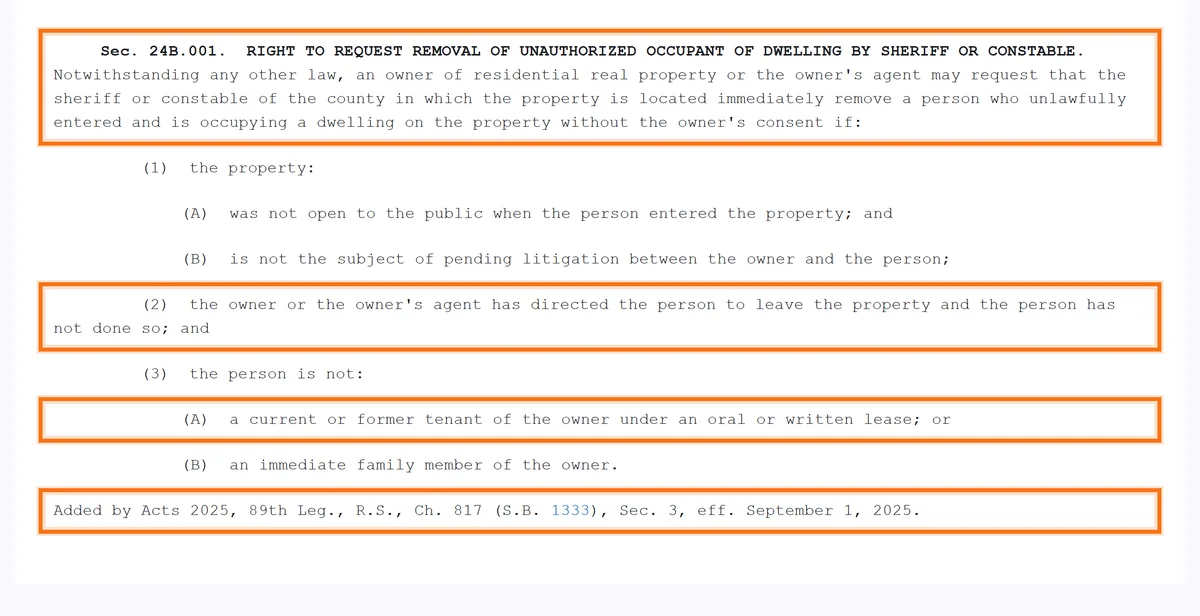
Section 24B.001 allows the sheriff or constable route only when all of these are true: the person unlawfully entered and occupies the house without your consent; the property was not open to the public when they entered and is not the subject of pending litigation between you; you or your agent told them to leave and they did not; and they are not a current or former tenant of yours, or an immediate family member.
A tenant who stayed after the lease ended is a holdover, handled by eviction (see our holdover tenant guide). Tarrant County Justice of the Peace Precinct 1 adds a trap in its information packet: if the person came in with the consent of someone in actual possession, such as a tenant's friend who stayed on, a forcible entry suit is improper and the owner files a regular eviction.
A lease waved at you does not make someone a tenant. The complaint asks you to swear that any lease the person produces is fraudulent. Since September 1, 2025, presenting a fake lease or deed to enter or remain on property is a Class A misdemeanor (Penal Code 32.56), and knowingly renting out a home without title or authority is a first-degree felony (32.57). Those scams often start with a copied listing; see how managers protect listings from rental scams.
How Chapter 24B removal works in Tarrant County, step by step
For a house in Tarrant County, which takes in Keller, North Richland Hills and most of Fort Worth, the statute sets these steps:
- Demand that the person leave, without going inside alone. Note the date, time and what was said.
- Gather proof. Attach a copy of your government-issued ID; an agent also attaches a document showing authority to act for the owner. Keep your deed or county property record ready, because the officer must verify that you are the record owner or the owner's agent (24B.003(a)).
- Sign the complaint. Section 24B.002 sets out twelve statements you initial, made under oath or as an unsworn declaration, under penalty of perjury.
- Submit it to the sheriff or a constable of the county where the house is located.
- The officer serves notice to immediately vacate by handing it to an occupant or affixing it to the front door, puts you in possession, and attempts to verify and note each occupant's identity. The officer may arrest anyone there on an outstanding warrant or for trespass or another offense with probable cause.
- Change the locks. You may ask the officer to keep the peace while you change the locks and place the occupant's belongings at or near the property line (24B.003(g)).
The fee: the officer is entitled to the same amount as for executing a writ of possession (24B.003(f)). Tarrant County's 2026 sheriff and constable fee schedule lists a writ of possession at $180, plus $80 per deputy per hour after two hours, and standing by while you change locks can carry an hourly rate the office sets (24B.003(h)). Confirm the amount with the office before you file. This is general information, not legal advice.
The risk of getting it wrong
Chapter 24B skips a judge, so the law puts the risk on whoever signs. Under section 24B.005, a person wrongfully removed, or whose belongings are wrongfully removed, can sue to recover possession and collect from the person who requested the removal: actual damages, exemplary damages equal to three times the fair market rent of the dwelling, court costs and reasonable attorney's fees. Illustrative only, not a quote: at a fair market rent of $2,000 a month, the exemplary damages alone are 3 x $2,000 = $6,000.
Act within the chapter and section 24B.004 protects you: the owner or agent is not liable for loss of or damage to personal property removed under the chapter, subject to that wrongful-removal action. The rule of thumb: if you would hesitate to initial any one of the twelve statements, go to court instead. This is general information, not legal advice.
When to file in justice court instead
A lawsuit is the right tool when facts are disputed, when someone in possession may have let the person in, or when you do not want to swear to the Chapter 24B statements. Senate Bill 38 changes in effect since January 1, 2026 make it faster than it used to be:
- Notice. After a forcible entry, the person entitled to possession may give oral or written notice to vacate, immediately or by a deadline (24.005(d)).
- Petition. A sworn petition (24.00505), filed in the justice precinct where the house is located (24.0041).
- Summary disposition. A forcible entry and detainer petition may include a sworn motion for summary disposition (24.005106). Unless the occupant responds with supporting facts within 4 days after service and the court finds a genuinely disputed fact, the court may rule without a trial.
- Writ. A winning owner gets a judgment for possession and a writ of possession (24.0061).
Tarrant County lists $54 to file an eviction suit in justice court and $90 per citation served. The full timeline is in the Texas eviction process timeline. This is general information, not legal advice.
What not to do when you find someone living in your rental
- Do not go in alone or argue at the door. Make the demand from a safe position, ideally with a witness, and call law enforcement if a crime is happening.
- Do not assume. If the person might be a tenant, a former tenant, or someone your tenant let in, the tenant rules apply. Under Property Code section 92.0081 a landlord may not lock a tenant out except by judicial process, with narrow exceptions, and a violation can cost one month's rent plus $1,000, actual damages, court costs and attorney's fees.
- Do not throw belongings away. Under Chapter 24B they go at or near the property line after the officer has served the notice.
- Do not wait. Every week adds damage to fix and rent you cannot collect.
Document everything: photos from outside, the date you noticed, the date you demanded they leave, any lease or listing they show you. That record supports whichever route you take.
Do squatters have rights in Texas?
What people call "squatters' rights" is adverse possession, and in Texas it is measured in years. Civil Practice and Remedies Code chapter 16 sets the periods for suing to recover land held in peaceable and adverse possession: three years for a possessor under title or color of title (16.024), five years for one who uses the property, pays the taxes and claims under a registered deed (16.025), and ten years for one who uses or enjoys it (16.026). Only when a suit is barred does the possessor get title (16.030).
Section 16.021 defines peaceable possession as continuous and not interrupted by an adverse suit, so acting promptly keeps a short occupation from becoming a title question. What squatters do have is a right to a lawful process, which is why the wrongful-removal remedy exists. This is general information, not legal advice.
How to keep squatters out of an empty rental
A rental is most exposed between tenants and while it is listed. Each step below makes the house look lived-in and watched, or makes your case easy if someone gets in anyway:
| Step | Why it helps | Source |
|---|---|---|
| Rekey at every turnover | Old keys stop working. Texas requires rekeying no later than the seventh day after each tenant turnover date. | Property Code 92.156(a) |
| Post "No trespassing" signs at entrances | A posted sign counts as notice for criminal trespass, so police are not relying on your word alone. | Penal Code 30.05(b)(2)(C) |
| Keep the yard, mail and lights normal | Overgrown grass and a full mailbox advertise an empty house. | Vacant-house guide |
| Control showings | Each visitor is identified and access is logged and time-limited. | Showings guide |
| Search for copies of your listing | A copied listing is one way a stranger ends up with a "lease" from someone who never owned the house. | Penal Code 32.57 |
| Keep ownership and authority papers ready | The officer verifies record ownership; an agent attaches proof of authority. | Property Code 24B.002, 24B.003(a) |
| Check the house every week | You find an occupation in days, before damage builds. | You or your manager |
How to read this table: the first five rows make an occupation less likely, the last two make it short. Checks and utilities on an empty house are covered in looking after an empty house and who handles utilities while the rental is empty, and showing controls in are self-guided showings safe. The best prevention is a short vacancy, so pricing the house right from day one matters as much as the locks.
How Perpetual handles a vacant house in Fort Worth, Keller and North Richland Hills
Perpetual Property Management is broker-owned, with our office at 5755 Rufe Snow Dr in North Richland Hills, and we manage homes in Keller, North Richland Hills, Fort Worth and nearby. What our site states about an empty home:
- Weekly reporting. While your home is vacant you get a written activity report every week, with showing feedback and market notes, or that month's management fee is credited, subject to the Guarantee Addendum in the Perpetual Promise.
- A short vacancy. Once market-ready, the home is live on every major rental platform within 5 business days, or the first month's management fee is waived.
- Controlled showings. ShowMojo self-guided showings with identity verification; access is logged, time-limited and monitored.
- Documented condition. A 360-degree inspection at every move-in and move-out, and 24/7 emergency response on every plan.
- Eviction service. Included on Full Service, optional at $7.95 a month on the other plans (price sheet).
Our site does not state how often we visit an empty house in person, whether we sign a Chapter 24B complaint as your agent, or whether the eviction service covers someone who was never a tenant, so those are confirmed in writing before you sign. If your house is empty now, or someone is already in it, start with a free rental analysis or call 682-593-7033.
The takeaway: Confirm it is a true squatter, demand that they leave, then file a Chapter 24B complaint with your ownership papers. If they are or were your tenant, or someone in possession let them in, use justice court.
Questions owners ask
How long does it take to remove a squatter in Texas?
Under Chapter 24B, once the sheriff or constable verifies your complaint, the officer serves the notice to immediately vacate and puts you in possession "without delay." The law sets no number of days. In court, the occupant has 4 days after service to answer a motion for summary disposition, and a disputed case goes to trial between the 10th and 21st day after filing.
Can the police remove squatters in Texas?
Criminal trespass under Penal Code section 30.05 covers a person who stays after being told to leave, and Chapter 24B does not limit an officer's authority to arrest an unauthorized occupant for trespassing, vandalism, theft or another offense. Whether an officer arrests is the officer's call. The Chapter 24B complaint is the owner's tool to regain possession.
Can I use Chapter 24B against a former tenant who will not leave?
No. Section 24B.001 excludes a current or former tenant of the owner under an oral or written lease, and an immediate family member. A tenant who stays after the lease ends is a holdover: you give written notice to vacate under section 24.005 and file an eviction suit in justice court.
What if the squatter shows me a lease?
Do not argue the paper at the door. The Chapter 24B complaint asks you to swear that any lease the person produces is fraudulent, and presenting a fake lease to enter or remain on property is a Class A misdemeanor under Penal Code section 32.56. If you are unsure whether it is genuine, use the court route.
How much does it cost to remove a squatter in Tarrant County?
For a Chapter 24B notice, the officer is entitled to the same fee as for executing a writ of possession; Tarrant County's 2026 schedule lists $180, plus $80 per deputy per hour after two hours. In court, the county lists $54 to file and $90 per citation served. Confirm current fees with the office.
Can my property manager file the squatter complaint for me?
The statute allows it: an owner or the owner's agent may request removal, and an agent attaches a document showing authority to act for the owner. Whether a particular manager does it, and on what terms, belongs in the management agreement before you need it.
Property management in Keller, North Richland Hills and Fort Worth. How full-service management works in Tarrant County →