Key takeaways
- Keep work you can do with no tenant in the house and no repair clock running: make-ready painting, caulking, blinds, yard and exterior projects while vacant.
- Leave tenant-reported repairs and emergencies with the manager, so the tenant has one contact and the Property Code repair clock is watched.
- Electrical, air conditioning and plumbing are licensed trades in Texas; the owner exemptions in Occupations Code 1305, 1302 and 1301 are written for a home you live in or your homestead.
- Entry into an occupied house follows the lease; no Texas statute sets a notice period.
- Put the split, the notice to the manager, the contractor standard and how your work is recorded into the management agreement.
Can you do some of the maintenance yourself and let the manager handle the rest? Usually yes, if the split is written into the management agreement. For a rental in Fort Worth, Keller or North Richland Hills, the clean version is simple: you take work done while the house is empty, the manager takes everything the tenant reports and every emergency. Licensed trades stay with licensed contractors.
This guide shows which tasks fit an owner, what Texas licensing law says about doing trade work on a house you rent out, how entry, insurance and warranties work, and the clause that keeps it all in one record.
Who can do what: a split that works
Here is how the usual maintenance tasks divide between a hands-on owner and a manager, and what decides each line:
| Task | Owner can keep it? | What decides it | Put in the agreement |
|---|---|---|---|
| Painting, caulking, blinds, cleaning while vacant | Yes | No tenant, no repair clock | Dates, so listing waits for you |
| Yard and exterior projects while vacant | Yes | Any HOA or city rules for the work | Who books and who pays |
| Electrical work | Hire a licensed electrician | Occupations Code 1305.151; owner exemption only for a dwelling you own and reside in | Contractor license and insurance standard |
| Air conditioning and heating | Hire a licensed A/C contractor | 1302.251; homeowner exemption only for your home (1302.053) | Same |
| Plumbing | Hire a licensed plumber | 1301.351; owner exemption only in your homestead (1301.051) | Same |
| Repairs the tenant reports during the lease | No: manager | Repair duty and clock under Property Code 92.052 and 92.056 | Manager handles all tenant-reported items |
| Emergencies | No: manager | Speed and access at any hour | Emergency authority clause |
| Supplying fixtures or appliances you buy | Yes | Who installs them and who warrants the install | Who installs |
How to read this table: the first two rows are where an owner saves money without risk to the tenant relationship. The trade rows are not about skill: the statutes require a license for the work, and the owner exemptions are written for a home you live in. The last rows keep the tenant's single point of contact intact. This is general information, not legal advice.
What owners sensibly keep for themselves
The work that fits a hands-on owner is work with no tenant in the house and no repair clock running:
- Make-ready between tenants. Painting, replacing blinds, caulking, pressure washing, mulching beds. The house is empty and your schedule is your own; what pays before renting lists what a turnover usually involves.
- Yard and exterior work while vacant, or during a lease if the lease gives the yard to the owner and the manager schedules your visit.
- Projects you plan well ahead, such as a fence replacement or a roof, where you hire and supervise your own licensed contractor and the manager knows the dates.
- Supplying materials, such as buying the ceiling fans or an appliance yourself and having a licensed installer fit them.
In each case the tenant's experience does not change: the tenant reports to the manager, and the manager knows what you are doing and when.
Licensed trades: what Texas law says about doing it yourself
Three chapters of the Occupations Code license the trades that matter most in a house, and each has an owner exemption worded for the owner's own home:
- Electrical (chapter 1305). Section 1305.151 says a person may not perform or offer to perform electrical work unless licensed, except as 1305.003 provides. The owner exemption in 1305.003(a)(6) covers work not specifically regulated by a municipal ordinance "performed in or on a dwelling by a person who owns and resides in the dwelling". TDLR's electricians page says anyone who performs non-exempt electrical work must be licensed.
- Air conditioning and heating (chapter 1302). Section 1302.251 requires a license to engage in air conditioning and refrigeration contracting, which 1302.002 defines to include repair, maintenance and service. The homeowner exemption in 1302.053 covers "a building owned solely by the person as the person's home".
- Plumbing (chapter 1301). Section 1301.051 exempts a property owner performing plumbing "in the property owner's homestead".
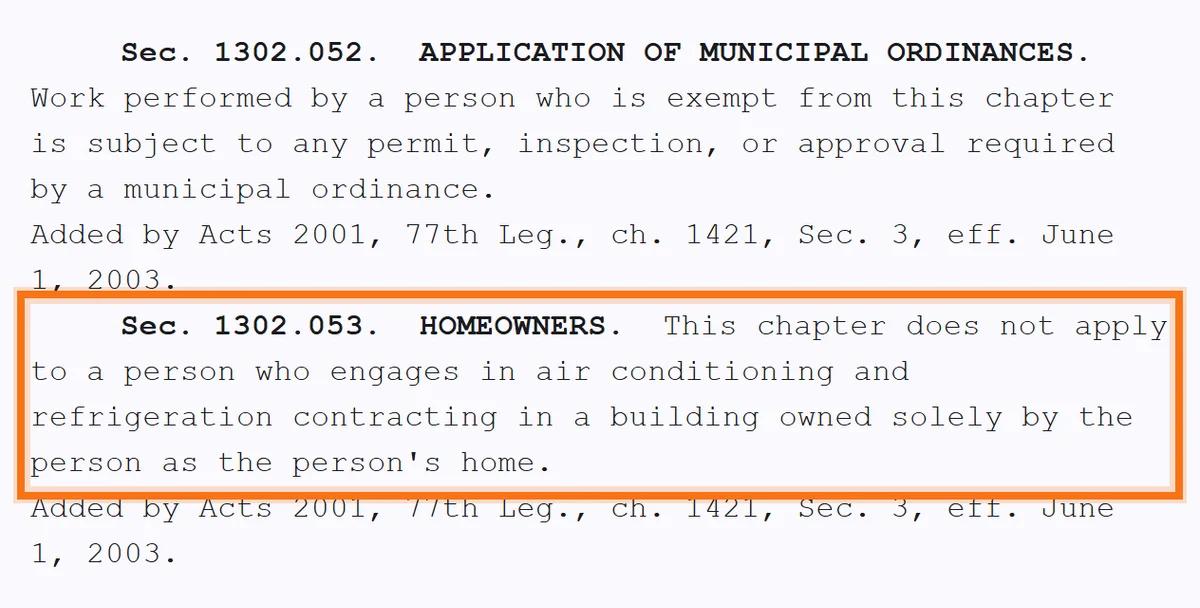
A rental house you do not live in is not described by those words. Before doing any of this work yourself, ask the agency (TDLR for electrical and A/C, the Texas State Board of Plumbing Examiners for plumbing), and confirm with the city whether the job needs a permit. How a manager checks a contractor's license is in how a property manager checks whether contractors are licensed and insured. This is general information, not legal advice.
What belongs with the manager, and why
Anything the tenant reports during the lease should run through the manager, even if you could fix it yourself. Three reasons.
Entry. No Texas statute sets a notice period for a landlord's entry; the lease sets it. A manager schedules entry under the lease and keeps a record. An owner who texts the tenant and drops by has created a second entry policy. Landlord entry rights in Texas covers what the lease should say.
The repair clock. Property Code 92.052 requires a diligent effort to repair a condition that materially affects health or safety once a tenant who is current on rent gives notice, and 92.056(d) presumes seven days is a reasonable time. A manager's job is to meet that; an owner with a day job and a weekend plan may not.
One contact. With two people answering, the tenant calls whoever answered faster last time, and the record of what was reported and when splits across two phones.
How to put the split in writing
Ask for the arrangement as a clause or an addendum to the management agreement, not an email. It should cover:
- Which categories you keep (for example, make-ready and planned exterior projects) and which the manager keeps (everything tenant-reported, all emergencies, all licensed trade work).
- How much notice the manager gets before you or your contractor go to the house, and who gives the tenant notice under the lease if it is occupied.
- The standard for your own contractors: license where the trade requires one, and proof of insurance.
- How your work is recorded, so the house keeps one history: dates, photos and receipts sent to the manager.
- Whether any coordination charge applies to work you do or supply, stated in the fee schedule.
The rest of the agreement's maintenance terms are covered in what to look for in a management agreement.
Insurance, liability and who warranties the work
When a licensed contractor does a job, three things stand behind it: the contractor's insurance, the contractor's warranty on workmanship, and a paper trail. When you do it yourself, you are all three. Before you pick up a tool, settle these:
- Your landlord policy. Ask your insurance agent how the policy treats damage that follows work you did yourself, and whether anything changes if someone is hurt at the house while you work. Get the answer in writing.
- The product warranty. Read the manufacturer's terms for any appliance, water heater or system you install or service; some set conditions on who installs or services it.
- Your own contractor. If you hire your own, ask for a certificate of insurance and the license number before work starts, and send both to the manager.
- The tenant. A repair that fails after the tenant reports it is still the landlord's problem. Property Code 92.0563(a) lists the tenant's judicial remedies when the conditions in 92.056 are met, including a civil penalty of one month's rent plus $500, actual damages, and court costs and attorney's fees.
None of this argues against doing your own make-ready work. It argues for keeping your own work to the jobs where a mistake costs you time, not a tenant's safety. This is general information, not legal or insurance advice.
An example of a split that works
Illustrative scenario. An owner in Keller is handy, lives ten minutes from the rental and wants to keep turnover costs down. The written arrangement says: owner handles make-ready between tenants and exterior projects planned more than two weeks ahead; manager handles all tenant-reported items, all emergencies and anything requiring a licensed trade.
A tenant moves out in spring. The manager does the move-out inspection and sends the owner the list. The owner repaints, replaces two blinds and resets sprinkler heads over a weekend, sends dated photos, and the manager lists the house. During the next lease the tenant reports a dripping tub faucet. The owner could fix it, but the arrangement sends tenant-reported items to the manager, so a licensed plumber handles it on the manager's schedule and the repair is on record.
The owner saved on the turnover, the tenant never dealt with two people, and the house has one maintenance file.
How Perpetual works with hands-on owners
Perpetual Property Management manages rentals in Fort Worth, Keller and North Richland Hills. What our published pages say that bears on a split:
- Your own vendor: asked whether an owner can use their own handyman or vendor, our maintenance page answers: usually yes, if they are insured and reliable; we coordinate with preferred vendors where it makes sense and tell you honestly if one is causing problems.
- Tenant requests: tenants report issues through their portal with photos, which creates a documented record.
- Approvals: routine repairs under your pre-approved limit get fixed fast; anything larger comes to you with a description, photos and a recommendation.
- Emergencies: they follow a 24/7 process.
- Billing: maintenance coordination is a percentage of the vendor's invoice (4.9% of cost on Standard, 5% on Full Service), and the original invoice is always in your portal.
Which work you keep, how you notify us before visiting an occupied house, and whether any charge applies to work you do yourself are confirmed in writing before you sign. See maintenance coordination, or call 682-593-7033.
The takeaway: Keep the work you can do in an empty house, give the manager everything the tenant reports, hire licensed trades for electrical, A/C and plumbing, and write the split into the agreement.
Questions owners ask
Will my management fee be lower if I do my own repairs?
Not usually, because the monthly fee pays for management: tenant contact, rent collection, statements, inspections and coordination. What you save is the contractor's labor on jobs you take on. Where a manager charges coordination as a percentage of the vendor's invoice, as Perpetual's price sheet does, ask how work you do yourself is treated and get the answer in the agreement.
Can I go to my rental to do repairs while a tenant lives there?
Only under the lease's entry terms, and ideally through the manager so the tenant hears from one channel. No Texas statute sets a notice period for a landlord's entry; the lease does. Showing up unannounced, even to help, can breach the lease and strain the tenant relationship, so tell the manager and let them schedule it.
Can I use my own handyman instead of the manager's vendors?
Usually, if the manager agrees and the handyman is insured and, for trade work, licensed. Perpetual's maintenance page answers this question: usually yes, if they are insured and reliable. The handyman should send invoices and photos so the work is on record, and emergencies normally stay with the manager. Put the arrangement in the agreement.
What if a repair I did myself fails and causes damage?
The cost of the damage generally lands on you, with no contractor's insurance or workmanship warranty behind it, and if the condition affects a tenant's health or safety the tenant's remedies under Property Code 92.056 and 92.0563 run against the landlord. Ask your insurance agent how your policy treats it. This is general information, not legal advice; a Texas attorney can advise on a specific situation.
Can I do my own electrical or air conditioning work on my rental?
The Texas licensing statutes require a license for electrical work (Occupations Code 1305.151) and air conditioning contracting (1302.251). The owner exemptions are worded for a dwelling the owner owns and resides in (1305.003(a)(6)) and a building owned solely as the person's home (1302.053). A rental you do not live in is not described by that wording, so ask TDLR before doing the work and hire licensed trades.
Do I need a permit for work I do myself on a rental?
It depends on the city and the job. Occupations Code 1302.052 says work by a person exempt from the A/C licensing chapter is still subject to any permit, inspection or approval a municipal ordinance requires. Permit rules come from the city where the house is, so confirm with the city for your address before starting.
Related services
Property management in Keller, North Richland Hills and Fort Worth. How full-service management works in Tarrant County →