Key takeaways
- "Neighborhood" is the wrong unit: the submarket, the HOA and the city are what matter.
- Local knowledge shows up in five places: comparables, school zone, HOA rules, city rules and vendors.
- Texas law lets TREC discipline a license holder who fails to consider market conditions for the specific area served.
- Test it with your own address: ask for leased comparables, the district, the HOA rule and the city program.
- Systems and licensing still come first; local knowledge comes second.
Your property manager does not need experience on your exact street, but it does need to know your submarket: the homes nearby that actually leased, the school district your address is in, your HOA's leasing rules, your city's rental rules and the vendors who can reach the house. Whether your rental is in Fort Worth, Keller or North Richland Hills, those five things decide the rent you set and the problems you avoid.
This guide shows what local knowledge changes, how to test it in an interview, and what Texas law already expects. How the cities around Keller and North Richland Hills differ from each other is in comparing the areas around Keller and North Richland Hills.
What local knowledge changes for a rental, and how to test it
Here are the five things local knowledge changes for a rental, how to test each one in an interview, and what a good answer names. Bring your address and ask every company the same questions:
| What local knowledge changes | How to test it in an interview | What a good answer names |
|---|---|---|
| The rent estimate (comparables) | Ask which recently leased homes the estimate is built from | Leased homes near yours, with addresses or streets, lease dates and how each differs from your house |
| School district and attendance zone | Ask which district and school zone your address falls in, and how that shows up in the listing | The district by name, checked on the district's own site, not guessed from the city name |
| HOA leasing rules | Ask what your HOA requires for a lease and whether the manager has read the documents | The leasing restriction (if any), what the HOA may request about the tenant, and the fine process |
| City rules for rentals | Ask whether your city has a rental registration or inspection program | The city by name, the program or "none found on the city's own page", and who files |
| Vendors and distance | Ask who would show the house, who would inspect it, and which vendor goes on an AC call | People and trades the company uses in your area, and how far its office is from your street |
How to read this table: the right column is what separates real local experience from a confident sales answer. A manager who names comparables, the district, the HOA's actual rule and the city's program has worked near you. One who answers every row with "we know the area" has not shown you anything you can check.
Where neighborhood knowledge reaches your statement
Local experience is worth paying for only where it changes money. Four places do:
- Pricing. A rent estimate is only as good as its comparables. Homes in the same subdivision, school district and age range behave alike; a citywide average can miss in either direction, and both directions cost you.
- Rules. HOA leasing rules and city rental programs differ from one subdivision and one city to the next. Learning them after the lease is signed is the expensive way.
- Presentation. A listing that names what renters in your area compare, such as the school district or the commute, reaches the right applicants.
- Response. Showings, inspections and repair calls all depend on how far the people and vendors are from your house.
The broader trade-off between local and national companies is in local vs. national property management in DFW. This guide is about how specific the local knowledge needs to be.
Your street versus your submarket: where the line is
A manager does not need to have leased a house on your block. A house in the same subdivision, built in the same era, in the same school district, is close enough to price from. What a manager cannot do well is price a house from experience in a different part of the metro with different schools, taxes and renters.
Think of it in rings. Your subdivision and the ones beside it decide the comparables. Your city decides the rental rules. Your county decides the appraisal district and the justice courts. The metro on its own is not enough. A manager working regularly in your ring has what it needs; one that would be leasing its first house in your area should say so.
What Texas law already expects of a manager's local knowledge
Local competence is not only a sales point in Texas. Occupations Code 1101.652(a)(6) lets the Texas Real Estate Commission suspend or revoke a license, or take other disciplinary action, if the license holder "fails to consider market conditions for the specific geographic area in which the license holder is providing a service."
TREC's own rules point the same way inside a brokerage. Under 22 TAC 535.2(i)(1), a broker who sponsors sales agents must keep written policies and procedures to ensure each agent is competent for the activities assigned, "including having competence in the geographic market area where the sales agent represents clients." Neither provision tells you which company knows your street. They tell you that local competence is part of the job, so asking a manager to show it is a fair question. Checking the license itself is covered in how to verify a property manager's Texas license. This is general information, not legal advice.
HOA rules: the local knowledge that costs the most when missing
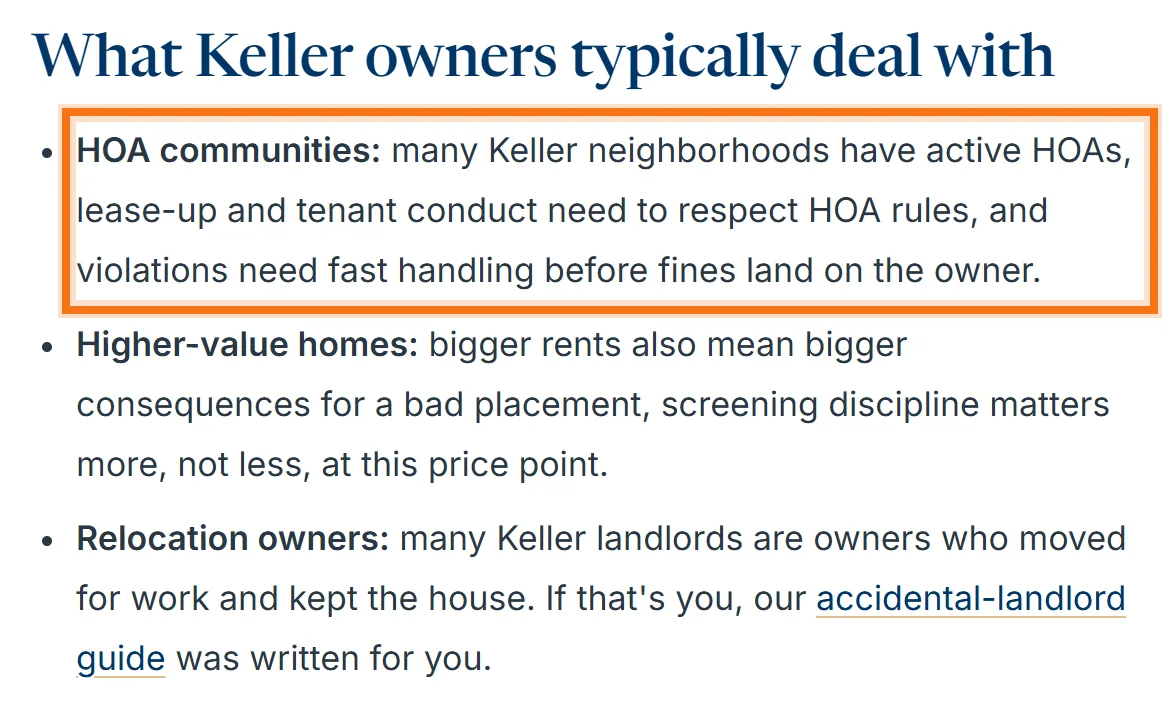
The HOA is where local knowledge saves or costs the most, because its rules sit in documents most owners have not read. Texas Property Code 209.016 limits what a property owners' association may require: under 209.016(b) it may not adopt or enforce a provision requiring a tenant or applicant "to be submitted to and approved for tenancy" by the association, or requiring a consumer or credit report or the lease application. Under 209.016(e) it may request contact information for each person who will live there and the lease's start date and term.
The same section, in 209.016(d), does not prohibit restrictions "relating to occupancy or leasing" in the dedicatory instruments, so what your HOA allows is in its own documents. A manager who knows your HOA can tell you which rule applies before the listing goes live. How to check yours is in how to check whether your HOA allows you to rent out your house and HOA rules and your rental property.
Testing it in an interview with your own address
Bring your own address and ask four things. "Which homes near mine have leased recently, and for how much?" A manager with local experience names streets and dates. "Which school district is my address in?" The answer should be checkable on the district's own site. "What does my HOA allow for a lease?" Listen for the actual rule or a promise to read the documents first. "Does my city have a rental registration or inspection program?" The answer should name the city's own page. For Fort Worth, see registering a rental in Fort Worth; for other cities, city rental registration in Tarrant County.
Then ask for the written rent estimate. Its comparables either come from your submarket or they do not, and that settles the question faster than any answer in a meeting. How to judge an estimate is in how to tell whether a rent estimate is realistic.
What matters more than neighborhood experience
Local knowledge without systems is a manager who knows your area and still sends a late statement. A licensed broker you can look up, every fee in writing, written screening criteria, a clear answer on where rent and deposits are held, and an inspection record you can read matter more than whether the company has leased on your street.
So rank it this way: systems and licensing first, submarket knowledge second, street-level familiarity a distant third. A manager with the first two learns your street from the first inspection and the first listing. A manager with only the third will cost you in ways that have nothing to do with the neighborhood. A one-owner decision scorecard is in is a local property manager better than a big national company.
Where Perpetual works, and how we show our local knowledge
Our areas page names Northeast Tarrant County as our home market, with Keller, North Richland Hills and Fort Worth as our main cities, and also serving Watauga, Hurst, Bedford, Euless, Haltom City, Southlake, Colleyville, Saginaw and the surrounding Tarrant County communities. For owners with several doors we manage portfolios across Tarrant, Dallas, Collin and Denton counties. In Fort Worth our page says we focus on northern Fort Worth and the areas adjoining our base, and that we will say honestly whether an address is inside the zone we can show, inspect and respond to quickly.
Our office is at 5755 Rufe Snow Dr in North Richland Hills, which our Keller page describes as about ten minutes from Keller. Rent recommendations come from leased comparables in your neighborhood, not city averages, through a free rental analysis with a written quote. Which HOAs and vendors we have worked with near your address is a question to ask us directly, and anything about your house that our site does not state is confirmed in writing before you sign. Call 682-593-7033.
The takeaway: A manager needs your submarket, not your street: recent leased comparables, the school district, the HOA's leasing rule, the city's rental rules and nearby vendors. Ask for each by name, and choose the company whose answers you can check.
Questions owners ask
Can a property manager in Fort Worth manage my house in Keller?
Yes, if the company actually works there: ask which homes near yours it has leased recently, how far its office is from your street, and who would show and inspect the house. Keller and the north side of Fort Worth are close to each other, so one office can serve both, but only if the company names real comparables and vendors in Keller rather than stretching to take your house.
Should I choose a property manager who lives in my neighborhood?
Living nearby is not the same as managing nearby. What you want is recent leased comparables, HOA and city knowledge for your area, and the systems that protect your money: a licensed broker, fees in writing and a clear answer on where rent and deposits are held. A neighbor who manages a few houses on the side may know the street and still lack those. Judge the operation, not the address.
How does neighborhood experience affect the rent estimate?
It decides which comparable leases the estimate is built from. An estimate from homes in your subdivision and school district, leased recently, will be close to what renters pay. One built from a citywide average or an automated tool can miss in either direction: too high and the house sits, too low and you lose rent every month of the lease. Ask to see the comparables behind any estimate.
Does a property manager need to know my HOA?
It needs to know how to work with it and to read its documents before the listing goes live. Texas Property Code 209.016 bars an HOA from requiring that your tenant be approved by the association or from requiring the tenant's credit report or application, but it may request residents' contact details and the lease dates, and it may have leasing restrictions in its dedicatory instruments. Attach the HOA rules to the lease so the tenant is bound by them.
Does Texas law require a property manager to know my local market?
Occupations Code 1101.652(a)(6) lets TREC discipline a license holder who fails to consider market conditions for the specific geographic area in which it provides a service, and TREC rule 22 TAC 535.2(i)(1) requires a sponsoring broker's policies to ensure agents are competent in the geographic market where they represent clients. Neither names a company for your street, so test it yourself. This is general information, not legal advice.
Should I rule out a manager that has never rented a house in my HOA?
Not on that alone. What matters is whether it reads your HOA's documents before the listing goes live, tells you the leasing rule in writing, and attaches the rules to the lease. A manager that has worked in the subdivision next door, with the same school district and similar homes, may know your submarket well. Ask how it would handle the first HOA notice, and judge the answer.
How do I check whether a property manager really works in my area?
Ask for the leased comparables behind its rent estimate for your house, the school district and HOA rule for your address, and your city's rental program. Then check the answers: the district on the district's own site, the HOA rule in your documents, the city program on the city's page. A company that works near you answers all four without guessing.
Property management in Keller, North Richland Hills and Fort Worth. How full-service management works in Tarrant County →