Key takeaways
- Ask "which inspections are included, which are billed, and at what price", not "are inspections included".
- On our price sheet the only inspection with its own price is the property enrollment inspection: $125, $49 or included, by plan.
- An annual property inspection is included on every plan; the move-in inspection is part of the tenant placement fee.
- Every move-in and move-out gets a 360-degree condition inspection under our written guarantees.
- In an illustrative two years on a $2,000 house, inspection line items come to $125, $49 or $0 by plan.
Are property inspections included in the monthly fee? Some are, some sit inside another fee, and some are billed per visit; the fee schedule tells you which. For a rental in Fort Worth, Keller or North Richland Hills on our price sheet, every plan includes an annual property inspection, the move-in inspection comes with tenant placement, and only the property enrollment inspection has its own price: $125, $49 or included, depending on the plan.
Below: what each inspection costs plan by plan, how to find the answer in any agreement, an illustrative two-year cost, and the questions to settle before you sign. How often and what gets checked are separate guides, linked below.
What each inspection costs under each plan
Here is where each inspection sits in our published fees, plan by plan, from our price sheet, our plan comparison table, our leasing page and our written guarantees:
| Inspection | Investor Special (5+ units) | Standard | Full Service |
|---|---|---|---|
| Property enrollment inspection, when management starts | $125 | $49 | Included (onboarding and enrollment inspection) |
| Annual property inspection | Included | Included | Included |
| Move-in condition inspection (360 degrees) | Part of tenant placement, 50% of one month's rent | Part of tenant placement, 75% of one month's rent | Part of tenant placement, 50% of one month's rent |
| Move-out condition inspection (360 degrees) | No separate fee on the price sheet | No separate fee on the price sheet | No separate fee on the price sheet |
| Extra inspection when something warrants a look | Can be arranged; not priced on the sheet | Can be arranged; not priced on the sheet | Can be arranged; not priced on the sheet |
How to read this table: only the first row is a separate dollar charge, and it happens once, when the house comes under management. The annual property inspection is included on every plan, and the move-in inspection is one of the things the placement fee covers, along with pricing, marketing, showings, screening and the lease. The last row is the one to ask about, because the sheet does not price it. Our price sheet also says that if a fee is not in the agreement, you do not pay it.
The five inspections and where each sits on a fee schedule
Over the life of a management agreement there are five kinds of inspection, and each can land on a different line of the fee schedule:
- Enrollment (or onboarding) inspection. Once, when the house comes under management. It records the condition before any tenant you place. It may be a separate fee or included. See the inspection before a manager takes on your house.
- Move-in inspection. The condition record the deposit will be measured against. It may be bundled into the leasing or placement fee.
- Periodic inspection during the lease. The one that varies most between agreements: included in the plan, billed per visit, or not offered.
- Move-out inspection. The comparison with the move-in record that supports any deposit deduction. Check whether it carries its own fee.
- Extra visits. A visit you ask for after a neighbor's complaint, a storm or a late payment. Priced per visit in some agreements, not offered in others.
Five lines, five places a charge can hide. The table above shows where each sits on our sheet.
Five ways an inspection can be billed
Each of those inspections can be billed in one of five ways, and a single agreement often mixes them. Here is how each model reads on paper and what you can check afterward:
| Fee model | How it reads on the fee schedule | What you can verify | What to watch |
|---|---|---|---|
| Stated count inside the monthly fee | "Includes one interior inspection per year" or a set schedule | The count, and a report for each one | The clearest model; check that each counted inspection produced a report |
| Charge per visit | A dollar amount per periodic inspection | A dated line on your statement for each visit | Ask what triggers a visit |
| "Included" with no count | "Inspections included" and nothing else | Very little | Nothing scheduled, nothing billed, nothing missed: zero inspections is possible |
| Folded into another fee | Move-in inspection inside the leasing or placement fee | The other fee's description | Ask for the report it produces |
| One-time enrollment fee | A fee when the house comes under management | A condition report before the first tenant you place | Charged once, at the start, not again later |
How to read this table: none of the five is wrong in itself. The first two make an inspection that did not happen something you can point to; the third makes a missed inspection invisible. Read each inspection separately: enrollment, move-in, during the tenancy, move-out and any extra visit. On our sheet the enrollment inspection is the fifth model, the move-in inspection the fourth, and the annual property inspection is included on every plan.
Find the answer in the fee schedule, not the sales conversation
Open the fee schedule and search for "inspection", "property visit", "condition report", "walk-through" and "trip". For each inspection, write down one of three answers: a dollar amount, "included", or "not mentioned". If a periodic inspection is included, the agreement should say how many per year or where the schedule is set. If it is billed, it should give the price per visit.
Then read the maintenance section for a trip or visit charge, because an inspection listed as included can come back as a trip fee. Finally, check two event fees that are easy to miss: whether the move-in inspection is inside the leasing or placement fee, and whether the move-out inspection has a price of its own. The move-out inspection guide explains why that one matters for the deposit.
The enrollment inspection when you switch managers or have a tenant in place
The enrollment inspection is the fee that surprises owners who are switching managers, because the house already has a tenant and a move-in report. On our page about switching to Perpetual, the enrollment inspection establishes a condition record as we begin management and helps connect the records we receive with the property we are taking over. Its charge depends on the plan ($125, $49 or included), and it is separate from the 360-degree condition inspection at every move-in and move-out.
So on an occupied takeover, sort the charges into two groups, as that page suggests: what applies at enrollment, and what belongs to later events such as a renewal or the next tenant placement. For a house rented at $2,000, illustrative only, the enrollment group is $125, $49 or $0 by plan; the next placement fee ($1,000 or $1,500) arrives only when a new tenant is placed. The written quote should show both groups. How a manager takes over mid-lease and the switching playbook cover the rest of the handover.
One more check when you switch: ask your current manager for the last inspection report and the move-in report. They give the new manager a baseline to compare against.
What "included" should buy you
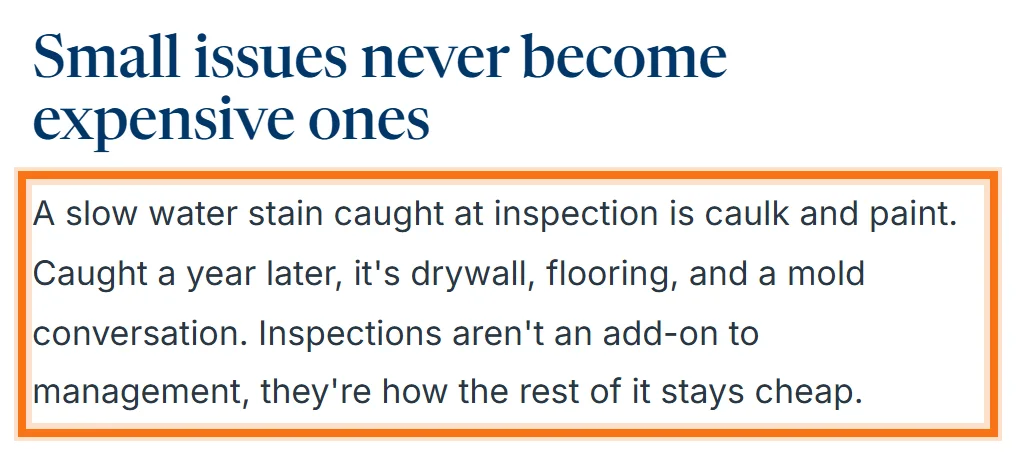
An included inspection that never happens costs more than a billed one that does. "Included" should buy a scheduled interior visit, notice to the tenant as the lease requires, and a dated photo report you can open later, with anything found turned into a recommendation. Ask for a sample report before you sign; if a company cannot produce one, the line on its fee schedule is only a line.
Look for one more line that is easy to miss: visits to the house while it is empty between tenants. An empty house can hide a slow leak or an open door for weeks, and agreements handle those visits in different ways, inside the plan, per visit, or not at all. If the schedule is silent, ask, and see managing a vacant house: checks and utilities for what those visits should cover.
How often a manager should inspect, and what each visit checks, are covered in rental property inspections: how often and what you receive and how often a property manager physically inspects a rental. What the report should contain is in inspection reports with photos. This guide stays on the cost.
Signs you are paying for inspections you did not get
The signs are the same across companies:
- An inspection line on the statement with no report in the portal.
- A report that is a paragraph of text with no photos.
- Photos that are undated or clearly from the listing.
- An inspection "completed" without the tenant ever being contacted for access.
If you see any of these, ask for the full report for the most recent billed inspection. A manager who has it can send it the same day. A tenant self-check, where the tenant uploads photos from a link, can be a useful low-cost check between visits, but it is not an inspection and should not be billed as one. More warning signs are in property management red flags.
An illustrative two-year inspection cost
Illustrative only, not a quote. Assume a house that rents for $2,000 a month, taken under management with a new tenant placed in year one and a renewal in year two. On our price sheet, the inspection line items alone come to:
| Plan | Year 1: start of management, new tenant | Year 2: tenant renews | Two-year inspection line items |
|---|---|---|---|
| Investor Special (5+ units) | $125 enrollment | $0 | $125 |
| Standard | $49 enrollment | $0 | $49 |
| Full Service | $0 (enrollment included) | $0 | $0 |
How to read this table: these are only the charges labeled as inspections. The annual property inspection is included on every plan with no separate price, and the move-in inspection is inside the placement fee: $1,000 at 50% of $2,000, or $1,500 at 75%. Renewal fees ($149, $200 or $150) are not inspection fees and are left out.
For comparison, picture an agreement that bills $75 per periodic visit, twice a year, plus $100 for a move-out inspection. Over two years with one turnover, that is $75 x 2 x 2 = $300 plus $100 = $400 in inspection charges. Neither number is good or bad on its own; what matters is that you can see it before you sign.
The number that matters: cost per report received
A fee only means something next to the reports it produces. Illustrative only, not a quote: three agreements on the same house for one year in which the tenant stays and nothing goes wrong except one hailstorm:
| Agreement | What it bills for inspections | Reports you receive | Cost per report |
|---|---|---|---|
| A: per visit, two a year | 2 x $80 = $160 | 2 | $160 / 2 = $80 |
| B: "included", no count | $0 | 0 | Nothing paid, nothing received |
| C: annual inspection included, extra visits billed | $0 + one extra visit after a storm at $80 = $80 | 2 | $80 / 2 = $40 |
How to read this table: agreement B looks cheapest and leaves you nothing to show at move-out or after the storm. A and C both produce two dated reports; C costs less because one of them is included. The $80 figure is a made-up per-visit charge, not a market price: put your own quote's numbers in the same columns.
Questions to settle before you sign
- "Which inspections are inside the monthly fee, and how many periodic inspections a year does that cover?"
- "Is the move-in inspection part of the leasing or placement fee? Does the move-out inspection have its own fee?"
- "What does an extra inspection cost if I ask for one after a complaint or a storm?"
- "Is there a trip or travel charge on top of any inspection?"
- "Who visits the house while it is empty between tenants, and is that billed?"
- "Where do I see the report, and is it kept so I can open it at move-out?"
Get every answer in the written quote, and compare it with the price sheet line by line. If the answers and the sheet disagree, the agreement decides.
How Perpetual handles this
Here is what our site states about inspections and what they cost:
- Enrollment: the property enrollment inspection is $125 on Investor Special, $49 on Standard and included with onboarding on Full Service (our price sheet).
- Annual: all plans include an annual property inspection.
- Move-in and move-out: every move-in and move-out gets a 360-degree condition inspection, one of the five written guarantees in the Perpetual Promise, subject to the Guarantee Addendum. The tenant placement fee covers the move-in inspection.
- During the tenancy: our inspections page describes scheduled interior inspections, with the in-tenancy schedule set in your management agreement, and extra inspections arranged when something warrants a look.
- What you get: a photo report in your Owner Portal with condition notes and any recommended actions. No Texas statute sets a notice period for a landlord's entry, so the lease sets the notice, and we follow the lease.
The price of an extra inspection, and the in-tenancy schedule for your house, are confirmed in writing before you sign. For the fee schedule on your house, request a free rental analysis or call 682-593-7033.
The takeaway: Read the fee schedule line by line for each inspection: enrollment, annual, move-in, move-out and extra. On our sheet only the enrollment inspection has its own price ($125, $49 or included); ask any manager to put the price of everything else, including extra visits, in writing.
Questions owners ask
How often should a property manager inspect a rental?
There is no Texas rule on frequency; the management agreement sets it. Ours covers move-in, scheduled inspections during the tenancy and move-out, with the in-tenancy schedule set in the agreement, and every plan on our price sheet includes an annual property inspection. Extra inspections can be arranged when something warrants a look. A drive-by view of the outside does not replace an interior visit.
Do I pay for the move-out inspection?
Check the fee schedule: some agreements bill a move-out fee, others include it. Under our written guarantees every move-out gets a 360-degree condition inspection, and our price sheet lists no separate move-out inspection fee. Our sheet also says that if a fee is not in the agreement, you do not pay it. A documented move-out with photos is what supports any deposit deduction.
Can the tenant refuse an inspection?
No Texas statute sets a notice period for a landlord's entry, so the lease decides how much notice the tenant gets and when entry is allowed. A manager gives the notice the lease requires. A tenant who keeps refusing access the lease allows is a lease matter for the manager to document and handle under the lease.
Will I get photos from inspections?
You should, and it is worth confirming before you sign. After each of our inspections you get a photo report in your Owner Portal with condition notes and any recommended actions: maintenance items, lease-violation follow-ups, or nothing at all, which is also good to know. Ask any manager for a sample report.
What is a property enrollment inspection and what does it cost?
It is the inspection when a house first comes under management: it establishes a condition record as management begins. On our price sheet it is $125 on Investor Special (portfolios of 5 or more units), $49 on Standard, and included with onboarding on Full Service. It belongs to the start of management, not to each month.
Do property managers charge extra for inspections?
Some do, per visit; some include a set number in the plan; some bundle the move-in inspection into the leasing fee. Read the fee schedule for each inspection and write down a price, "included" or "not mentioned". On our sheet the enrollment inspection is the only one with its own price; ask for the price of any extra visit in writing.
Is the enrollment inspection the same as the move-in inspection?
No. The enrollment inspection happens once, when the house comes under management, and records its condition as management begins, even with a tenant already living there. The move-in inspection happens each time a new tenant moves in and is the baseline for that tenant's deposit. On our plans the enrollment inspection is $125, $49 or included; the move-in inspection is part of the placement fee.
What should I do if I was billed for an inspection with no report?
Ask for the full report for that date, in writing, through the portal or by email. A manager who did the inspection can send it the same day. If there is no report, ask for the charge to be reversed, and check whether earlier inspection lines on your statements have reports behind them.
Related services
Property management in Keller, North Richland Hills and Fort Worth. How full-service management works in Tarrant County →