Key takeaways
- Weigh a review by whether you can check it, not by whether a landlord or a tenant wrote it.
- For each specific claim, ask the company for the document that would prove or disprove it.
- The TREC license record is the one check no review can replace.
- A reply that points to a document is evidence; a reply that argues is a warning.
- Date and pattern matter: three recent reviews about the same failure outweigh one old rant.
Should you pay more attention to landlord reviews or tenant reviews? Pay the most attention to whichever reviews you can verify. A landlord review describes results for owners, a tenant review describes day-to-day handling, and either one can be checked against a document, a license record or a pattern. When you compare managers in Fort Worth, Keller or North Richland Hills, a checked claim beats an unchecked one, whoever wrote it.
Why owners and tenants complain about different things is covered in our guide to reading property management reviews. This one is about testing what a review says before it decides anything for you.
Review says, what to ask, what proves it
Here are claims that show up again and again in property management reviews, the question that tests each one, and the document or record that settles it:
| The review says | What to ask the company | What proves it |
|---|---|---|
| "They kept my deposit for nothing" (tenant) | How deductions are listed and sent at move-out | A move-out inspection with photos, and a written itemized list of deductions, which Texas Property Code 92.104(c) requires when part of a deposit is kept |
| "Repairs took weeks" (tenant) | How a repair request is logged and how the owner sees it | A dated work-order record and the vendor's original invoice |
| "Surprise fees on my statement" (owner) | For the fee schedule and the management agreement before you sign | A written price sheet and an agreement that lists every fee |
| "They never answer" (owner or tenant) | What response time is promised, and what happens if it is missed | A written commitment with a stated remedy |
| "The house sat empty for months" (owner) | What you receive while a house is vacant, and how often | A sample vacancy update with inquiry and showing counts |
| "Great company, highly recommend" (anyone) | Which service the reviewer actually used | The detail in the review: management, leasing only, or a home sale |
| "Unlicensed" or "under investigation" (anyone) | For the license numbers of the company and its broker | The TREC License Holder Search record and its status |
How to read this table: a review is a lead, not a verdict. If the company can show you the document in the last column, the complaint tells you how it handles a hard case; if it cannot, the complaint is probably describing how it works. Either way, you learn more from the answer than from the star rating.
This works for landlord and tenant reviews alike. A tenant's deposit complaint is tested the same way as an owner's statement complaint: ask what the paper trail looks like and whether you can see an example before you sign.
Ask for the document behind the claim
Most review claims point at a document the company should already have. Four requests cover nearly all of them:
- A sample owner statement. It tests "my statements were confusing" and "surprise fees." How to evaluate a sample owner statement before you sign covers what to look for.
- A blank or sample move-out inspection and deduction list. It tests deposit complaints. Under Property Code 92.104(c), a landlord who keeps all or part of a deposit must give the tenant the balance with a written description and itemized list of all deductions, with a narrow exception when the tenant owes rent and the amount is not in dispute.
- The fee schedule and the management agreement. They test any review about money.
- Any written guarantees. They test reviews about response times, payouts and vacancy, because a promise with a stated remedy can be checked.
A company that hands these over without fuss is showing you how it will treat your questions later. Hesitation is information too.
Check the license record that reviews cannot give you
In Texas, a company that leases and collects rent for other owners works under a real estate license, and the Texas Real Estate Commission's License Holder Search is public. You can search by name or license number and filter by license status: Active, Inactive, Un-Sponsored, Expired, Suspended, Surrendered or Revoked.
Use it to test the most serious kind of review claim. A review that says "they lost their license" or "they are not licensed" is either confirmed or contradicted by the record in two minutes. Search the company name on the agreement and the broker's name. Step-by-step instructions, and what each status means, are in how to verify a property manager's Texas license.
A clean license record does not make bad reviews wrong. It tells you the company may legally do the work, which is the floor, not the bar.
What a formal complaint can and cannot show
A review is easy to write; a formal complaint is not. TREC's complaint page says anyone can file a complaint against a license holder, the complaint must be in writing and signed with a name and contact information, TREC cannot accept an anonymous complaint, and it cannot investigate an incident that occurred four or more years ago.
The same page sets limits worth knowing. Personal issues or contractual disputes with a license holder generally are not matters the Commission can address, and TREC has no authority to order a license holder to pay damages. A staff attorney can close a complaint, or issue an advisory letter that becomes part of the license holder's record.
So a reviewer who writes "I reported them to the state" is making a claim you cannot fully test from outside. Ask the company directly whether there has been a complaint and how it ended, and judge the answer by its specifics.
The reply, the date and the pattern
The reply. The best replies point to a fact: "the deduction list was mailed to the forwarding address on file," "the repair was completed and the invoice is on the owner's statement." That kind of reply gives you something to ask for. A reply that argues with the reviewer, or a page where no negative review is ever answered, tells you how disagreements go.
The date. A company can change owners, staff or systems. Weigh the last year or two more than the years before, and if the tone changes sharply at some point, ask what changed then.
The pattern. One angry review is a story. Several recent reviews, from different people, describing the same failure in specific terms, are evidence. Count the specific claims, not the stars. How owner and tenant complaints differ in what they reveal is covered in how to read property management reviews.
Check which service the review is about
Many real estate companies, ours included, both manage rentals and help people buy and sell. A five-star review of a home sale says the agent was responsive and skilled; it says nothing about statements, repairs or tenant screening. Read each review for the service it describes before you count it toward management.
The same goes for the company's own website. A reviews page should say where the reviews come from, so you can read the full versions, including the negative ones, on the original site. If a page shows only short quotes with no source, treat them as marketing.
Then put reviews in their place: one input among several. How to tell if a property management company is actually good gives an eight-point scorecard where reviews are a cross-check, not the main test.
A twenty-minute check before your first call
Put the steps above in order and the whole check fits in one evening:
- Five minutes: collect. Open the company's reviews on two independent sites. Copy every specific claim, landlord or tenant, into one list, with its date. Skip the ones that say only "great" or "terrible."
- Five minutes: sort. Group the claims by subject: money, repairs, deposits, communication, vacancy. Mark any subject that shows up three or more times in the last two years.
- Five minutes: the record. Search the company and its broker on the TREC License Holder Search and note the status of each.
- Five minutes: the questions. For each marked subject, write the question from the table above and the document you will ask to see.
Take that list to your first conversation. A manager who answers each question with a document has given you more than any review can. One who answers with reassurance alone has given you an answer too. The full first-meeting question set is in questions to ask a property manager before you sign.
How to run these checks on Perpetual
Perpetual Property Management is broker-owned, with our office in North Richland Hills, and we manage rentals in Keller, North Richland Hills, Fort Worth and nearby. Here is how to run the checks in this guide on us:
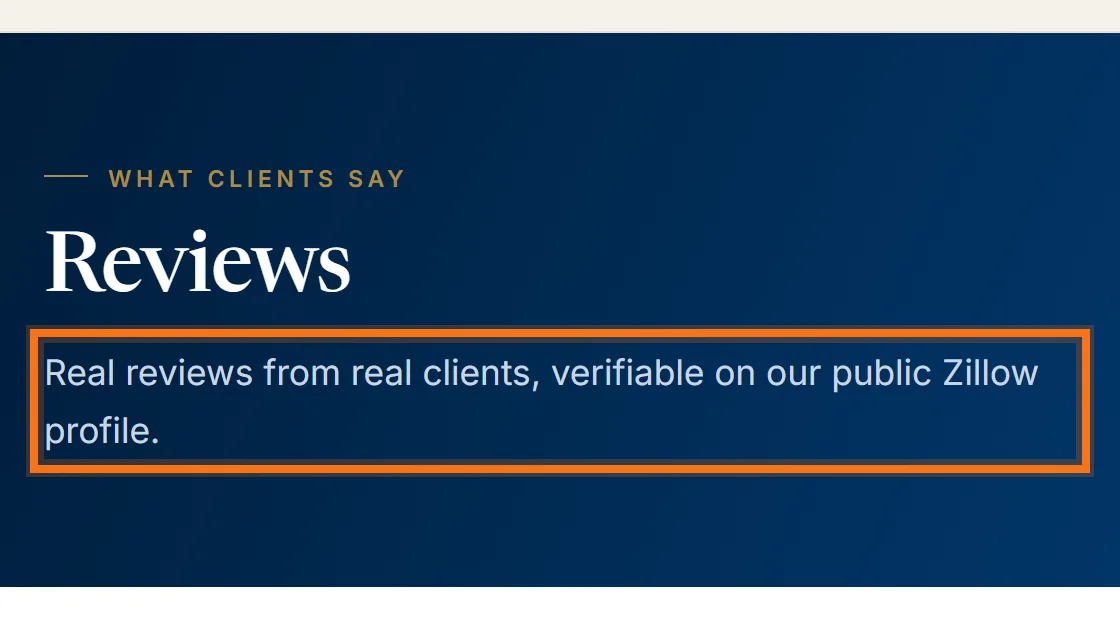
- Our reviews and their source. Our reviews page says the reviews are real reviews from real clients, verifiable on our public Zillow profile, and that the quotes are excerpts reproduced with the original reviewer usernames. Six of the eight excerpts there describe buying or selling real estate with Justin Brown, so read them as reviews of the brokerage side, and test the management side with the documents below.
- Our license numbers. Perpetual Property Management is a registered assumed name of Perpetual Realty Group, LLC, TREC Broker Company License 9008702-BB; Justin Brown, Broker/Owner, TREC Broker License 549418-B, licensed since 2006.
- Our fees. Every fee is on our price sheet and listed in your written agreement; if a fee is not in the agreement, you do not pay it.
- Our written promises. The five guarantees in the Perpetual Promise each come with a stated remedy, including calls and emails answered within one business day and photo or video proof of every completed repair over $500.
- Our criteria. The rental criteria are public, so a tenant's denial complaint can be read against them.
Ask us for any document in the table above and judge how we answer. To see our numbers for your house, request a free rental analysis or call 682-593-7033.
The takeaway: Read both kinds of review, then trust the ones you can check: the document behind the claim, the license record, the company's reply, and a pattern of recent reviews.
Questions owners ask
Are tenant reviews of property managers usually negative?
They tend to be written after a dispute more often than after a smooth year, so a share of negative tenant reviews is normal for any manager that enforces leases. What matters is whether the claims hold up: ask for the document behind a repeated complaint, such as an itemized deduction list or a work-order record, and look for several recent, specific reviews describing the same failure.
Can I trust owner reviews on a property manager's own website?
Treat them as a starting point. A company chooses what appears on its own site, so check that the page names where the reviews come from, then read the full reviews, including the negative ones, on that original site. Note which service each review describes; a review of a home sale says little about management.
What if a property manager has very few reviews?
Few reviews means you need other evidence, not that the company is bad. Check the license record on the TREC License Holder Search, ask for a sample owner statement, the fee schedule, the management agreement and any written guarantees, and look at the company's live listings. Documents you can read tonight tell you more than a dozen star ratings.
How can I tell if a property management review is true?
Turn the review into a question and ask the company for the document that would answer it: a deduction list for a deposit complaint, a work-order record for a repair complaint, the fee schedule for a fee complaint. Then check the date, whether others describe the same thing, and how the company replied.
Can I look up complaints against a Texas property manager?
You can look up the license record on the Texas Real Estate Commission's License Holder Search and filter by status, such as Active, Suspended or Revoked. TREC's complaint page explains how a written, signed complaint is filed and what TREC can and cannot do; it cannot order a license holder to pay damages. Ask the company directly about any complaint and how it ended.
Do tenant reviews matter if I am the owner?
Yes, for anything the tenant can see better than you: how repair requests are handled and whether anyone answers. A verified pattern there reaches you later as a turnover. Complaints about rules the lease allows, such as a late fee, matter less. Weigh each claim by whether you can check it.
Related services
Property management in Keller, North Richland Hills and Fort Worth. How full-service management works in Tarrant County →