Key takeaways
- No Texas statute assigns ants, roaches, rodents or termites to the owner or the tenant. The lease does.
- Property Code 92.052 requires the landlord to make a diligent effort to remedy a condition that materially affects health or safety, after proper notice, unless the tenant or their household caused it.
- A live report is settled by three questions: when it started, what the pest is and what the vendor says caused it.
- A company treating your rental for pay must hold a Texas Department of Agriculture structural pest control business license (Occupations Code 1951.301).
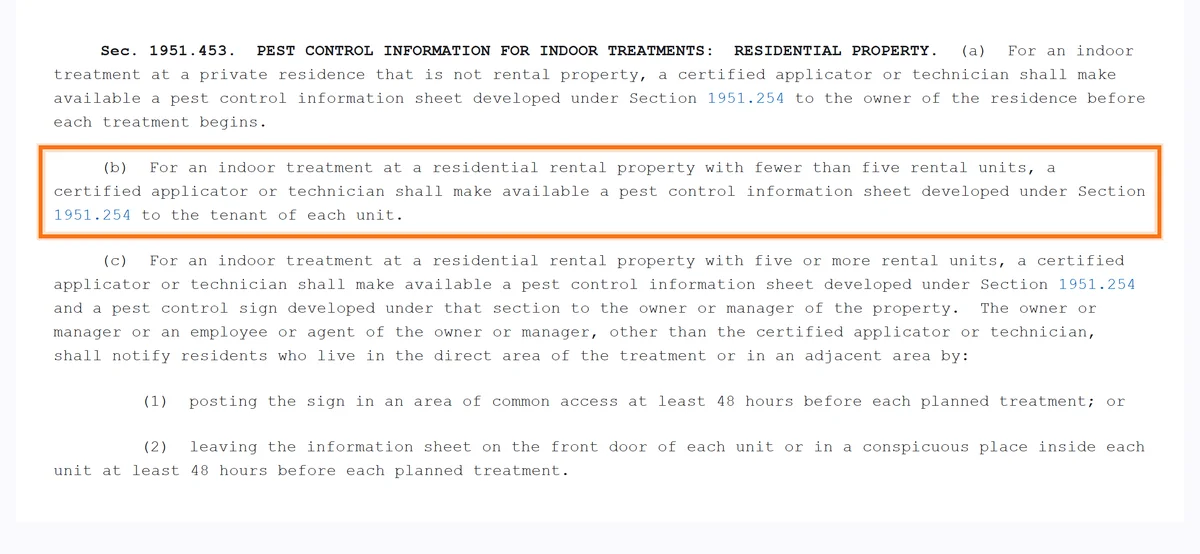
- For indoor treatment of a rental with fewer than five units, the applicator must make a pest control information sheet available to the tenant (Occupations Code 1951.453).
Who handles pest control, the tenant or the landlord? The lease decides, within a floor Texas law sets. On a rental in Fort Worth, Keller or North Richland Hills, the landlord delivers the home free of pests and handles problems tied to the building, and the tenant usually handles routine control after move-in and anything their household caused. That sounds clear until a tenant texts a photo of roaches in month four and both sides are sure it is the other's problem.
This guide is the decision process a property manager applies to a live report, the Texas rules behind it and who may legally treat the home. The pest-by-pest baseline is in pest control in Texas rentals: owner or tenant responsibility.
Pest control, tenant or landlord: how a report is usually decided
Here is how common pest reports are usually assigned under a lease that gives routine pest control to the tenant, and the evidence that settles each one:
| Situation | Who usually pays | Why | The evidence |
|---|---|---|---|
| Activity reported in the first weeks after move-in | Owner | The home was supposed to be delivered free of pests | The move-in condition report and photos |
| Termites or other wood-destroying insects | Owner | It is damage to the structure, not a housekeeping issue | The vendor's inspection findings |
| Rodents entering through a gap, vent or soffit | Owner, for sealing the entry and the initial trapping | The entry point is a building defect | The vendor's note of the entry point |
| Ants or roaches drawn to food or trash months into the lease | Tenant, if the lease assigns routine control | The landlord has no repair duty for a condition the tenant caused (Property Code 92.052(b)) | The vendor's cause note on the invoice |
| Fleas brought in by the tenant's pet | Tenant | Caused by the household | The vendor's findings and the pet agreement |
| An infestation serious enough to affect health or safety | Owner acts first; the cost is assigned afterward | Property Code 92.052(a) requires a diligent effort to remedy after notice | The tenant's notice, the vendor's report and the timeline |
How to read this table: the middle column is a default, not a rule of law. The lease sets it, the move-in report and the vendor's note prove which row a report belongs in, and the last row overrides the others on timing: fix first, assign the cost second.
Question one: when did it start?
Timing does most of the work. A pest problem reported in the first weeks after move-in is treated as an owner problem in almost every case, because it is far more likely to have been there at make-ready than to have been created by a tenant who just unpacked. That is why the owner's side is usually described as delivering the home pest-free, and why treating and sealing belong on the turnover list.
After that early window, the default flips. A fresh ant trail in the kitchen in month eight is, by default, routine control the tenant handles, unless questions two and three point back at the structure. The move-in condition report is the evidence for question one: if it recorded a clean home with no activity, with dated photos, the early window has a start date that both sides can see.
Question two: what is the pest?
Some pests point to the owner whatever the timing, because they are about the building rather than about housekeeping:
- Termites and wood-destroying insects. They attack the structure and are rarely tied to how a tenant lives.
- Rodents entering through gaps, vents, soffits or the garage. The entry point is a building defect, so sealing it and the initial trapping fall to the owner.
- Wasps, bees or hornets in eaves, attics or wall voids. Structural, and sometimes a safety issue, so they are handled quickly.
- Pests tied to a leak, such as drain flies from a slow leak under a sink. They follow the leak, which is a repair.
Other pests are about conditions inside the home: ants and roaches drawn to food and moisture, fleas brought in by a pet, pantry moths in open flour, flies from trash. These default to the tenant after the early window. Pests in the yard, such as fire ants or ticks, follow whatever the lease says about yard care and routine pest control.
Question three: what caused it?
When the first two questions do not settle it, cause does, and the vendor's report is the evidence. A technician notes what they found: a gap under the garage door, a branch touching the roof, a pet door left open, food left out, a pet with fleas. That note on the invoice is what a manager uses to assign the charge, and it carries more weight than either side's account.
The practical rule: if the fix is to the building, the owner pays for the fix; if the fix is a change in how the home is kept, the tenant pays for the treatment, as the lease allows. Ask your manager to require a cause note on every pest invoice. It costs nothing and ends most arguments before they start. How the same test works for other repairs is in how a manager decides whether a repair is the tenant's responsibility.
Two examples from the same week
Illustrative only, not real cases. In a Keller kitchen in August, a tenant in month nine reports ants along the counter. The vendor finds no entry point beyond ordinary gaps, treats the perimeter and notes sugar residue and open cereal boxes. Timing says tenant, the pest says routine, the cause says housekeeping. Under a lease that assigns routine control to the tenant, the tenant pays for the treatment.
In an older Fort Worth home the same week, a tenant in month three hears scratching in the attic. The vendor finds a gnawed soffit vent and droppings suggesting weeks of activity. Timing is borderline, but the pest and the cause both point to the building: the owner pays for exclusion work, trapping and the vent repair, and the tenant is asked to keep the garage door closed from here on. Same kind of lease, opposite answers, each documented.
What Texas law says: the repair duty and the lease
Texas has no statute that assigns pests by name. Two parts of Property Code chapter 92 frame every pest decision:
- The repair duty. Section 92.052(a) requires a landlord to make a diligent effort to repair or remedy a condition that materially affects the physical health or safety of an ordinary tenant, if the tenant gives notice to the person or place where rent is normally paid and is not delinquent in rent when the notice is given. A serious infestation can be that kind of condition.
- Tenant-caused conditions. Section 92.052(b) says that, unless the condition was caused by normal wear and tear, the landlord has no duty during the lease to repair a condition caused by the tenant, a lawful occupant, a family member or a guest.
The lease cannot simply hand the health-and-safety duty to the tenant. Section 92.006 allows that only in narrow cases, including an owner who owns only one rental dwelling at the start of the lease, and only with an underlined or bold agreement that meets the section's conditions. The safe order for an owner is fix first, assign the cost second. How notice and tenant remedies work is in Texas landlord repair obligations. This is general information, not legal advice.
Who may treat a rental in Texas, and what the tenant receives
Pest control done for pay is a licensed trade in Texas. The Texas Department of Agriculture's Structural Pest Control Service licenses and regulates the professionals who apply pesticides in and around structures, under the Structural Pest Control Act, Occupations Code chapter 1951. The parts that matter to an owner:
- A business license. Under section 1951.301, a person may not engage in the business of structural pest control without a structural pest control business license. Section 1951.003 defines that business to include identifying and treating infestations of insects, spiders, mites, ticks, rodents and other pests in or around structures, for compensation.
- Liability insurance. Section 1951.312 bars the department from issuing or renewing a business license until the applicant files insurance of at least $200,000 for bodily injury and property damage, with a $300,000 aggregate, or other security the section allows.
- Information for the tenant. For an indoor treatment at a rental with fewer than five units, the applicator must make a pest control information sheet available to the tenant of each unit (section 1951.453). For an outdoor treatment at such a rental, the sheet is made available at each unit at the time of treatment (section 1951.457).
- The tenant's own treatment. Section 1951.052 says the chapter does not apply to a person treating the property they own or lease as their dwelling, so a tenant treating the home they lease does not need a license.
Ask any vendor for its business license number before the first visit. How a manager checks licenses and insurance across trades is covered in how a property manager checks that contractors are licensed and insured.
Preventing the report in the first place
Most pest charges are avoidable at make-ready. A perimeter treatment, sealed gaps around pipes and vents, door sweeps on the garage and exterior doors, branches trimmed off the roof and a look in the attic remove most of the owner's exposure for the early window. The make-ready guide has the full turnover list these items belong on.
Some homes call for more than that: heavily wooded lots, older homes with crawl spaces and houses near a creek see more activity. For those, an owner-paid recurring service can be simpler than arguing over each report. Whether it pays for itself depends on the house and the vendor's quote, so decide it with real numbers rather than a rule of thumb.
How Perpetual handles this
Perpetual Property Management is broker-owned, with our office at 5755 Rufe Snow Dr in North Richland Hills, and we manage homes in Keller, North Richland Hills, Fort Worth and nearby. What our site states that applies to pest reports:
- Requests come through the tenant portal, with photos, which creates a documented record and lets us triage before dispatching anyone (maintenance coordination).
- A 360-degree condition inspection at every move-in and move-out, the baseline for question one.
- Texas-compliant leases with property-specific addenda, prepared at placement (leasing and move-in).
- Spending limits you set. Work under your pre-approved limit goes ahead; anything larger comes to you with a description, photos and a recommendation.
- Invoices you can see. The original vendor invoice is in your owner portal, and every completed repair over $500 gets photo or video proof.
- Emergencies, meaning anything threatening the property or habitability, follow a 24/7 process.
The pest-control clause in our lease, which vendors we use for pest work and whether a recurring service suits your house are confirmed in writing before you sign. If a pest report is already on your desk, send it to us or call 682-593-7033.
The takeaway: The lease sets the default, Property Code 92.052 sets the floor, and a live pest report is settled by when it started, what the pest is and what a licensed vendor says caused it, all in writing.
Questions owners ask
Can a landlord charge a tenant for pest control in Texas?
Yes, when the lease assigns routine pest control to the tenant or allows charging for an infestation the tenant caused. Property Code 92.052(b) says a landlord has no duty to repair a condition caused by the tenant, their household or guests, unless it is normal wear and tear. The charge should rest on the vendor's findings and be explained in writing. Problems tied to the structure, such as termites or rodents entering through a gap, stay with the owner.
Is a landlord responsible for bed bugs in a single-family rental?
It depends on timing and cause. Bed bugs found at move-in point to the owner; bed bugs that appear months later after travel or used furniture usually point to the tenant under the lease. Because treatment is disruptive and timing is often disputed, document the move-in condition and ask the licensed vendor to assess how established the infestation is. If it affects health or safety, treat first and assign the cost afterward.
Who pays for termite treatment at a rental property?
Under a lease that splits pest control between owner and tenant, the owner, in almost every case. Termites damage the structure and are rarely tied to how a tenant lives, so they are treated as a building repair. Have a licensed vendor inspect an older home before the lease starts, because wood damage found late is the expensive version.
Should pest control be included in the rent?
For many single-family rentals, no: the tenant handles routine control and the owner handles structural pests. For heavily wooded lots, older homes with crawl spaces or houses with a history of problems, an owner-paid recurring service can be simpler than disputing each report. Get a vendor's quote and decide with real numbers.
Do property managers need a different pest control contract than a single homeowner?
The treatment can be the same, but Texas rules differ for rentals. For indoor treatment of a rental with fewer than five units, the applicator must make a pest control information sheet available to each tenant (Occupations Code 1951.453), and for five or more units the owner or manager must notify residents in and next to the treated area at least 48 hours before a planned treatment. A written contract with a licensed company must include the Department of Agriculture's address and phone number (section 1951.451).
Who handles ticks or fire ants in the yard of a rental?
The lease decides. Yard pests usually follow the lease's yard-care and routine pest-control clauses, so on many single-family leases the tenant handles them. If the problem is serious enough to affect health or safety, the landlord's repair duty under Property Code 92.052 can apply once the tenant gives proper notice. Ticks are among the pests a licensed structural pest control business treats under Occupations Code 1951.003.
Property management in Keller, North Richland Hills and Fort Worth. How full-service management works in Tarrant County →