Key takeaways
- Monthly statements, portal access, invoices and the year-end form are the basic record of your money, not an add-on.
- A Texas broker holding your rent must give you an accounting at least monthly when the trust account has activity (TREC rule 535.146).
- The IRS instructions say a property manager must report the rent paid over to the owner on Form 1099-MISC.
- Some charges can be fair: paper statements by mail, custom reports, extra ownership entities, wires you request.
- Our price sheet lists an online owner portal on every plan and no technology, statement or portal fee.
With most well-run property managers, there are no extra fees for accounting or for access to the owner portal. The monthly statement, the portal where you read it, the vendor invoices and the year-end tax form are the record of what happened to your money. For a rental in Fort Worth, Keller or North Richland Hills, the job is to find any such fee in a quote before you sign and ask what it buys.
This guide gives you a question table to use with any manager, what the TREC and IRS rules say about statements and 1099 forms, which accounting charges can be fair, and what we charge.
Accounting and portal charges: what to ask any manager
Here are the accounting items owners ask about, the question to put to each manager, and what a good written answer looks like:
| Item | Question to ask | A good written answer |
|---|---|---|
| Monthly owner statement | Is there any charge for the statement, paper or electronic? | Included; paper by mail, if offered, priced separately |
| Owner portal access | Is there a portal, technology or software fee? | No separate fee; the portal is part of the service |
| Vendor invoices | Will I see the original invoice behind every repair charge? | Yes, in the portal, next to the statement |
| Year-end statement and Form 1099-MISC | Is there a year-end, 1099 or tax-package fee? | No; the form is a filing duty, not an extra |
| Access for your CPA | Can my accountant get the statements and year-end reports, and at what cost? | Yes, by export or shared access, at no charge |
| Several houses | Do I get reporting for each property, and does it cost more? | Per-property figures included in the fee |
| Several owners or LLCs | Is there a charge per ownership entity? | Stated up front, if any, with what it covers |
| Bank charges | Who pays for a wire or a returned payment? | Passed through at the bank's cost, only when you cause it |
How to read this table: the first five rows are the core accounting of your money, and a fee on any of them deserves a direct question. The last three can carry a real cost, but each should be named in the fee schedule and triggered by something you chose. Ask all eight in one email so the answers arrive together.
What the management fee should already pay for
The management fee pays for the people and systems that collect rent, pay bills and account for both. The output of that work is accounting, so these should come with it:
- A monthly statement showing rent received, each charge with a description, the fees, and the amount paid to you.
- Portal access to current and past statements, documents and your payout history.
- The vendor's invoice behind each repair charge.
- Payouts to your bank on the schedule in the agreement.
There is also a rule behind the statement. TREC rule 535.146, which governs trust money held by a Texas real estate broker, defines trust money to include rent and security deposits. It says the broker must "provide an accounting to each beneficiary of trust money at least monthly if there has been any activity in the account," and must not commingle trust money with the broker's own money.
A statement fee therefore charges you for an accounting the broker must give anyway. That is not proof of wrongdoing, but it is worth a question. What each statement line means is in how to read your monthly owner statement.
Year-end forms: what the IRS instructions say
The year-end form is not a favor. The IRS Instructions for Forms 1099-MISC and 1099-NEC (revised December 2026) say that "the real estate agent or property manager must use Form 1099-MISC to report the rent paid over to the property owner." For tax years beginning after 2025, the same instructions set the reporting threshold for rents at $2,000.
They also say the payer must "furnish the payee statements by January 31." So the form reaches you because the manager has a filing duty, which is why a separate "1099 fee" deserves a question.
Which figure the form reports, how it lines up with your statements and what your CPA does with it are covered in year-end reporting for rental owners. This is general information, not tax advice; ask your CPA how it applies to you.
Accounting charges that can be fair
A few accounting charges have a real cost behind them and can be fair, as long as they are optional, named in the fee schedule and priced before you need them:
- Paper statements by mail. Printing and postage are a cost the portal avoids. A small charge for owners who want paper is reasonable.
- Custom or reissued reports. A special report for a lender, or a year-end form reissued because you changed the ownership entity, takes staff time.
- Several ownership entities. Three houses in three LLCs can mean three ledgers and three sets of year-end forms. Some managers charge per entity.
- Bank charges you cause. A wire you asked for instead of the standard transfer, or a returned owner contribution.
Each of these is triggered by something you chose. None should recur every month for the basic service.
Charges to question, and what they cost you
The charges to question appear every month, apply to every owner and buy nothing the management fee did not already cover. Their usual names are technology fee, software fee, portal fee, administrative fee, statement fee and year-end or 1099 processing fee.
Small numbers add up. Take an illustrative house renting for $2,100 at a 9% management fee, which is $189 a month or $2,268 a year. A $12 monthly technology fee adds $144 a year, so the year costs $2,412 instead of $2,268. That is $12 / $189 = about 6.3% more than the quoted fee, and the effective rate becomes $201 / $2,100 = about 9.6%, not the 9% on the quote. Illustrative only, not a quote.
Put any such fee on the "other monthly charges" line of a fee comparison worksheet so it is counted with everything else. The full list of small lines that add up this way is in hidden property management fees.
Where these fees hide in a quote and an agreement
Accounting charges rarely appear next to the management percentage. Look in three places:
- The fee schedule or price sheet. Read every line that recurs monthly, not only the management fee.
- The management agreement. Search for "administrative," "technology," "statement," "reporting" and "1099." A clause that lets the manager add new charges with notice deserves a question too.
- The portal's terms. If the portal is a separate product, ask whether its cost is passed to you.
Then ask to see a sample owner statement with another owner's details removed. Every recurring charge has to appear on a statement, so the sample shows the real fee structure. What you should be able to open once you have access is in what you can see in the owner portal.
Get the answers in writing. A fee that was waived on a phone call has a way of reappearing in the agreement.
When an accounting charge appears after you signed
Sometimes the first sign of a technology or statement fee is a new line on a monthly statement. Handle it in this order:
- Find the line and the amount. Note the name it carries and the first month it appeared.
- Find the clause. Search your signed management agreement and fee schedule for that name. If the charge is there, it is part of what you agreed to, and the question becomes whether it is worth renegotiating at renewal.
- Ask in writing if it is not there. Email the manager: which clause allows this charge, and when was I told about it? Ask for a credit if no clause covers it.
- Check the next statements. A charge that was reversed once should not come back.
Keep the emails with your statements. A clear written record makes the conversation short, whether the charge was an error or a term you missed. A monthly reconciliation routine that catches lines like this early is in how to spot mistakes on your owner statement.
What Perpetual charges for accounting and the owner portal
Here is what our site states, and nothing beyond it:
- The portal is on every plan. Our price sheet lists an online owner portal on the Investor Special, Standard and Full Service plans, and it lists no technology, statement, portal or 1099 fee.
- What the portal holds. Our owner portal page says it holds your statements, documents and disbursement history on our secure AppFolio system.
- Statements and payouts. Our FAQ says owners receive disbursements and monthly statements through the online Owner Portal, with income, expenses and documents in one place.
- Invoices. Maintenance coordination is a percentage of the vendor's invoice, and the original invoice is always in your portal.
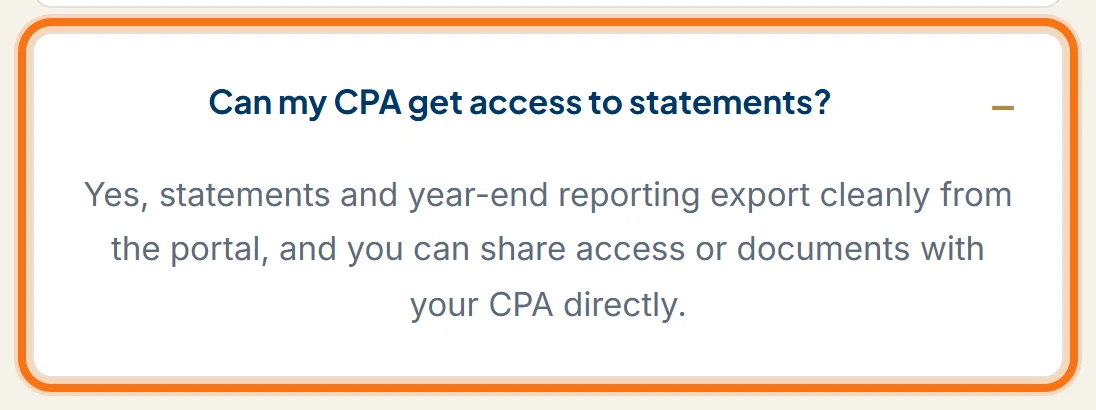
- Your CPA. Our rent collection page answers the question directly, as the screenshot shows.
Every fee is confirmed in writing before you sign, and if a fee is not in the agreement, you do not pay it. Charges for optional extras, such as paper statements by mail, are not on our price sheet, so whether any applies is confirmed in writing in your agreement. Perpetual is broker-owned, with our office in North Richland Hills, managing rentals in Keller, North Richland Hills, Fort Worth and nearby. For a written quote on your house, request a free rental analysis or call 682-593-7033.
The takeaway: Statements, the owner portal, invoices and the year-end form belong inside the management fee; ask about any technology, statement, portal or 1099 charge in writing before you sign.
Questions owners ask
What should a monthly owner statement include?
Rent received, each charge with a description, each management, leasing or renewal fee as its own line, and the amount paid to you with the date. The vendor's invoice should be available behind each repair. If a line has no description or no invoice, ask for the document; a statement you cannot check is only a notice.
Does the property manager send me a 1099?
If the manager collects rent for you, the IRS instructions for Form 1099-MISC say the property manager must use that form to report the rent paid over to the property owner, and payee statements are due by January 31. For tax years beginning after 2025, the reporting threshold for rents is $2,000. This is general information, not tax advice; ask your CPA.
Can I give my accountant access to the owner portal?
Ask before you sign, because portals differ. Some let you download statements and year-end reports, some allow a second login. With us, our rent collection page says statements and year-end reporting export from the portal, and you can share access or documents with your CPA directly. Our price sheet lists no fee for it.
Is a technology fee normal in property management?
It appears on some fee schedules, but it charges you for the manager's own software. Ask what it buys beyond the service the management fee already covers, and ask for it to be removed or folded into the stated fee. In the illustrative example on this page, a $12 monthly technology fee turns a 9% fee into about 9.6%.
Is it fair to pay extra for paper statements?
It can be. Printing and mailing a statement every month is a real cost that the portal avoids, so a small, stated charge for owners who choose paper is reasonable. It should be optional, named in the fee schedule and priced before you sign, and the electronic statement should stay included for everyone.
Do property managers charge for year-end 1099 forms?
Some fee schedules carry a "year-end" or "1099 processing" fee. Because the IRS instructions say the property manager must use Form 1099-MISC to report the rent paid over to the owner, that fee charges you for a filing duty. Ask what it covers beyond the form, and compare it on the same line for every quote.
Does Perpetual charge for the owner portal or statements?
Our price sheet lists an online owner portal on every plan and no technology, statement, portal or 1099 fee. Every fee is confirmed in writing before you sign, and if a fee is not in the management agreement, you do not pay it. The portal holds your statements, documents and disbursement history.
Related services
Property management in Keller, North Richland Hills and Fort Worth. How full-service management works in Tarrant County →