Key takeaways
- Every Texas residential lease of 30 days or more needs a written floodplain notice, signed by landlord and tenant at or before signing.
- It answers two separate questions: is the home in a 100-year floodplain, and has it flooded in the last five years.
- FEMA's free flood map tells you the zone; your records tell you the flood history. A Zone X house can still have one.
- If the notice is missing and a flood ruins the tenant's belongings, the tenant can end the lease within 30 days.
- We put the signed notice in every lease packet we prepare in Fort Worth, Keller and North Richland Hills.
Renting out a house in Tarrant County? Yes, you have to tell the tenant about flooding, in writing. Texas Property Code 92.0135 requires a notice with every residential lease of 30 days or more, signed by you and the tenant at or before signing. It states whether you are aware the home is in a 100-year floodplain, whether you know it flooded in the last five years, and that most renters policies do not cover flood.
This guide covers exactly what the notice says, which leases are exempt, how to answer it for your house, how to check a Fort Worth, Keller or North Richland Hills address on FEMA's map, and what a missing notice can cost after a storm.
What the Texas floodplain notice has to say
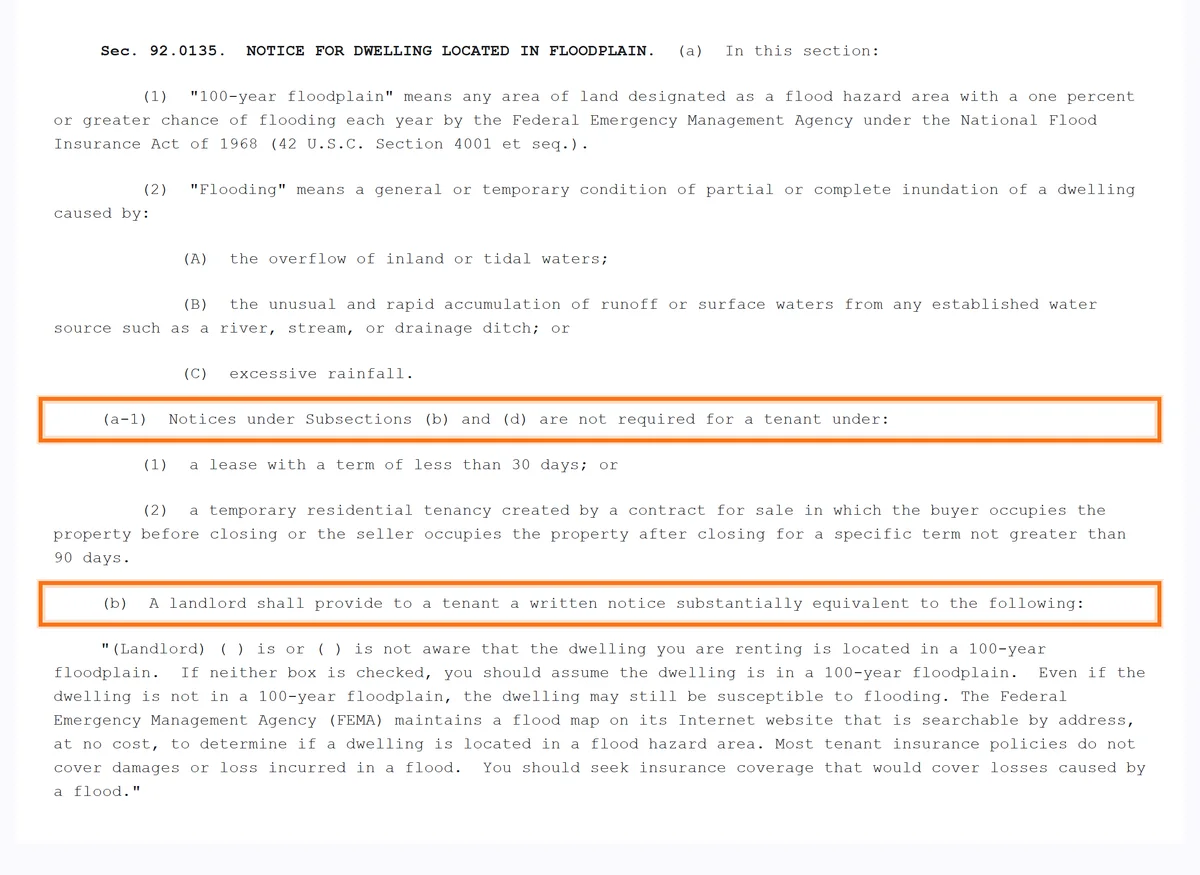
Texas Property Code Section 92.0135 has applied to residential leases since January 1, 2022. It asks you two separate questions and adds an insurance warning. You can use your own wording as long as it is "substantially equivalent" to the statute, but most owners and managers simply use the statutory text or the Texas Real Estate Commission's Landlord's Floodplain and Flood Notice, which follows it.
1. The floodplain statement
You check one box: you are or are not aware that the dwelling is located in a 100-year floodplain. The statute defines that as land FEMA designates as a flood hazard area with a 1% or greater chance of flooding each year. The notice also tells the tenant that if neither box is checked, they should assume the home is in the floodplain, that a home outside the floodplain can still flood, and that FEMA's flood map can be searched by address for free.
One exception: you do not have to say you are aware the home is in the floodplain if the dwelling has been elevated above the 100-year flood level in line with federal regulations.
2. The flood history statement
If you know that flooding damaged any part of the dwelling at least once during the five years before the lease's effective date, you must also give a written notice that you are or are not aware the home has flooded at least once in the last five years.
"Flooding" has a specific meaning here: water partly or fully covering the dwelling because of overflowing inland or tidal waters, a sudden buildup of runoff or surface water from a river, stream or drainage ditch, or excessive rainfall. A burst supply line under the kitchen sink is water damage, but it is not flooding under this definition.
3. The insurance warning
The statutory wording ends by telling the tenant that most tenant insurance policies do not cover flood damage and that they should look for coverage that does. This sentence is part of the notice on every home, including homes far from any creek.
Which leases need it, and which do not
The notice applies to a standard residential lease, which covers nearly every single-family rental we lease in Fort Worth, Keller and North Richland Hills. The statute lists two exceptions:
- A lease with a term of less than 30 days.
- A short occupancy tied to a home sale: the buyer moving in before closing, or the seller staying after closing, for a set term of no more than 90 days.
A 12-month lease, a 6-month lease and a month-to-month lease that runs past 30 days all need the notice. A renewal is a good moment to give a fresh one: if the house flooded during the last lease, the five-year history question now has a different answer.
How to answer the notice for your house
The two questions are independent. A house can sit outside the mapped floodplain and still have a flood history, and a house can sit inside the floodplain and never have taken water. Work through each one from records, not memory: seller disclosures, insurance claims, repair invoices, dated photos.
Situation, what to check, how to answer
| Your situation | What to check | How the notice reads |
|---|---|---|
| No known flood risk | Look the address up on FEMA's map and review any repair or insurance records for water that came in from outside | "Is not aware" on the floodplain line, if the map and records support it; insurance warning stays |
| Part of the lot is in a mapped floodplain | Where the floodplain boundary runs relative to the house itself, not only the yard | If you know the mapped floodplain reaches the dwelling, "is aware"; if the line is too close to call, get help reading it before you sign |
| The house flooded in the last 5 years | The date, the cause (rain, creek, drainage) and which part of the house was damaged | The flood history notice is required: "is aware" that it has flooded at least once in the last five years, whatever the map zone |
| The house was raised above the flood level | Records showing the dwelling was elevated above the 100-year flood level under federal rules (an elevation certificate) | You may leave out the "is aware" floodplain disclosure; the flood history question is still answered on its own |
| You do not know | Map, records and the previous owner's disclosures; ask the city that serves the address if the map is hard to read | Answer from what you know; remember the notice tells the tenant to assume floodplain if neither box is checked |
How to read this table: the left column is where you start, the middle column is the evidence to pull before the lease is signed, and the right column is how that evidence turns into the notice. Keep whatever you looked at, the map image and the records, in the lease file, so the answer on the notice can be traced back later.
How to check a Fort Worth, Keller or North Richland Hills address on FEMA's map
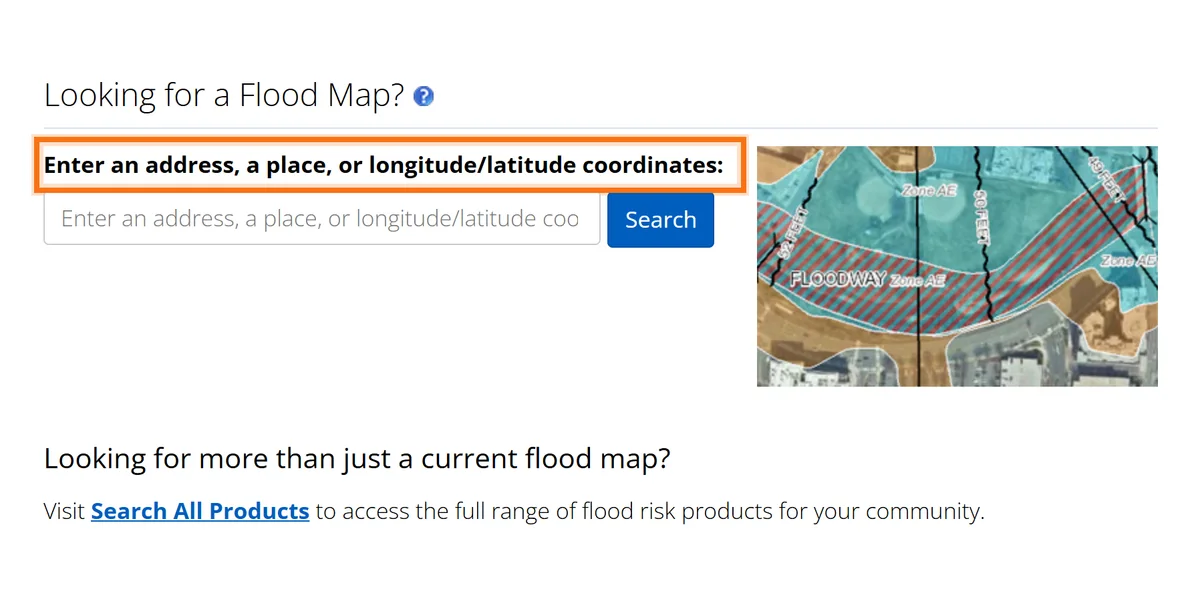
- Open the FEMA Flood Map Service Center at msc.fema.gov and type the full street address with the city and "TX".
- Find the house, not the pin. The address marker can land on the driveway or the middle of the lot. Zoom in until you can see where the building sits.
- Read the zone. Zones A and AE are the 100-year floodplain, which FEMA calls the Special Flood Hazard Area. Zone X is moderate or minimal risk, depending on the shading. The map legend explains each label.
- Save what you saw. Download or print the map panel showing the house and the zone label, write the date on it, and put it with the lease.
Tarrant County has plenty of homes near creeks and drainage channels, and spring thunderstorms can push a lot of water through a low street quickly. The map is the start, not the end: a house in Zone X that took water in a storm three years ago still has a flood history you know about. For the insurance side of the same lookup, see landlord insurance vs. homeowners insurance.
When to give the notice, and what proof to keep
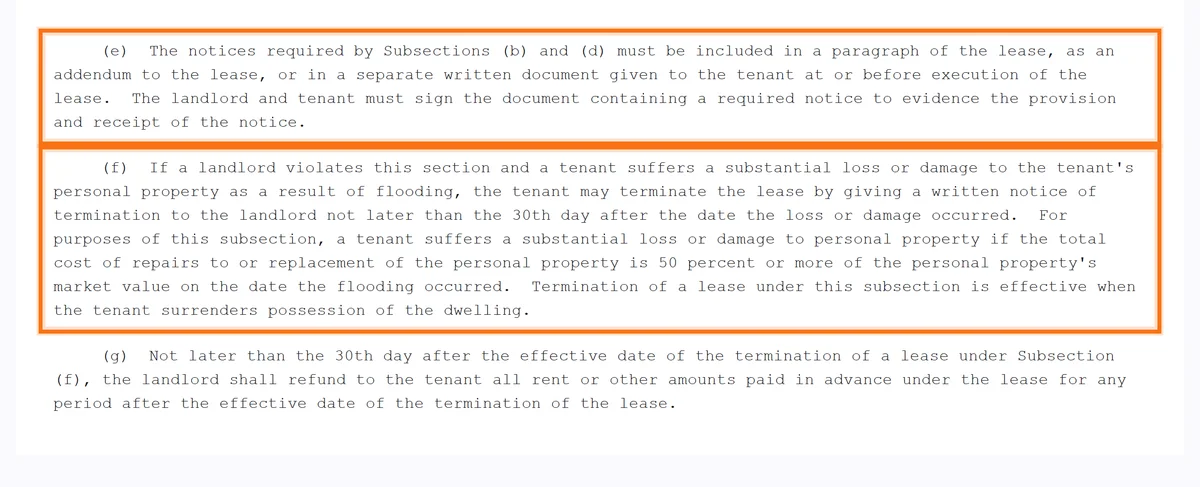
The statute gives you three places to put it: a paragraph of the lease, an addendum to the lease, or a separate written document. Whichever you choose, it has to reach the tenant at or before the lease is signed, and both you and the tenant must sign the document that contains it. That signature is your proof the tenant received it.
- Fill in the notice from your map check and records before the lease packet goes out.
- Put it in the signing packet with the other addenda, so the tenant signs it in the same session as the lease.
- Check that the signed copy is complete: both signatures, the property address, both questions answered.
- File it with the executed lease, the FEMA map image and any flood records.
If you took over a rental with a tenant already in place, ask the previous landlord or manager for the signed notice. A blank template in a folder shows what someone meant to use; only the signed copy shows what the tenant received. Our guide to what a Texas residential lease must include lists the other required notices that belong in the same packet.
What happens if the notice is missing and the house floods
If a landlord does not give the required notice and the tenant suffers a substantial loss to their personal property because of flooding, the tenant may end the lease. The statute sets the test: the cost to repair or replace the damaged belongings is 50% or more of their market value on the day of the flood.
The tenant's termination, step by step
| Step | What the statute says | What it means for the owner |
|---|---|---|
| The flood | The tenant's personal property suffers a substantial loss (repair or replacement cost of 50% or more of its market value) | Damage to the house itself is your insurance question; this right is about the tenant's belongings |
| Written notice | The tenant gives written notice of termination no later than the 30th day after the loss | A phone call is not a termination; keep the written notice and its date |
| Lease ends | The termination takes effect when the tenant surrenders possession | Rent runs until the keys are back and the home is vacated |
| Refund | Within 30 days of that date, the landlord refunds rent and other amounts paid in advance for the period after it | Prorate any prepaid rent; the security deposit follows the usual deposit rules |
| Unpaid rent | The tenant still owes rent and other sums that were delinquent before the termination | Past-due amounts are not wiped out by the termination |
How to read this table: the right is narrow, but when it applies, it costs you the rest of the lease term, a vacancy in a home that just flooded, and a make-ready on top of the repairs. A signed notice on file removes that risk entirely, for the price of a page in the lease packet.
Found a lease without the notice? Pull the signed packet, give the notice now with both signatures, and fix the template so the next lease has it. This guide is general information, not legal advice; for a flood that has already happened or a disputed termination, talk to a Texas landlord-tenant attorney.
Leasing a house soon? Call 682-593-7033 or request a free rental analysis: we price it from comparable leased homes nearby and send a written management quote.
Insurance: what to ask your agent, and what to tell the tenant
Your landlord policy. Tell your agent the house is a rental and ask, in those words, whether water coming in from outside during heavy rain or a rising creek is covered. Standard policies usually exclude flood, which is why the statute makes you warn the tenant about theirs. Our checklist of landlord insurance before renting out a house covers the rest of that conversation.
The tenant's renters policy. It protects their belongings against the perils the policy lists, and most do not list flood. If your lease requires renters insurance, the notice is your chance to make that clear; see requiring renters insurance.
Separate flood coverage. Owners can ask about building coverage and tenants about contents coverage, through the National Flood Insurance Program or a private insurer. Ask about the waiting period before a new policy takes effect, so nobody shops for it when the forecast turns.
How Perpetual handles the floodplain notice when we lease your home
The floodplain notice is part of every lease packet we prepare as part of tenant placement and leasing, next to the other addenda the house needs: pet, HOA, yard, smoking and pool addenda, the inventory and condition form, and the lead-based paint disclosure for homes built before 1978. Our guide to lease addenda for Texas landlords shows how the packet fits together.
Before the packet goes out, we ask you what you know about past water in the house and look the address up on FEMA's map. The signed notice is stored with the lease, and our 360-degree condition inspection at every move-in and move-out records the home's condition at both ends of the tenancy. Every completed repair over $500 gets photo or video proof in your owner portal.
We manage single-family rentals across Northeast Tarrant County from our office in North Richland Hills. Our published price sheet lists Full Service at 10% of monthly rent, Standard at 9% and Investor Special at 7% for portfolios of five or more units; every plan includes an annual property inspection, 24/7 emergency response and the owner portal. Every fee is confirmed in writing before you sign. Renting out a house in Fort Worth for the first time? Our Fort Worth rental owner guide walks through the other steps.
Call 682-593-7033 or request a free rental analysis with a written management quote.
The takeaway: Check the map, check the records, and put a signed floodplain notice in every lease. It takes one page and a few minutes, and it closes off a termination right that would otherwise open after the worst kind of storm.
Questions owners ask
Do I need a floodplain notice if my rental is in Zone X?
Yes. The notice is required on a residential lease whatever the flood zone. Zone X tells you how to answer the floodplain line; the insurance warning stays, and if you know the house flooded in the last five years, you also give the flood history notice.
What if the backyard is in Zone AE but the house is not?
The floodplain statement is about the dwelling. Check where the mapped boundary runs relative to the house itself. If it is too close to call from the map, ask the city that serves the address for help before you complete the notice.
Does a short-term or month-to-month lease need the notice?
A lease with a term of less than 30 days does not, and neither does a buyer or seller occupancy of up to 90 days tied to a home sale. A month-to-month residential lease that runs past 30 days does.
The previous owner told me the house flooded. Do I have to disclose it?
If you know that flooding damaged any part of the dwelling during the five years before the lease starts, yes, even if it happened before you bought the house. Find out when it happened and how the water came in.
Does a verbal warning count?
No. The notice must be written, given at or before the lease is signed, and signed by both the landlord and the tenant.
Can a tenant end the lease just because the notice is missing?
Not on that alone. The tenant needs a substantial flood loss to their belongings, meaning repair or replacement costs of 50% or more of their market value, and must give written notice within 30 days of the loss. The lease ends when they move out.
Is a pipe leak "flooding" for this notice?
No. The statute defines flooding as water from overflowing inland or tidal waters, a rapid buildup of runoff or surface water from a river, stream or drainage ditch, or excessive rainfall.
Does renters insurance cover flood damage?
Most renters policies do not, which is exactly what the notice tells the tenant. A tenant who wants coverage for their belongings can ask an agent about a separate flood policy.
Related services
Property management in Keller, North Richland Hills and Fort Worth. How full-service management works in Tarrant County →