Key takeaways
- Yes, a manager can take over mid-lease with the tenant in default; the handover file decides how quickly it can act.
- Day one: the lease, every payment record, copies of notices already delivered (date and method), the deposit record, keys and tenant contacts.
- Property Code 24.005: at least three days' written notice to vacate unless the lease sets another period, delivered by a method the statute lists.
- Whether the tenant was late before this month decides the form of notice, and the eviction petition must say so (TRCP 510.6).
- Do not change the locks or remove belongings yourself: Property Code 92.0081 sets a civil penalty of one month's rent plus $1,000.
Yes. A property manager can take over a rental in the middle of a lease while the tenant is behind on rent, step in as your agent, and run the Texas process from a demand through a notice to vacate and, if needed, an eviction suit in justice court. For owners in Fort Worth, Keller and North Richland Hills, what decides the speed is the file you hand over on the first day: the lease, the payment record and any notice you already delivered.
Below is the day-one handover table, then the 2026 notice rules as the Property Code reads, what the eviction petition must state under the Texas Rules of Civil Procedure, and what not to do while the handover happens. If the tenant is late every month rather than stopped entirely, see tenant late every month or not paying: manager takeover.
The day-one handover: what the manager needs and why
Here is what a manager needs on the first day to act on a nonpaying tenant, why each item matters under Texas law or the court rules, and who usually has it:
| Item | Why it matters | Who has it |
|---|---|---|
| The signed lease, addenda and renewals | Sets the rent, the due date, any late fee (Property Code 92.019 requires notice of the fee in a written lease) and any notice-to-vacate period other than three days (24.005(a)). | You, or the previous manager |
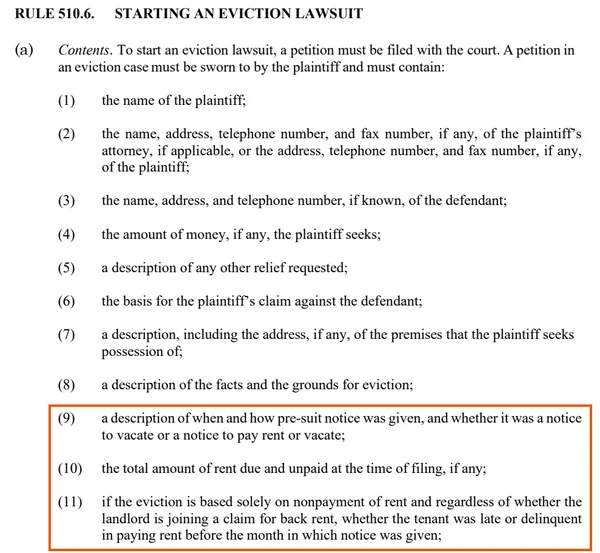
| The full payment ledger: every charge and payment with dates | The eviction petition must state the total rent due and unpaid (TRCP 510.6(a)(10)) and, in a nonpayment case, whether the tenant was late before the month notice was given (510.6(a)(11)). | You: bank deposits, payment-app history, receipts |
| Copies of any notice already delivered, with date and method | The petition must describe when and how pre-suit notice was given and which kind it was (510.6(a)(9)); delivery must use a method in 24.005(f-3). | You |
| Every message about rent, including promises and partial payments | Shows what was agreed and when, before anyone serves a new notice. | You: texts, emails, letters |
| Names of every adult tenant on the lease | In a written-lease case, all tenants obligated under the lease who live there and whom you seek to evict must be named (510.6(d)). | The lease and the application file |
| The security deposit amount and where it is held | It is settled after move-out under 92.103 and 92.104, whatever happens to the tenancy. | You, or the previous manager |
| Keys, codes, the tenant's contact details, any HOA contact | Access for the enrollment inspection and a channel for the first notice; the petition lists the defendant's name, address and telephone number if known (510.6(a)(3)). | You |
How to read this table: the middle column explains why a missing item slows the case down. A lease, a ledger and copies of earlier notices let the manager choose the correct notice on day one; without them, the safest path may be to start the notice over. Gaps are normal: send what you have and the manager will tell you what is missing.
Why the first week matters
Every month a nonpaying tenant stays is a month of rent that may never be collected. Owners often wait because the tenant promised, or because they are not sure a manager can work with a lease they wrote themselves. A manager can work with your lease; what it needs is the record behind it.
The decision point is simple: if a full month has been missed and the promises have not turned into payments, start the handover now, because waiting adds rent to the loss without changing the outcome. How long a manager should wait before acting in the first place is covered in how long to wait before acting on unpaid rent.
What the manager does with the file
A manager's first job is to read the file and choose the path. Our evictions page describes it this way: "The first step is assessing the file (lease, ledger, notices already sent) and mapping the fastest compliant path." Concretely, that means checking whether a notice already delivered was valid and is still usable, working out the balance as of the takeover date, and deciding whether a payment conversation, a new notice or a filing comes next.
The tenant then hears, in writing, who manages the house now and where rent and repair requests go. Our switching page puts the money side in one line: "A balance needs to be understood before it can be carried forward accurately." Whether the new manager collects rent owed from before its start is covered in can a new property manager collect unpaid rent from before; the general mid-lease handover is in how a property manager takes over a rental mid-lease.
The notice to vacate and the eviction suit under the 2026 rules
Property Code 24.005, as amended by SB 38 effective January 1, 2026, sets the rules. Subsection (a) requires at least three days' written notice to vacate before a forcible detainer suit, unless the parties contracted for a shorter or longer period in a written lease or agreement. The form depends on the tenant's history: for a tenant terminated solely for nonpayment who was not late before the month notice is given, the notice must be a notice to pay rent or vacate; for a tenant who was late before, it may be either that or a notice to vacate.
Under 24.005(f-3), it must be delivered by mail (including a delivery service), delivery to the inside of the premises in a conspicuous place, hand delivery to a tenant 16 or older, or, if agreed in writing, e-mail or other electronic means.
If the tenant stays, the suit is filed in the justice precinct where the house is located (24.0041), with a sworn petition that must state specific facts:
A rent claim of not more than $20,000 may be joined (510.1(a)). A judgment for the landlord awards possession, costs, delinquent rent and attorney fees if recoverable (510.18(d)); no writ of possession may issue before the 6th day after the judgment is signed or the day after the appeal deadline, whichever is later (510.18(g)(1)), and the writ is executed by a sheriff or constable (510.18(g)(4)). Either side may appeal within five days (24.005107). The full sequence is in the Texas eviction process. This is general information, not legal advice; a landlord-tenant attorney can advise on your case.
What not to do while the handover is underway
The costliest mistakes happen in the days before a manager is involved. Do not change the locks to keep the tenant out, remove doors or appliances, or take the tenant's belongings: Property Code 92.0081 limits those steps, and a violation lets the tenant recover possession or end the lease plus a civil penalty of one month's rent plus $1,000, actual damages, court costs and attorney's fees. Do not write your own notice from a template: as our evictions page puts it, Texas notice types, delivery methods, timelines and court filings each have rules, "and errors restart the clock."
Before you accept a partial payment, tell the manager, because how it affects a notice already delivered depends on your lease and the facts; ask a Texas attorney if unsure. Do not make verbal deals, and keep every message. From the day the manager starts, send the tenant to the manager: rent goes through one channel, and that channel is not you. Notice to vacate in Texas covers delivery in more detail.
Sometimes the right answer is an agreed move-out
Not every case should end in court. A tenant who cannot pay will sometimes leave sooner under a written move-out agreement than under a judgment. Our evictions page lists it first: attempt resolution, because a documented payment conversation resolves many situations faster and cheaper than court, and pursue it "without letting it become stalling."
The manager's job is to put the options side by side: an agreed move-out by a date, with the house left clean and the deposit settled under the lease, against the notice, the filing and the wait for a writ. The decision is yours. Whichever you choose, put the agreement in writing and signed, and keep the notice option open until the keys are back. If you are in this situation today, reach Perpetual here.
How Perpetual takes over a nonpaying tenancy
Perpetual Property Management is broker-owned, with our office at 5755 Rufe Snow Dr, Suite 155, in North Richland Hills, and we take over occupied rentals in Keller, North Richland Hills and Fort Worth, including tenancies where eviction may be needed. From our switching and evictions pages:
- What we request: the lease and related documents, security deposit, keys, tenant ledger, property records and open work orders.
- The tenant: receives instructions on where to pay rent and how to submit maintenance requests.
- The process: attempt resolution first; "the notice to vacate that Texas procedure requires, delivered and documented correctly"; the ledger, lease, notices and communication history organized for court; coordination of filing logistics and, where appropriate, an attorney experienced in landlord-tenant law. We are not a law firm and do not pretend to be.
- Plans: eviction service is included on Full Service and optional at $7.95 per month on Standard and Investor Special; the enrollment inspection is included on Full Service, $49 on Standard and $125 on Investor Special.

Whether we pursue rent owed from before our management starts, and how fees apply to it, is confirmed in writing before you sign. See our eviction coordination and the price sheet, or call 682-593-7033.
The takeaway: Hand over a complete file on day one, keep yourself out of the rent conversation from then on, and let the notice and the filing follow the 2026 rules exactly; that is how a nonpaying tenancy gets resolved without a restart.
Questions owners ask
Can a manager take over if my tenant has no written lease?
Yes. Property Code 24.005(a) applies to a tenant under a written lease or an oral rental agreement: the landlord must give at least three days' written notice to vacate before filing, unless the parties contracted for a different period in a written lease or agreement. The manager will document what was agreed about rent and the due date, and a written lease comes with the next tenant.
Will the tenant have to pay the new manager's fees?
No. Management fees are between you and the manager and appear on your statement, not the tenant's. The tenant owes the rent and the charges the lease allows, such as a late fee if the written lease gives notice of it (92.019). If the court rules for you, the judgment covers possession, costs, delinquent rent and attorney fees if recoverable by law (TRCP 510.18(d)).
What if the tenant pays everything once the manager sends the first letter?
That is a good outcome. The manager records the payment, confirms the account is current, and the tenancy continues under management with the lease enforced from then on. Whether to renew that tenant at lease end is your decision, with the full payment history in front of you.
How fast can a manager start if I call today?
As fast as the file allows. With the lease, the ledger and copies of any notice already delivered, the manager can decide on day one whether an earlier notice is still usable or a new one is needed. Missing documents are the usual delay, so send what you have first and let the manager tell you what is missing.
Can a property manager represent me in eviction court in Texas?
Under Texas Rule of Civil Procedure 510.3, an individual owner may represent themselves, be represented by an authorized agent, or by an attorney; a corporation or other entity may be represented by a property manager or other authorized agent, among others. Our evictions page says attorney involvement is wise for contested cases or appeals.
Why does it matter whether my tenant was late before this month?
Because it decides the notice. Under Property Code 24.005(a), a tenant evicted solely for nonpayment who was not late before the month notice is given must receive a notice to pay rent or vacate; a tenant who was late before may receive either that or a notice to vacate. The eviction petition must state which applies (TRCP 510.6(a)(11)), so the ledger has to show it.
Related services
Property management in Keller, North Richland Hills and Fort Worth. How full-service management works in Tarrant County →